Things to Do With Friends at Home: Games, Food & Movies
If you’re wondering what to do with friends at home, the short answer is one main activity plus food.
Pick the activity by two things: how many people are coming and how long they’ll stay. Two friends on a weeknight want something very different from eight people on a Saturday, and a plan that tries to suit both usually doesn’t suit either.
Below are twenty things to do with friends at home, grouped by the kind of evening you’re after. There’s cooking together, watching something, making something, playing a game, and keeping it quiet. Each idea says who it’s for, roughly how long it takes, what to get ready, and how it wraps up.
Pick by group size and time
Start with the row that sounds like your night, then jump to that idea.
| Your night | Good picks | Needs |
|---|---|---|
| Two or three friends on a weeknight | Taste test, coloring and a podcast, skill swap | A few snacks or printed pages |
| Four to eight people on a relaxed Saturday | Pizza night, emoji puzzles, riddle round | An oven and a printer |
| A loud group of six or more | One-minute challenges, short-film night | Clear floor space and a timer |
| Friends who don’t all know each other | Conversation cards, taco bar | Printed cards |
| Nobody wants to plan anything | Movie theme night, jigsaw puzzle | A streaming account or a puzzle |
| Some tired people, some chatty ones | Spa night, old photos night | Towels and photos |
Two rules hold for every row.
Settle the main activity before anyone arrives, because “so what do you want to do?” can quietly swallow the first hour. And have the food ready or half-ready, since hungry guests won’t want to start anything.
Food you make together
Cooking becomes the activity when everyone has a job. These four suit a kitchen where two or three people can stand at the counter at once.
Build-your-own pizza night
Good for: two to eight people and about ninety minutes, with store-bought dough, jarred sauce, shredded mozzarella and toppings chopped into bowls before anyone shows up.
Divide the dough so each person shapes a small pizza, then let everyone top their own.
Bake two at a time and eat in rounds. That keeps people at the counter instead of drifting off to the couch, and the night’s over when the last pizza comes out.
The catch is oven space. Most home ovens hold one or two pans, so eight personal pizzas mean several rounds, and it’s easiest to start the pickiest eaters first while the confident cooks wait their turn.
Taco or rice-bowl bar
Good for: four to ten people and about an hour, with one cooked protein, a vegetarian option, rice or tortillas, and five or six toppings in a line.
A build-your-own bar is the friendliest meal for a group with mixed diets, because everyone assembles their own plate.
Ask about allergies when you invite people, not at the door. Label anything with nuts, dairy or gluten on a sticky note, especially the sauces, since those are the toppings nobody can identify by looking.
Bake one thing together
Good for: two to six people and an hour or two, with one tested recipe, ingredients measured into bowls, and two baking sheets.
Choose something with a hands-on step, like cookies you roll, scoop or decorate.
Split the jobs: one person mixes, one shapes, one watches the timer. It’s finished when the cookies are cool enough to eat, and the leftovers go home in bags.
Want a bigger event? A cookie exchange party has the rules for swapping whole batches.
Blind taste test
Good for: three to ten people and about half an hour, with three to five brands of the same thing (potato chips, dark chocolate, sparkling water, salsa), paper plates or cups, numbered sticky notes and a pen each.
One person plates each brand out of sight and tags it with a number.
Everyone tastes, ranks the samples from best to worst, and writes down which one they think is the expensive brand. Reveal the labels at the end and add up the rankings.
The usual slip is plating in front of everybody. Do it in another room.
Things to watch together
Watching works best with a little structure around it. Otherwise half the room ends up scrolling on their phones.
A movie theme night
Good for: two to eight people and an open-ended evening, with a theme (one director, one decade, one actor, or something you all loved as kids) and the first movie already chosen.
Choosing the first title ahead of time matters more than the theme does.
Scrolling for a movie with six people can easily take half an hour, so let the group vote on the second movie during the break. Our family movie night ideas have snack ideas and ways to keep that break short, and they work just as well for adults.
Bad-movie bingo
Good for: three to ten people and one movie, with a famously bad or very predictable film and a homemade card for each person, filled with clichés like “slow-motion walk,” “the phone has no signal” or “someone says we’ve got company.”
Everyone marks a square when it happens on screen.
The first full row calls bingo, and then play keeps going for a full card. Make sure no two cards are identical, or everyone wins at once. The printable bingo rules cover other patterns if you’d like more than one round.
Short-film night
Good for: four to twelve people and about an hour, with every guest bringing one video under five minutes, from a music video to an animated short or an old commercial.
Play them back to back on the TV, and let whoever picked each one introduce it in a single sentence.
At the end, everyone votes for a favorite. It’s great for groups with different tastes, because nobody’s stuck with a full movie they didn’t choose.
Hold the five-minute limit firmly. Otherwise somebody will queue up a forty-minute documentary.
Make something with your hands
Craft nights suit people who like to talk while their hands are busy. Cover the table first and keep drinks off the work surface.
Coloring pages and a podcast
Good for: two to six people and an hour or two, with printed coloring pages, colored pencils or markers, and a podcast or playlist everyone can agree on.
It’s the lowest-effort craft night there is.
Detailed adult pages keep people busy for the whole hour, while simpler ones get finished and passed around. Markers bleed through regular printer paper, so slide a spare sheet underneath. For blending and shading, see our coloring tips.
Paint night with one reference picture
Good for: two to eight people and about two hours, with small canvases or thick paper, acrylic paints, brushes, water cups, paper towels and one reference picture on a tablet or the TV.
Everyone paints the same picture, and that’s the fun part, because no two come out alike.
Pick a simple subject like a sunset, a potted cactus or a coffee mug. Paint in layers: background first, then the big shapes, then the details.
The night ends with the paintings lined up against the wall and a vote for the best one. Acrylic dries quickly, so squeeze out small amounts and add more as you go.
Fuse bead keychains
Good for: two to six people and an hour or so plus cooling time, with fuse beads, pegboards, ironing paper, an iron and keychain rings.
Each person picks a small design, such as an initial, a piece of fruit or a pet’s face, and fills a pegboard.
The host does the ironing. Keep the iron in one spot with one person in charge of it. The full steps are in our fuse bead keychain guide and how to iron fuse beads.
A jigsaw puzzle that stays out all night
Good for: two to five people and an open-ended evening, with a puzzle of five hundred or a thousand pieces and a table you won’t need for dinner.
Sort out the edge pieces first.
Then split the rest by color into a few piles, so people can work different areas without reaching over each other. A puzzle makes a good background activity, since people can wander off to eat and come back whenever they like.
Decide up front whether it stays out for the next visit. Otherwise someone will sweep it back into the box at midnight.
Printable games for a group
Games give a quiet room a push, especially early in the evening, and each of the four below is something you print at home.
Print and cut them the day before. Cutting cards while guests wait is the slowest part of the whole thing.
For more choices, our party games for adults list covers bluffing and dinner-table games, and the family game night ideas list covers mixed-age groups.
Emoji guessing round
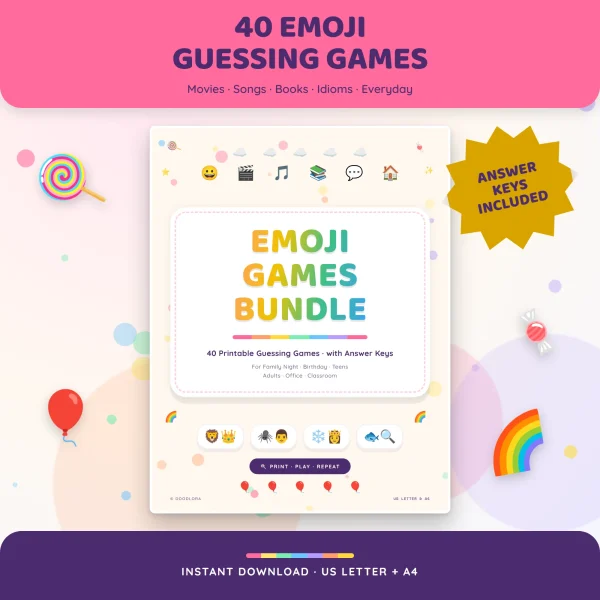
Good for: two to twenty people, alone or in teams, using our emoji guessing game printed on card stock or heavy paper, plus pens.
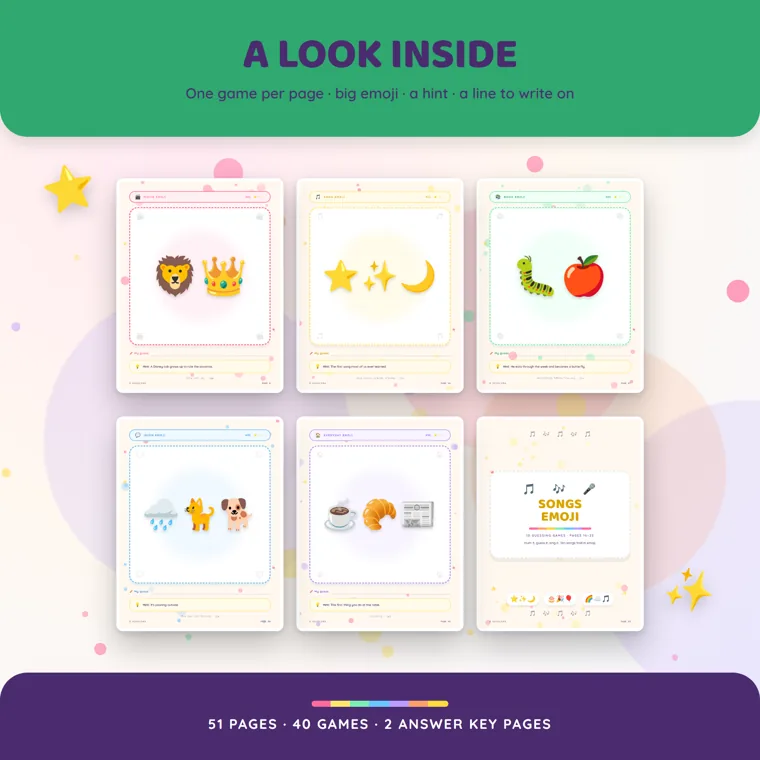
The set has forty puzzles, one to a page, split into movies, songs, books, idioms and everyday moments. Each page shows a few big emoji, a line for the guess and a one-line hint. Hand out one sheet per player or per team, guess, and give a point for every right answer. If you allow a minute per puzzle, a ten-puzzle round stays around ten minutes, which makes it a handy warm-up while late guests arrive.
One detail catches hosts out.
Every puzzle page prints its answer upside down along the bottom edge, so a player can simply flip the sheet and read it. If the sheets are going around the room, fold that strip under or trim it off, and keep the answer key at the back of the file for yourself. The last answer page also has a scoring scale, running from “emoji genius” at the top down to “time for a rematch.”
Riddle round with answer cards
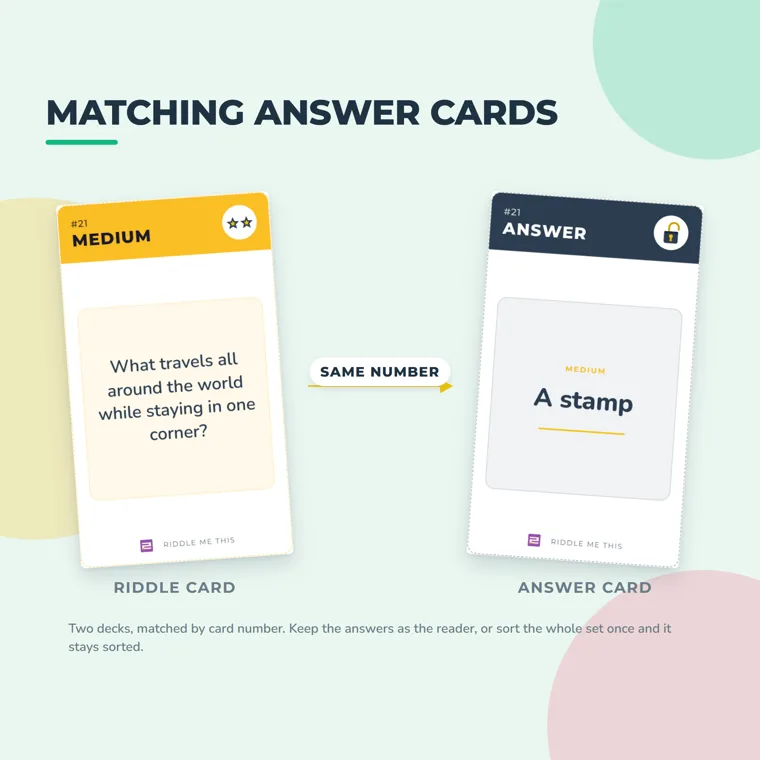
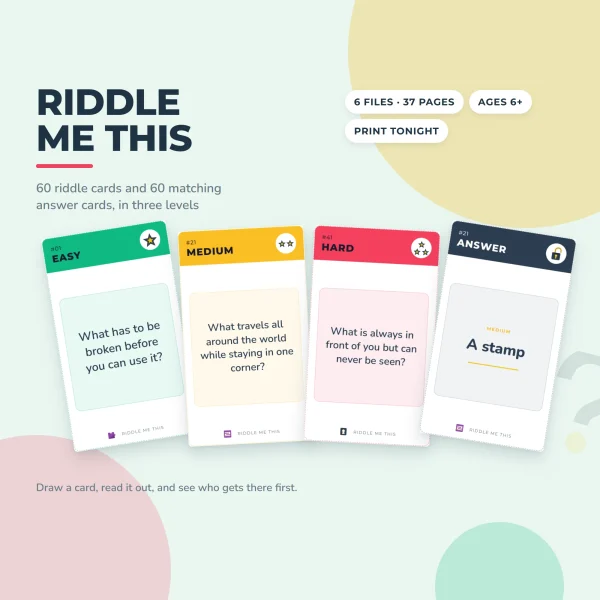
Good for: two to twenty or more people, from about age six up, using our Riddle Me This cards printed at actual size, with riddles and answers on separate sheets and cut into index-card-sized cards.
The deck holds sixty riddles at three levels, Easy, Medium and Hard, and every riddle has its own numbered answer card. One person holds the answers and reads. In the Classic game, players take turns drawing and reading a card, the first right answer scores, and if nobody gets it in thirty seconds, the reader reveals it. Team Challenge gives the drawing team a minute to answer together for two points, and the other team can steal it for one.
For a table of adults, deal the Medium and Hard cards and keep the Easy ones as a warm-up.
The host tips also suggest playing to fifteen points rather than to the end of the deck, which keeps the round from dragging. And when nobody solves a card, shuffle it back in rather than retiring it, because the groan when it comes around again is half the fun. For riddles you can read out without printing anything, see riddles for adults.
One-minute challenges
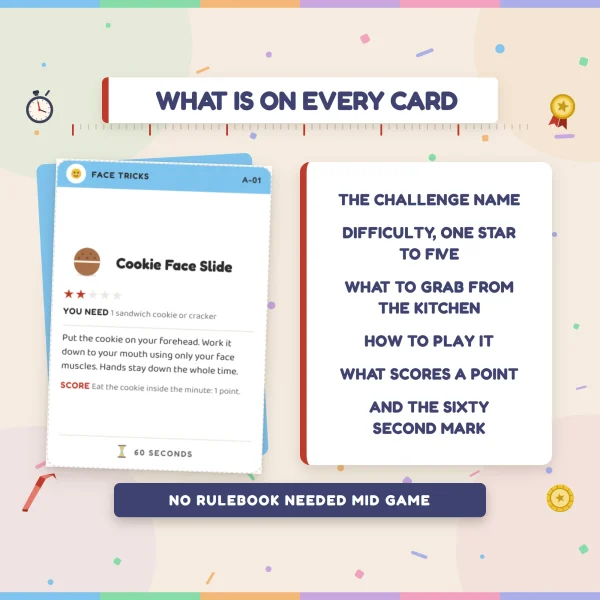
Good for: two to twenty people, with six as the sweet spot on the instructions page, using the One Minute Challenge cards, a timer, and kitchen supplies like paper cups, balloons, ping pong balls, straws and marshmallows.
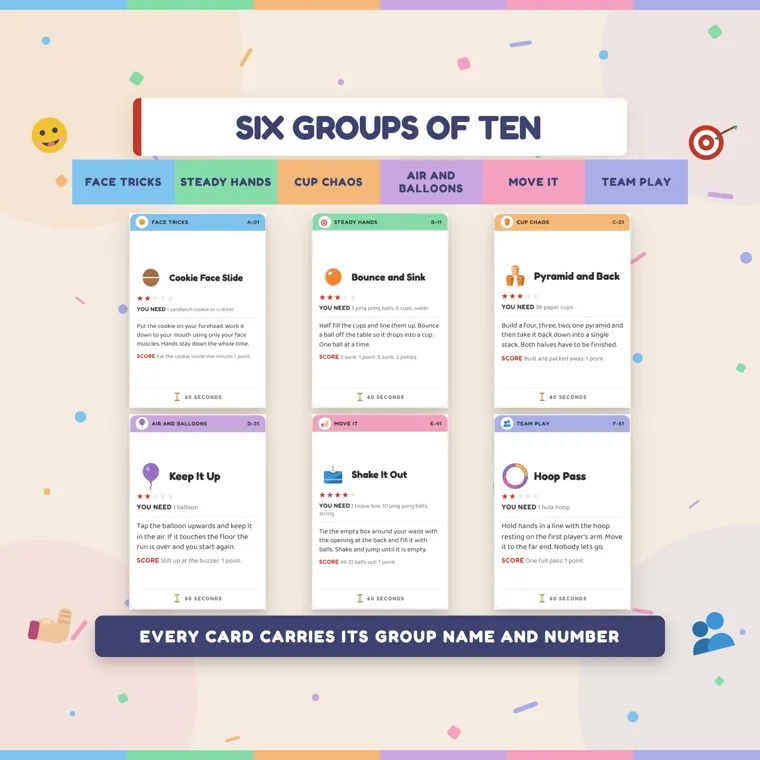
There are sixty challenge cards in six groups: Face Tricks, Steady Hands, Cup Chaos, Air and Balloons, Move It and Team Play. A player draws a card, collects whatever it lists under “You need,” and gets a minute while the room counts down the last ten seconds. Each card has its own score line, usually one point, with two for beating a harder target. The instructions suggest playing until everyone’s had five turns.
This is the loudest idea on the list.
It suits a house better than a shared-wall apartment late at night. Clear a table and a stretch of floor first, and pull out any cards that need things you don’t have, such as a hula hoop, or water in cups over a carpet, before you shuffle. The full rundown is in one-minute party game ideas.
Conversation cards for a quieter table
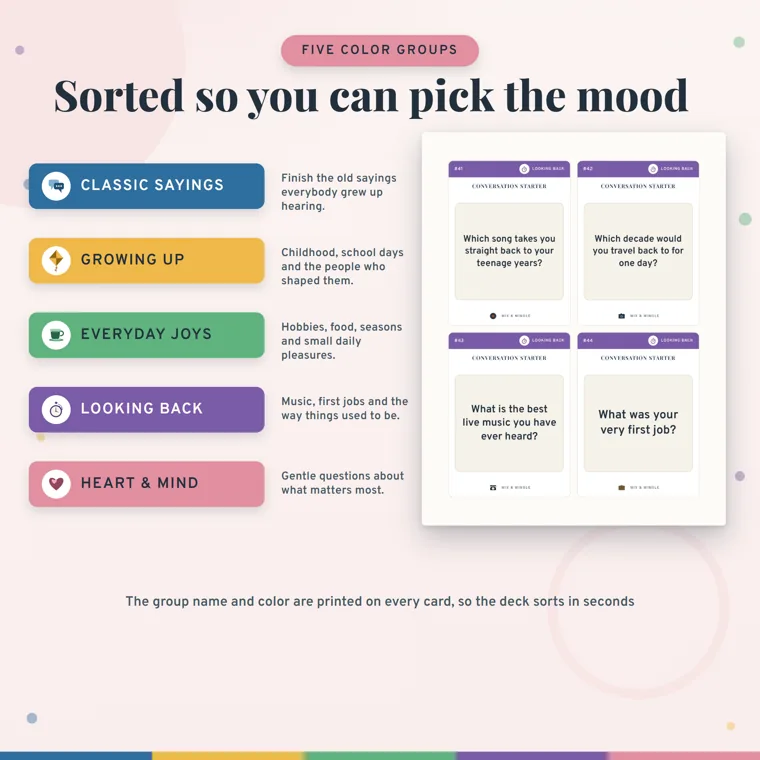
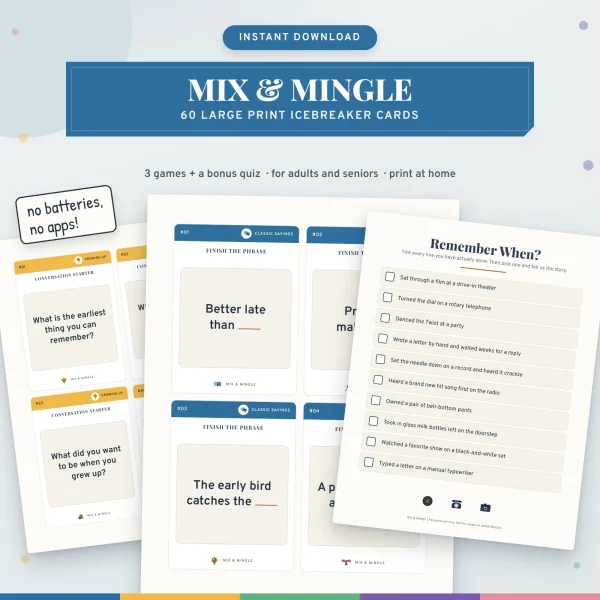
Good for: four to eight people taking turns, for about twenty minutes, using the Mix & Mingle cards, printed in large type four to a page.
These work best when some of your friends are meeting each other for the first time.
The set’s forty Conversation Starter cards come in four groups: Growing Up, Everyday Joys, Looking Back, and Heart & Mind. A player takes a card, reads it aloud and answers first, then anyone else can jump in. There’s no winner, and the host guide’s advice is to stop “while people still want more.”
Read the set’s Remember When? checklist before you hand it out.
Lines like watching the first moon landing live or turning the dial on a rotary phone land well with older guests, but they’ll fall flat with friends in their twenties. For a younger group, stick with the Everyday Joys and Growing Up cards. There are more options in icebreaker games for adults.
A full game night: trivia or an escape room
Good for: six to sixteen people and a whole evening, after a day or two of writing questions or puzzles.
If your friends love a challenge, give the entire night to one big game.
A trivia night needs rounds, answer sheets and a tiebreaker, and how to host a trivia night covers all three. A homemade escape room takes more setup but makes a bigger impression, and our DIY escape room guide walks through the puzzle chain. An indoor scavenger hunt sits somewhere in between.
Quiet ideas for two or three friends
Not every night needs a plan. These four work when people are tired, or when the whole point is catching up.
Spa night
Good for: two to four people and an hour or two, with clean towels, sheet masks, nail polish and remover, slippers and a calm playlist.
Set everything out on one tray so nobody has to dig through your bathroom cabinet.
Ask about skin sensitivities before handing out products, and let guests bring their own if they’d rather. It ends naturally once the polish dries.
Clothes or book swap
Good for: four to ten people and an hour or so, with everyone bringing a handful of clean items in good condition, plus a mirror and a spot to try things on.
Lay everything out by type.
Give people a few minutes to browse before anyone takes anything, then go around the circle taking one item at a time. Decide beforehand where the leftovers go, such as a donation drop-off, so nothing ends up living at your place by accident.
Teach each other one skill
Good for: two to six people, with each friend picking one small skill they can teach using what’s in the house, like a card trick, a knot, a phone photo trick, a drink recipe or a few words of another language.
Go one at a time with a timer, so each teacher keeps it short and everyone gets a turn. It works best with friends who already know each other well, because it brings out sides of people the group hasn’t seen before.
Old photos night
Good for: two to six people and an hour or two, with everyone bringing a stack of photos from before you met, or a shared folder you can open on the TV.
Take turns telling the story behind each photo. Give each person the same number of photos, so one person’s vacation slideshow doesn’t take over the evening. For friend groups that go back years, a pile of printed photos can also turn into a collage you finish together.
A simple plan for a three-hour night in
If you’d like a ready-made shape for the evening, this order works for most groups of four to eight:
- As people arrive: snacks out, drinks poured, and one short warm-up, like a single emoji round or a few conversation cards.
- The main block: the main activity, whether that’s pizza, painting or a movie.
- Food: if the main activity wasn’t cooking, eat now.
- The last hour: one game or one quieter activity, depending on the energy in the room.
End on purpose. Saying “one more round, then dessert” gives everyone a clear finish, and it beats watching the energy drain away on its own.
And if a game falls flat in the first five minutes, drop it and move to the food, because pushing through a dud game is the most common way a perfectly good night in loses its momentum.
Printables from this article
Related articles
Printable Party Games
New Year’s Eve Party Ideas: Themes, Food & a Night at Home
Choose the kind of New Year's Eve party first, then pick a theme, a timeline that ends where your guests will, food that can sit out for hours, and a countdown that fits the youngest person in the room.
Printable Party Games
Christmas Pajama Party Ideas: Invitation, Food & Games
Pick the kind of Christmas pajama party first, then send an invitation that says pajamas and pickup time, plan food and a simple timeline for that group, and end with bedtime, breakfast or a thank-you card.
Printable Party Games
Western Party Ideas: Cowboy Theme Food, Games and Decor
Pick the western party that fits your crowd first: a 90-minute cowpoke birthday for preschoolers, a two-hour cowgirl or rodeo party for older kids, an evening barbecue and line dance for adults, or a western day at school. Each plan below covers guests, timing, decor, food, games and how to wrap up.