One-Minute Party Games: Cup, Balloon and Team Challenges
A one-minute party game gives one player one task and a 60-second timer, and the target is set before anyone says go. Six guests, a cleared kitchen table and a sleeve of paper cups are enough for a whole evening of them. Add a stretch of open floor and a bag of balloons, and you get the louder half.
Pick games by the room you’ve got, keep score on paper, and keep everyone in the game when they fail a challenge. If children under eight are playing, read the balloon note before you open the bag.
One-minute party game ideas for a table, a floor and a team
Check the room before you pick the challenges, because space decides what you can play. Our printable One Minute Challenge deck has 60 challenges in six groups of ten, and each group needs a different amount of room:
| Group | What it is | Space it needs | Two to start with |
|---|---|---|---|
| Face Tricks | Small tricks with cookies, sticky notes, cotton balls and pencils, a few with no hands allowed | Mostly a table | Sticky Note Face, Cookie Face Slide |
| Steady Hands | Stacking, threading and carrying small things like coins and beans | Mostly a table | Coin Tower, Straw and Beans |
| Cup Chaos | Building, flipping and bouncing into cups, some with water | A table | Balloon Blast, Pyramid and Back |
| Air and Balloons | Keeping balloons up, fanning them along and popping them | Open floor | Keep It Up, Sit and Pop |
| Move It | Walking, carrying and sliding across the room | A clear run of 10 to 16 feet (3 to 5 m) | Book Walk, Sock Shuttle |
| Team Play | Whole-team tasks with a hoop, a puzzle or a tower | Room for a line or a circle | Hoop Pass, Puzzle Race |
Each card also carries a star rating from one to five, and only three cards in the whole deck get a single star.
Cup and table challenges: face tricks, steady hands and cups
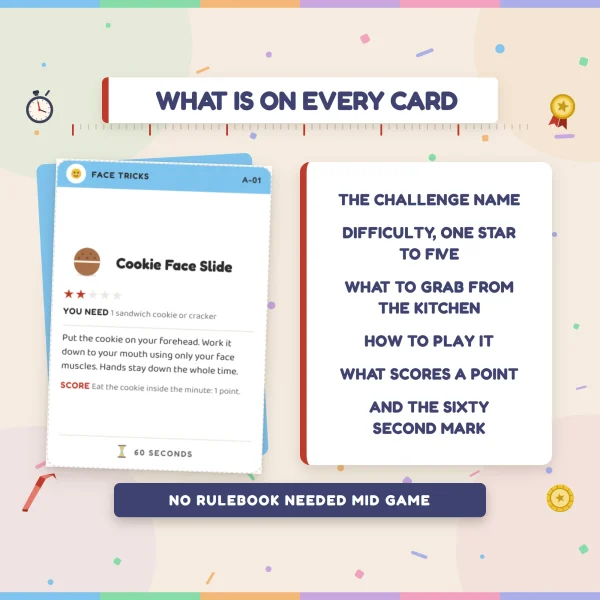
The first three groups, 30 cards in all, happen on or around a table, so they’re the place to start in a small apartment with no clear floor. Three Face Tricks cards ban hands outright: Cookie Face Slide, Straw Transfer and Nose Nudge. Cookie Face Slide puts a sandwich cookie or cracker on your forehead, and you get 1 point if you can wriggle it down to your mouth and eat it inside the minute.
Sticky Note Face is the gentlest card in the group: press notes onto your own forehead, cheeks, nose and chin, and 10 still holding at the buzzer earns a point, 20 earns two. Nose Nudge keeps you at the table too, pushing cotton balls onto a second plate with your nose, with 1 point for three and 2 for six.
Steady Hands is where the stars climb. Coin Tower asks for 20 matching coins stacked one-handed with the other hand behind your back, and 10 coins still standing scores 1 point, 15 scores 2. Chopstick Marbles sits at four stars, and its card won’t let you scoop marbles up the side of the bowl. Dice Tower gets five: six dice picked up with chopsticks, and the tower has to stand on its own for three seconds.
Cup Chaos covers the classic cup stack. Pyramid and Back needs 36 paper cups built into a four, three, two, one pyramid and then taken down into a single stack, and you don’t score unless both halves are finished.
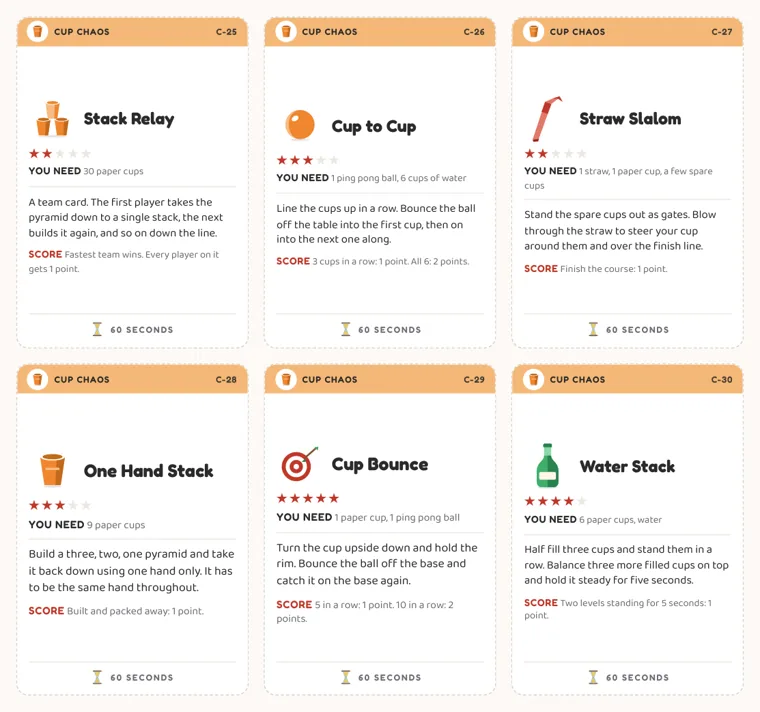
Water is the mess to plan for. Four cards in the deck use it, and three of them sit on the table: Bounce and Sink, Cup to Cup and Water Stack. Lay a towel or an old tablecloth underneath before anyone starts bouncing ping pong balls into half-full cups.
Balloon and movement challenges that need floor space
Most of the 20 cards in Air and Balloons and Move It need floor, and a few need more of it than a living room rug. Keep It Up needs nothing but one balloon: tap it into the air, and if it touches the floor, the run’s over and you start again. Still up at the buzzer is worth a point.
Sit and Pop, one of the three one-star cards, has you pop balloons by sitting on them, with no hands helping, and five popped earns 1 point while 10 earn 2. Fan It In wants a basket 10 feet (3 m) away and a paper plate to fan the balloon along, with no blowing and no hands.
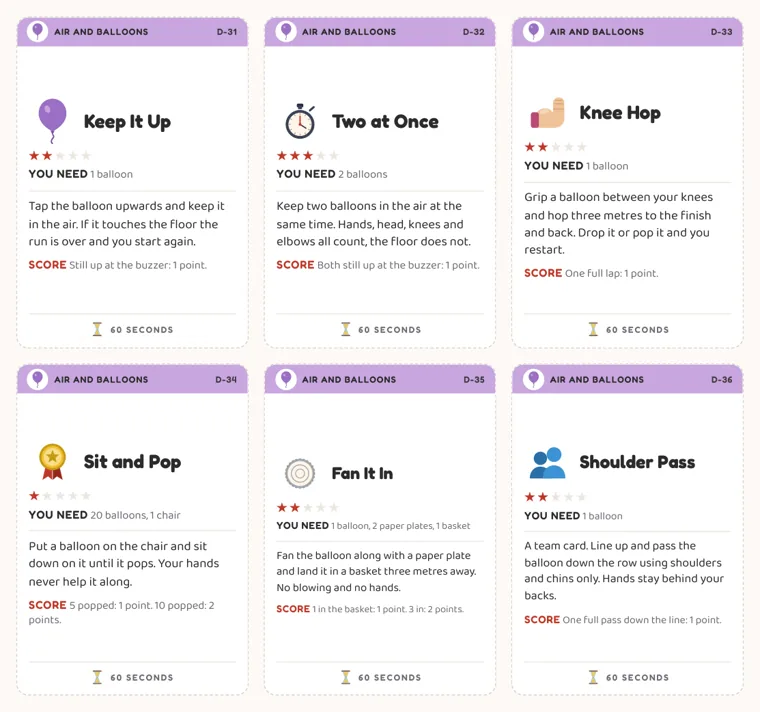
Count your balloons beforehand. Sit and Pop alone uses up to 20, and Pop Relay, a team card, uses 10 more, so those two cards can empty a bag of 30 before anyone’s drawn Two at Once.
Every popped balloon leaves pieces on the floor, and that matters when young children are in the room. The U.S. Consumer Product Safety Commission (CPSC) warns that children under eight can choke or suffocate on uninflated or broken balloons. It recommends that parents and guardians not allow children under eight to play with uninflated balloons without supervision, and that they immediately collect the pieces of a broken balloon and dispose of them out of the reach of young children. With kids at the party, have an adult pick up the pieces after every Sit and Pop turn, before the next player draws.
Move It is the group that sends people across the room. Book Walk is 16 feet (5 m) out and back with a hardback flat on your head, and Sock Shuttle carries 10 socks one at a time to a basket the same distance away. Shake It Out, a four-star card, ties an empty tissue box around your waist with the opening at the back and 10 ping pong balls inside, and you shake and jump until the box is empty.
Check the floor surface before the two skating cards. Tissue Skate needs a smooth floor rather than carpet, since you slide 10 feet (3 m) with a tissue under each foot, and Plate Skate twists forward on two paper plates over a 16-foot (5 m) course.
Team challenges for groups
Team cards are the ones that change the whole turn: everybody on the team plays at once, and everybody on the team gets the point. Six of them sit outside the Team Play group, marked “A team card.” Stack Relay passes a 30-cup pyramid down the line, one player taking it down and the next building it back up, and every player on the fastest team scores a point.
Pass the Water is the messiest of the six, since each player holds a paper cup by the rim in their teeth and tips water into the next player’s cup. The team scores if more than half the water’s left at the end.
The ten Team Play cards are built for two or more players. Hoop Pass moves a hula hoop down a line of people holding hands, and nobody lets go. Puzzle Race is the only card that can pay half a point: finish any 30-piece puzzle you already own for 1 point, or get more than halfway for half.
Marshmallow Tower builds the tallest free-standing tower of dry spaghetti and marshmallows, with 1 point for anything over 11.8 inches (30 cm) and 2 for anything over 19.7 inches (50 cm). Act It Out is a one-minute round of charades, the way kids play it: a player acts out challenge names off the list pages with no words, and 5 correct guesses score 1 point, 10 score 2.
Memory Match lays 12 pairs from two decks of playing cards face down, and players taking turns need 4 pairs inside the minute for a point and 8 for two. The timed round assumes everyone already knows the slow game: flip two, keep a match, and put a miss back exactly where it was. If your group doesn’t, start with the rules of the memory game and add the clock later.
What you need for one-minute games: a kitchen list and a printed deck
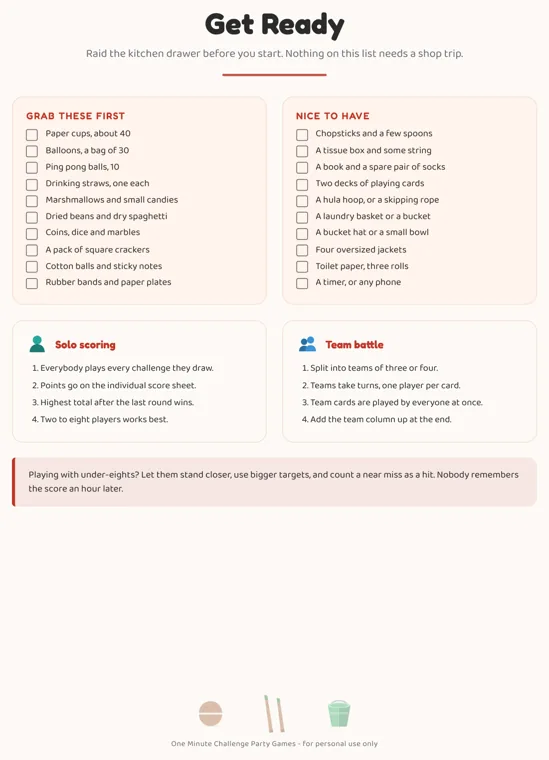
Everything the cards ask for comes out of an ordinary kitchen drawer, and nothing on the list needs a special trip. These ten things cover most of the deck:
- Paper cups, about 40
- Balloons, a bag of 30
- Ping pong balls, 10
- Drinking straws, one each
- Marshmallows and small candies
- Dried beans and dry spaghetti
- Coins, dice and marbles
- A pack of square crackers
- Cotton balls and sticky notes
- Rubber bands and paper plates
The rest are nice to have: chopsticks and spoons, a tissue box and string, a book and spare socks, two decks of playing cards, a hula hoop or jump rope, a laundry basket or bucket, a bucket hat or small bowl, four oversized jackets, three rolls of toilet paper and a timer, which can be any phone. Forty cups covers Pyramid and Back’s 36 with four to spare. Rim Flip and Flip Run ask for plastic cups rather than paper, so keep a sleeve of those beside the paper stack if those two cards stay in the deck.
The deck is a 19-page PDF in US Letter and A4, in full color or an ink-saving black and white. Print at 100 percent or Actual size with Fit to page turned off, and measure a card from the first page before you run the rest. Card stock of 250 gsm or heavier (about 92 lb cover) shuffles well, and our chart of paper weights for printables lines up the US pound labels with gsm. Two straight cuts down and one across free all six cards on a page, and with the six blank cards the deck comes to 66, small enough for a sandwich bag.
How to play one-minute games: the round and the house rules
Every round runs in the same five steps once the cups are counted and the cards are cut:
- Shuffle the deck and put it face down where everyone can reach it, with the score sheet and a pen next to it.
- The first player draws a card, reads it out loud and gathers the things listed under You need.
- Set a timer for 60 seconds. Somebody shouts go, and the whole room counts down the last ten.
- When the timer goes, stop. Read the Score line on the card and write the points on the sheet.
- Pass the deck to the left, and play until the deck runs out or until everyone has had five turns.
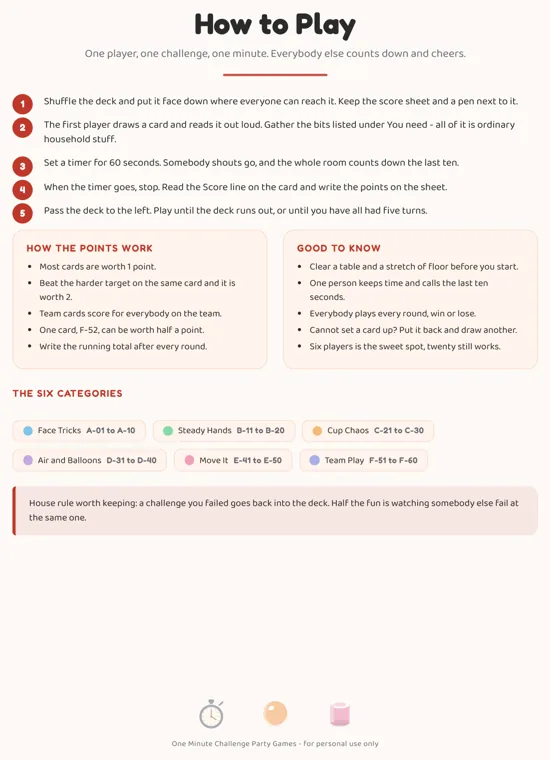
Set the room up before the first card. One person acts as timekeeper and calls the last ten seconds, so the player doesn’t have to watch a phone. Clear a table and a stretch of floor, because you won’t know which group the next draw comes from.
Nobody sits out. Everybody plays every round, win or lose, and a card you can’t set up, because you’re out of balloons or nobody owns a hula hoop, goes back for another draw. The house rule we’d keep above all the others is printed at the bottom of the page: a challenge you failed goes back into the deck, so somebody else can fail at it too, and the room gets to watch.
Plan the evening in turns rather than minutes, since reading the card, gathering the cups and writing the score all happen outside the 60 seconds. The rules call six players the sweet spot and say twenty still works. With six players and five turns each, you’ll get through 30 cards, half the deck. Past eight players, the solo sheet needs a second printout, and that’s usually the point to switch to teams of three or four and keep them together all evening.
Scoring one-minute games: one point, two points and team cards
Reading the Score line is where this deck differs from most one-minute games, because nearly every card has two targets and a turn isn’t simply a pass or a fail. Most cards are worth 1 point, and beating the harder target on the same card is worth 2. Straw and Beans pays 1 point for 10 dried beans carried on a straw to the second plate, and 2 for 20. Coin Drop works the same way: stand up straight, drop coins into a narrow-necked bottle from chest height, and 5 in scores 1 while 8 scores 2.
A few cards break the pattern with only one target, like Keep It Up and Pyramid and Back, and they pay a single point when it’s done.
The two targets matter most at a mixed party, where the competition isn’t even. A player who can’t stack 15 coins can still get 10 standing, so a hard card still gives them something to write down. They also let you add up results that measure different things, since a coin tower, a bean count and a cup pyramid all turn into 1s and 2s on the same sheet. Write the running total after every round, not at the end, and the evening turns into a small tournament everyone can follow.
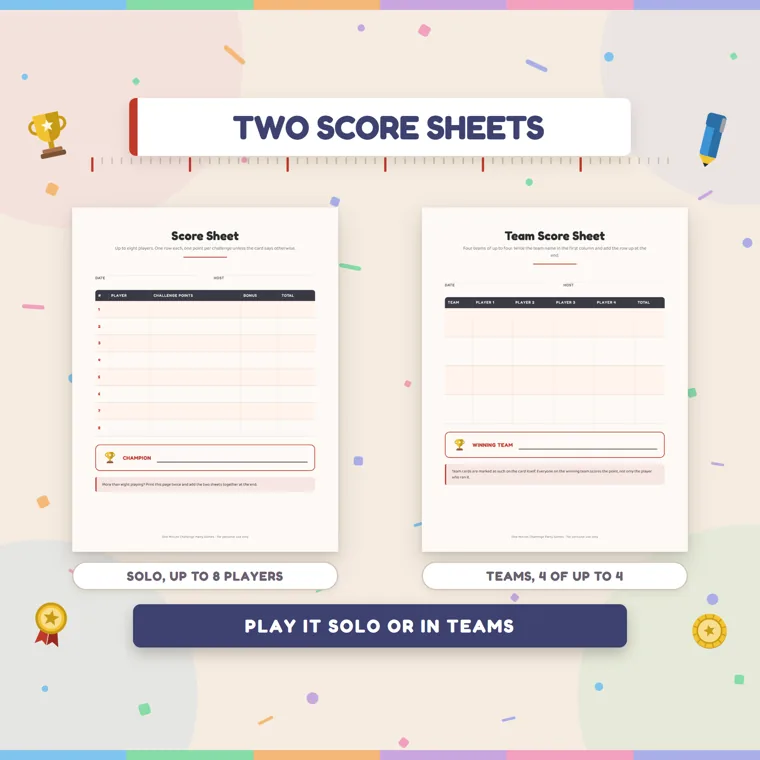
Solo play and team play use different sheets. For solo play, everyone plays the challenges they draw, points go on the individual sheet, and the highest total after the last round wins. The rules say two to eight players works best, and the sheet has eight rows; with more than eight, print it twice and add the two sheets together at the end. For a team battle, split into teams of three or four. Teams take turns sending one player per card, team cards are played by everyone at once, and the team column gets added up at the end. The team sheet holds four teams of up to four.
Two gaps in the rules are worth settling before the first card. The solo sheet has a Bonus column the rules never explain, so decide what goes in it or leave it blank and nobody argues later. The rules don’t settle a tie either. As a tiebreaker, we’d draw one more card, have both tied players do it at the same time, and score it on the same line.
One-minute games for young kids, mixed ages and adults
Children under eight get one more change on top of the two targets. The Get Ready page says to let them stand closer, use bigger targets and count a near miss as a hit, and puts it plainly: nobody remembers the score an hour later.
Start small children on the one-star cards: Sticky Note Face, Balloon Blast and Sit and Pop. The two balloon cards need an adult close by. In Balloon Blast the player blows up the balloon and lets it go at a cup pyramid, and the CPSC notes that children have sucked uninflated balloons into their mouths while trying to blow them up, so an adult should do the blowing for players under eight. In Sit and Pop, follow the CPSC advice above and collect the pieces of every broken balloon right away.
Pull the cards that end with something small in a child’s mouth before you play with preschoolers. Catch It, Marshmallow Launch and Launch and Catch all have a marshmallow tossed and caught in someone’s mouth, and Pass the Water has players holding a cup in their teeth. Cookies, crackers, candy and marshmallows turn up on several cards, so check for food allergies when you’re confirming the guest list.
Older players can take the harder cards. For teenagers and adults, add the five-star cards, Dice Tower and Cup Bounce, where 10 bounces in a row off the base of an upside-down cup earns 2 points. Grandparents who’d rather stay seated can play Coin Tower, Thread the Pasta and Memory Match comfortably, and skip Spin and Walk, which asks for ten spins on the spot before a walk along a line.
Most one-minute cards put one player alone in front of the room, which is a lot to ask of adults who met at the door. Start that kind of party with one of our icebreaker games for adults, which give everyone something easy to say and let anyone pass.
One-minute games with no supplies: movie, word and drawing rounds
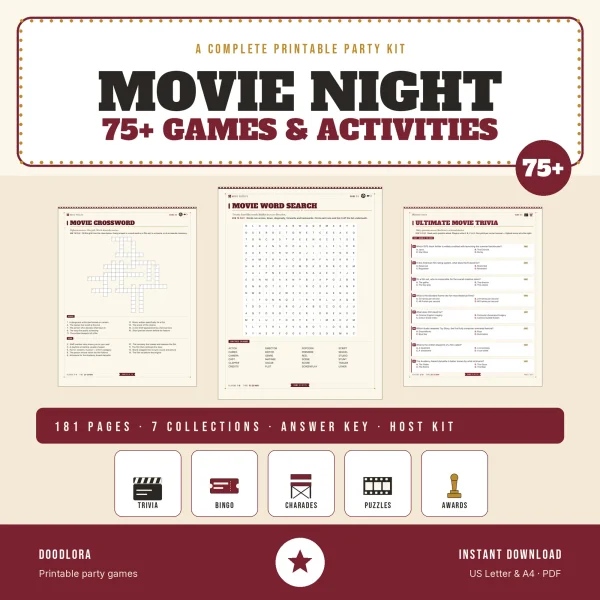
A minute on the clock still works with nothing but paper, a pen and a good memory, which suits rooms that don’t want balloons at all. Our Movie Night Party Games kit has a whole collection of timer rounds. In Name 5 Movies, a player picks one of 20 categories, starts the timer and names five films that fit, and a miss lets the next player steal the category.
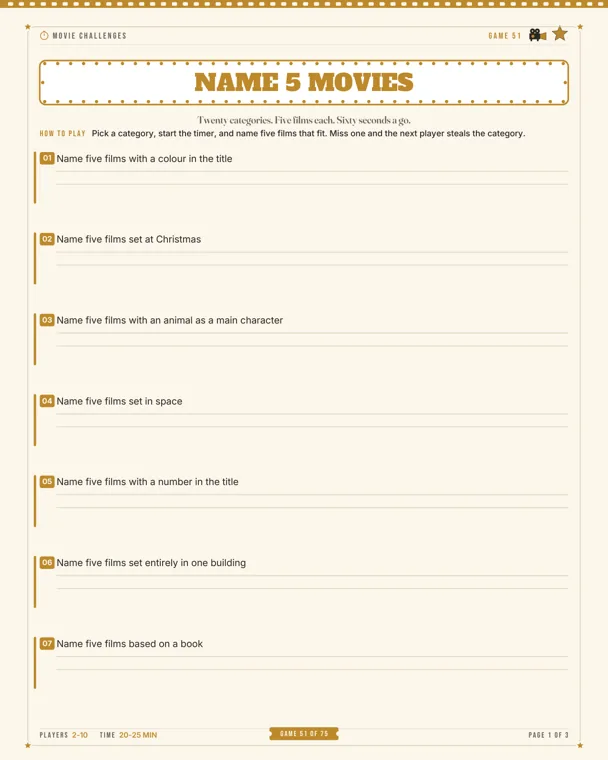
The kit has two more 60-second rounds. Movie Memory Challenge gives everyone 60 seconds to study a list of 15 titles, then covers it and asks questions like how many of the titles began with the word “The.” Draw the Movie has 24 prompts, from a shark fin in open water to a house lifted by balloons, and the artist gets 60 seconds with no letters and no numbers while the team guesses.
For a fall evening, two seated rounds from our fall party games run on the same timer: Don’t Say It, where you describe a word without saying the three banned words under it, and a no-lift drawing challenge. The six blank cards at the back of our Doodlora Studio deck are the place for whatever your family invents next, and a 60-second round doesn’t need much more than a task, a target and someone holding the timer.
Printables from this article
Related articles
Printable Party Games
How to Plan a Baby Shower: Timeline, Food & 2-Hour Schedule
A baby shower plan from the first talk with the parents-to-be to the last gift: timing, guest list, budget, venue, a two-hour schedule, safe food and backup plans.
Printable Party Games
How to Plan a Bridal Shower: Timeline, Budget and Schedule
A host's plan for a bridal shower, from the first talk with the bride and co-hosts to the guest list, invitations, a timed party schedule, the gift opening and what to do when something slips.
Printable Party Games
35th Birthday Ideas: Party, Trip, Theme and Gift Ideas
Ways to celebrate turning 35, sorted by how many people the birthday star wants around, with group size, time, prep and the snag to plan for in each.