How to Host a Trivia Night: Trivia Night Ideas & Scoring
To host a trivia night at home, split your guests into small teams of three to five people, plan four or five rounds of about ten questions, and read every question twice while each team writes one answer on its own sheet. That fills about 90 minutes, break included. The step most hosts skip is settling the scoring rules before the first question, because spelling, near-misses and ties start most of the arguments.
Planning comes first, then the rounds, the paperwork, what to say as host, scoring, tie-breakers and the problems that come up at almost every table. Short on preparation time? The table below gives a starting plan for four common holiday gatherings.
| Gathering | Guests | Teams | Rounds | About how long |
|---|---|---|---|---|
| Thanksgiving, after dinner, ages 8 to 80 | 8–16 | 3 or 4 mixed-age teams | 4 rounds of 8, the first one easy | 60 minutes |
| Friends’ holiday party, adults | 10–24 | Teams of 4 or 5 | 5 rounds of 10, plus a picture round | 90 minutes |
| New Year’s Eve, before the countdown | 6–14 | Pairs or threes | 3 rounds and a final wager, done by 11:45 p.m. | 45–60 minutes |
| Family night with kids under 10 | 4–8 | 2 teams, each with an adult reader | 3 short multiple-choice rounds of 6 | 30–40 minutes |
These figures are starting points we’d plan around, not rules from any quiz league. Count your guests, then adjust the rounds to fit.
Planning a trivia night: guest count, teams and running time
Team size matters more than the guest count. Three to five people per team means everyone on it usually knows at least one answer, and nobody sits there with nothing to do. With four guests or fewer, skip teams and let everyone play alone. Some pubs cap quiz teams at six to ten people, but that’s too many for a living room, where a whole team has to whisper over one sheet.
Splitting guests into fair teams
Count off around the room instead of letting guests choose. People who pick their own teams cluster by age and interest, and you end up with the movie buffs on one side and the grandparents on the other. For a family crowd, put at least one adult and one child on every team. Give the child a real job, such as writing the answers down or holding up the sheet.
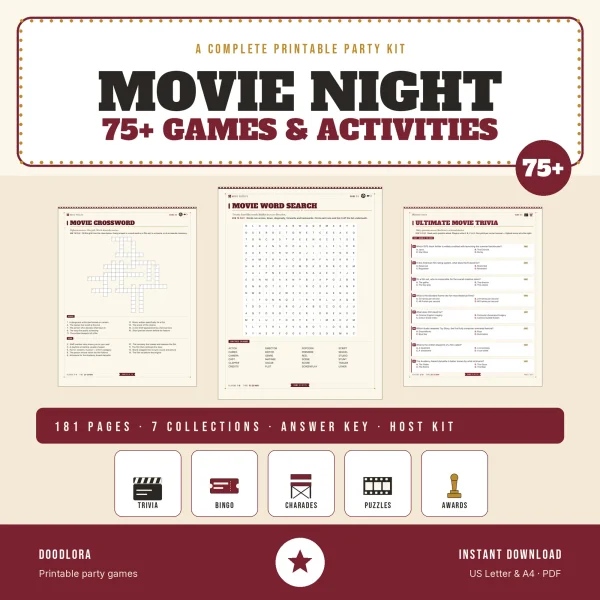
Our movie night kit gives identical advice about counting off on page 161 of its US Letter file. A word dropped out of the printed line, though, so it reads as if guests should pick their own teams. They shouldn’t. Ask each team for a name, too, and have them write it on every sheet so the scoreboard stays readable.
How long a trivia night takes
By our estimate, a ten-question round takes about 12 minutes at home. That’s roughly 45 seconds per question to read it twice and let the team talk, plus three or four minutes to mark the sheets. Four rounds, a 10-minute break and a final question come to 70 to 80 minutes. After a big holiday meal, concentration in a mixed group rarely lasts much longer than that.
Pub quizzes typically run anywhere from one to six rounds. At home, four or five is plenty, and stopping while people still want one more round is better than dragging through a seventh.
Trivia night ideas: round formats that work at home
Change the format between rounds, not only the topic. Ten read-aloud rounds in a row wear a room out, while a picture round or a quick list round changes who on each team gets to shine. Pick three or four formats from the table and put the hardest one in the middle of the night.
| Round format | How it works | What to prepare |
|---|---|---|
| General knowledge | You read ten questions; teams write one answer each | A question list with answers |
| Multiple choice | Three or four options per question; the easiest format for kids | The options written out |
| Picture round | A handout of photos, logos or flags to name, kept on the table all night | One handout per team |
| Music round | Play the first few seconds of a song; teams name the title or the artist | A playlist and a speaker |
| Which came first | Read two events; teams pick the earlier one | Your own pairs, or a card set |
| Name three | Teams list as many answers in a category as they can in 30 seconds | A timer |
| True or false | Short statements, read fast; a good closer | A list with answers |
| Lightning round | Five quick questions in 60 seconds | A timer |
Two of these come straight from pub quizzes. A picture round usually stays on the table for the whole evening and gets collected at the end, and a music round often plays just the intro of each song. Both give quieter guests an opportunity to contribute without answering out loud.
Mixing easy and hard questions
Write each round so the first few questions are easy enough for everyone, the middle ones are general, and the last one or two are hard. Every team should score something in every round. A team stuck on zero after round two stops trying, and the evening loses a table.
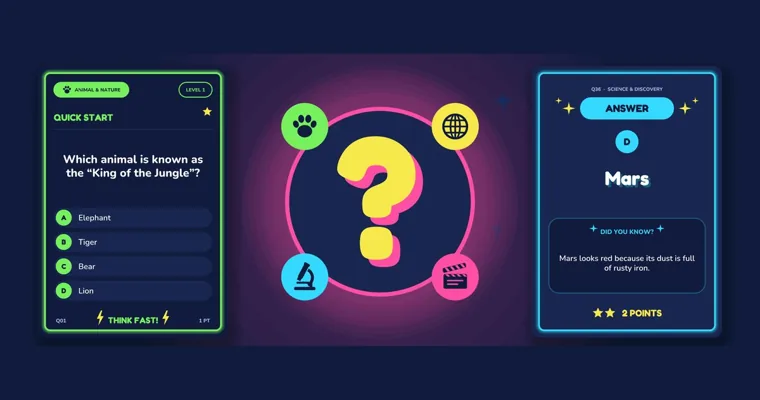
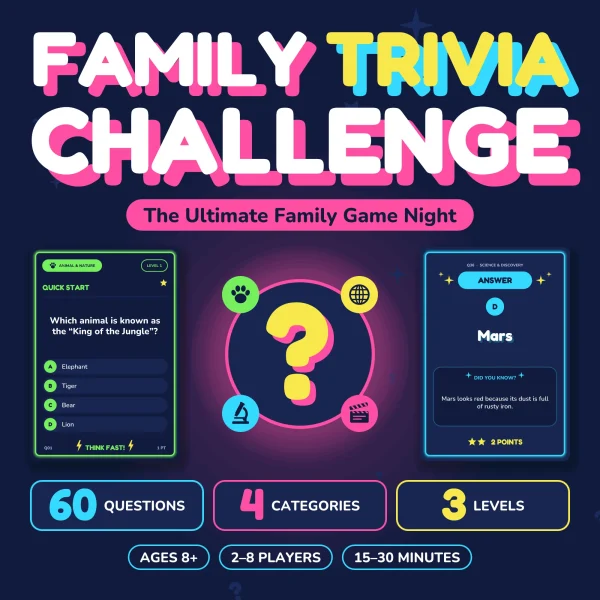
Our Family Trivia Challenge deck builds that mix into its cards. One-star Quick Start cards are for kids and younger players and score 1 point. Brain Boost cards score 2, and Expert Mode cards, meant for teenagers, adults and dedicated quiz lovers, score 3. Its game plan runs one round per level, followed by a 60-second lightning round and a final showdown, for 2 to 8 players or teams aged 8 and up.
Where to get trivia questions
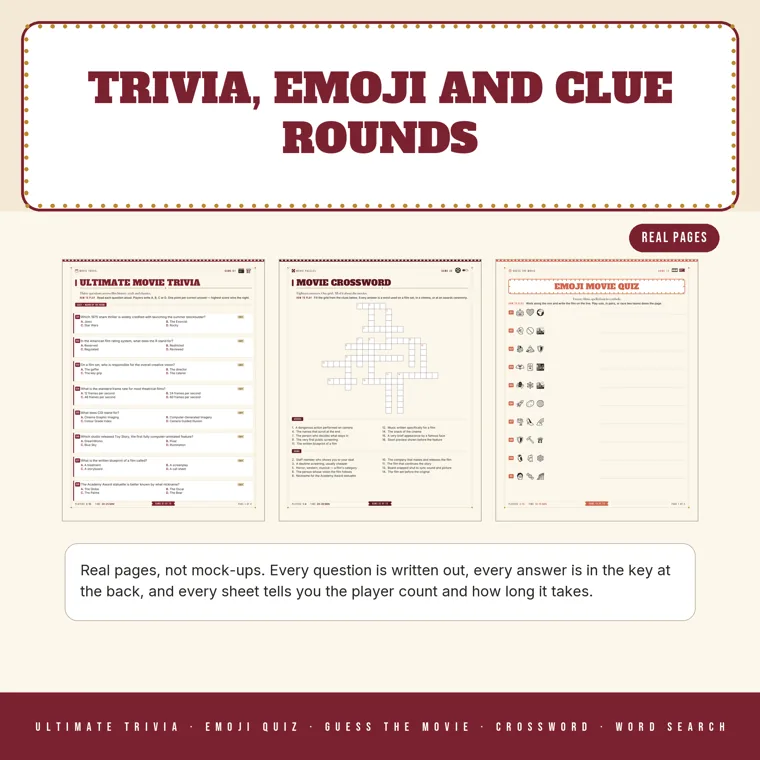
You don’t have to write every question yourself. Our Thanksgiving trivia list suits the November table, and history trivia questions run from easy to hard. For a film crowd, use the movie trivia questions. When grandparents make up most of the room, trivia for seniors sorts its questions by decade. One list per round keeps the topics from blurring together.
If you write your own, give each question one clear answer and check it against a reliable source. Skip questions whose answers change, like “the tallest building” or “the current record,” unless you add a year to the question.
What to prepare before trivia night
Do all the preparation the evening before, so on the night your only jobs are reading and timekeeping. Here’s the list:
- Your question sheets, in reading order, with the answer printed next to each question. Number them and staple them.
- Answer sheets, one per team per round, numbered 1 to 10, with a line for the team name.
- Pens and something hard to write on, two pens per team.
- A scoreboard, either a printed sheet or a whiteboard everyone can see.
- A timer; a phone is fine.
- Two or three tie-breaker questions with number answers.
- The picture handouts or playlist, if you’re running those rounds.
- Small prizes for the winning team and the runner-up, as many pub quizzes do.
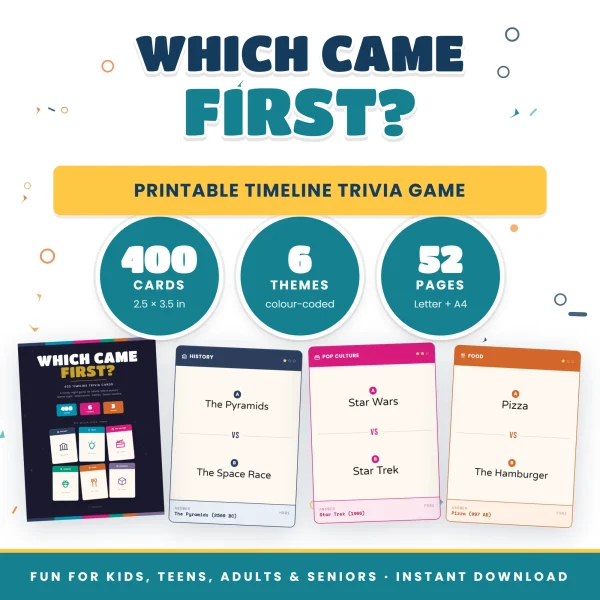
Read every answer aloud to yourself the day before, because printed question sets make mistakes too, ours included. One Pop Culture card in our Which Came First? timeline trivia cards says Iron Man came before Spider-Man. In fact, Spider-Man first appeared in Amazing Fantasy #15, dated August 1962, and Iron Man in Tales of Suspense #39, cover-dated March 1963.
Remove any question you can’t verify before the night rather than making a judgment call mid-round. The same deck’s History cards also repeat a few subjects, such as two separate elevator cards, so take out the duplicates when you build a round from it.
Hosting the trivia night: what to say and how to read
The host’s job is to keep the rules clear and the pace steady. Don’t play on a team while you host. You’ll know the answers, and the other teams will notice.
The house rules to announce before round one
Say the rules once, out loud, before the first question. You can read this almost word for word:
“Welcome to trivia night. We have five rounds of ten questions, and I’ll read each one twice. Write one answer per question on your team’s sheet. Phones go face down until the last round. Spelling doesn’t count as long as I can tell what you mean. My answer sheet is final, so if you think I’m wrong, tell me after the round, not during it.”
Each rule heads off a familiar problem. Reading twice stops “can you repeat that?” after every question. The phone rule keeps quiet searching out of the competition, and the spelling rule saves your youngest players. “After the round” keeps one argument from stalling everybody else.
Reading each question
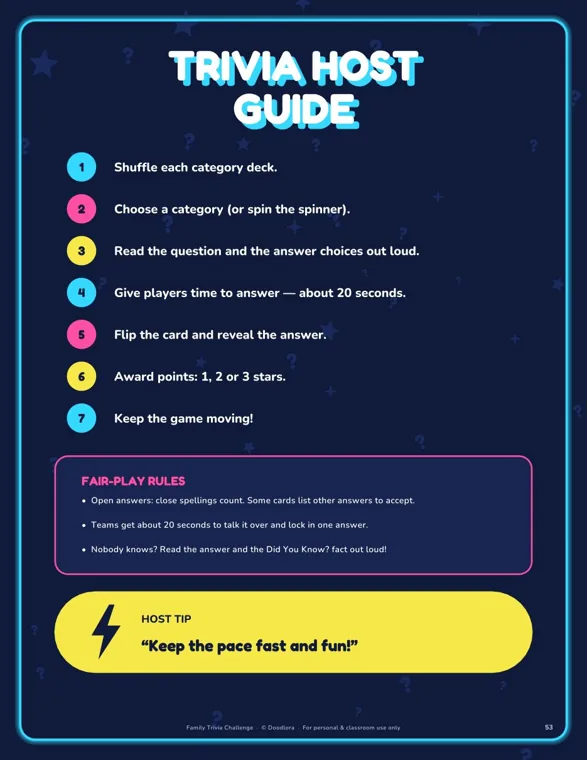
Read the question number, then the question, pause, and read it again. Give teams 20 to 30 seconds to talk, then move on even if someone asks for more time. The host guide in our family trivia deck allows teams about 20 seconds of discussion before they commit to a single answer, which keeps the competition moving.
If a team asks you to clarify a question, repeat the question rather than explaining it. Anything extra you say to one team counts as a hint, and every team should hear it. When no team gets an answer, read it out with a sentence of background, then go on to the next question.
Marking answers between rounds
Collect the sheets at the end of each round, or have teams swap sheets with the team on their left and mark them while you read the answers out. Swapping is faster and keeps everyone listening. Marking them yourself gives better consistency when the scores are close. Either way, read the standings after every round, because a close race keeps the room playing.
Trivia night scoring and answer sheets
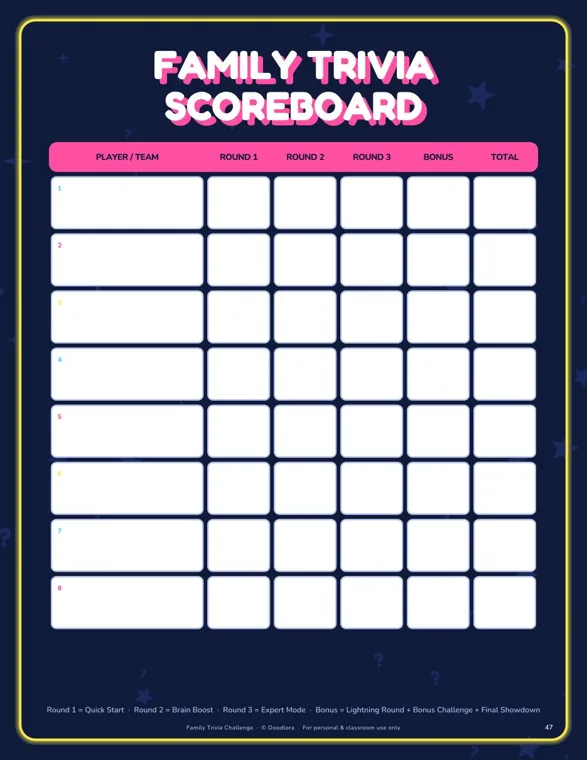
Most quizzes award one point for each correct answer. Before round one, decide three things: whether a last name is enough for a person, how close a year has to be, and whether near-misses get half a point. Some pub quizzes allow half marks for nearly right answers. Once you’ve said the rule, apply it to every team, even when it costs your favorite one a point.
Two extras make the scoring more interesting. A joker lets each team pick one round in advance to count double, a rule borrowed from pub quizzes. A final wager round lets each team bet some of its points on the last question. In the classic version, a wrong answer loses the bet, which can drop a leading team to last.
For kids, use a gentler final. In the Final Showdown in our family deck, every player privately chooses a level, and a right answer scores double: 2, 4 or 6 points. A wrong answer scores nothing that round, but nobody loses points they already have. Children take a big swing much more happily when it can’t wipe them out.
How to break a tie at trivia night
Have a tie-breaker ready before you start, because it always comes up at the end, when everyone’s waiting. The best kind has a number answer that nobody will know exactly. Each tied team writes down a number, both reveal at once, and the closest wins. Count the candies in a jar before the party, or ask both teams to guess the combined points every team scored tonight.
For a sudden-death version, read one hard question to both teams, and whoever answers correctly first takes the win. Our family deck uses one Expert Mode card each for this. The host kit in our movie night party games adds 24 tie-breaker cards, like naming the most films in thirty seconds, and a three-step rule for ties that won’t break.
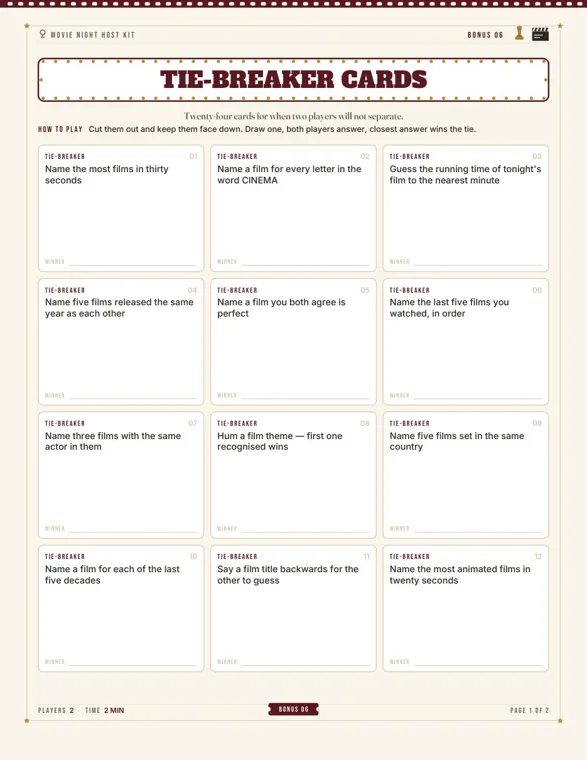
That rule goes like this. First, draw a card. If the tie holds, the two players name films in turn, and whoever hesitates more than five seconds loses. If even that doesn’t settle it, the host decides, and nobody gets to complain.
Common trivia night problems and how to fix them
Most trivia nights hit the same few snags, and every one of them is easier to handle when you’ve decided your response in advance.
When an answer is disputed
Go by your answer sheet during the round, and hear any challenge once the round ends. If your sheet turns out to be wrong, give the point to every team that wrote the right answer. Rewarding only the team that complained teaches everyone that arguing pays. When nobody can prove it either way, take a quick vote, note the decision on the answer sheet, and continue, which is also the fix our movie night host guide suggests.
When one team is far ahead
A runaway leader drains the excitement from every other table. Switch the next round to a format where knowledge matters less, like a name-three round or a picture round. Let the last-place team choose the next topic, too. If the same team wins two nights in a row, reshuffle the teams at the break next time.
When kids and adults play together
Give every team one “kid question” per round that only its youngest player may answer, and make those questions multiple choice. A child who isn’t writing confidently yet can whisper the answer to a teammate, who handles the spelling. For children under about 8, keep each round to six questions and the whole game under 40 minutes, since their attention runs out well before the adults’ does. Our family game night ideas include games for the youngest guests while the older ones finish.
If you’re running long, cut a middle round rather than the final or the prizes, because the last question and the prize-giving are what guests talk about afterward. On December 31, plan backward from midnight, and use the evening schedule in our New Year’s Eve games guide to fit trivia between the other activities. For more printables, browse the party games in the Doodlora Studio shop.
Printables from this article
Related articles
Printable Party Games
How to Plan a Baby Shower: Timeline, Food & 2-Hour Schedule
A baby shower plan from the first talk with the parents-to-be to the last gift: timing, guest list, budget, venue, a two-hour schedule, safe food and backup plans.
Printable Party Games
How to Plan a Bridal Shower: Timeline, Budget and Schedule
A host's plan for a bridal shower, from the first talk with the bride and co-hosts to the guest list, invitations, a timed party schedule, the gift opening and what to do when something slips.
Printable Party Games
35th Birthday Ideas: Party, Trip, Theme and Gift Ideas
Ways to celebrate turning 35, sorted by how many people the birthday star wants around, with group size, time, prep and the snag to plan for in each.