15 Family Game Night Ideas: Family Game Night Games by Age
Family game night ideas work best when they’re planned around the youngest and the oldest person at the table, not the middle. A shape that fits most families is about an hour and three games: a fast warm-up anyone can join, one main game with a handicap that evens out the ages, and a short closer that ends on a laugh. Agree on the house rules, phones included, before the first card is dealt.
Below are 15 games sorted by who’s playing, each with the head count, rough time, what to set out and how it ends. After them come ways to keep a five-year-old and a teenager in the same game, what to do when someone cries or sulks, a few theme nights and how to turn one good evening into a weekly habit.
| Game | Players | Reading needed? | Rough time | What you need |
|---|---|---|---|---|
| Memory | 1 to 10 | No | 10 to 15 minutes | A picture card deck |
| Go Fish | 2 to about 6 | No, with picture cards | 10 to 15 minutes | Picture cards or a standard deck |
| War | 2 to 4 | Numbers only | Until the timer goes | A standard deck |
| Slapjack | 2 or more | No | 10 minutes | A standard deck |
| Sardines | 3 or more | No | 15 to 20 minutes | A house with hiding spots |
| Crazy Eights | 2 to 7 | Numbers and suits | 10 minutes a hand | One deck, two past five players |
| Twenty Questions | 2 or more | No | 5 minutes a round | Nothing |
| Hangman | 2 or more | Yes | 5 minutes a word | Paper and a pencil |
| Charades | 4 or more | Only to read a slip | 20 minutes | Slips of paper and a timer |
| Family trivia cards | 2 to 8 | The reader does | 15 to 30 minutes | Printed question cards |
| Spoons | 3 to 13 | No | 15 to 20 minutes | A deck and spoons |
| Picture telephone | 3 or more | Yes, on writing turns | 15 minutes | Paper strips and pencils |
| Mafia | About 7 or more | No | 20 to 30 minutes | Nothing; a grown-up runs it |
| Emoji guessing | 1 or more, or teams | To write the answer | 15 minutes | Printed puzzle sheets |
| Timeline trivia | 2 or more, or teams | The reader does | 15 to 20 minutes | Printed timeline cards |
The player counts come from each game’s rules where they give one. The times, and the head counts for Sardines, Twenty Questions, Charades, picture telephone and Mafia, are our planning suggestions, so stretch or shrink them to fit your family.
Planning a family game night: players, ages and how long it runs
Start by counting heads and checking who can read. A table of four is easy; once you’re past six, turn-taking games get slow and team games work better. Any game with printed questions needs a reader, so a child who can’t read yet either gets picture cards or sits on a team with someone who can.
Then set an end time and say it out loud. On a school night, the youngest child’s bedtime sets it, and an hour is plenty. A clear finish line also heads off the “one more round” argument at the end.
A one-hour family game night plan
| Part | Time | What to play |
|---|---|---|
| Warm-up | About 10 minutes | Something fast that latecomers can join: Twenty Questions, Slapjack, a speed round of matching cards |
| Main game | 25 to 30 minutes | The game with turns, cards and a score |
| Closer | About 10 minutes | Short and silly: charades, picture telephone, a round of would you rather |
| Wrap-up | 5 minutes | Write down the winner, pack the cards back in the box |
The order matters more than the exact minutes. A quick opener lets the person still loading the dishwasher slide in. The main game comes while everyone is fresh, and a closer that takes ten minutes gives a natural stopping point instead of a game abandoned halfway.
Family game night games when the youngest can’t read yet
Most families need one game for the littlest player and one that the oldest won’t roll their eyes at. Pick the warm-up and closer for the youngest, and let the main game stretch a little higher. The four games here run on pictures, numbers or hiding, so a preschooler can play next to a teenager.
Memory
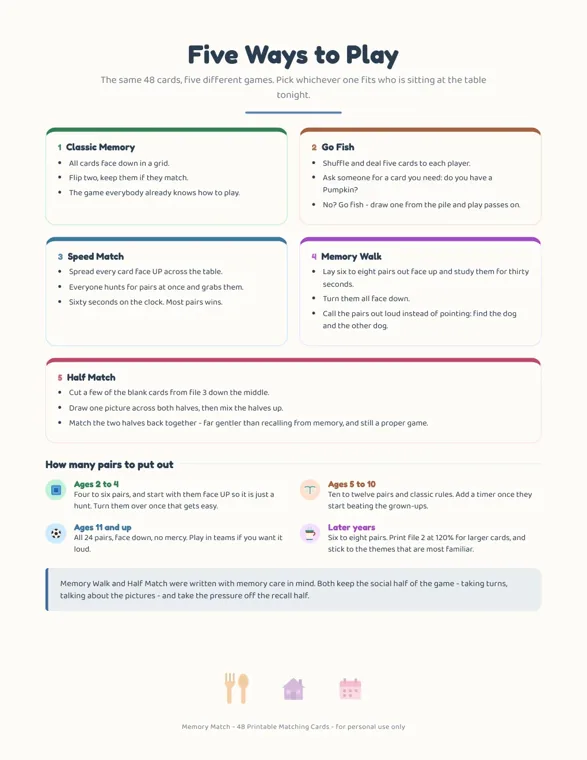
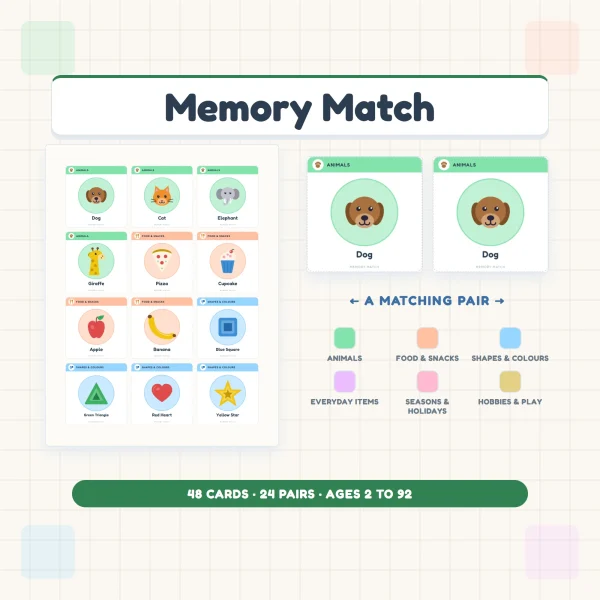
Memory is the classic pick because it runs on pictures and concentration, so nobody has to read. Our printable memory game is 48 cards, or 24 pairs, for one to ten players, and cutting them out takes about five minutes. Shuffle, lay them face down in a grid (six by eight works for the full set), and let the youngest go first. On each turn a player flips two cards so everyone sees both; a match is kept and earns another turn. The game ends when the table is empty, and whoever holds the most pairs wins.
The deck’s instructions also say how many pairs to set out: four to six for ages 2 to 4, face up at first so it’s just a hunt; ten to twelve for ages 5 to 10; and all 24 for ages 11 and up. When latecomers are still arriving, the same cards make a 60-second warm-up called Speed Match. Spread every card face up and let everyone grab pairs at once, and most pairs wins.
One rule causes more fights than any other with little ones: cards that don’t match go back face down in exactly the same spot. Say it before the first turn. The full rules, scoring and two-player version are in our memory game rules.
Go Fish
Go Fish suits two players up to about five or six. With the memory cards, deal five to each player and pile the rest face down. On your turn, ask someone for a card you need (“Do you have a Pumpkin?”); if they don’t, they say “go fish,” you draw one from the pile, and play passes on. With a standard deck, deal five cards each (seven when only two or three play), ask for a rank such as eights, lay down each set of four, and the first player to run out of cards wins. With the memory cards, lay down pairs instead.
The snag with small children is asking for something they don’t hold, just to see what happens. The usual rule is that you have to hold at least one card of the rank you ask for. Say it at the start, and let a preschooler show their hand to a grown-up teammate before asking.
War
War is all luck, which is exactly why it works for a four-year-old against a teenager: nobody can play badly. Deal the whole deck out evenly. Two players get 26 each; three get 17 each and four get 13 each. Everyone flips their top card at once, the highest card takes the lot, aces are high and suits don’t count. When the top cards tie, it’s war: every player puts one card face down and one face up, and the highest face-up card wins everything on the table.
Officially the game ends when one player has every card. That can take a long time. For game night, set a timer for ten minutes and have the biggest stack win; one old German version of the game is decided the same way, by most cards at the end. Also decide before you start what happens when someone runs out of cards in the middle of a war, because the published rules don’t agree. Either that player loses, or they play their last card face up for the rest of the war.
Slapjack
Slapjack is often a child’s first card game, and it needs a standard deck and quick hands. Deal the deck into face-down stacks as evenly as you can. Players take turns turning their top card face up onto one pile in the middle. When a jack lands, everyone slaps the pile with the hand they didn’t use to place a card, and the first hand to cover it takes the whole pile, shuffles it and adds it to the bottom of their stack. A player who runs out gets one more chance to slap a jack and get back in. The last player holding cards wins. With a timer, the biggest stack wins.
Expect a stinging hand or two when a grown-up and a five-year-old go for the same pile, so agree that the first hand down wins and every hand on top of it pulls straight back. Older players often want a penalty for slapping a card that isn’t a jack. In one common version, a wrong slap lets the other players split the pile between them.
Sardines
Sardines turns hide-and-seek inside out, and it’s the one game on this list that gets everyone off the couch and burns off some excitement before the card games. One person hides while everyone else counts. Then the seekers spread out, and each one who finds the hider quietly squeezes into the same hiding spot. The hiding place gets more crowded, like sardines in a tin, and the last seeker to find the group becomes the next hider.
Plan on three or more players and a few rounds. Before the lights go down, agree which rooms are in bounds and that nobody hides inside anything that latches. A preschooler can seek with an older sibling and still feel like the one who found everyone.
Family game night games for kids around 6 to 10
Once a child reads short words and knows their numbers, the card and guessing games open up. These five work with grown-ups at the table, and all of them can be taught in under a minute. Picture bingo fits this age too, since one caller can run it for the whole table; our printable bingo rules cover calling, patterns and checking a win.
Crazy Eights
Crazy Eights works for two to seven players with one standard deck, or two decks shuffled together once you’re past five. Deal five cards each (seven if only two are playing), turn the top card of the pile face up, and take turns playing a card that matches it by number or suit. An 8 can go down anytime, and whoever plays it names the next suit. If you can’t play, draw until you can. The first player with an empty hand wins.
The 8 is where new players trip up. Whoever plays it has to name the suit, and if that isn’t said clearly, the next player can argue for a different one. Have them say the suit out loud as the card goes down.
Twenty Questions
Twenty Questions needs nothing at all. One person thinks of something, and everyone else asks questions that can only be answered yes or no. A right guess makes the guesser the next one to think of something; if 20 questions go by without it, the thinker has won and goes again. Younger players do better with a category up front: person, place or thing. A common variant tells the guessers whether it’s animal, vegetable or mineral.
Hangman
Hangman needs paper, a pencil and one player who can spell. That player thinks of a word and draws one dash for each letter. The others guess letters; a right letter gets written in every place it appears, and a wrong one adds a piece to the drawing. Guess the word before the drawing is complete and the guessers win; finish the drawing and the word-setter wins. The guessers can try the whole word at any time, though a wrong try can cost another piece.
With small children at the table, swap the hanging figure for something gentler, such as apples you cross off a tree or slices you take out of a pie. Agree beforehand on how many wrong guesses the drawing allows, and whether names of people and places count.
Charades
Charades needs four or more players split into two teams, slips of paper and a timer. Each team writes answers for the other side to act. One player draws a slip and acts it out without speaking while their own team guesses against the clock, and teams take turns until everyone has acted at least once. Score a point for each correct guess, plus one when the other team runs out of time.
The rules vary so much from family to family that the arguments start over them, not the guesses. Before the first slip, settle whether pointing, mouthing words or making sounds is allowed. Also teach the few signals everyone uses: fingers held up for the number of words, cranking an old movie camera for a movie, and tugging an earlobe for “sounds like.” Our charades for kids guide has easy and hard prompts and how long to give a child’s turn.
Family trivia cards
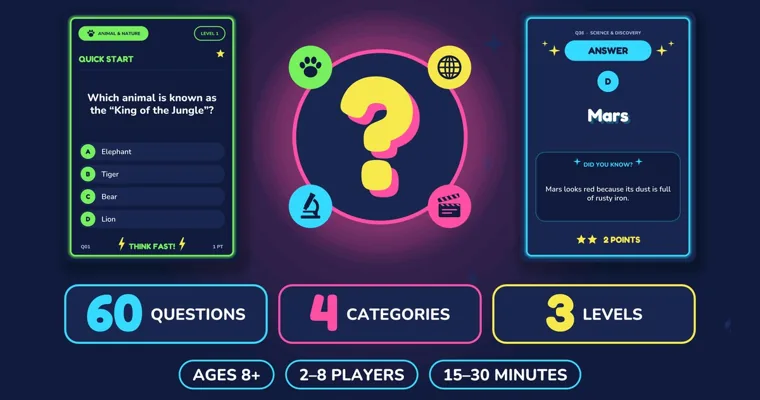
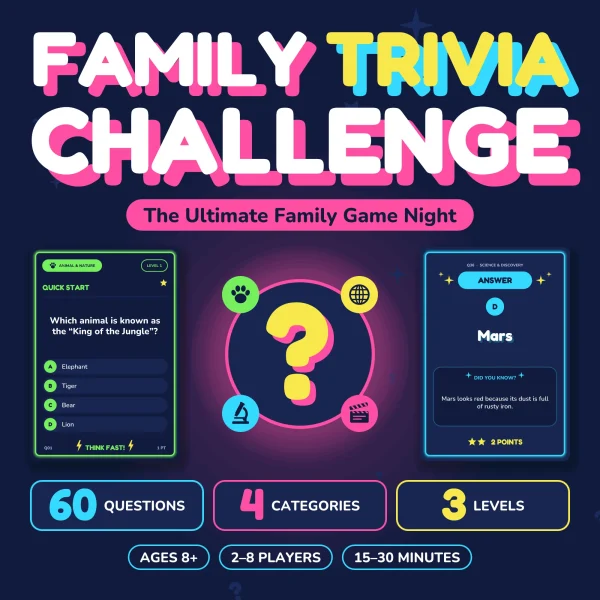
A trivia deck is the main game for this age group, especially once a child is about 8. Our Family Trivia Challenge is for two to eight players and runs 15 to 30 minutes. It has 60 questions in four categories, and its host reads each question and the answer choices aloud, gives about 20 seconds, then flips the card to reveal the answer. Points add up over a round at each level, a lightning round and a final showdown, and the most points wins.
How to make that fair between a second-grader and a parent is the next section’s job. The short version is that every card says who it’s written for.
Games for tweens and teens at family game night
Older kids want speed, a bit of chaos or the chance to outwit their parents. These five games give them that, and the younger ones can still join in on a team.
Spoons
Spoons is loud, fast and a little rough, which is why older kids tend to like it. It takes three to 13 players, and four to seven is the sweet spot. Put spoons in the middle, one fewer than the number of players, and deal four cards each from a deck that holds one set of four matching cards per player. Everyone passes one card to the left at the same time. When someone collects four of a kind, they take a spoon, and everyone else grabs for the rest. The player left without one gets a letter of S-P-O-O-N-S; spell the whole word and you’re out, and the last player in wins.
Card-game references put pig, the game Spoons grew out of, at ages 7 and up. With younger children at the table, add one house rule before you start: you can grab a spoon from the middle, never from someone’s hand. For teens who want it harder, there’s a known variant where the spoons are hidden somewhere awkward nearby instead of sitting on the table.
Picture telephone
Picture telephone is the pencil-and-paper cousin of the whispering game, and it ends with the whole table laughing. Each player gets a strip of paper and writes a short phrase at the top, and the strips are passed one seat along. The next player draws the phrase, folds the writing out of sight and passes the strip on. The next writes what they think the drawing shows, folds the drawing away, and so on. Each player only ever sees the step just before theirs, so imagination fills in the rest.
When the strips come back to their owners, unfold them and read each one from the top. There’s no winner. The fun is in the gap between “Dad’s lost his keys” and whatever it turned into. A child who can’t write yet can say the caption out loud for a teammate to write down; drawing turns need no help at all.
Mafia
Mafia is a game about bluffing and accusations, so save it for tweens and teens with a parent running it. It needs a moderator who doesn’t play, plus players secretly handed a role, usually by dealt cards. One common setup has two mafiosi and an odd total including the moderator, which makes seven about the smallest table where the mafia don’t win before the first vote. Some families play the same game as villagers and werewolves.
At night, everyone closes their eyes, the mafiosi open theirs and silently point out a victim, then close them again. By day, the moderator announces who “died,” and the living players talk and vote. If more than half vote to eliminate someone, that player is out and night falls again. The villagers win when every mafioso is gone, and the mafia win when they equal the villagers in number.
Two snags come up with families. Gestures at night are easy to hear, so have everyone tap the table softly to cover them. An eliminated player isn’t allowed to influence the rest of the game, which takes real patience from a 10-year-old who’s sure they know who did it. Give them a quiet job, such as counting votes.
Emoji guessing
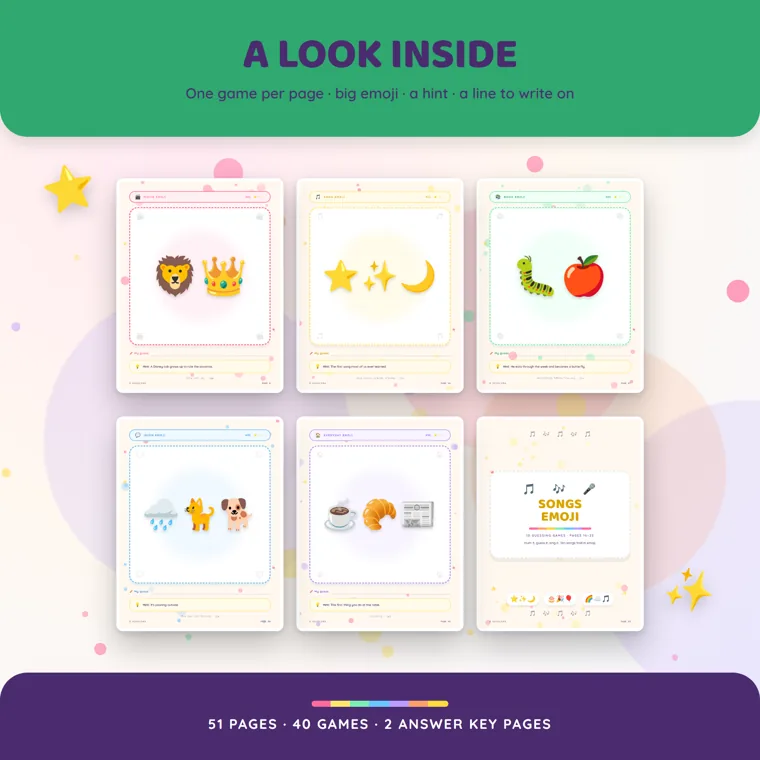
Emoji puzzles make a good teen-versus-parents round. Our emoji guessing games have 40 puzzles across movies, songs, books, idioms and everyday life. Hand out one sheet per player or per team, say the answer out loud, write it on the line, then flip to the answer at the foot of the page. It’s one point per right answer. Most points wins the round.
Timeline trivia
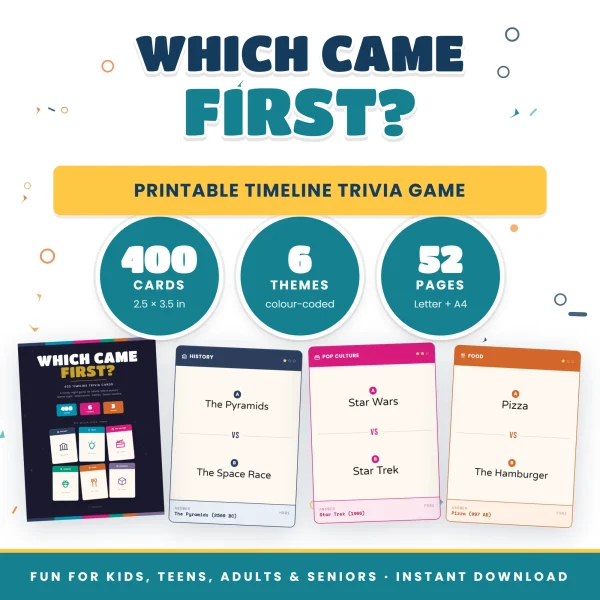
In a timeline game, players hear two things and name the one that came first, with no dates to memorize. Our timeline trivia cards give four ways to play, and Team Challenge is the one for a family split down the middle. A neutral reader reads each card aloud, the first team to call out the right answer wins the point, and the best of 20 cards takes the round. For a warm-up, Lightning Round gives one player 60 seconds to answer as many cards as they can.
Keeping it fair when the ages are far apart
A family game night falls apart when the same person wins every week. The fix is a handicap that’s built into the game instead of a grown-up quietly playing badly, because kids usually spot the difference.
Card games with difficulty levels make the handicap easy to see. In our Family Trivia Challenge, every card is marked Quick Start (1 point, written for kids and younger players), Brain Boost (2 points, tweens, teens and adults) or Expert Mode (3 points, teens, adults and trivia fans). The game guide runs a round of each level before the lightning round and the final showdown.

For a big age gap, we’d put each young child on a team with an older player. The deck’s host guide gives teams about 20 seconds to talk it over and lock in one answer, which gives the child a voice without leaving them alone with a 3-point question. A tie ends with sudden death: one Expert Mode card each, and the first right answer wins.
Other games carry the same idea. The timeline cards mark every card with one to three stars, and their rules say to deal one-star cards to the youngest and oldest players and three-star cards to whoever always wins. In memory, the instructions suggest starting a three-year-old on six pairs and adding four more every time they win. Luck games such as War and Slapjack need no handicap at all, which makes them a good reset after a hard-fought trivia round.
When the youngest loses and cries at game night
Short games are the best protection. If a game takes eight minutes, losing it isn’t a disaster, because another chance is coming soon. A 40-minute game that ends badly for a five-year-old can sink the whole evening.
A few things to set up before the tears start:
- Say how the game ends before it starts. “Whoever has the most pairs when the table is empty wins” is easier to accept than a surprise.
- Give the loser a job. The last-place player deals the next game, spins the category spinner or reads the next card.
- Play on teams when one child loses every time. A team loss is shared, and the older teammate can model how to take it.
- Stop while it’s still fun. Ending one game early beats a fourth round with a tired child.
If a child is still upset after a minute or two, let them sit out a round as scorekeeper rather than pushing through. Game night only works if they want to come back next week.
When older kids think family game night is babyish
The easiest way to bring a reluctant 12-year-old in is to hand them the job of running it. The host guide in our trivia deck fits the whole job into a short list: read the question and the answer choices out loud, give players about 20 seconds, flip the card, reveal the answer and award 1, 2 or 3 points. Hosting comes with power. That tends to land better with tweens than being asked to play a kid’s game. Mafia does the same thing for a teen who’s played it before, since the moderator runs the whole game.
Letting them pick one game each week helps too, and so does handing them the hard cards: Expert Mode in trivia, three-star cards in timeline, all 24 pairs face down in memory. Teens also tend to enjoy questions with no right answer at all, and our would you rather questions for kids include a set written for families.
Phones at family game night: a basket and one shared timer
Put every phone in a basket by the door. Grown-ups’ phones go in too. If the adults keep checking theirs, the kids will notice and the rule won’t last.
Two things make the basket easier. First, use a kitchen timer or one shared device for timed rounds, so nobody needs their own phone to count 60 seconds. Second, choose games where the answer is already printed, so there’s no reason to look anything up. Our trivia cards put the answer on the back of each card when you print them double-sided, and the timeline cards carry it in a strip at the bottom.
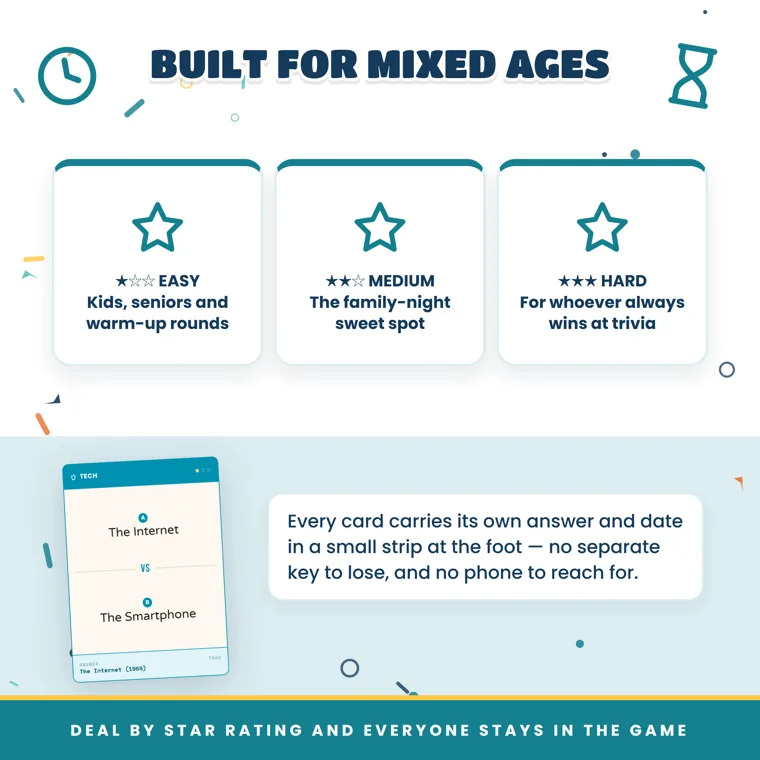
The timeline rules have the reader keep a thumb over that strip while reading the two options aloud, then lift it to reveal the date. Remind a young reader of this, since a child who reads the answer out by accident ends the round early.
Theme nights when the usual games get stale
A theme is an easy way to make the fourth Friday in a row feel new. Pick one, let the kids name it and choose the snack, and build the hour from the games above.
| Theme | What to play | The extra touch |
|---|---|---|
| Card sharks | War to warm up, Crazy Eights as the main game, Spoons to close | One standard deck does all three; add spoons for the closer |
| Quiz night | Family trivia cards, then a timeline Points Race | The timeline deck has a score sheet page; print one per night |
| Movie night | Charades with movie titles only, then the emoji movie puzzles | Teach the movie-camera signal before the first slip |
| Lights down | Sardines, then Mafia with a grown-up moderating | Agree on in-bounds rooms before the lamps go off |
| Holiday night | A seasonal set from our Halloween games for kids, Thanksgiving games or Christmas games for kids | Keep one standing game, like War, so the night still feels like yours |
In the timeline deck’s Points Race, a right answer scores 1 point, naming the year within 20 years adds 3 more, and the first player to 25 wins. That makes it a good main game for a quiz night once everyone has warmed up on the trivia cards.
Making family game night a weekly habit
Pick the same night and the same start time, and keep it short. We’d rather see 45 minutes every Friday than a three-hour marathon once a month, because a short night is easy to repeat.
A game box takes most of the work out of it. Print and cut decks ahead of time, not ten minutes before you play. For card games, the files tell you to print on cardstock at 100% or “Actual size,” not “Fit to page,” so the cards come out the right size. If you print the trivia cards double-sided, flip on the long edge so the answers land behind their questions. Add a standard deck of cards, pencils, paper strips, a timer and a notebook for scores, and the box covers most of this list.
Rotating who picks the main game shares the planning, and a running score in the notebook gives everyone a season to win. On weeks when everyone is worn out, skip the competition and pass around a stack of questions at the table instead; our family conversation starters have ways to make that work for mixed ages. Missing a week is fine. Just put the next game night on the calendar before you pack up.
For more card games and printable sets, browse the shop.
Printables from this article

Related articles
Printable Party Games
How to Plan a Baby Shower: Timeline, Food & 2-Hour Schedule
A baby shower plan from the first talk with the parents-to-be to the last gift: timing, guest list, budget, venue, a two-hour schedule, safe food and backup plans.
Printable Party Games
How to Plan a Bridal Shower: Timeline, Budget and Schedule
A host's plan for a bridal shower, from the first talk with the bride and co-hosts to the guest list, invitations, a timed party schedule, the gift opening and what to do when something slips.
Printable Party Games
35th Birthday Ideas: Party, Trip, Theme and Gift Ideas
Ways to celebrate turning 35, sorted by how many people the birthday star wants around, with group size, time, prep and the snag to plan for in each.