Coloring Tips: Supplies by Age, Shading and Fixing Mistakes
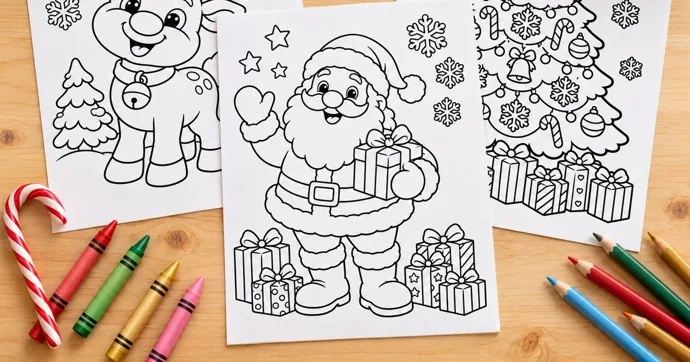
The coloring tips that make the biggest difference come before the first stroke: match the tool to the page, then color the light shades and the big shapes first and save the dark colors and tiny details for last. Thick outlines and chunky crayons suit small kids. Fine-line pages need sharp colored pencils or fine-tip markers, and a busy page goes better split into sections over a few sittings than rushed in one.
That order holds for a four-year-old with a snowman page on a snow day and for an adult with a detailed winter scene after work. What changes is the tool, the paper and how much page one person can take on at once.
| Who’s coloring | Page to pick | Tools that suit them | Paper |
|---|---|---|---|
| Preschoolers | One big picture, thick outlines | Chunky crayons, washable markers | Everyday printer paper; heavier for markers |
| School-age kids | Scenes with more small parts | Crayons, colored pencils, washable markers | Printer paper; heavier for markers |
| Older kids, teens, adults | Fine lines, textures, full scenes | Sharp colored pencils, fine-tip markers, gel pens | Printer paper for pencils; 24 to 32 lb or light cardstock for markers |
| Anyone painting | Bold outlines, open shapes | Watercolor paint, watercolor pencils | 32 lb (120 gsm) or heavier |
The line widths and shape counts quoted below are ones we measured on Doodlora Studio’s own printable files, not numbers from a package.
Coloring supplies by age: crayons, markers and colored pencils
Each tool gives a different amount of control, and kids grow into control. That’s why the same page can be easy with one tool and frustrating with another.
Crayons cover a big area fast and never need sharpening, which makes them the first tool for small hands. Chunky or triangular crayons are easier for a preschooler to grip than thin ones. A crayon tip can’t get into a space smaller than itself, though, and wax doesn’t erase cleanly, so crayons belong on pages with big shapes.
Washable markers, the felt-tip kind most kids in the US get at school, give the brightest color for the least pressure. They’re good for children who don’t press hard enough for crayons to show. The ink soaks into thin paper, can bleed onto the table and can’t be erased. Put a spare sheet under the page.
Colored pencils give the most control. They fit small spaces, they layer, and they shade from pale to dark with nothing but pressure. They need a sharpener nearby, and light pressure looks thin and patchy, which bothers some younger kids. School-age kids and adults get the most out of them.
Gel pens and fine-tip markers are for the smallest spaces on adult pages: window panes, icing dots, the pattern on a mitten. Watercolor paint or watercolor pencils work on bold outlines with open space, on heavy paper.
Paper matters most for markers and paint. Everyday 20 lb printer paper is fine for crayons and pencils. Markers want 24 to 32 lb paper or light cardstock, and wet paint wants as heavy a sheet as your printer will take. The full table, including the printer settings that keep lines from printing gray, is in how to print coloring pages.
How to choose a coloring page for kids and adults
Two things decide how hard a coloring page is: how wide the lines are and how many separate shapes there are to fill. Both are easy to check on a printed test page before you print a stack.
For preschoolers: thick lines and big shapes
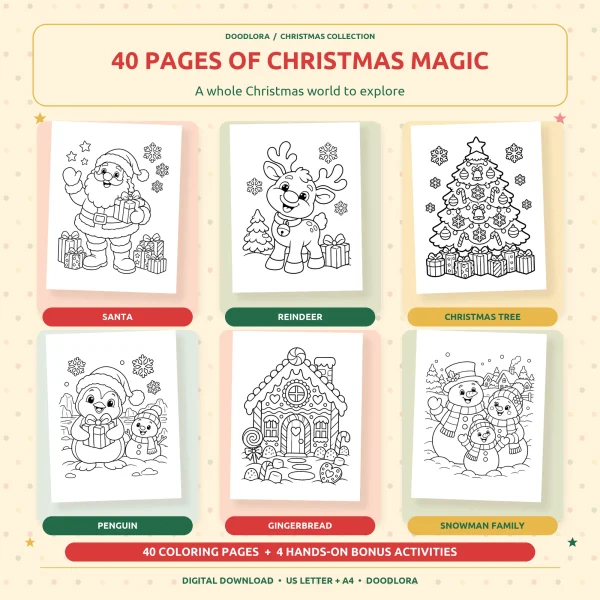
Look for one picture per page, a wide outline and plenty of open space. On our Christmas Magic coloring pages, a typical line measures about 1/25 inch (1 mm), and the snowman, the hats and the coats are each one big shape that a crayon can fill in a few strokes.
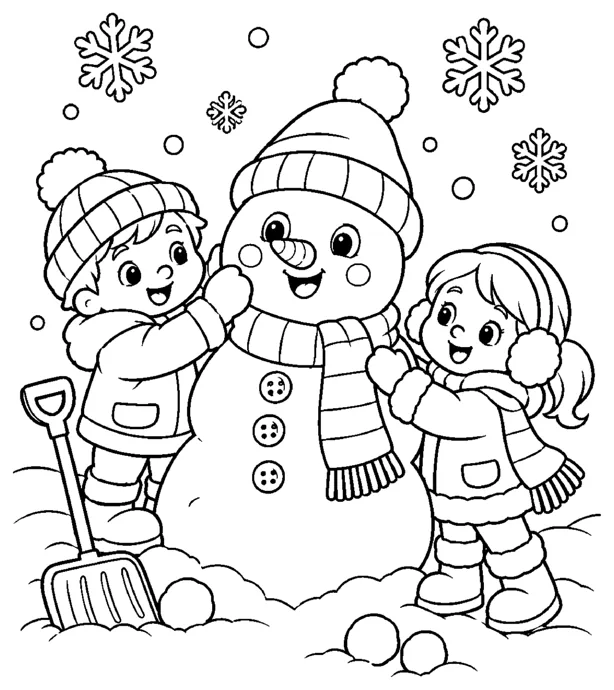
Small details still turn up on these pages: buttons, cheeks, striped scarf ends. A preschooler doesn’t have to color them. Snowflakes left white still look like snow, and the page looks finished once the big shapes are done.
For siblings at different ages: one theme, three levels
When a five-year-old and a twelve-year-old sit at the same table, they rarely want the same page. A set drawn at more than one level lets both color the same thing without the younger one getting stuck.
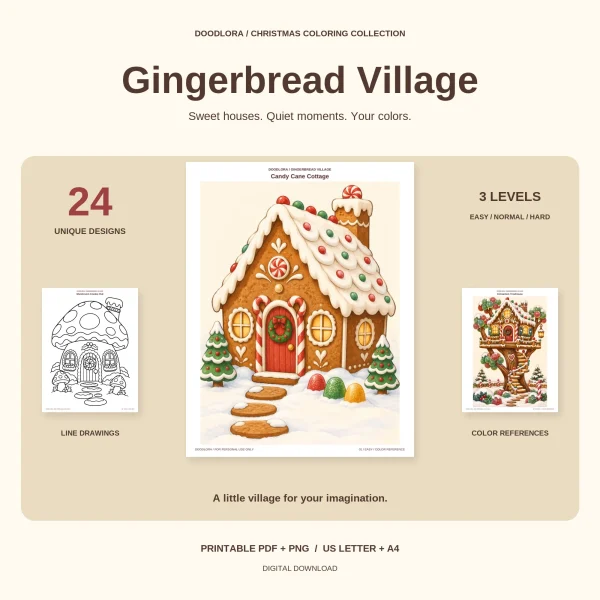
Our gingerbread house coloring pages sort 24 houses into Easy 01 to 08, Normal 09 to 16 and Hard 17 to 24, and the level is printed at the bottom of every page. When we counted the closed spaces at least 1/8 inch across, each Easy line drawing had roughly 130 to 175 of them. The Normal pages had about 270 to 355, the Hard pages about 290 to 395. Each Hard page also carries roughly 550 to 1,100 specks smaller than that.
The set’s printing guide calls the levels relative and suggests letting children and teens pick their own pace. Let an older child try a Hard house, and keep a Normal one printed in case it turns out to be too much.
For adults: how to pick a fine-line page
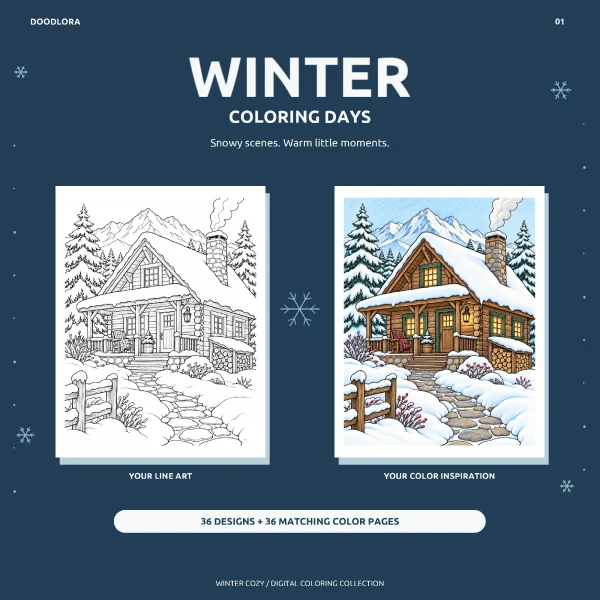
On a detailed adult page, compare the lines with the tip you plan to use. The lines on our Winter Cozy pages measure about 0.02 to 0.03 inch (0.5 to 0.85 mm), and the cabins, sweaters and snowy branches are drawn with wood grain, cable knit and layered snow. Those textures add hundreds of tiny shapes.
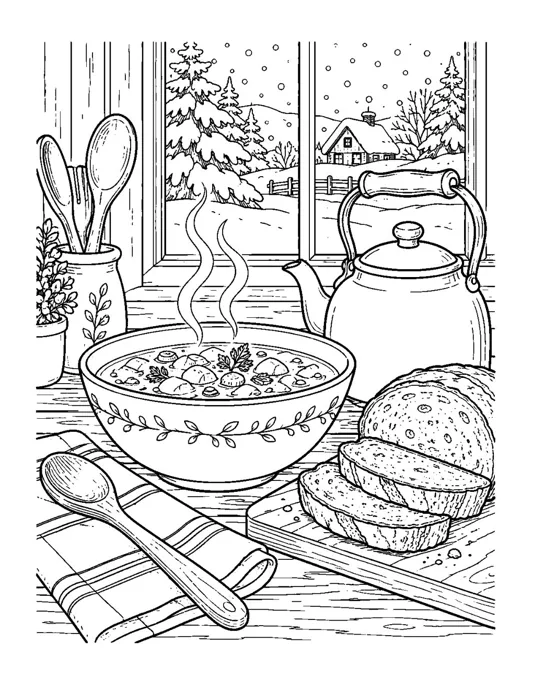
Decide before you start what the texture lines are for. You can color each little shape on its own, or color straight over them so the black lines do your shading for you. The second way is faster and still looks detailed.
Fine lines and wet markers don’t mix well, so these pages suit sharp colored pencils and fine tips. The Winter Cozy printing guide asks for one test page before printing the whole set. Doing that also shows you whether your printer keeps the thinnest lines sharp.
Where to start coloring: light colors and big shapes first
Once the page is picked and printed, the order you color in decides most of how it turns out. Crayons, colored pencils and markers all go on at least partly see-through. A dark layer covers a light one, but a light layer won’t cover a dark one.
Pick three to five colors before you start
A small set of colors looks planned, and it saves a child from stopping every minute to choose. Pick one main color, a darker one for shadows and small parts, and one or two accents. Try them in a corner of the back of the page or on a scrap from the same paper.
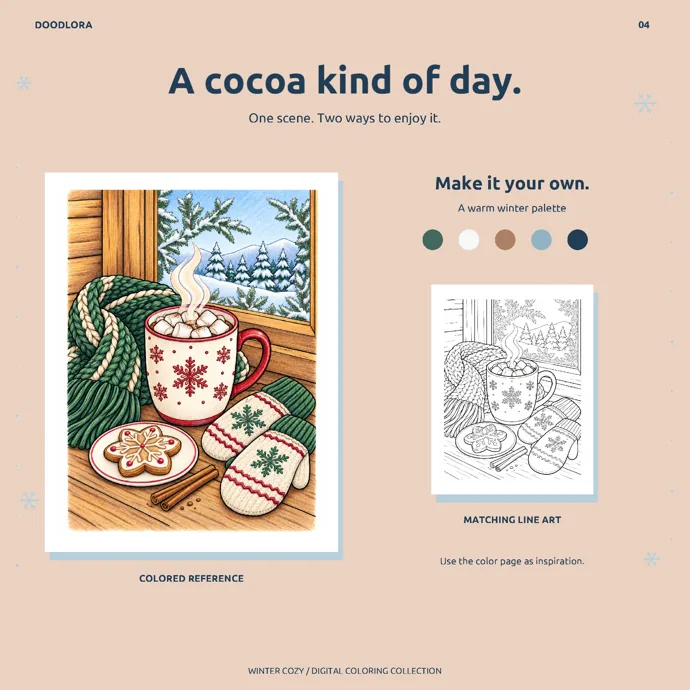
Color reference pages help here. Each Winter Cozy design comes with a colored version, and its printing guide treats them as ideas for your own palette rather than a key. The gingerbread guide says the same and adds that small details on its color pages can differ from the line drawing.
Big shapes first, light to dark
- Color the biggest light areas first: a sky, a wall, a pale roof. Leave anything that should stay white alone.
- Go around the inside edge of each shape before you fill it. A slow line along the outline keeps the fast filling strokes inside it.
- Fill with small circles or short strokes going one way. Light, even pressure gives a smoother patch than one hard pass.
- Add the middle colors, then the dark ones, then the tiny details.
Right-handed colorers can work from the top left of the page toward the bottom right, and left-handers the other way. That keeps your hand off the parts you’ve already done, which matters most with crayon and wet marker.
Shading coloring pages: white space, shadows, gradients
The paper is the lightest color you have. A spot left white on a mug, a window or a snowbank reads as shine or as snow, and you can’t get that back once it’s colored.
For shading, choose where the light comes from, such as the window on a winter page. Then press harder or use the darker color on the side of each object facing away from it, keeping that side the same on every object.
A gradient with one pencil is just pressure: press firmly at one end and ease off as you move across. With two colors, lay the lighter one over the whole shape, then bring the darker one in from one side and let it fade out halfway. Layering, burnishing and blender pencils are in how to blend colored pencils.
Fixing coloring mistakes when color goes outside the lines
A slip past the line is the mistake everyone makes, and the fix depends on the tool. Pencil can come partly off. Crayon and marker mostly can’t, so they get covered or turned into something else.
| What happened | Crayon or colored pencil | Marker |
|---|---|---|
| Color went over the line | Lift it gently with a white plastic eraser; light layers come off best | Let it dry, then make it a shadow or thicken that part of the outline with a black fine tip |
| The wrong color | Go over it with a darker color, which will cover | Cover it with a darker marker, or turn it into a pattern |
| Patchy or streaky fill | Add another light layer in small circles | See the streak fixes in coloring with markers |
| Paper pilled or torn | Stop working that spot and print the page again | Print the page again on heavier paper |
Turning a slip into part of the picture often works better than trying to hide it. A stray stroke under a house becomes a shadow, one past a snowbank becomes more snow, and a blob in a tree becomes an ornament.
A printable page has one fix a printed book doesn’t: print it again. Every Christmas Magic picture, all 40 plus the four bonus pages, is also its own one-page PDF, so a child who wants a fresh snowman doesn’t need the whole book reprinted.
Coloring with kids over winter break, a few sections at a time
A detailed page doesn’t have to be one long sitting, and on a winter break it’s better spread out. The child who stops while it’s still fun usually comes back the next day. A child pushed to finish often won’t want the next page.
Split a busy page into parts before anyone starts. On the Hard Christmas Cookie Square house, the parts are easy to see. The house with its shop window is one sitting, then the round plaza, the decorated tree with its presents, and the bench, lamps and candy-cane posts around the edges.
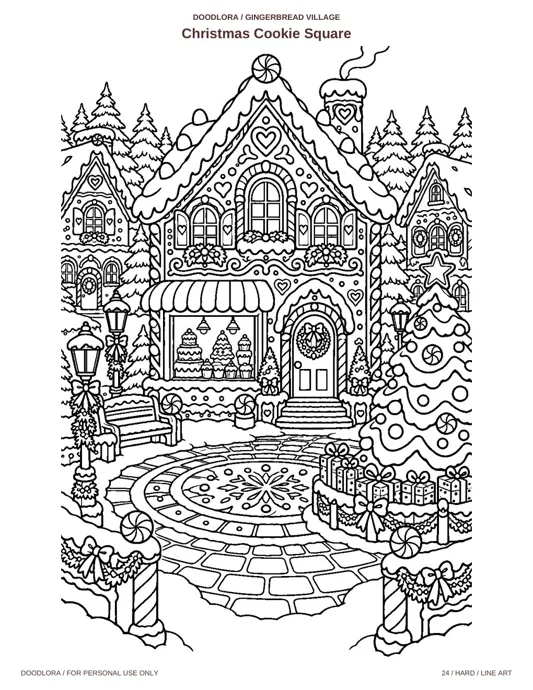
A few habits keep a page going across several days:
- Write the child’s name and the date on the back, and keep unfinished pages flat in a folder.
- Leave the color reference page or the chosen pencils with the page, so tomorrow’s roof matches today’s walls.
- If tiny spaces start to frustrate a child, let them leave the icing dots white or hand those parts to an older sibling.
- Print a few pages at a time rather than a whole book, so a favorite can be printed again later.
For quiet days that need more than coloring, our Christmas activities for kids cover crafts, kitchen projects and classroom ideas for the weeks around the holiday. More printable sets are on the Doodlora Studio home page.
Printables from this article
Related articles
Printable Coloring Pages
Turkey Disguise Ideas: 18 School Project Ideas & Template
Eighteen ways to disguise a paper turkey for the school project, from a ten-minute snowman to a recycled robot, with materials, ages, time and the usual snags.
Printable Coloring Pages
Fall Activities for Kids: Toddlers, Preschoolers & Outdoors
Leaf walks, apple and pumpkin play, counting games and rainy-day pages, sorted by age and by where you'll be, with timing and setup for each.
Printable Coloring Pages
Christmas Activities for Kids: Crafts for Home and Classroom
19 Christmas activities for kids, grouped by situation: crafts, kitchen projects, outings, quiet evenings, after Christmas and the last week of school.