Cookie Exchange Party Ideas: Rules, Cookie Counts & Labels
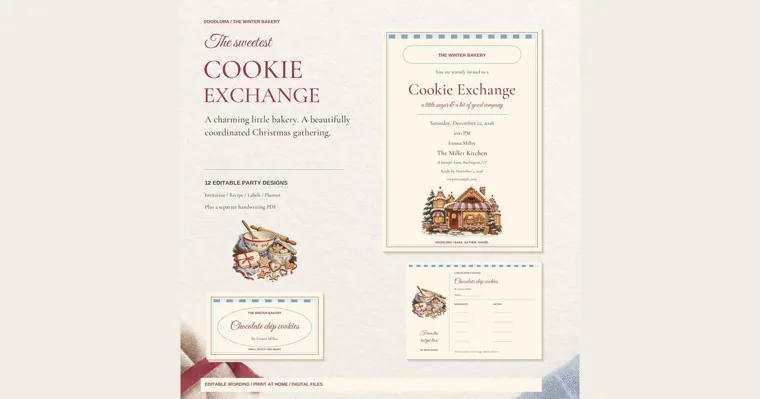
A cookie exchange party is a swap: each guest bakes one kind of cookie in a big batch, brings it packed in small bundles, and goes home with a mix of everyone else’s cookies. The whole plan hangs on one number. Each baker brings one bundle for every other baker, so the bundles per baker equal the number of bakers minus one.
Settle three things before you send a single invitation: how many bakers, how many cookies go in a bundle, and whether store-bought cookies count. Everything else on this page (the rules card, the labels, the schedule) follows from those three answers. The group sizes and timings below are our planning suggestions, so adjust them to your kitchen and your friends.
What you need before you invite anyone
- A guest list of bakers, plus a reply-by date about a week before the party
- A table long enough to give each baker a spot for their bundles
- Bags, boxes or tins for the bundles, which each baker brings
- An empty container for each guest to carry the swap home in
- A pen and blank cards for cookie names and ingredients
- A plate or two for tasting, kept apart from the bundles
How many bakers and how many cookies
Pick the bundle size first, then do the math once the replies are in. Six cookies to a bundle keeps the baking load sane. A dozen per bundle is the classic version, but it doubles every number in the table below.
| Bakers | Bundles each baker brings | Cookies to bake (6 per bundle) | Cookies to bake (12 per bundle) |
|---|---|---|---|
| 5 | 4 | 24 | 48 |
| 6 | 5 | 30 | 60 |
| 8 | 7 | 42 | 84 |
| 10 | 9 | 54 | 108 |
| 12 | 11 | 66 | 132 |
Each guest takes home exactly as many cookies as they baked, which is why the swap feels fair. The math stays easy between 5 and 8 bakers. Past 10, a dozen per bundle means more than nine dozen cookies from every kitchen. Shrink the bundle to four cookies rather than asking anyone to bake 130.
The catch is that the count is only final after the replies are in. A baker who drops out the day before leaves everyone holding one extra bundle. Tell bakers the bundle count only after the reply-by date, and if someone cancels late, put the spare bundles on the tasting plate.
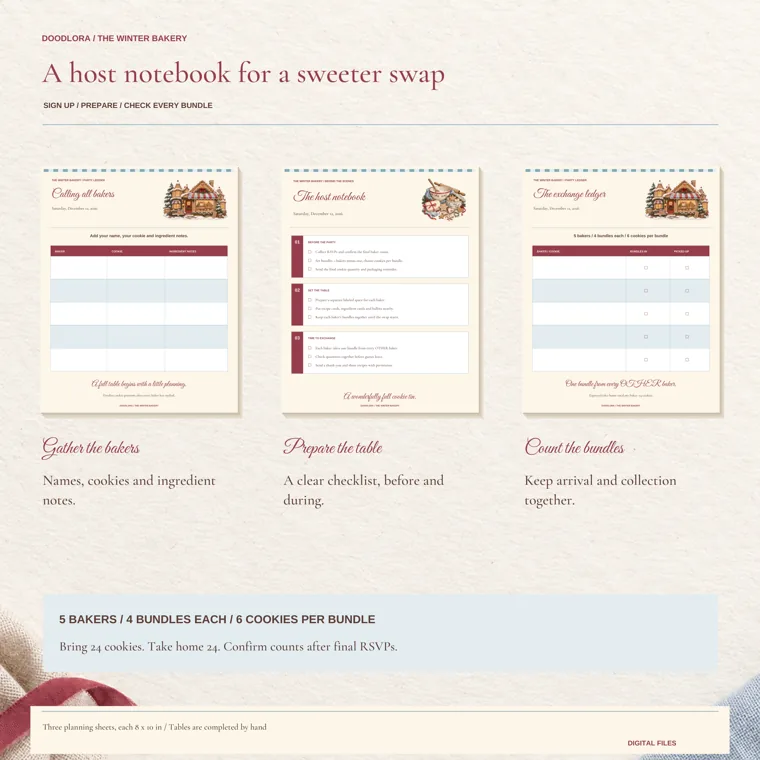
The sign-up sheet in our cookie exchange invitation kit does a second job too. When each baker writes down their cookie ahead of time, two people don’t both turn up with chocolate chip.
Cookie exchange rules to put on the invitation
Write the rules on the invitation or on a small card that goes out with it. Guests can’t follow a rule they first hear at the door. These six cover most arguments before they start:
- Bring one kind of cookie, baked by you, in [number] bundles of [number]. Fill in both numbers after the replies.
- Homemade or store-bought. Decide this one up front. Some groups allow a bakery box from anyone who can’t bake that week; others don’t. Either works if it is written down.
- Pack the bundles before you arrive. Counting cookies into bags at the party eats half an hour.
- Label your cookies with the name, your name and what’s in them (more on that below).
- Bring a container to take your share home in.
- Recipe cards are optional. Bring a few copies if you’d like to share the recipe.
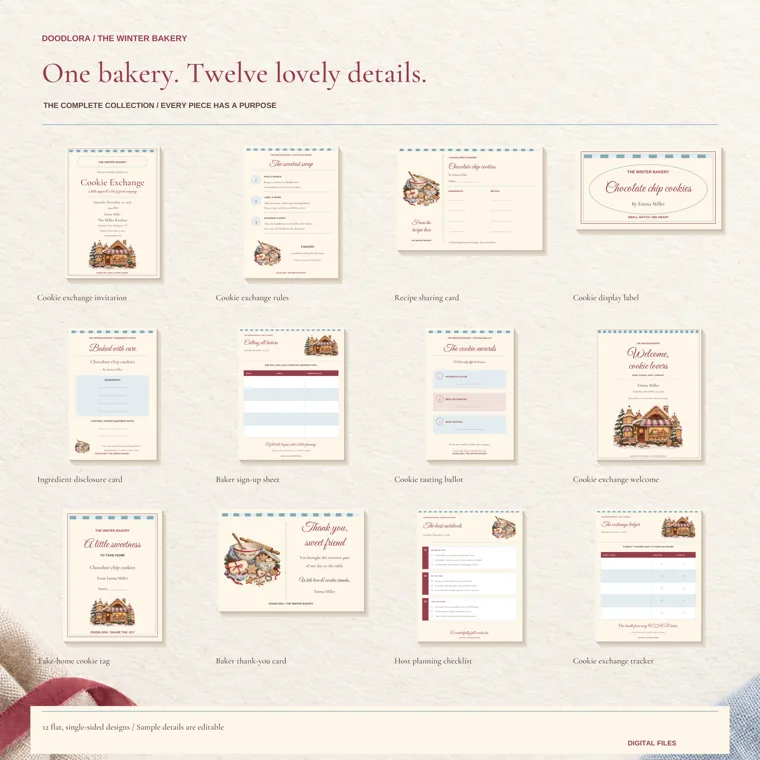
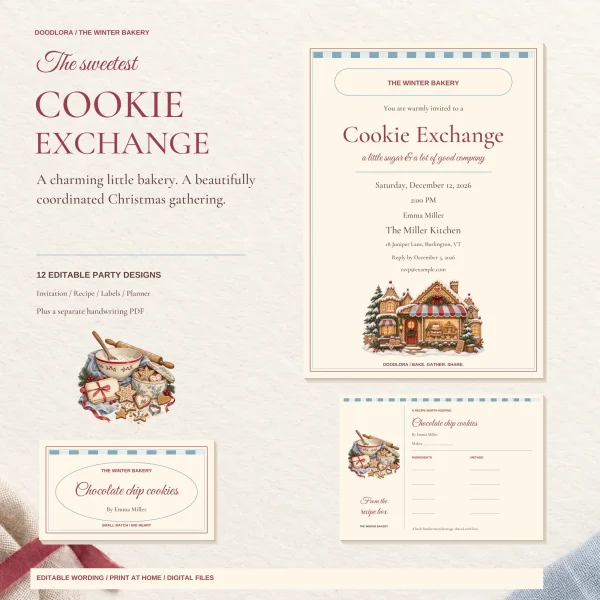
Our cookie exchange invitation kit has a 5 x 7 rules card in the same winter bakery design as the invitation, with three steps: bake and bundle, label and share, exchange and enjoy. Its sample reads “Bring 24 cookies in 4 bundles of 6,” set for a party of five bakers. The kit’s editor doesn’t do the math for you, so change the bundle line on the rules card and the count on the ledger yourself, and change both.
Send invitations two to three weeks out. Early to mid-December is the busy window, since most people want their tins full well before Christmas on December 25, 2026. The kit’s sample invitation uses a Saturday afternoon party with replies due a week before, and that spacing works for almost any date.
Cookie exchange ideas: what to bake
The best swap cookies survive a car ride and a few days in a tin. Sturdy cookies hold up: shortbread, gingerbread and sugar cookie cutouts, snickerdoodles, molasses cookies, biscotti, thumbprints, and bar cookies such as brownies or blondies cut into squares.
Leave out anything that needs the fridge, such as cream cheese frosting or cream fillings. A guest may leave with a stack of bundles and a long drive home, and a room-temperature cookie is the safe bet. Very soft or crumbly cookies break in the bag, and iced cookies smear if the icing hasn’t set, so ice them the day before.
A few twists keep the party from turning into a simple handoff at the door:
- A tasting plate. Ask each baker to bring a few extra cookies for a shared plate, so everyone tries everything before they choose a favorite.
- Cookie awards. A ballot with three categories (favorite flavor, best decorated, most festive) gives the tasting a point. Count the votes while people pack up.
- A recipe swap. Lay recipe cards next to each baker’s bundles, and guests can take a copy of the ones they liked.
- A theme. Family recipes only, cookies from one country, or one shared ingredient such as cinnamon. Keep it loose, or nobody signs up.
How to pack the bundles
Pack each bundle in its own bag or small box, all the same size, so the swap is a quick grab-one-from-each. Clear bags let people see what they’re taking. Put wax paper between layers of iced cookies.
Tag every bundle with the cookie name and the baker’s name. At the party, keep each baker’s bundles together in one spot until the swap starts, so nobody’s batch gets split up or picked up by mistake. Each guest’s own empty container goes at the end of the table, ready to fill.
Allergy and ingredient labels
Ask every baker to bring one card per kind of cookie that lists the real ingredients, written from the recipe and the packages they baked with. Chocolate chips, sprinkles and premade doughs can contain milk, soy, wheat or nuts, so the label has to come from the package, not from memory.
The FDA recognizes nine major food allergens in the United States: milk, eggs, fish, crustacean shellfish, tree nuts, peanuts, wheat, soybeans and sesame. Sesame was added as the ninth, effective January 1, 2023. A cookie made with butter, eggs and flour already carries three of the nine (milk, eggs and wheat), so a “contains” line on each card is more useful than a full ingredient list nobody reads.
Shared equipment matters too. A home kitchen that made peanut butter cookies on Tuesday may still have peanut traces on the mixer on Wednesday. Don’t promise a nut-free swap you can’t check. Ask bakers to note shared equipment on the card, and let each guest decide what they can eat.
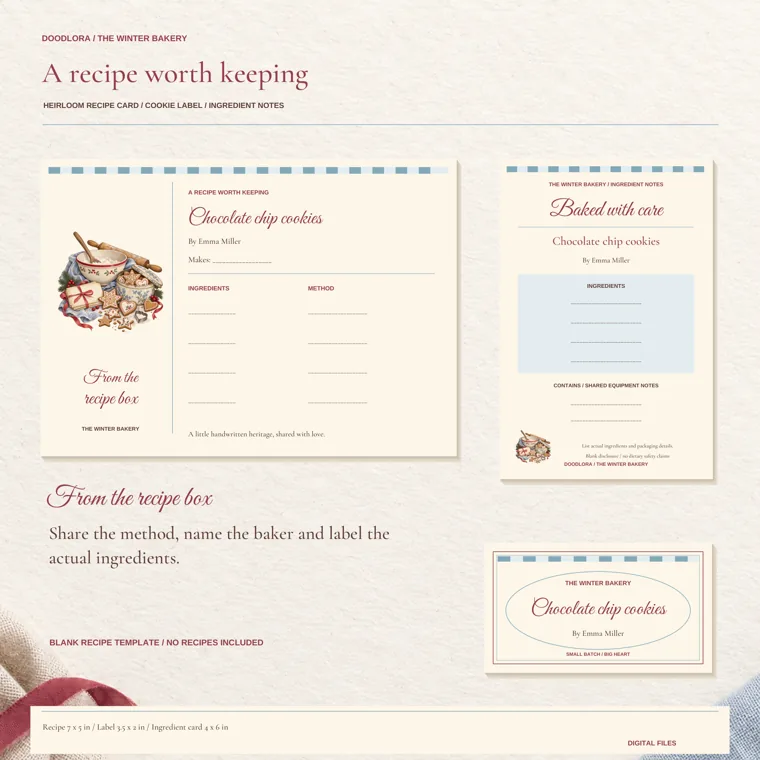
The ingredient card in our kit has four ingredient lines plus a separate section for “contains” and shared-equipment notes. Its footer reads “Blank disclosure / no dietary safety claims,” which is the right attitude for a homemade label: it records what went in, and it doesn’t promise anything about safety.
A 2-hour cookie exchange party plan
A swap for six to ten bakers fits comfortably into two hours. The longest part is the tasting, not the swap.
| Time | What happens |
|---|---|
| First 15 minutes | Guests arrive, set their bundles in their spot, add labels and recipe cards |
| 15 minutes to 1 hour | Drinks, the tasting plate, people walk the table and read labels |
| 1 hour | Ballots go out; give it about 10 minutes |
| 1 hour 15 minutes | The swap: each guest takes one bundle from every other baker |
| 1 hour 35 minutes | Count check, announce the cookie awards |
| 2 hours | Guests head home with full containers |
During the swap, have guests go around the table in one direction rather than all at once. Before anyone leaves, ask each guest to count their bundles. Everyone should hold one fewer bundle than the number of bakers. A tracker sheet with “bundles in” and “picked up” columns makes the check fast.
Afterward, a thank-you note and a shared list of recipes (with each baker’s okay) close the party nicely.
If kids come to the cookie exchange
Count bakers by household, not by person. A parent and two children who bake together bring one set of bundles and take home one share. Otherwise every number in the table jumps.
Kids can help with the baking and frosting at home. Decorating sessions need some planning, and our Christmas activities for kids page covers a cookie decorating setup. At the party itself, keep the bundles away from small hands until the swap. A coloring table helps a lot here.
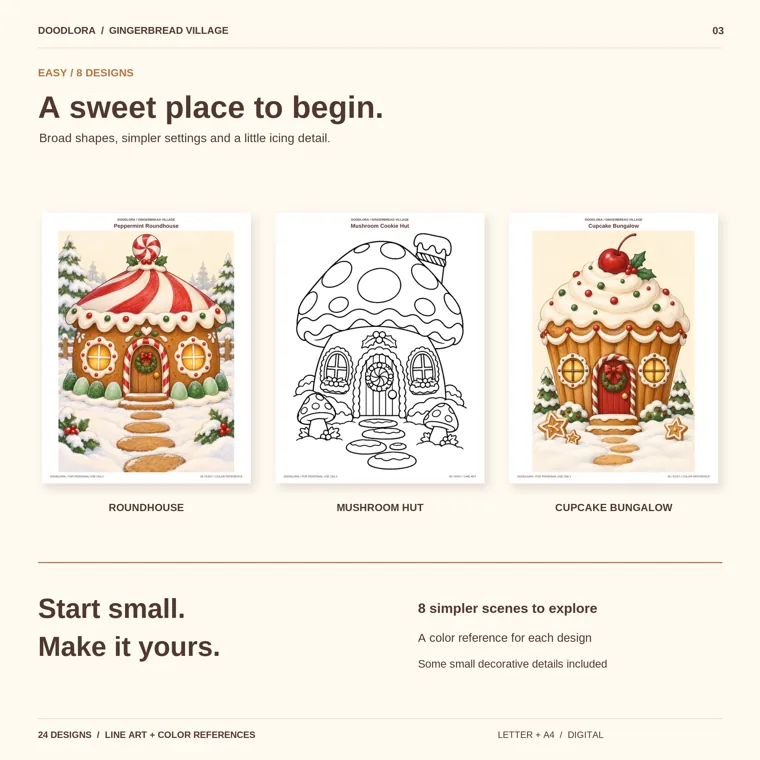
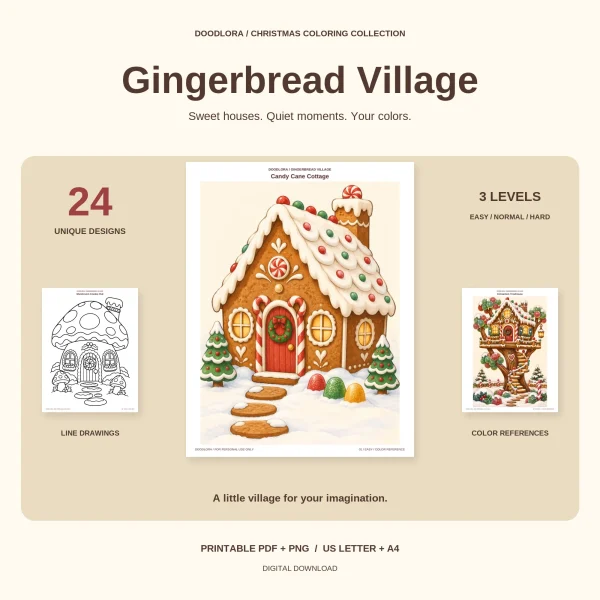
Our gingerbread house coloring pages come in three levels with 24 designs in all. The eight Easy designs have big open shapes for preschoolers, while the Hard ones suit older kids and adults who want small details. Print a stack before the party and put out crayons.
One rule if the party includes a cookie dough swap or a decorating station with dough: the FDA says not to let children eat raw dough, taste it, or play with it. Raw flour and raw eggs can both carry germs that baking kills, so the dough is for baking at home, not for snacking on at the party.
When a cookie exchange goes wrong
- Someone shows up empty-handed. Let them take a smaller share from the tasting plate rather than a bundle from every baker. Otherwise somebody else’s count comes up short.
- A baker cancels late. Everyone has one extra bundle. Put the extras on the tasting plate, or send them home with the host.
- Two bakers made the same cookie. Nothing to fix. Next year, use the sign-up sheet.
- Cookies broke in the car. Broken cookies still count. Put them in a bundle anyway and save the best pieces for the tasting plate.
- The swap turns into a free-for-all. Stop and send guests around the table in one direction, one bundle per baker.
For a game to run while the swap ends, see our gift exchange games or Christmas party games.
Printables from this article
Related articles
Printable Invitations & Cards
Christmas Card Messages: What to Write, Funny & Religious
Short Christmas card messages sorted by who gets the card, with sign-offs, wording for a hard year, and tips for writing inside a card you print yourself.
Printable Invitations & Cards
Thanksgiving Card Messages: What to Write for Hosts & Family
Copy-ready Thanksgiving card messages sorted by who gets the card, with notes on length, timing, sign-offs and the lines to avoid.