Printable Bingo Rules: How to Play and Call Picture Bingo
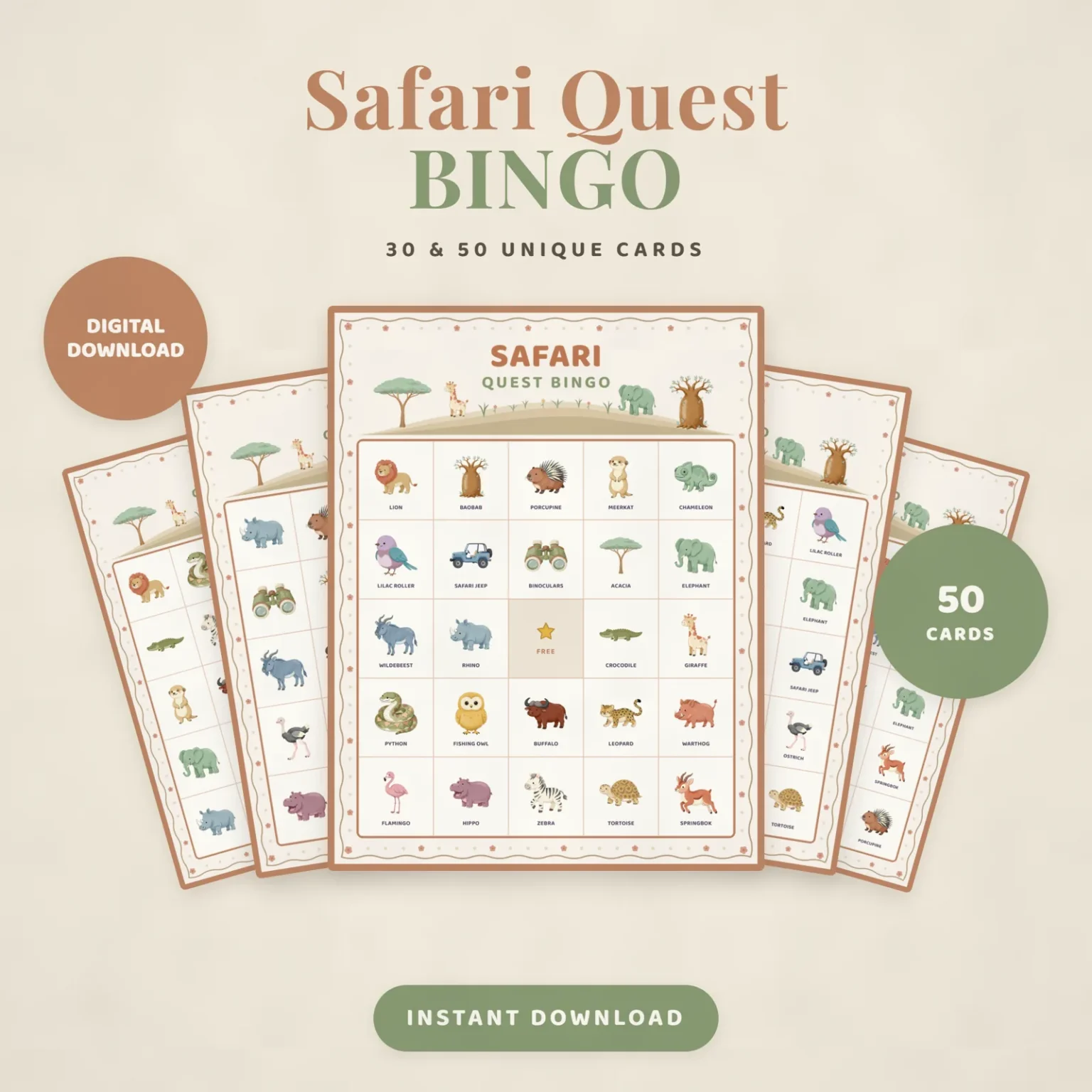
In printable picture bingo, each player gets a different card, and the caller pulls one calling card at a time from a bag, says its name and holds it up. Anyone with that picture on their card covers it with a marker.
The first player to complete the pattern announced before the first draw shouts “Bingo!”, and the caller checks that card against the calling cards already drawn.
Pick that pattern with your deck in mind.
On most of our printable sets, each card already shows 24 of the deck’s 25 pictures. That’s why one line usually falls within about ten calls, while a full card tends to end with several players finishing on the very same draw.
Setting up printable bingo: player cards, the calling deck and markers
Every player needs a card of their own, and no two cards in one of our files share a layout.
Our safari set comes as a 30-card file and a 50-card file, and the two files don’t repeat each other’s layouts either.
Print the smaller file for a group of up to thirty, or the bigger one for larger classrooms and parties.
The US Letter and A4 versions of a file hold the same cards in the same order, so printing both just gives you two copies of every card.
Print whichever one matches the paper in your tray, and if you can’t tell, measure a sheet against the widths in US Letter or A4.
Two preschoolers can share a card with an adult beside them. Two players who each want to win need separate layouts, though, because a shared card finishes for both of them on the same call.
Handing everyone an identical card turns this into a different game, one where players cover what they see around them instead of what the caller draws. That’s the spotting bingo at a fall party, played on a walk or a drive.
Bingo needs a caller and suits a crowd. For four players or fewer, a round of memory needs no caller at all, only every picture printed twice.
In the safari set, the calling deck prints six cards to a page, each about 3.5 by 2.8 inches (8.8 by 7.2 cm) inside a dotted cutting line.
With twenty-five pictures, that makes four full pages and a fifth page holding a single card.
In our safari deck it’s the binoculars, alone in the top corner of an otherwise empty page.
It’s an easy page to miss.
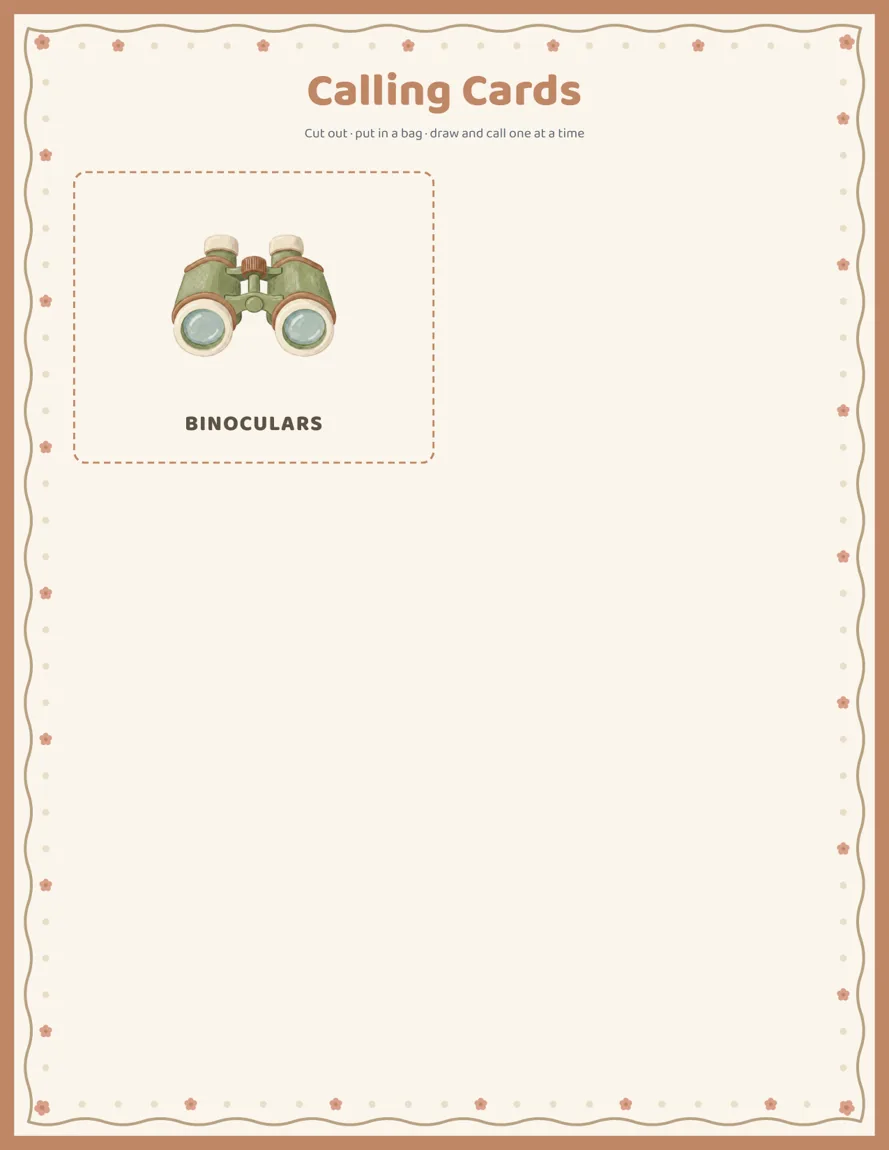
Print and cut that page too, since without it, every line that needs the binoculars stays one square short for the whole game.
Count the deck before the first round. Our smaller sets should come to twenty-five cards, and the bigger ones to thirty, forty, forty-two or forty-eight, depending on the theme.
In the picture-only version, the one difference is on the players’ cards, which lose their names. The calling cards keep them, so the caller can always read the call, even if nobody at the table can.
The last page of every file is a sheet of round paper markers.
The safari sheet has 80 whole ones, eight across and ten down, each about half an inch (1.4 cm) wide on squares roughly 1.5 inches (3.7 cm) across.
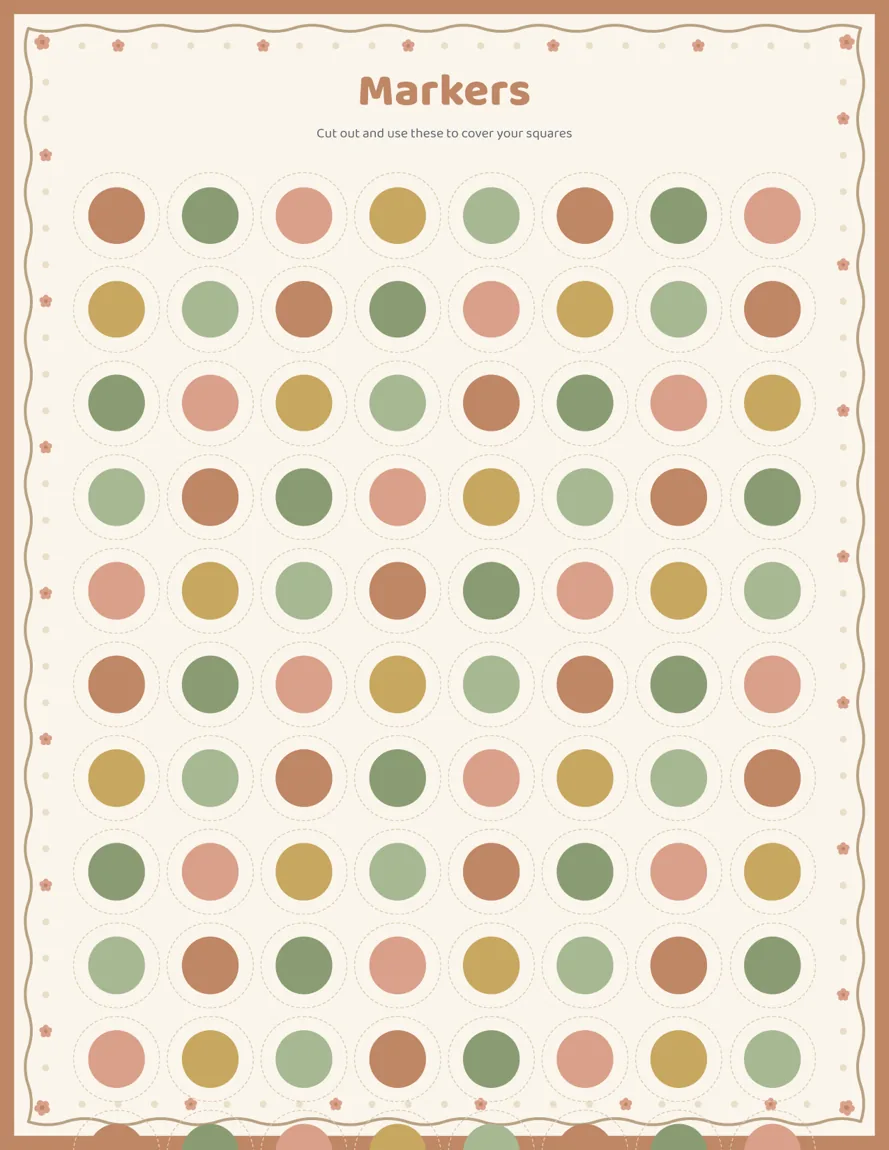
A one-line round rarely needs more than a dozen markers per player, but a full card takes twenty-four, so one sheet covers three players for that pattern.
The how-to-play page also suggests candy, buttons or coins, and pieces that small need an adult’s attention whenever a toddler’s at the table.
Bingo patterns on a picture card: one line, four corners or a full card
With the cards printed and the deck cut, the pattern comes next, since every Doodlora Studio bingo set lists it as the first playing step: decide on a line, four corners or a full card before anyone draws.
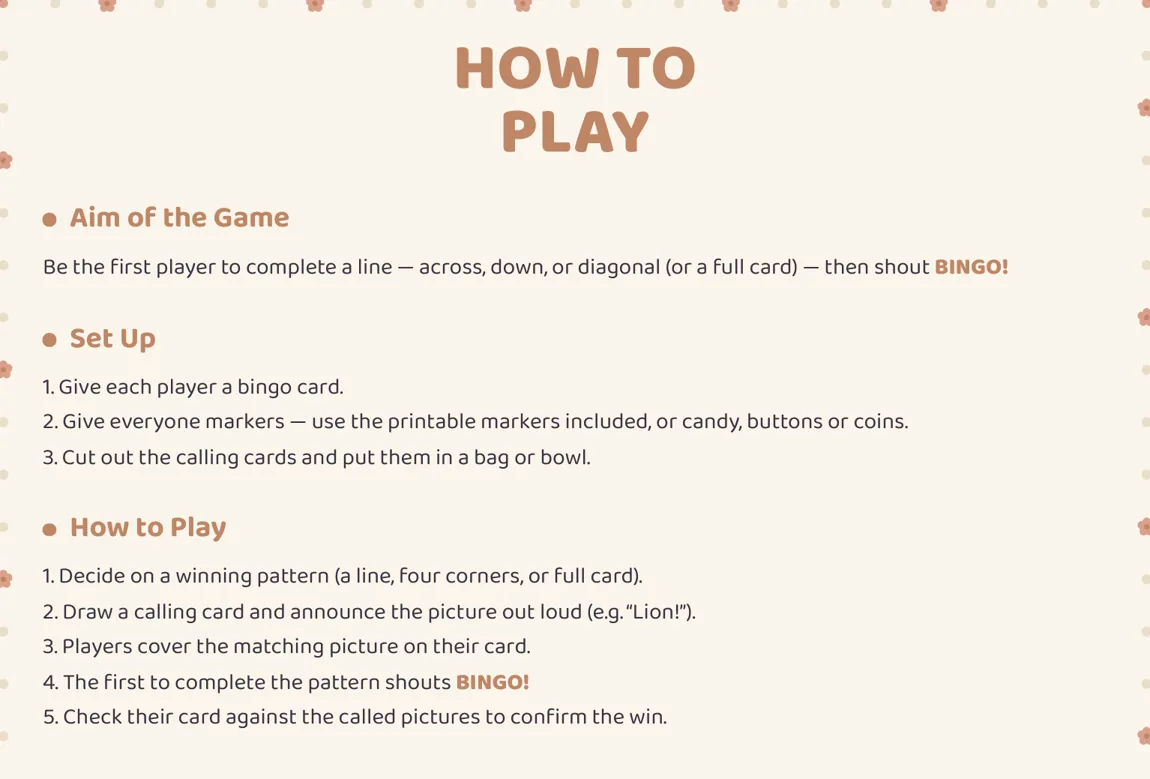
A line means five covered squares straight across, straight down or diagonally from one corner to the opposite one.
A five-by-five card has twelve lines, and the four that run through the FREE center need only four pictures called, because that square is covered before anyone draws.
Four corners ignores the center completely. It needs the particular pictures in the corner squares, so it usually runs longer than a line even though it’s one square fewer.
A full card doesn’t end until all twenty-four pictures on the card are covered.
To see how long each pattern takes, we ran a computer simulation of the draw 20,000 times against the first eight cards in our labeled 30-card safari file, and again against all thirty.
| Pattern | Eight players: usually ends on | Thirty players: usually ends on | Two or more winners on the same call |
|---|---|---|---|
| One line | Call 10 | Call 8 | About one game in five with eight players, one in four with thirty |
| Four corners | Call 15 | Call 11 | About one game in ten with eight players, one in six with thirty |
| Full card | Call 25, the last card in the bag | Call 24 or 25 | About nine games in ten with eight players, seven in ten with thirty |
The full card is the row that surprises people.
The reason is simple.
Every safari card leaves out exactly one picture, so after twenty-four calls a card is full only if the single calling card still in the bag is the one it’s missing.
Among those first eight labeled cards, only five different pictures are missing.
That means that in twenty draws out of twenty-five, the last card left is a picture all eight cards show. Nobody can finish until it’s called, and then all eight finish at once.
With all thirty cards in play, the whole room finishes on that last card in about one game in three.
So save the full card for a set with a bigger deck. Ocean Animal Bingo draws from forty-two pictures, so each card holds just over half the deck.
Run the same way, a full card there takes about forty calls with eight players, and roughly one game in three still ends with two or more cards finishing together.
Our bingo sets list which themes draw from the bigger decks.
Two lines isn’t in the printed instructions, but it works as a house rule for a longer round.
Whatever you choose, show it on a spare card before the first draw and keep it throughout the round.
If the room gets restless, play the round out and save a quicker pattern for the next one, with the announcement made before anyone draws.
How to call picture bingo so every player keeps up
Once the pattern’s announced, the caller takes over.
Shake the calling cards in a bag or bowl, draw one without looking and say the name, then hold the card up long enough for every player to find the picture.
Lay each drawn card face up in a row beside you, in the order it came out.
That row is the record every claim gets checked against, so drawn cards stay out of the bag until the round’s over.
Say the full name every time. The Safari Animal Bingo deck has two trees, a baobab and an acacia, and a call of “tree” leaves players guessing which square to cover.
Before the next draw, ask whether everyone’s found it.
A quick “Got it?” works better than a fixed count of seconds, since a kindergartner hunting for the chameleon may need longer than the adult next to them.
If someone missed a call, say it again for the whole table and point to the card in the row. Don’t let one player dig through the drawn cards alone while the game moves on.
Calling cards get handled on every draw, so they’re the pieces worth putting on cardstock, as our paper guide recommends, even if the player cards go on plain paper.
Checking a bingo claim and settling a tie
That row of called cards is what settles every shout of “Bingo!”
Stop drawing the moment someone calls it.
Ask the player to read their five pictures back, or point to each one, and match every picture against the row, which is the last step on the how-to-play page.
If one picture in the line hasn’t been called, take that marker off and carry on drawing. Markers slide onto the next square, so treat a wrong claim as a slip and move on without a penalty.
Check every claim made on the same call separately before you draw again.
Ties are part of picture bingo.
The table above puts a shared line at about one game in five for a table of eight.
Here’s how it happens.
In the labeled 30-card Doodlora Studio safari file, card 4 has the python, leopard, warthog, giraffe and binoculars down its left-hand column, and card 15 has the same five down its right-hand edge, in a different order.
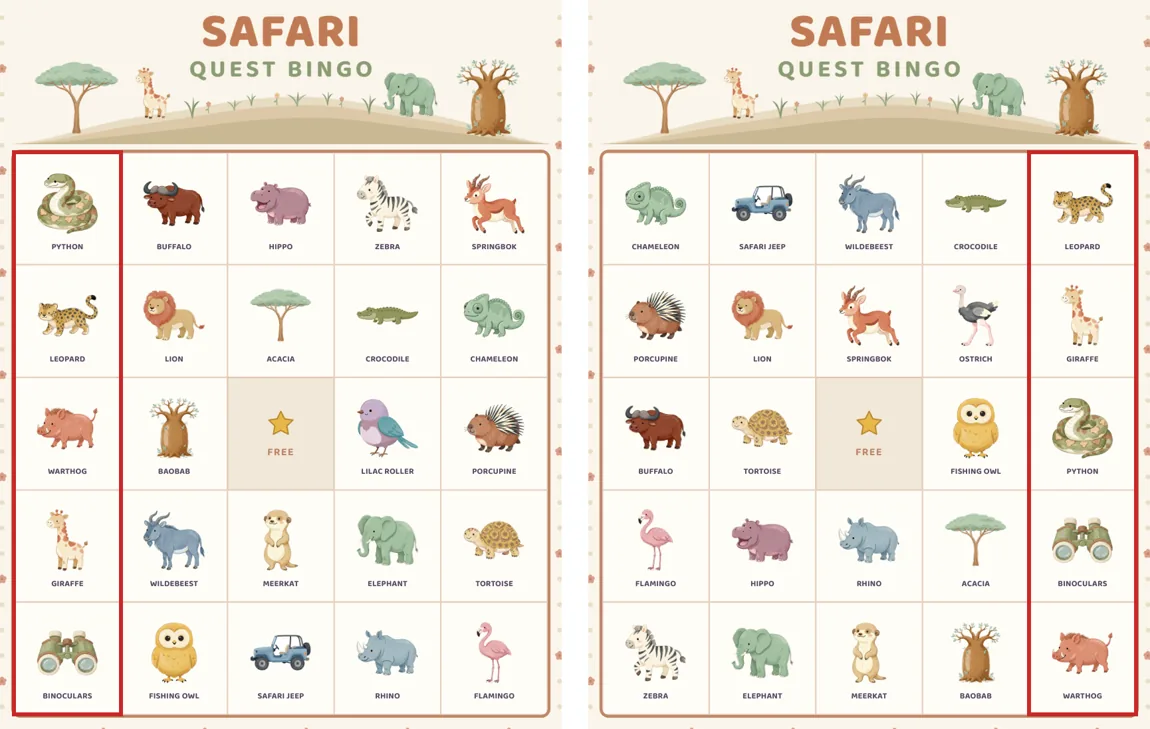
Call those five, in any order, and both columns finish on the same draw.
And if the fifth calling card page never got printed, neither column can ever finish, because the binoculars are in both.
Agree on a tie rule first.
Letting every valid card on that call win is the simplest arrangement, and it suits a party with a small prize for each winner.
If there’s only one prize, play a quick tiebreaker between the tied players: clear their cards, put every calling card back in the bag, shake it and play to the first line.
For the next full round, clear everything except the marker on FREE and return the whole row of called cards to the bag.
A round that starts with cards still sitting in the row is short of pictures, and some lines can’t finish at all.
Picture bingo rules for young kids and a whole classroom
Those rules hold for any group, but two kinds of table need a few changes.
Kids who can’t read yet
Print the picture-only cards for a child who can’t read.
The calling card still carries the name, so the caller reads it out and holds it up, and the child matches the drawing.
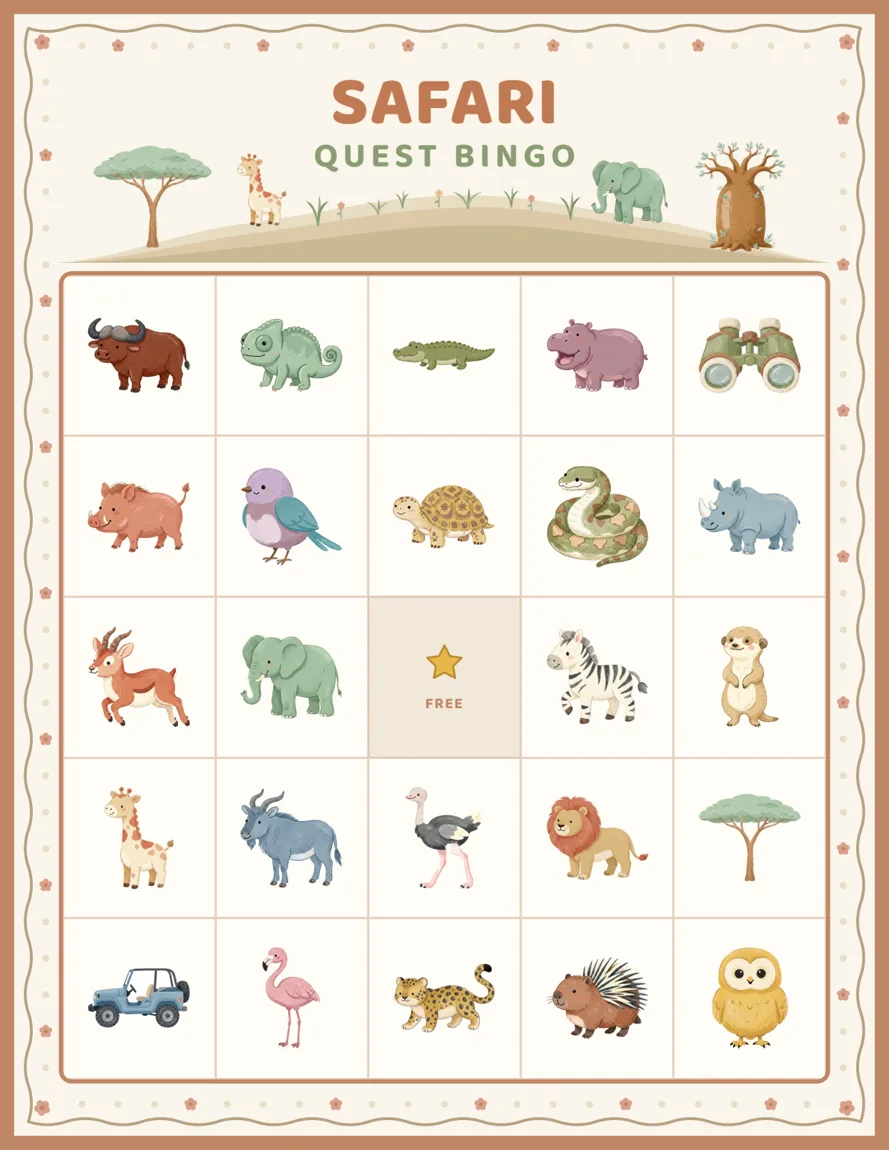
Name and point together. “Lilac roller” means nothing to a four-year-old, but the purple bird on the calling card does.
Seat a younger child next to an adult or an older sibling who checks along. The child finds the picture and places the marker, and the partner keeps track of the call.
Play one line with this group, since a full card on a smaller deck ends in a group finish anyway, and one line gets a small table to a winner in about ten calls.
When a child starts reading, the labeled cards put each name in capitals under its picture, so the word and the illustration turn up together on every call.
For the same table on a different night, charades for kids who can’t read yet keeps that no-reading rule, with a grown-up whispering each prompt.
A classroom or a party of 30
A class of thirty fits the 30-card file exactly, one card per student.
When the cards come off the printer, lay two side by side.
If one comes out a little smaller than the rest, Fit to page was most likely switched on for that copy. The other usual culprits, a printer driver with its own fit option or the wrong paper size, are on the 100% scale printing page.
Markers add up fast in a classroom. At about a dozen per player, thirty players need five marker sheets for a one-line game, and nine for a full card.
With all thirty cards in play, our draw simulation puts the first line around call 8, and about one game in four has two or more winners on that call.
Have your shared-prize rule ready beforehand.
Use one caller the whole room can see and hear.
Before the game, have someone stand at the back while you hold up a calling card at the front. If the meerkat and the warthog aren’t recognizable from there, walk each card along the rows as you call it.
Splitting the class into tables, each with its own caller and deck, works as well.
Each table is then playing its own game, though, with its own draw order and its own winners, so a bingo at one table says nothing about the others.
Printables from this article
Related articles
Printable Bingo Cards
Space Activities for Preschoolers: Games, Hunts & Moon Watch
Eleven hands-on space activities for three- to five-year-olds, sorted by situation, with group size, prep, how to start and finish, plus a five-day plan.
Printable Bingo Cards
Space Facts for Kids: Our Solar System, Moon and Stars
The Sun, Mercury to Neptune, the Moon, the stars and life on the space station, with NASA's numbers and simpler lines for preschoolers and early readers.
Printable Bingo Cards
Dinosaur Activities for Preschool: Games, Crafts & Fossils
Thirteen dinosaur activities for three- to five-year-olds, from ice eggs and sand digs to circle-time games, plus dinosaur facts that hold up and fixes for the usual snags.