Party Games for Adults: Dinner Party Games & Bluffing Games
Choosing party games for adults comes down to three questions: how many guests are coming, whether they’ll stay seated, and how competitive they like to be. For six friends after dinner, Fictionary needs only a dictionary and slips of paper. A birthday crowd can vote on Most Likely To titles, and a card table that likes to argue will get the most out of Kemps or Cheat.
Below are 13 games in four groups, each with player numbers, rough timing, what to set out and how a round ends. Each one also comes with the snag that tends to stall it, so you can settle that rule before anyone starts.
| Game | Players | Time | You need | Good for |
|---|---|---|---|---|
| Fictionary | 4–10 | 10 min a round | Big dictionary, pens, identical slips | Word lovers at a dinner table |
| Botticelli | 3–10 | 10–30 min a round | Nothing | Trivia fans, no printing |
| Picture consequences | 4 per sheet | 10 min | Paper, pens | Guests who say they can’t draw |
| Riddle team challenge | 2 teams | 20–30 min | Riddle cards, timer | Mixed crowds, teams |
| Which Came First? | 2 teams or solo | 20–30 min | Timeline cards, score sheet | History and pop culture fans |
| Quote or Fake? | 2–12 | 15–20 min | One printed page, pens | Movie fans |
| Cheat | 3–8 | 15 min | 1 or 2 decks of cards | A loud card table |
| Kemps | 4–12, in pairs | 30 min | 1 deck of cards, paper for score | Couples and close friends |
| Ghost | 2–6 | 10 min | Nothing | Spellers, a drive or a wait |
| Most Likely To | 4–24 | 15 min | Ballots, pens | Birthdays, reunions |
| Who Knows the Birthday Star Best? | 3–20 | 20 min | Answer key filled in ahead | Milestone birthdays |
| Guess the Year | 3–24 | 15 min | Guest sheets, answer key | After the cake |
| Never Have I Ever (ten fingers) | 3–12 | 15–20 min | A list of lines | Friends who know each other |
Where a printed game lists its own players and time (Quote or Fake?, Never Have I Ever and the three birthday games), the table copies them. For the rest, we’ve guessed the numbers for planning, so adjust them to your own guests.
Dinner party games for adults around one table
A seated game suits the stretch after dinner, when plates are cleared but nobody wants to move. These three need paper at most, and each round ends cleanly, so you can stop after one or keep going until coffee.
Fictionary
Fictionary is a bluffing word game for about four to ten players, and a round takes roughly ten minutes. You need a large dictionary, a pen for everyone and identical slips of paper, so no slip stands out by its look.
The picker finds an obscure word, then announces and spells it. Everyone else writes a believable fake definition, initials it and hands it in. The picker shuffles the fakes with the real definition, reads the whole set once, then reads it again while each player votes. You score a point for picking the real one and a point for every vote your fake collects. If nobody finds the real definition, the picker scores three.
The snag is the read-aloud. A picker who stumbles over messy handwriting gives that slip away as a fake, so the picker should read every slip privately as it comes in. If anyone already knows the word, they say so, and the picker chooses another.
Botticelli
Botticelli is a guessing game for three or more people who know their famous names, with no props at all. The chooser thinks of a well-known person and reveals one letter, usually the first letter of the last name.
Guessers then think of someone with that letter and ask a clue question about them. With the letter D, a guesser thinking of Charles Darwin might ask, “Did you sail on the Beagle?” The chooser has to name a match (“No, I’m not Charles Darwin”). If the chooser can’t think of anyone, the guesser reveals their person and earns a direct yes-or-no question about the hidden identity. Whoever guesses the identity becomes the next chooser.
A round stalls when the chooser picks someone half the table has never heard of. The traditional rule is that the person should be at least as famous as Sandro Botticelli, the painter the game is named after.
Picture consequences
Picture consequences is a drawing game for any number of guests, played four to a sheet, and it takes about ten minutes. Each person needs a pen, and each group of four needs a sheet of paper.
The first player draws a head at the top, folds the paper so the drawing is hidden, and passes it on. The next player draws a body, folds and passes; the third adds legs and the fourth adds feet. When everyone unfolds the sheets, the mismatched figures go around the table. Nobody wins, and that is the point for a guest who would rather not compete.
Before each fold, let the lines of the neck or waist run a little past the crease. The next person can then join their part to something instead of guessing where the figure was.
Card and quiz games for teams of 6 to 20
When the group grows past one table, split the room into two teams and let a host read. These three quiz games come from our printable decks and sheets, each with its own scoring, so the host doesn’t have to invent points mid-game.
Riddle team challenge
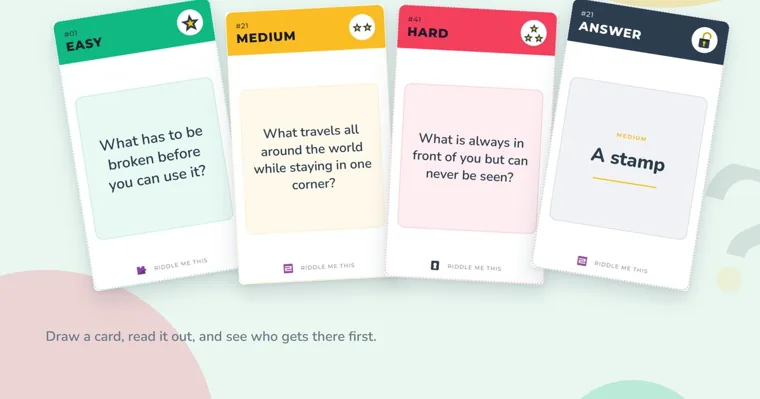
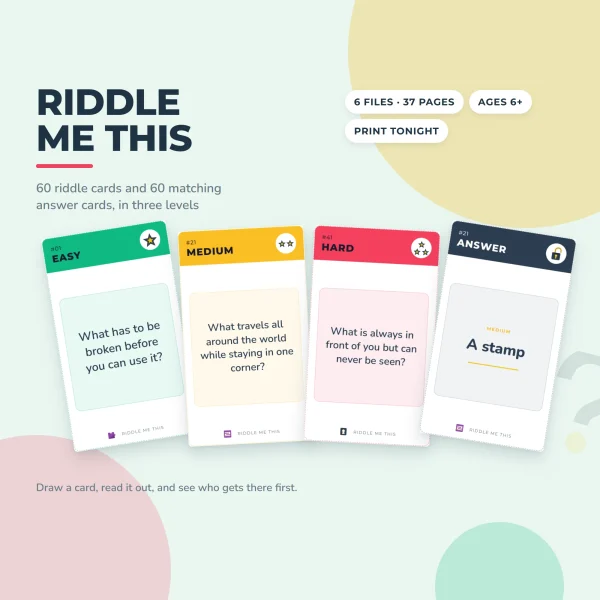
A riddle round works for 2 to 20 or more players in two teams, and we’d plan about half an hour for 20 cards. The Riddle Me This party riddle cards have 60 riddles on 3 x 5 inch cards in three levels: Easy (1 to 20), Medium (21 to 40) and Hard (41 to 60). Each riddle has a separate numbered answer card.
Teams take turns drawing. The drawing team has 60 seconds to agree on an answer, and a correct answer scores two points. A wrong answer lets the other team steal it for one point. For an office or adult group, the deck’s host tips suggest the red Hard cards with a 30-second timer as an icebreaker.
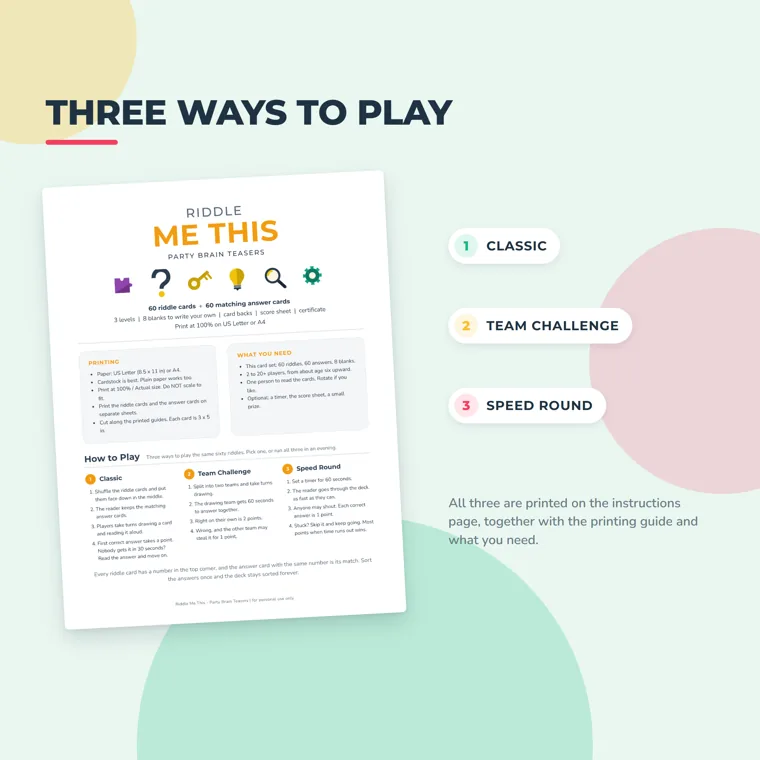
Print the riddles and the answers on separate sheets, because the reader holds the answer cards. When nobody solves a card, put it back in the deck. It comes around again later, and someone usually gets it on the second try.
Which Came First? timeline trivia
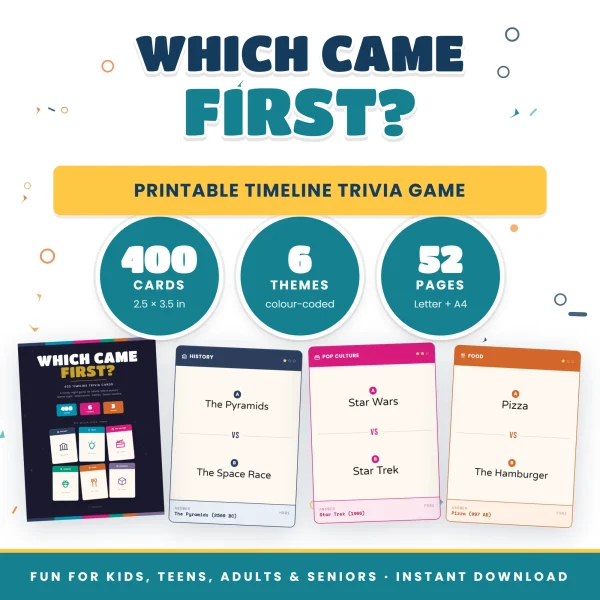
This game needs no knowledge of exact dates, which makes it friendlier than straight trivia. Each card in our Which Came First? timeline cards names two things, and players say which happened first. The deck has 400 cards in six themes: History, Tech, Pop Culture and Everyday with 80 cards each, plus Animals and Food with 40 each.
For a party, play Points Race. A correct pick scores one point, and naming the year printed on the card within 20 years adds three more. The first player or team to 25 points wins. Team Challenge is faster: a neutral reader draws, the first team to call out the answer wins the point, and the best of 20 cards wins the round.
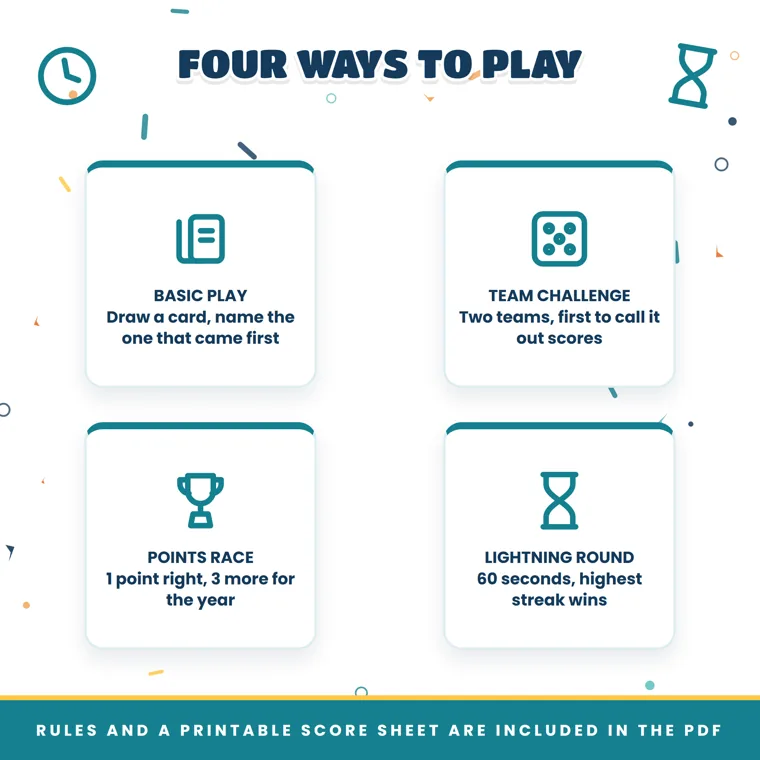
The answer and its date sit in a strip at the bottom of each card. The reader should cover that strip with a thumb while reading aloud. Print at 100% scale, too, because fit to page shrinks the cards below their 2.5 x 3.5 inch size.
Quote or Fake?
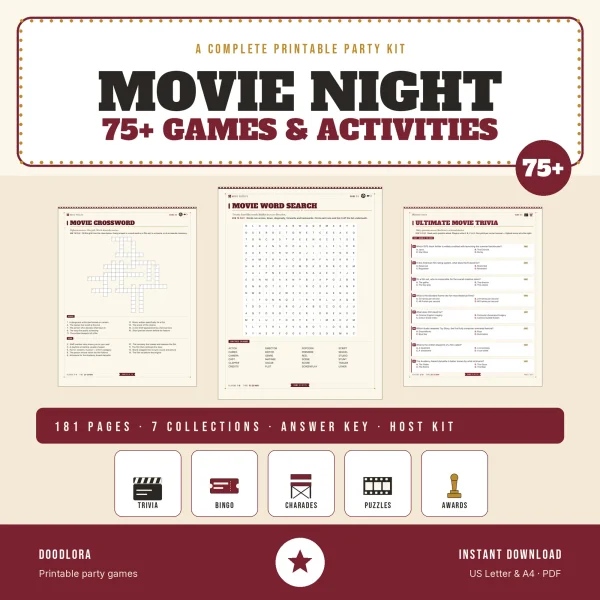
Quote or Fake? is a single movie game for 2 to 12 players that runs 15 to 20 minutes. You’ll find it on pages 61 and 62 of the movie night party games set. Each player needs a printed copy.
The sheet lists 20 lines, ten from real movies and ten invented. The host reads each one aloud, and players circle REAL or FAKE. A right call scores one point, or two if the player called it instantly. Add up the points after line 20.
Decide what “instantly” means before the first line. Hands up before the host finishes reading is one clear rule, and it saves an argument over every two-point claim.
Bluffing games for a small, competitive group
Bluffing games need fewer guests and more nerve. They run best with three to eight people at one table, and each needs only an ordinary deck of cards or nothing at all. For a big group that wants hidden roles, Mafia and Wink Murder are written up in our Halloween party games, and they work just as well without the costumes.
Cheat (I Doubt It)
Cheat, also called I Doubt It, suits three to eight players, and we’d allow about 15 minutes for a game. One 52-card deck is enough for four or fewer players, and groups of five or more usually shuffle two decks together. Deal out every card.
The first player lays one or more cards face down and calls them aces, the next calls twos, and the ranks keep climbing. Players say how many cards they laid, and they’re allowed to lie. Anyone who doubts a play calls “Cheat!” and the cards are turned over. A liar picks up the whole pile; a truthful player hands the pile to the accuser. The first player out of cards wins.
The rule people forget is timing. Once the next player has laid cards, it’s too late to challenge the previous play, so a slow challenger has to speak up quickly.
Kemps
Kemps is a card game for two to six teams of two, played with one standard deck, and we’d allow about half an hour for a game. Before the deal, each pair agrees on a secret signal that means “I have four of a kind.” The signal can’t be spoken. Partners sit across from each other, which gives opponents a chance to spot it.
The dealer gives everyone four cards and lays four more face up in the middle. There are no turns: anyone may swap cards from their hand with the middle cards, and the first to touch a card gets it. When the players agree, the dealer clears the middle and deals four new ones. A player who thinks their partner has four of a kind calls “Kemps!” If they’re right, the other team gets a letter, and if they’re wrong, the calling team does. You can also call “Stop Kemps!” when you think an opponent has four of a kind. The first team to spell K-E-M-P-S loses.
Settle one rule before the deal: house rules differ on fake signals meant to confuse the other side, so agree up front whether a decoy signal is allowed.
Ghost
Ghost is a spoken spelling game for two or more players, with no equipment, and a round lasts a few minutes. Players take turns adding one letter to a shared fragment, and the fragment always has to be the start of a real word.
Whoever completes a word loses the round. Instead of adding a letter, a player may challenge the previous player to name a word that the fragment begins. If that player can’t, they lose the round; if they can, the challenger loses. Each lost round earns a letter of G-H-O-S-T, and a player who collects all five is out. The last player in wins.
Agree on two things first: the shortest word that counts (three or four letters is usual) and which dictionary settles a challenge. Without both, the first challenge turns into a debate.
Birthday party games for adults
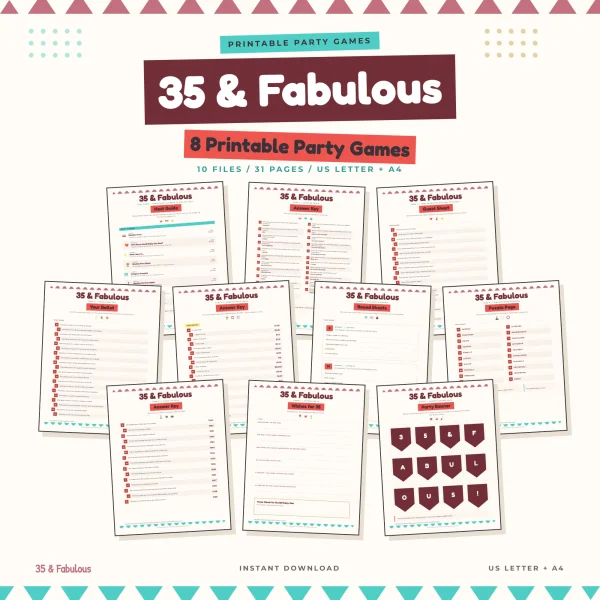
A birthday changes the center of the room, so the best games are about the guest of honor. These three come from our 35th birthday party games set, built around a nineties childhood. The format works for other ages too, though some questions and titles would need rewording.
Most Likely To
Most Likely To works for 4 to 24 players and takes about 15 minutes. Print one ballot per guest and one tally sheet for the host. The ballot lists 20 titles, from “Most likely to reply to a work email at midnight” to “Most likely to be the last one dancing tonight.”
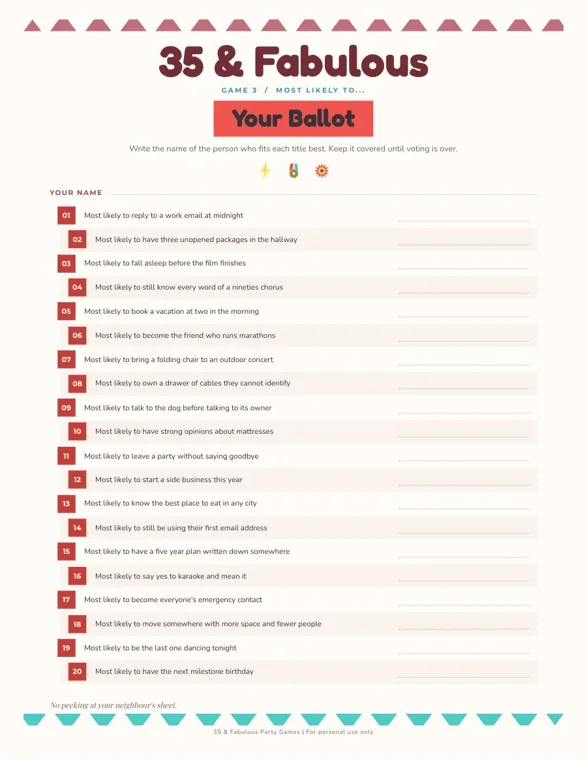
The host reads each title, and guests quietly write the name of the person who fits it. You may vote for yourself and for the same person more than once. Once all 20 are done, the host reads the titles again, counts hands and announces each winner like an award. A tie gives both people the title.
Skim the titles before printing. In a group that doesn’t know each other well, cross out any title that could sting, and the game stays a roast rather than a verdict.
Who Knows the Birthday Star Best?
This quiz suits 3 to 20 guests and takes 20 minutes, plus one job a week before the party. The birthday star fills in the answer key on their own, answering 20 questions such as their first job and how they take their coffee.
At the party, each guest writes what they think the birthday star answered, with ten minutes to finish. The birthday star then reads the real answers aloud, and every match scores a point. Twenty is a perfect score, and the birthday star settles every dispute. The scoreboard page has a tie-breaker question: what color socks is the birthday star wearing right now?
If the answer key was forgotten, hand it over before the guests arrive. Keep the guest sheets away from the birthday star until the reveal.
Guess the Year
Guess the Year takes 15 minutes for 3 to 24 players, and it’s the quietest of the three. The guest sheet lists 15 events, every one between 1990 and 1999, such as the Atlanta Summer Olympics and the handover of Hong Kong. Guests write the year they think each one happened.
The host reads the answer key aloud. An exact year scores three points and a year within one scores one, so 45 is a perfect total. The set’s host guide places it during the cake break, when people are sitting with a plate and don’t want to shout.
The catch is the guest list. A decade quiz favors people who were teenagers or adults in it, so pair younger guests with older ones instead of scoring everyone alone.
Never Have I Ever without drinks: the ten-finger version
Never Have I Ever is usually played as a drinking game. The version here keeps score on fingers instead, and it works for 3 to 12 players in 15 to 20 minutes.
Everyone holds up ten fingers. A reader says a line that starts “Never have I ever,” and anyone who has done that thing puts one finger down. The last player with a finger still up wins. Our movie night set prints 20 ready-made lines on pages 96 and 97, all about watching movies, from walking out of one to watching the same movie twice in a day. The second page ends with a short scoreboard for fingers left and the most surprising confession of the night.
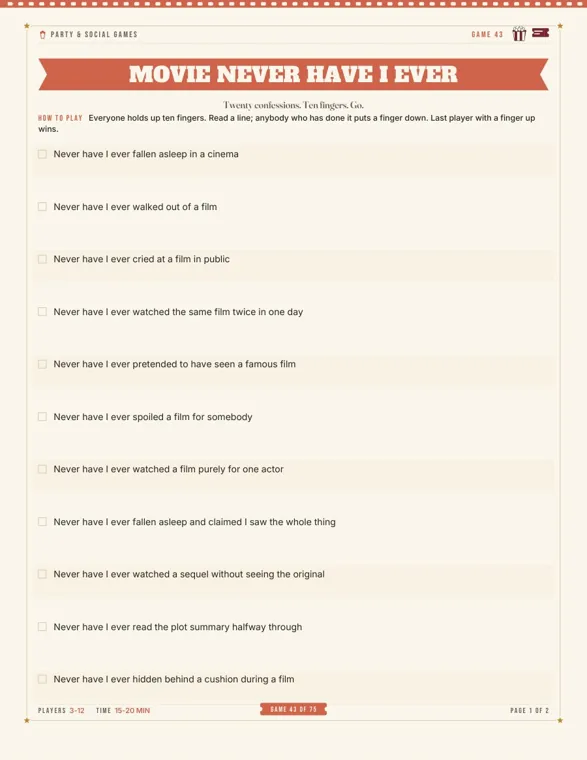
This game drifts toward personal confessions fast, so pick the topic before you start. Movies, travel or food keeps it light for a mixed group. Anyone may sit out a round, and nobody has to explain their finger.
Running an adult game night: order, teams and guests who’d rather watch
The order matters more than the choice of games. Start with something guests can join late, such as a riddle round or picture consequences. Put the loud team game in the middle of the evening, and save a seated game like Guess the Year for the end, when people are tired.
Keep teams to four or five people, so everyone gets a turn to answer. Mix couples and close friends across teams, unless you’re playing Kemps, where partners need each other. A neutral reader or scorekeeper also gives a guest who doesn’t want to play a real job.
None of these games need alcohol. Put water and soft drinks on the game table, and let any guest pass a turn without a penalty. If someone is meeting the group for the first time, start with a round from the icebreaker games for adults guide, then move on to the bluffing.
For a room that wants to stand up and move, the one-minute party game ideas use cups, balloons and a timer. Around the holidays, our Christmas party games and New Year’s Eve games cover the seasonal parties, and the printable decks themselves are listed under party games.
Printables from this article
Related articles
Printable Party Games
How to Plan a Baby Shower: Timeline, Food & 2-Hour Schedule
A baby shower plan from the first talk with the parents-to-be to the last gift: timing, guest list, budget, venue, a two-hour schedule, safe food and backup plans.
Printable Party Games
How to Plan a Bridal Shower: Timeline, Budget and Schedule
A host's plan for a bridal shower, from the first talk with the bride and co-hosts to the guest list, invitations, a timed party schedule, the gift opening and what to do when something slips.
Printable Party Games
35th Birthday Ideas: Party, Trip, Theme and Gift Ideas
Ways to celebrate turning 35, sorted by how many people the birthday star wants around, with group size, time, prep and the snag to plan for in each.