Icebreaker Games for Adults: Party, Work and Large Groups
The icebreaker games that work for adults hand people something easy to say and let anyone pass. Finish a well-known saying, check off a list of things you’ve done and tell the story behind one, or answer a question card. Pick the game by three things: how well the group knows each other, how many people there are, and whether everyone can get up and move.
Below are 20 games sorted by the room you’re in: a small table, a big party, a work meeting and a family reunion with three generations in it. Most need a printed page or two, a few need a ball, a ball of yarn or a hat of paper slips, and several need nothing at all.
How to choose icebreaker games for adults
When a room of adults stays quiet, the reason is usually one of three things. They don’t know each other, there are too many of them to take turns, or some of them can’t do what the game asks.
Strangers need something to say. A question card or an unfinished saying does that job. People who’ve known each other for years need the opposite: a game that pulls out stories they haven’t told yet.
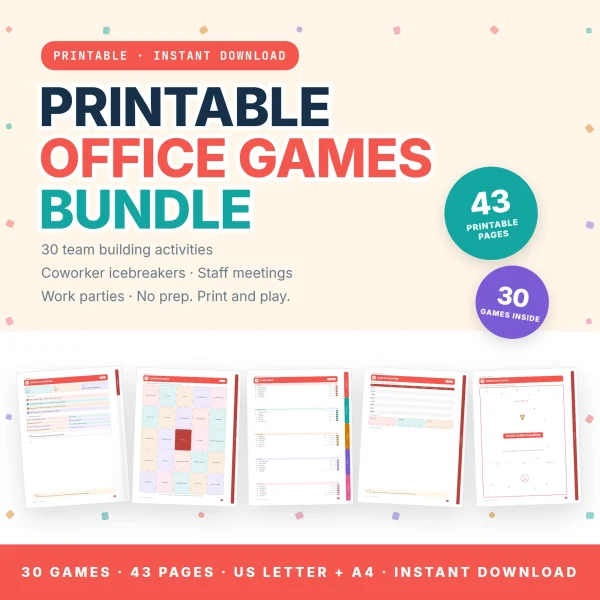
The head count decides the format. Taking turns around a table works for about four to eight people, the range the host guide in our Mix & Mingle cards gives for its “On Your Own” style, where everyone answers in turn. Past about 20, turns drag. The game selector in our Office Party Games set lists four games for groups over 20: Would You Rather, Human Bingo, Four Corners and a trivia quiz. In each one, everybody plays at the same time instead of waiting for a turn.
Check the room before you choose. Can people stand up and move without shifting furniture? Can everyone read a card at arm’s length and hear from the far end of the table? A game that leaves one guest out defeats the point of an icebreaker.
Small group icebreaker games for a table of 4 to 8
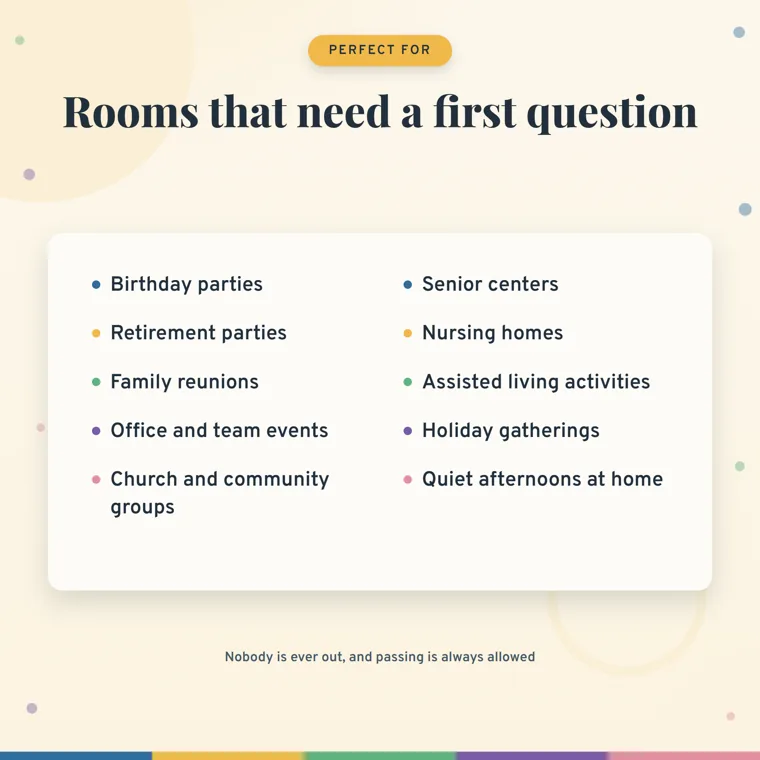
A table of four to eight can take turns, so every person gets a moment to talk while the rest listen. These six games suit a dinner party, a book club’s first meeting or a table of wedding guests who’ve never met.
1. Finish the Phrase
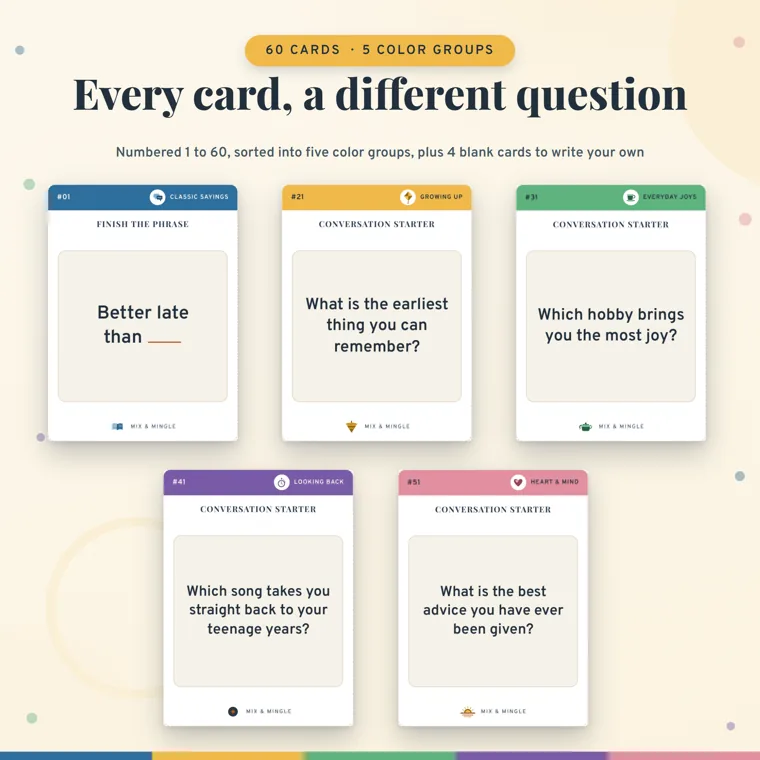
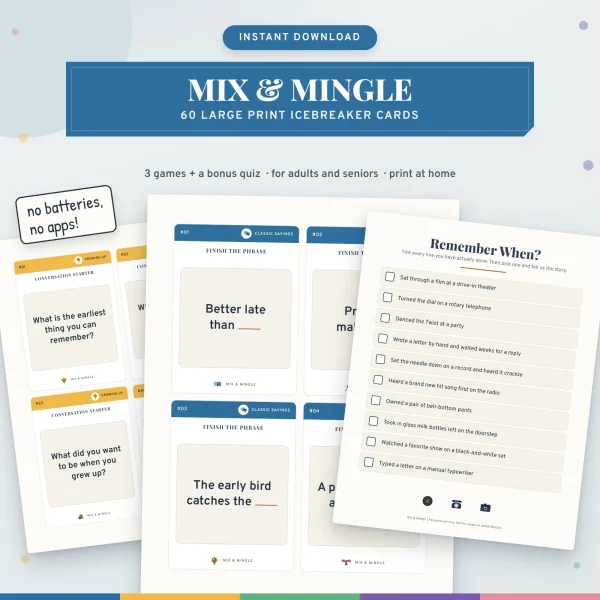
Finish the Phrase works as a first game because nobody can get it badly wrong. Each card carries a well-known saying with the last word missing, such as “Better late than ” or “Every cloud has a silver .” Someone reads a card aloud, the first person to finish it keeps the card, and whoever holds the most cards at the end wins. The answer key in our set counts any common ending a player knows, since some sayings end more than one way.
2. Remember When?
Remember When? uses a checklist to get people telling stories. Everyone gets a list of things people may have done, like turning the dial on a rotary telephone or sitting through a movie at a drive-in theater, then checks every line they’ve actually done and counts them up. Each player then picks one checked line and tells the story behind it. The host guide in our set says it plainly: the stories are the point, and the score is only an excuse.
3. Draw a question card
Question cards give each guest one easy thing to talk about. Spread a deck face down. Each player takes one, reads it aloud and answers first, and anyone who wants to can answer the same card after them. There’s no winner, so you stop when the table feels warm.
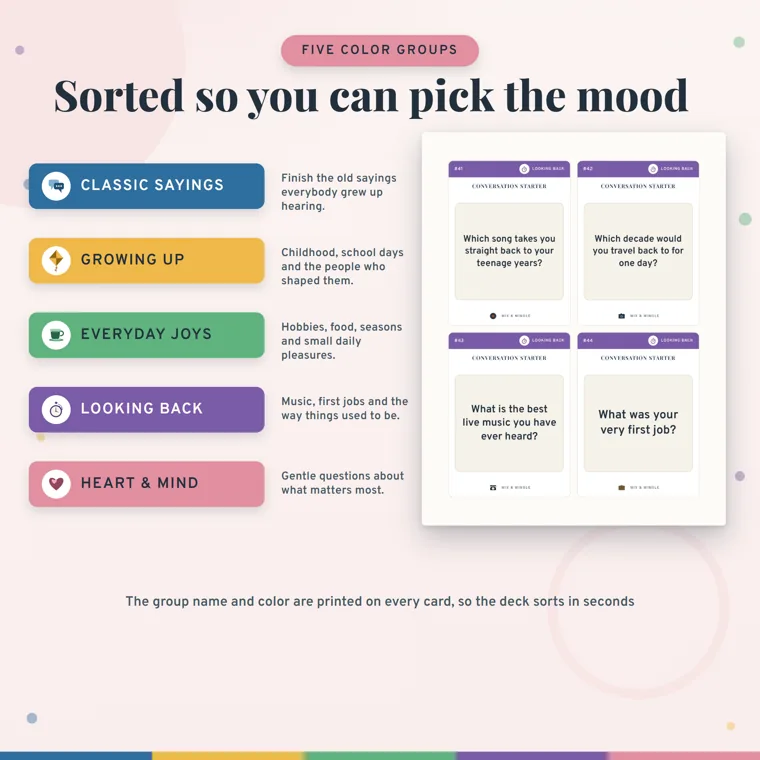
Good question cards ask about memories and tastes, not opinions that start arguments. “What is the earliest thing you can remember?” and “What was your very first job?” get almost everyone talking. If the table is family rather than guests, our conversation starters for families come in star levels, so a child and a grandparent can draw from the same theme.
4. Two Truths and a Lie
Two Truths and a Lie needs only a pen and a scrap of paper per person. Each person gets two minutes to write three statements about themselves, two true and one false, and reads them out in any order. The table votes on the lie, and whoever spots the most lies wins. The version in our office set allows ten minutes for three to 30 people.
Pick statements that surprise. A hobby or a strange job from your twenties beats where you live. The host tip in our office set makes the same point for coworkers: skip work facts, because a surprising fact makes a better game than a start date.
5. Three Things in Common
Three Things in Common sends pairs or groups of three looking for what they share. They get five minutes to find three things they all have in common, and the one rule is that nothing anyone could see or guess counts, so “we’re all wearing shoes” and “we all live in Ohio” are out. Each group then reads its three out. The fun is in the dead ends along the way, like finding out two of you hate cilantro, for opposite reasons.
6. Paired interviews
Paired interviews get everyone properly introduced without anyone talking about themselves to the whole room. Pair up people who don’t know each other and give the pairs five minutes to interview each other. Then the group comes back together, and each interviewer introduces their partner. Tell the pairs to split the five minutes, or the chattier partner gets all of it.
The first three games on this list come as a printed set in the Mix & Mingle Icebreaker Game: 20 Finish the Phrase cards, a 20-line Remember When? checklist and 40 question cards in four color groups, with a bonus 20-question trivia quiz.
Icebreaker games for large groups and parties
Once a party grows past a couple of tables, turn-taking stops working. Big groups need games where everyone plays at once and has a reason to cross the room.
7. Human bingo
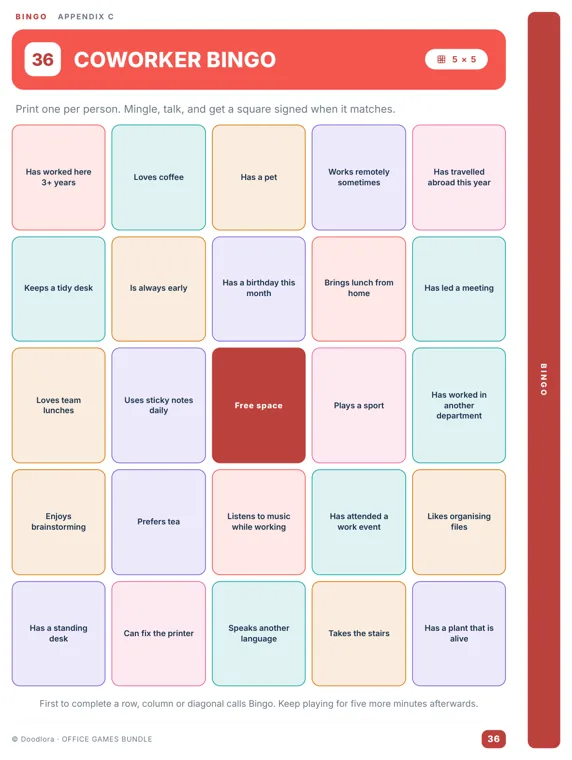
Human bingo gives every guest a reason to talk to people they haven’t met. Everyone gets a bingo card with a short description in each square, like “has a birthday this month” or “speaks another language.” Guests mingle and get each square signed by someone it describes, and the first to fill a row, column or diagonal calls “Bingo.” The office version allows 15 minutes for five to 30 people.
Two rules from the bingo game in our office set keep it honest. One person may sign at most two squares on a single card, and play goes on for five minutes after the first “Bingo,” because the best conversations start once the race is over. For a party, swap the work squares for your crowd: “has been to a wedding in another country,” “can still sing their school song.”
8. Find your other half
Find your other half pairs up a crowd using a deck of unfinished sayings. Hand half the guests a card with a saying cut short, and the other half a slip with a missing last word. Everyone hunts for the person who completes their saying, and with a 20-card deck you can pair up 40 guests. Once the pairs find each other, give each pair one question card to answer together, so the first conversation of the party is already underway.
9. The birthday lineup
The birthday lineup gets a room working together without anyone saying a word. Ask everyone to line up in order of birthday, January 1 at one end and December 31 at the other, in silence. People use fingers, gestures and a lot of pointing.
When the line’s done, walk down it and have each person say their date out loud. Expect a few people in the wrong place, and a cheer if two of them turn out to share a birthday. The game needs everyone standing, so skip it for a seated crowd.
10. Mixed-table trivia
Mixed-table trivia turns a quiz into an introduction. Split the room into teams of three before the quiz, and seat people who don’t know each other on the same team: the bride’s family with the groom’s, accounting with the warehouse.
Teams confer before they answer, which the host guide in our Mix & Mingle set says takes the pressure off anyone who’s shy. Trivia also scales well, since one person reads and every team writes at once.
11. Mingle, mingle, mingle
Mingle, mingle, mingle sorts a crowd into small groups at random, and it needs nothing but open floor. Everyone walks around the room in one direction, saying “mingle” over and over. The host shouts a number, and everyone scrambles to form groups of that size. Anyone left over gets a word of sympathy, and the walking starts again.
The classic version stops there. For a party, it helps to give each new group one question to answer before the next round, and to end on a number that matches your table size, so the last groups sit down together. Like the lineup, it needs everyone on their feet.
12. The hat game
The hat game, also called Celebrity, suits a party once people have loosened up. Have everyone write famous names on slips of paper, fold them into a hat or bowl, and split the room into two teams. On each turn, one player draws names and has one minute to get their own team to guess as many as possible, without saying any part of the name. The team scores a point for each one guessed. A name still in play when time runs out goes back in the hat.
Teams take turns, and each team rotates its clue-giver until everyone has had a go. When the hat is empty, the team with the most points wins. A popular variant plays three rounds with the same names: full descriptions first, then one word only, then mime only.
At a mixed-age party, choose names carefully. A name half the room has never heard of stalls a turn, so ask for names most of the room would know.
13. Wink murder
Wink murder works best with six or more people standing or sitting in a circle. One player, the detective, leaves the room while the rest secretly choose a murderer. The detective comes back and stands in the middle. The murderer “kills” by winking at people, and anyone winked at dies noticeably. The detective gets three guesses, and the round ends when the murderer is named or the guesses run out.
A mingling version, often called the deadly handshake, has everyone walk around greeting each other while the murderer kills with a secret handshake. Victims take a few steps before they die. Save that version for a party of friends. Icebreakers at work shouldn’t ask people to touch each other, and a handshake game does.
For a louder round once the room has mixed, our guide to one-minute party games sorts 60-second challenges by whether you have a table, a stretch of floor or a whole team in a line. For a party built around one occasion, like a shower, a milestone birthday or a fall night in, our printable party games are grouped by occasion. For that fall night in, our guide to games for a fall party has two adult rounds, a forbidden-words card game and a 30-second list race, and says which scoring rule to settle first.
Icebreaker games for work meetings
Work icebreakers have a narrower job. They have to warm up a room in a few minutes, and they shouldn’t make anyone share more than they’d share at their desk. The host checklist in our office set gives a rule of thumb for a meeting: one icebreaker, five minutes, no debrief.
14. Little-known fact
The little-known fact round turns ordinary introductions into an icebreaker. Each person gives their name, their role, how long they’ve been with the group and one little-known fact about themselves. The fact gives coworkers something to bring up at the coffee machine later. Say beforehand that the fact should be something they’re happy for the whole team to know, so nobody feels pushed into sharing anything personal.
15. Would you rather, standing version
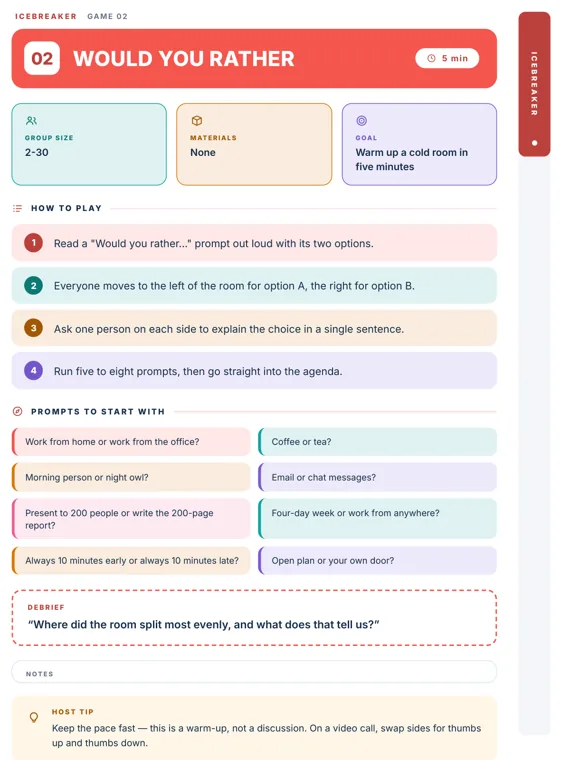
The standing version of would you rather gets a meeting on its feet and fits the five-minute slot. Read a question with two options. Everyone moves to the left side of the room for the first option and the right side for the second. Ask one person from each side to explain their choice in a single sentence, then read the next one. Run five to eight questions and go straight into the agenda. On a video call, thumbs up and thumbs down replace the two sides.
Keep the choices light and a little work-flavored. Would you rather give a five-minute talk with no slides, or a 30-minute talk with slides? Would you rather have a desk by the window or a desk by the coffee machine?
16. One riddle to open the meeting
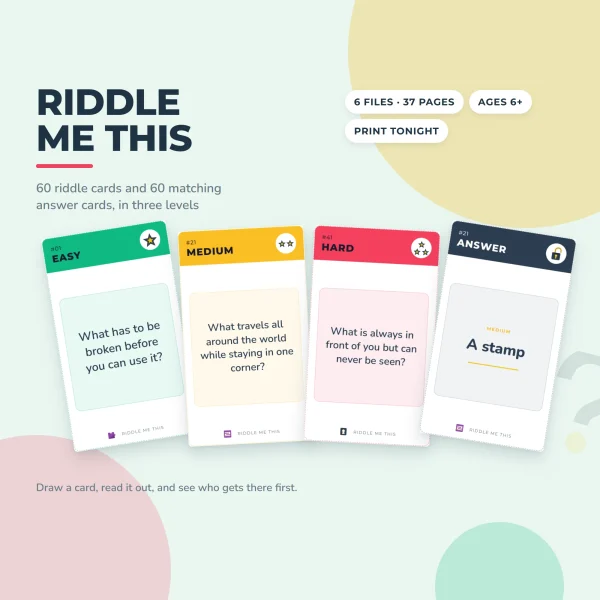
A single riddle opens a meeting without asking anyone anything personal. Read it before the first agenda item and give the room 30 seconds. If nobody gets it, reveal the answer and move on. That makes it a gentle opener for people who barely know each other, and the host tips in our Riddle Me This cards suggest one medium-level card to open a meeting for that reason.
For a longer team-building afternoon, the same office host checklist suggests a different shape: two teamwork games, one creative game and one relaxing game to close. The office set files its scavenger hunt under those relaxing games, and our guide to running an indoor scavenger hunt covers the office version, where three finds need help from another department and everything goes back afterward. The checklist also says to ask about physical contact and mobility before choosing anything like Human Knot or Trust Walk. The next two games fit that longer afternoon better than a five-minute slot.
17. The ball toss
The ball toss starts as a name game and turns into a lesson in teamwork. Stand the group in a circle. Each person throws a soft ball to someone on the other side of the circle while stating their name, until everyone has thrown it at least once.
Then the host times a repeat with three rules. The ball goes in the same order as the first round, every person touches it with at least one hand, and the clock stops when it’s back with the host. Whatever the time, the host says it isn’t good enough and asks for faster, and only repeats the rules if asked. The group has to redesign how it passes the ball. After several tries, the host calls a halt and asks what the group learned about challenging assumptions.
The disappointment is part of the design. Tell the room so at the end, or a new team may take it as real criticism.
18. Human spiderweb
The human spiderweb suits a team that’s about to work on something together, because it maps who relies on whom. The host keeps one end of a ball of yarn and passes the ball to someone. That person gives their name and role, holds on to the strand and passes the ball to someone else, saying how they depend on that person. The web grows until everyone’s been introduced.
To end it, the host pulls the starting thread and asks if anyone’s hand didn’t move. The yarn then stands in for how the team depends on each other, which is a useful picture to open a project kickoff.
Icebreaker games for family reunions and older adults
A family reunion puts a teenager, their parents and a great-aunt at one table. A game built for an office team or a college mixer rarely suits all three, and the ones that do tend to be about memory and choice rather than speed.
19. This or That
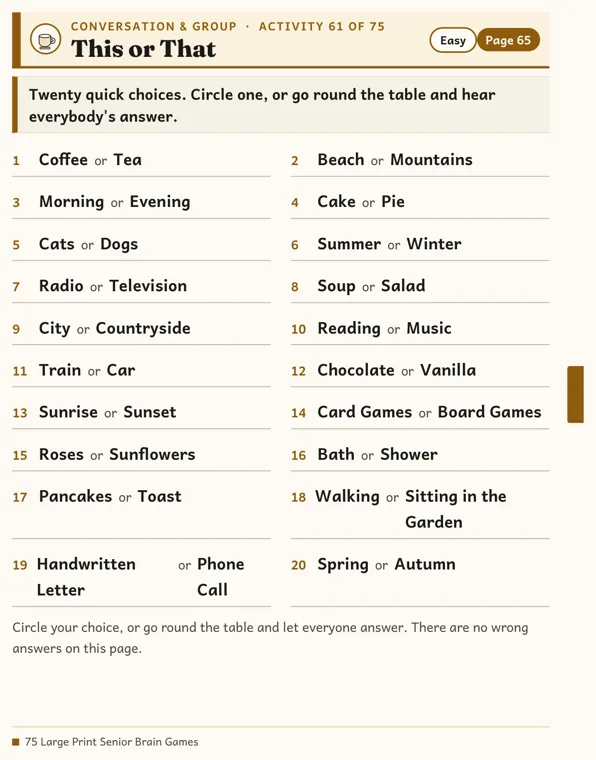
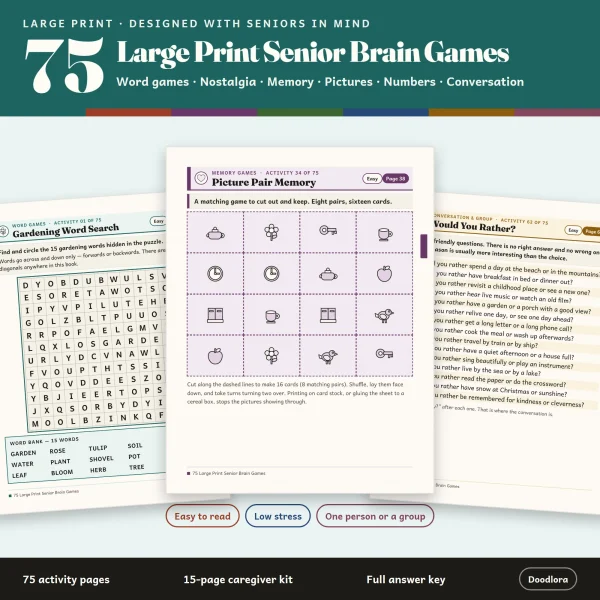
This or That needs no pen and has no wrong answers. Read out a pair of choices, like “Radio or Television” or “Train or Car,” and go around the table so everyone picks one. Then ask the person with the odd answer why. The This or That page in our large print brain games book has 20 pairs, and the book lists it among its games that need no pen at all, which helps when hands are unsteady.
20. Twenty questions
Twenty questions works across generations because anyone who can ask a yes-or-no question can play. One player, the answerer, thinks of something, and the others take turns asking questions that can only be answered yes or no. Lying isn’t allowed. Whoever guesses right wins and becomes the next answerer. If 20 questions go by without a correct guess, the answerer has stumped the table and takes another turn.
In the common “animal, vegetable or mineral” variant, the answerer says which of the three it is at the start. Settle the odd cases before the first round: a wooden table counts as vegetable, since wood comes from trees, and a leather belt counts as animal. Have one person keep count of the questions out loud, or the table will argue about whether that was question 19 or 20.
Two of the small-table games work across generations too. Remember When? reaches back to the rotary telephone and the first moon landing, so the checkmarks tend to pile up at the older end of the table. The younger guests ask questions, and the older ones end up telling the stories.
For question cards, the Mix & Mingle host guide has a “share a memory” style. After each answer, the player adds one memory the question brings back, and the guide calls it the best style across generations and for unhurried afternoons.
A few changes help in a senior center or nursing home. The same guide suggests printing the checklist and quiz single-sided on plain paper so they can be written on, and keeping cards in a shallow tray rather than a stack. Reading a card aloud for the whole group works as well as passing it around. A deck of picture pairs suits the same table, and our guide to playing memory suggests six to eight pairs for older players, printed a little larger.
How to run an icebreaker game so nobody dreads it
When an icebreaker falls flat, the hosting is often to blame rather than the game. The groans come when people feel put on the spot, when the game runs too long, or when nobody knows how to start.
Go first. Read the first card or tell the first story yourself, so nobody has to go first cold. In Two Truths and a Lie, make your lie a close one, so the table sees how the game works.
Let anyone pass. Say it before the game starts, not after someone freezes. The Mix & Mingle host guide puts it plainly: nobody has to answer.
Seat strangers side by side, not opposite. Two people facing each other across a table feel interviewed. Side by side, they’re both looking at the same card.
Let a good story run. If a question sets someone off on a story the whole table wants to hear, the next card can wait.
Stop early. Twenty minutes is plenty for a table game. Stop while people still want more, and they’ll take the conversation into the rest of the evening on their own.
Give the quiet ones a way in. Anonymous games help here. In a snowball fight, everyone writes a fact on scrap paper, crumples it and throws it across the room. Each player reads out the ball they pick up, and the room guesses whose it is. The host tip in our office set points out that the anonymity lets the quietest person in the room offer the boldest fact.
Set the cards out early. For a party, leave a few question cards on each table before anyone arrives. Guests pick them up while they wait, and some tables will be talking before you’ve said a word.
Printing icebreaker cards at home
Printable icebreaker games come as PDF files, so you can print only the games you need and print the checklist again for the next party. A few settings make the difference between cards that read well and cards people squint at.
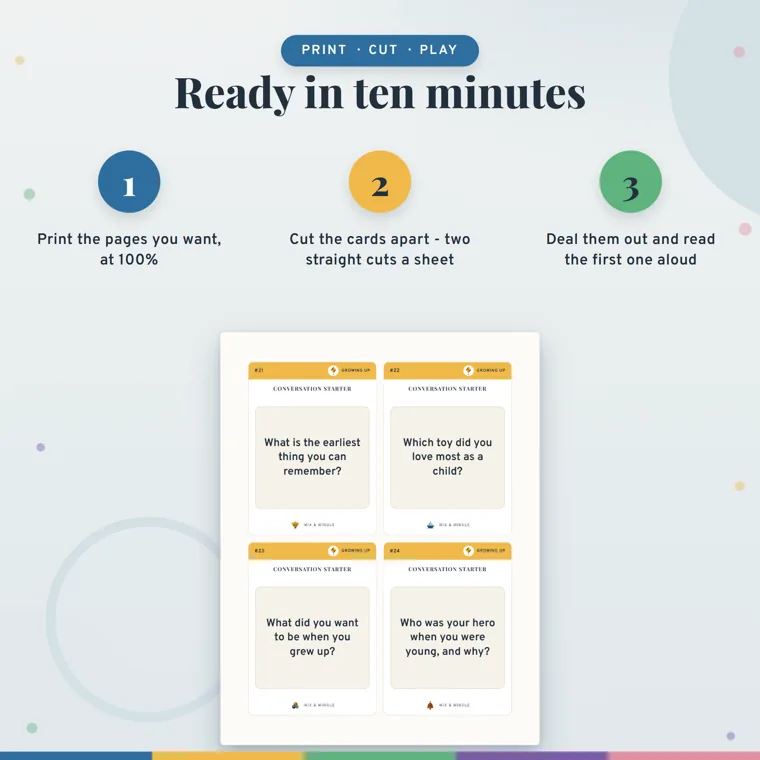
Print at 100%, or “Actual size,” rather than “Fit to page,” so the cards come out the size they were designed. How to print at actual size shows where that setting lives.
Paper depends on how hard the cards will be handled. For cards that get shuffled and passed around, cardstock lasts longer, and our paper guide suggests 65 to 80 lb cover (176 to 216 gsm) for game cards and says plain paper is fine for a one-time party. Checklists and quiz sheets that people write on can go on ordinary printer paper.
Type size is worth checking before you print, especially with reading glasses in the room. The words on the Mix & Mingle cards are set at about 19 to 24 point, four cards to a US Letter page, so they can be read across a table, and the checklist and quiz sheets use 14-point type. If you’re printing for a big group, the ink-saver version prints the same cards in grayscale. You’ll need scissors or a paper trimmer for the card games, and that’s the only other thing on the list.
Printables from this article
Related articles
Printable Party Games
How to Plan a Baby Shower: Timeline, Food & 2-Hour Schedule
A baby shower plan from the first talk with the parents-to-be to the last gift: timing, guest list, budget, venue, a two-hour schedule, safe food and backup plans.
Printable Party Games
How to Plan a Bridal Shower: Timeline, Budget and Schedule
A host's plan for a bridal shower, from the first talk with the bride and co-hosts to the guest list, invitations, a timed party schedule, the gift opening and what to do when something slips.
Printable Party Games
35th Birthday Ideas: Party, Trip, Theme and Gift Ideas
Ways to celebrate turning 35, sorted by how many people the birthday star wants around, with group size, time, prep and the snag to plan for in each.