Collage Ideas: 36 Theme, Magazine and Paper Collage Prompts
The collage ideas that get a blank page moving are narrow ones: tear only the blues out of a magazine, collage a single day from its receipts, make a self-portrait with no photo of yourself in it, or spend ten minutes with the scraps already on your desk.
Each one hands you a single subject, material, color rule or time limit.
The 36 ideas below are grouped by where they start: a theme, magazines, other paper, mixed media, a rule, or a child’s scissors.
The last section covers the glue and paper that decide whether a finished collage yellows or holds.
Collage theme ideas: start from one subject
A theme settles the first question every collage asks, which is what goes on the page and what stays in the drawer. These eight start from a subject.
1. One day. Keep every piece of paper from a single date: the receipt, the ticket, the sugar packet, the parking stub. Nothing from any other day goes in.
2. A place you’ve lived. Use a map of the neighborhood as the base, then cut the names of the streets you walked most and glue them on top.
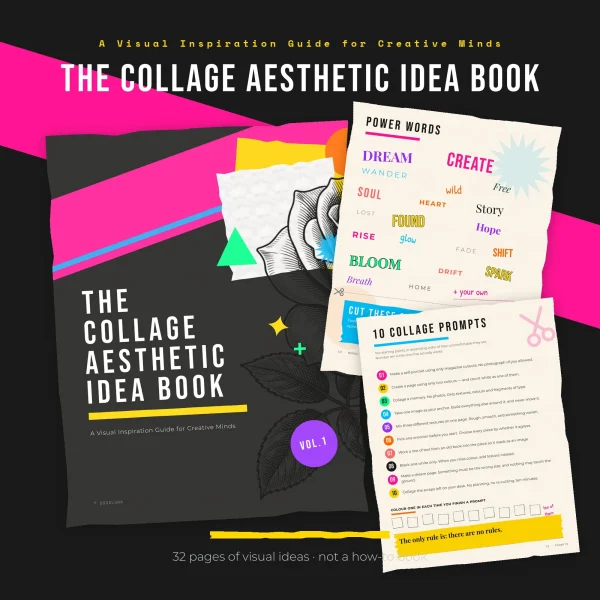
3. A self-portrait with no photo of you. Build a face from magazine cutouts only. It’s the first of the ten prompts in our Collage Aesthetic Idea Book, and it’s harder than it sounds, because every eye you find already belongs to somebody else.
4. A family recipe. Photocopy the handwritten card, glue the copy in the middle, and surround it with the labels and wrappers of what goes into the dish. The original card stays in the recipe box.
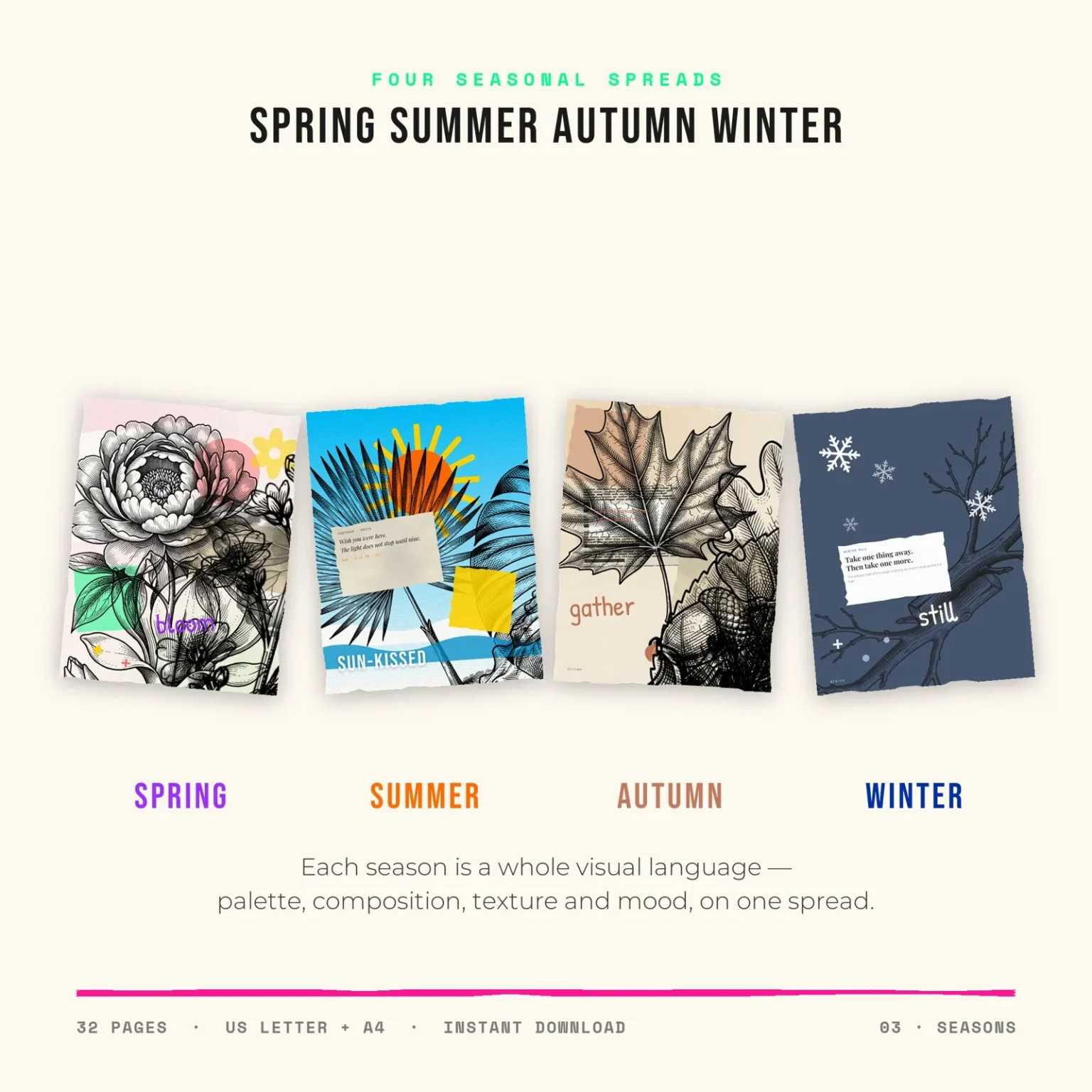
5. A season. Pick one and let it choose the colors. The four seasonal spreads in the idea book each put a palette, a texture and a mood together, which is a tighter brief than “make something about fall.”
6. One word. Write a single word at the top of the page, like “salt” or “late,” and keep only the pieces that agree with it.
7. Your street after dark. Start on black paper and add only the lit things: windows, signs, headlights cut from car ads.
8. A trip you haven’t taken. Travel brochures, a foreign stamp, a train schedule, a menu in another language. Everything on the page is about somewhere you want to go.
Magazine collage ideas
A stack of old magazines gives you photographs, colors and type you’re free to cut up, and artists found that out early. Tate dates papier collé, French for “pasted paper,” to the last months of 1912, and notes that Picasso used pages of the newspaper Le Journal to bring everyday life into his pictures.
9. One color. Go through a whole issue and tear out every patch of one color, whatever it belongs to. Forty blues from forty different things read as one mood.
10. A found poem. Cut out words and short phrases and move them around until they say something, then glue. Headlines give you big type and captions give you small type, and mixing the two keeps it looking like a collage instead of a ransom note.
11. Swapped faces. Take the eyes from one face, the mouth from another and the hair from a third. This is photomontage, and the National Museum of Women in the Arts notes that Hannah Höch, one of the founders of Berlin Dada, and Raoul Hausmann are often credited with inventing it.
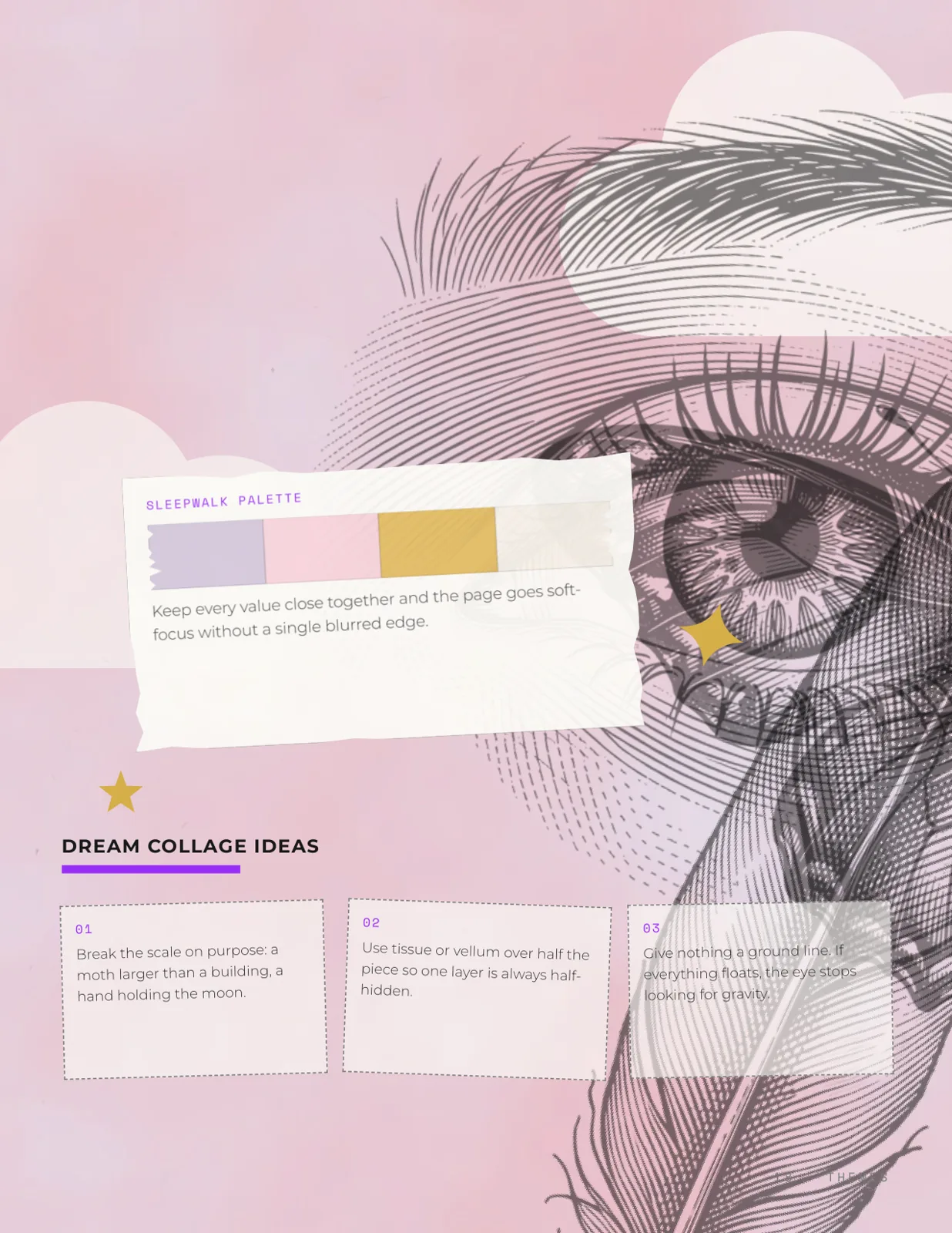
12. Wrong scale. Put something small where something huge should be, like a moth bigger than the building behind it. The dream page in the idea book uses this trick, and the scale break alone makes the page feel like a dream.
13. Sixteen squares. Cut one magazine spread into a four-by-four grid, shuffle the squares and glue them back in a new order. The colors don’t change, but the picture does.
14. Surfaces, no objects. Cut out only textures: a knit sweater, wet pavement, a wooden table, a close-up of bread. Glued edge to edge, they make a flat page look like it has a surface you could run a finger over.
15. A horizon made of type. Cut long strips of printed text and lay them across the page as hills or waves, then add one photo on top as the only object.
Easy paper collage ideas with torn, painted and found paper
Magazines are optional. In the Eric Carle Museum’s write-up of a torn-paper session at home, the papers came from around the house: tissue paper, wrapping paper, copy paper, brown paper bags, construction paper, newspaper and notebook paper.
16. Tear, don’t cut. Tear every shape, even the ones you’d normally cut. Torn edges are never straight, which suits hills, clouds, water and tree tops.
17. Cut without drawing first. Tate says Matisse turned to cut paper in his late sixties, when ill health kept him from painting, and cut straight into painted paper with scissors. Try a whole page of shapes cut with no pencil lines at all.
18. Paint your own papers. Eric Carle painted acrylic onto plain white tissue paper to get the colors and patterns in his picture books, according to the Carle Museum. Paint a few sheets one afternoon and you’ll have a supply of collage paper nobody else owns.
19. Tissue in layers. Lay one color of tissue partly over another and watch what the overlap does. The Carle Museum’s tissue and starch activity asks exactly that question, and the kids’ section below has the method.
20. Wood grain, then pencil. Tate describes Braque’s first papier collé, made in the last months of 1912, as a drawing on imitation wood-grain paper pasted onto white paper. Glue down one printed texture and draw the rest of the picture around it in pencil.
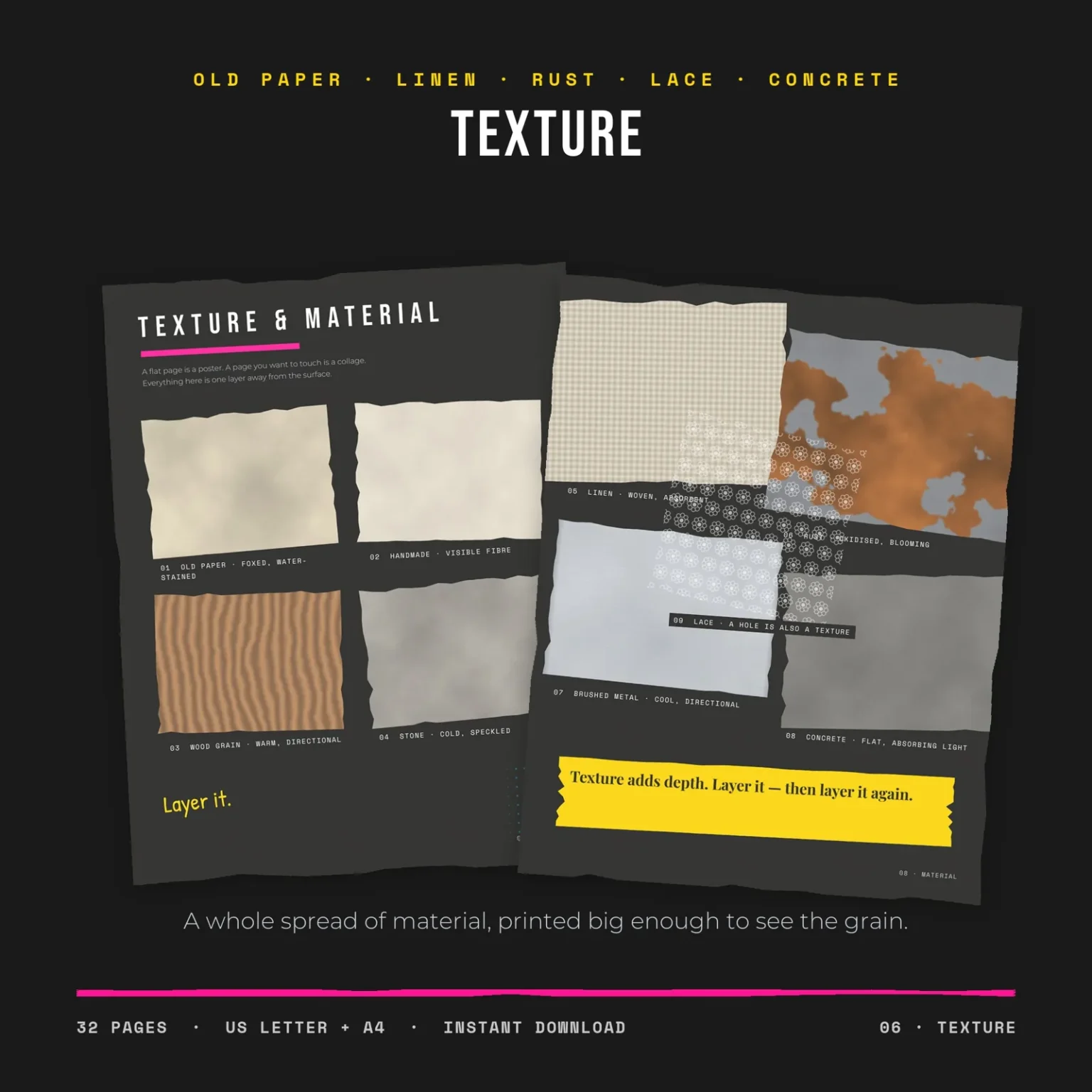
The texture spread in the idea book prints nine materials, wood grain, linen and old paper among them, big enough to see the grain, so you can print it and cut from it for this one.
21. Envelope linings. The patterned print inside bill envelopes makes a fine-grained paper you already have, good for skies, roads and clothes.
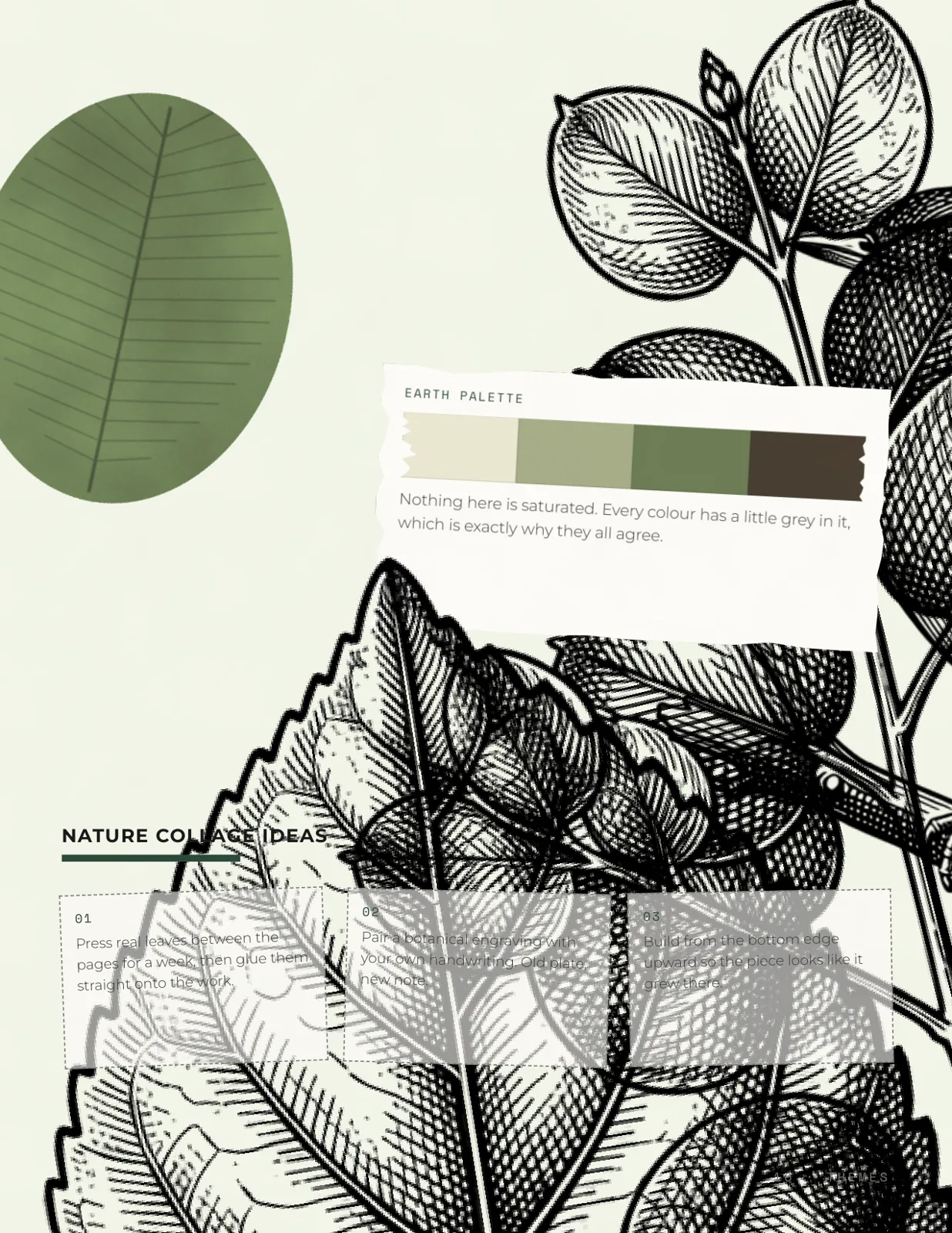
22. Pressed leaves. Press real leaves between the pages of a heavy book for a week, then glue them straight onto the page. That’s one of the three nature ideas in the idea book.
Mixed media collage ideas
Once paper comes easily, add something that isn’t paper. Tate’s definition of collage already makes room for fabric, painting, drawing and three-dimensional pieces alongside paper and photographs.
23. Lace on top. Glue a piece of lace or netting over a finished area so the picture shows through the holes.
24. Stitching. Poke a row of holes with a needle first, then sew a line of thread through the page, straight or wandering.
25. Draw back in. When the glue is dry, go over the collage with gel pens, markers or colored pencils. The Carle Museum’s tissue activity ends the same way.
26. Paint over half. Brush thin white paint over part of the page so that area goes quiet and the rest stands forward.
27. One shiny, one matte, one soft. Put a glossy magazine scrap, a plain uncoated paper and a piece of fabric on one page, and nothing else.
28. Real objects. Buttons, a ticket stub, a dried flower, a key. Glue the flat ones and stitch the heavy ones.
Collage ideas that start from a rule: palette, layout and mood
The ideas so far start from a subject or a material. These four start from a rule, and the rule does the choosing for you, because anything that breaks it goes back in the box.
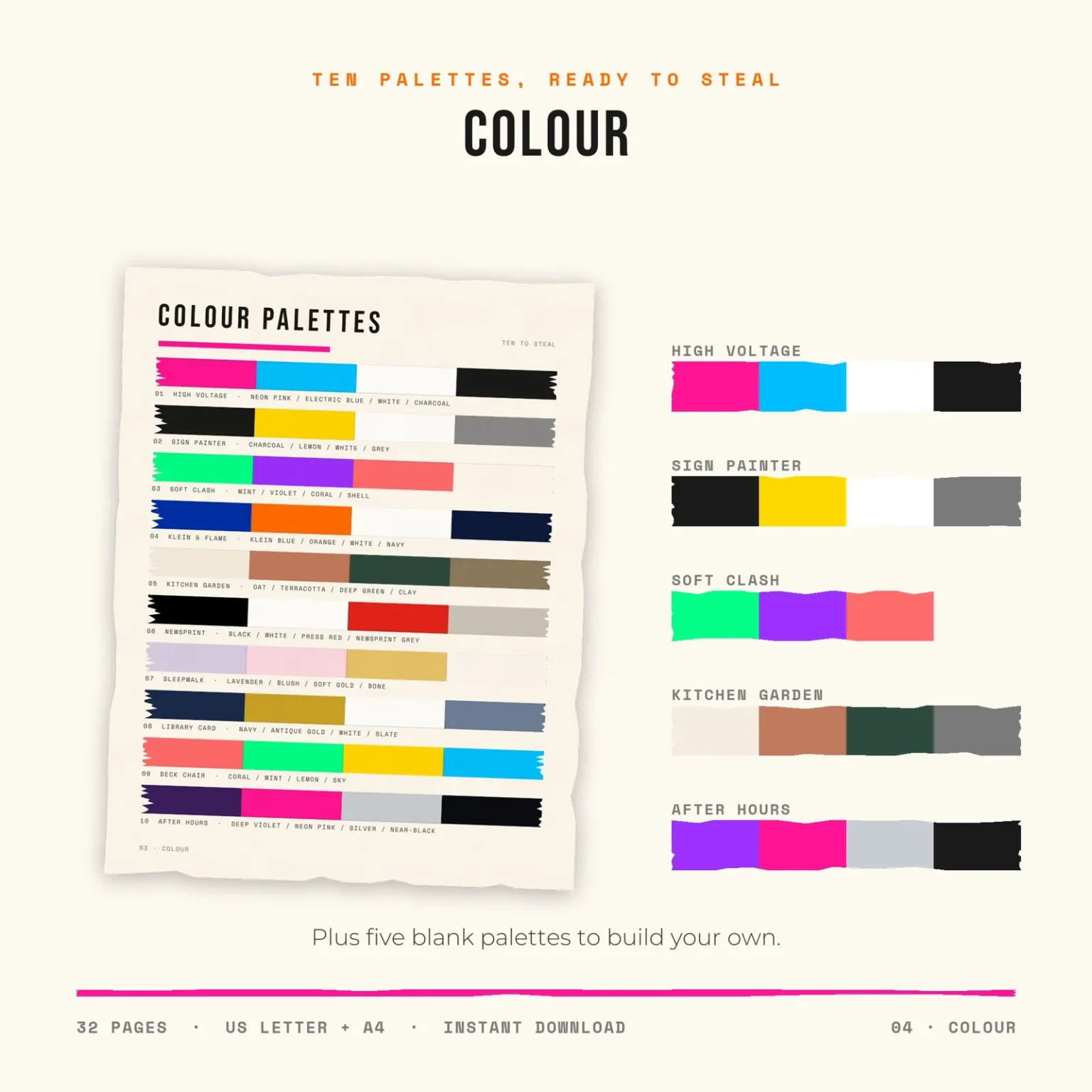
29. Four colors, fixed in advance. Pick four colors and throw out every scrap that isn’t one of them. The idea book names ten palettes like this. Kitchen Garden, for example, is oat, terracotta, deep green and clay.
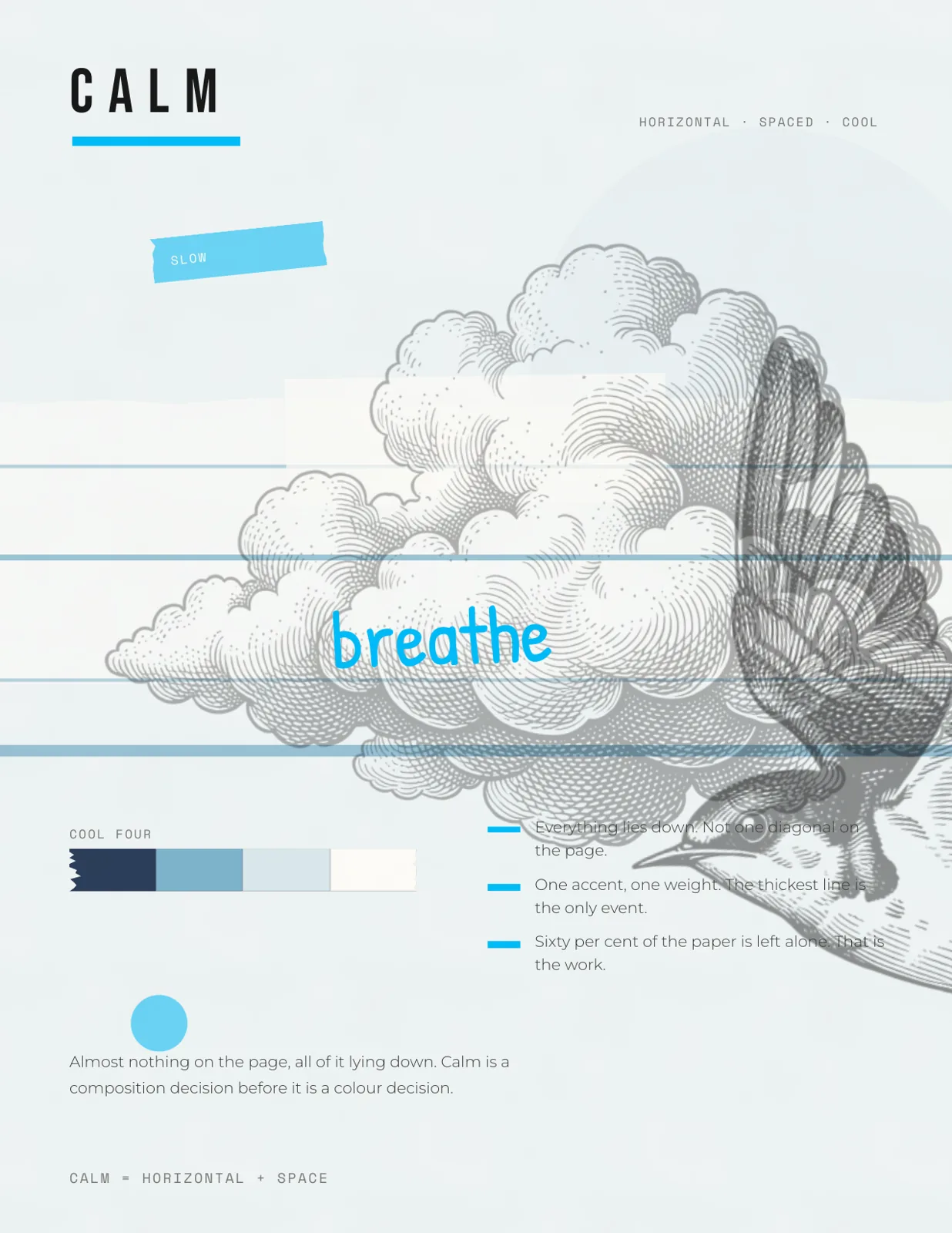
30. Calm or chaos. Decide the mood first and let the lines carry it. The idea book’s calm page lays everything horizontal and leaves most of the paper empty, and its chaos page is all diagonals, packed tight. Try the same scraps both ways.
31. Negative space. Glue one small piece off-center and leave the rest of the page blank. Then resist the urge to fill it.
32. Ten minutes, no re-cutting. Set a timer and use only the scraps already on your desk, glued as they are. It’s the last of the ten prompts in the idea book.
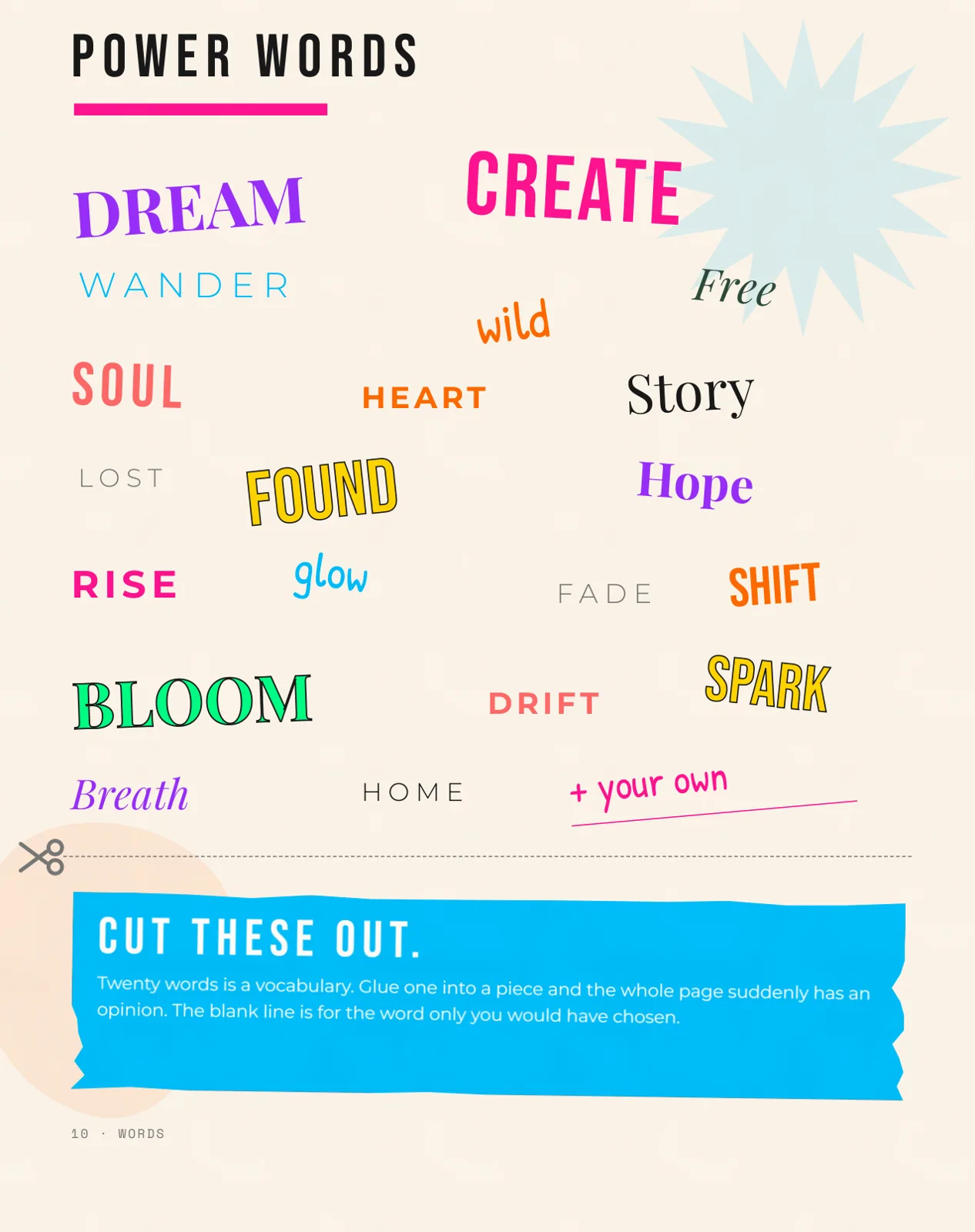
The Collage Aesthetic Idea Book is built around this kind of rule. Its 32 pages hold the palettes, six compositions, the texture spread, 20 power words and ten prompts, plus blank palettes and six empty frames to try them on. Its welcome page says outright that it isn’t a how-to book.
Collage ideas for kids
The same ideas work for children once the pieces get bigger and the glue gets drier.
33. A Matisse snail. Tate Kids’ version is simple: cut shapes from brightly colored paper, arrange them on a large sheet, and stick them down when the picture looks right. Show Matisse’s The Snail, made in 1953, before anyone picks up scissors.
34. Tissue and starch. From the Carle Museum: brush a thin layer of liquid laundry starch onto watercolor or heavy drawing paper, lay torn or cut tissue in it, and brush more starch over the top so it lies flat.
Cover the table first and decide where the wet pictures will dry. The museum also warns that some tissue papers bleed their dye when wet.
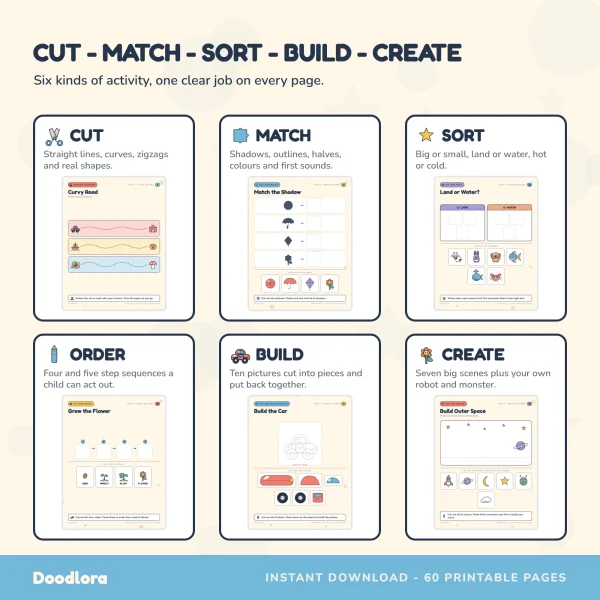
35. A scene to fill. Give a child a background and a handful of cut-out pieces to paste wherever they like. The seven scene pages in our Preschool Cut and Paste Worksheets work this way, with a farm, an ocean or a birthday party and six pieces each, for ages 3 to 5.
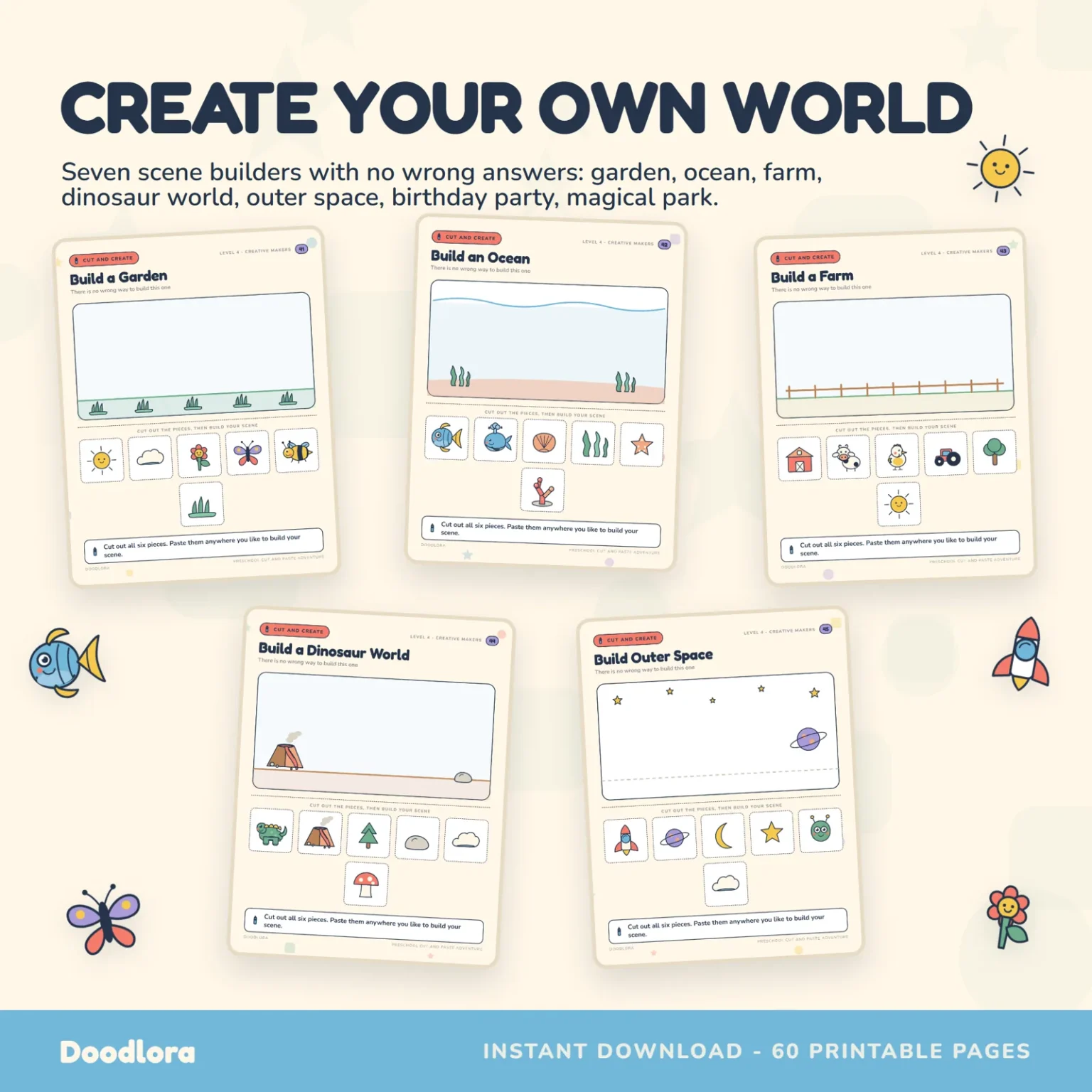
For little hands, the printing guide that comes with that book asks for child-safe scissors and a glue stick. It advises against liquid glue because it soaks through and curls the page, and suggests thicker paper or light cardstock.
To print your own cut-out pieces instead, our guide to using clipart shows how to size a transparent PNG so it prints at the width you want.
36. All about me. Cut the letters of the child’s name from magazine headlines for the middle of the page, then fill the space around them with pictures of favorite foods, animals and colors.
Glue and paper for a collage that lasts
A glue stick is what the Carle Museum’s torn-paper session and that printing guide both reach for, and it’s fine for practice pages. For a piece you want to frame or keep for years, the adhesive and the paper under it matter more than they seem to.
Eric Carle is the clearest case. The Carle Museum says that before the mid-1980s he used commercially pre-dyed papers, and their colors quickly faded. He later switched to acid-free paper and methyl cellulose adhesive, rather than rubber cement, so his art would last.
Rubber cement and pressure-sensitive tape are the first things preservation guides warn about. The Library of Congress tells people to avoid both, and notes that many over-the-counter adhesives used to mount photos in albums and scrapbooks are acidic and will eventually discolor, turn brittle and damage the materials.
The Preservation Self-Assessment Program at the University of Illinois Library describes rubber adhesives turning yellow or dark amber and staining paper.
The same guide rates PVA glue from conservation suppliers as pH neutral and stable, but not easily reversible and sensitive to moisture. Starch paste it describes as water-soluble, reversible and pH neutral.
So keep tape and rubber cement for work you don’t mind losing. When the piece matters, use a conservation-grade PVA or a starch paste instead. If the collage uses a family photo, glue a copy and keep the print.
Wet glue also needs a heavier base. The Carle Museum’s starch activity uses watercolor or heavyweight drawing paper, and the cut-and-paste guide pairs its warning about liquid glue with a suggestion to print on thicker paper.
If you print pages from the idea book to cut up, its printing note asks for 32 lb (120 gsm) paper or heavier, since several pages are dark from edge to edge, and suggests pages 4 to 13 and 30 to 31 if you only want the reference pages.
Our paper guide explains what those weights feel like in the hand.
Printables from this article
Related articles
Printable Guides & Magazines
How to Start Homeschooling: Steps for Beginners
A first-year plan for new homeschool families: where state rules live, the order for leaving school, curriculum, daily hours, records, friends and the first 90 days.
Printable Guides & Magazines
Year of the Goat 2027: Fire Goat Dates, Years and Customs
When the 2027 Year of the Goat starts and ends, every Goat year with its exact dates, why 2027 is a Fire Goat, what tradition says about Goat people, and what to do when it's your own year.
Printable Guides & Magazines
Chinese Zodiac Signs: 12 Chinese Zodiac Animals by Year
The twelve Chinese zodiac animals in order, the years that belong to each, what tradition says about them, and how to work out your own sign from your birthday.