Indoor Scavenger Hunt: A 20-Item List, Clues and Rules
An indoor scavenger hunt is a list of things to find inside the rooms you choose, and the step most hunts skip is deciding what counts as finding something.
Players can bring each find back, point to it, write down where it is or take a photo, and each of those suits a different room.
Our fall party list sends players to bring every find back. Our classroom hunt leaves everything in place and has teams write down where it is, and our office hunt lets teams take a photo instead.
The rest is simpler: about 20 lines on the list, a boundary said out loud, and a 15-minute timer, which three of our printable hunts share.
What to put on an indoor scavenger hunt list
A good indoor list mixes two kinds of lines: things you name, like “a key,” and things you describe, like “something smaller than your thumb.”
Named things have one right answer, so they’re quick to check and easy to race for.
Described things have dozens of right answers, which means the list still works in a house you’ve never set foot in.
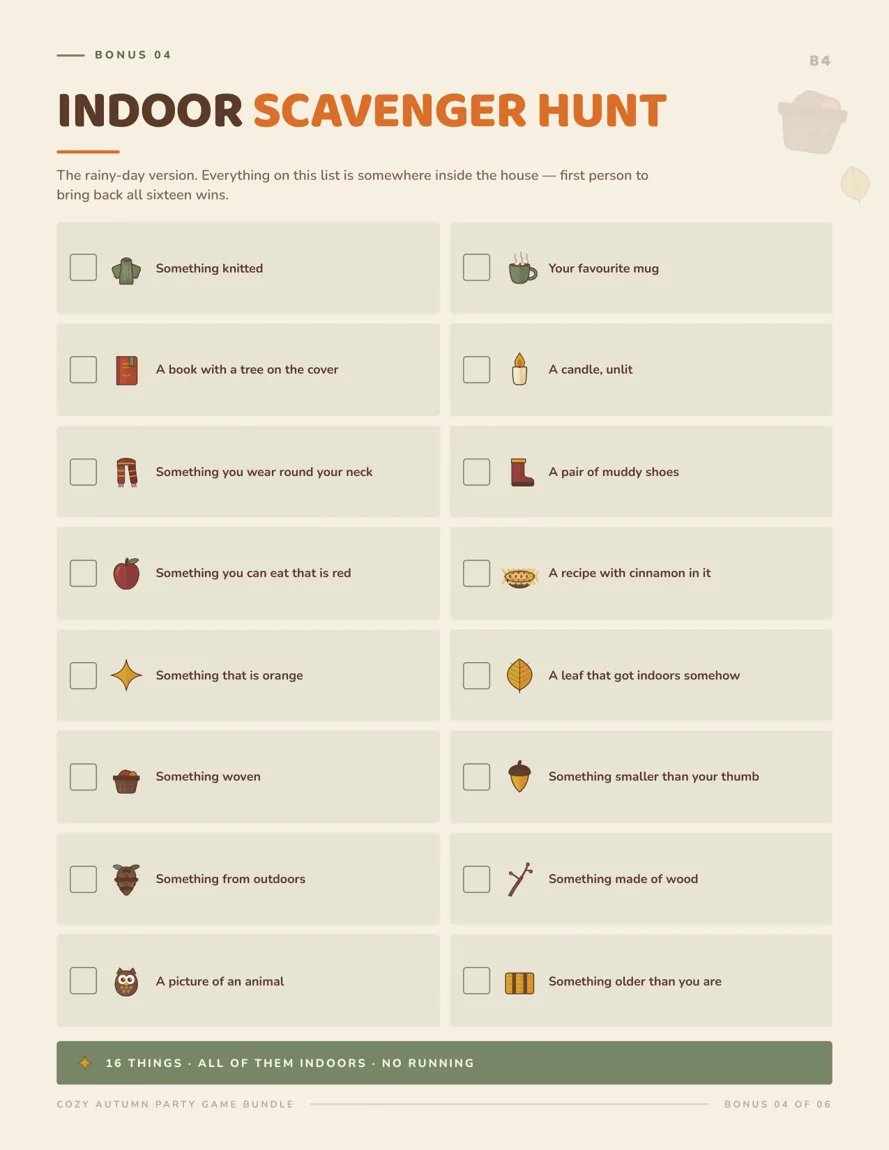
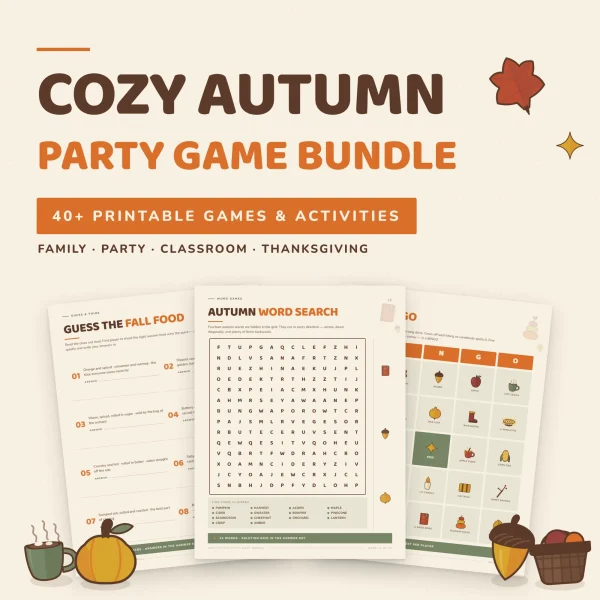
The indoor list in our Cozy Fall Party Games bonus pack puts both kinds on one page.
“A candle, unlit” and “a book with a tree on the cover” share the page with “something woven” and “something older than you are.”
Here’s a 20-item list for an ordinary house, built the same way. The first ten name a thing:
- A key
- A spoon
- A book with a tree on the cover
- Two socks that match
- A candle that isn’t lit
- A clock
- A toy with wheels
- A picture of an animal
- A pillow with a pattern on it
- Your favorite mug
The next ten describe a thing, and players can pick any object that fits:
- Something knitted
- Something woven
- Something smaller than your thumb
- Something older than you are
- Something you can eat that’s red
- Something made of wood
- Something that came in from outdoors
- Something you wear around your neck
- Something that makes a sound without a battery
- Something with words printed on it
Walk through the rooms with the list beforehand, ideally right before you hand it out.
If nobody could find a line there, like a candle in a house that doesn’t keep one, cross it off for everyone or swap in something you can see from the doorway.
Settle one more rule during that walkthrough: whether a single object can count for two lines. A wooden toy car fits both “a toy with wheels” and “something made of wood,” and players will ask.
If you’re planning a party around it, our fall game night plan uses the same fall indoor list as the rainy-day swap for its outdoor hunt.
Indoor scavenger hunt rules: rooms, proof and scoring
Once the list fits the house, three rules decide whether the hunt stays fair: where players may look, what counts as a find, and how the game ends.
Set the boundary out loud
Name the rooms before the first sheet goes out.
“The kitchen, the living room and the hallway” is a boundary that players can follow, and “anywhere in the house” isn’t one.
Then name what’s closed even inside those rooms: drawers, cupboards, the fridge, anything plugged in and anyone’s bag.
The host guide in our teen birthday pack makes the boundary the first thing to settle before its photo hunt, house and yard only with no going out front, because it heads off an awkward conversation in the middle of the party.
Our fall list prints “no running” along the bottom of the sheet, which means you don’t have to keep repeating it.
If something on the list turns out to be missing once the game has started, cross it off every team’s sheet at the same moment.
Letting one team swap a line while another keeps hunting for it makes the sheets impossible to compare.
Decide how a find counts
There are four ways to prove a find, and the right one depends on whether players are allowed to move things:
| How a find counts | Where it fits | Agree on this first |
|---|---|---|
| Bring it back | A home where everything on the list can be moved | What’s off-limits to carry, and that every find goes back afterward |
| Point to it or check it off | Toddlers, rooms with fragile things | Who walks over to see it |
| Write down where it is | A classroom, a hotel, someone else’s house | That items stay put; answers get read out together at the end |
| Take a photograph | An office, a teen party, older kids | One picture per line, no people or screens without permission, and who gets to see the photos |
Our office hunt lets teams collect or photograph each find, and it closes with a rule worth borrowing at home: everything gets returned afterward.
Our classroom hunt goes further and doesn’t move anything at all, which suits any room where you’re a guest.
Photograph hunts need one extra promise from players: no pictures of people, phones or paperwork without asking, and the photos stay on the phone they were taken on.
Two teams can count the same object independently. The clock on the kitchen wall doesn’t belong to whoever spots it first.
For the described lines, ask players why their find fits. A placemat and a laundry basket are both “something woven,” so accept whatever matches the description, not just the object you pictured when you wrote the line.
Score it so everyone finishes with a number
One point per find, with the first full sheet winning, is the simplest scoring. In a group with a 4-year-old and a 10-year-old, though, the younger player almost never gets to the bottom of the sheet.
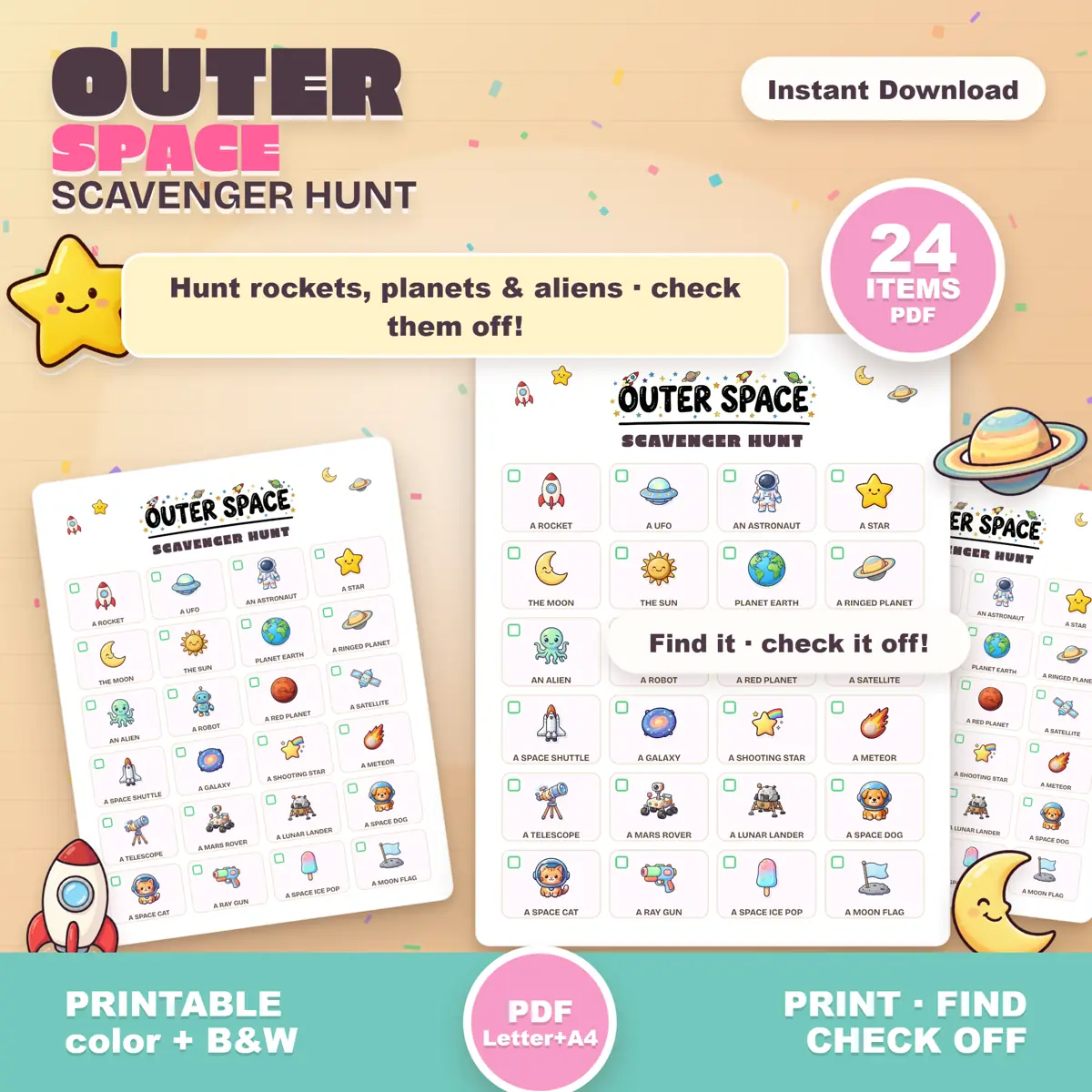
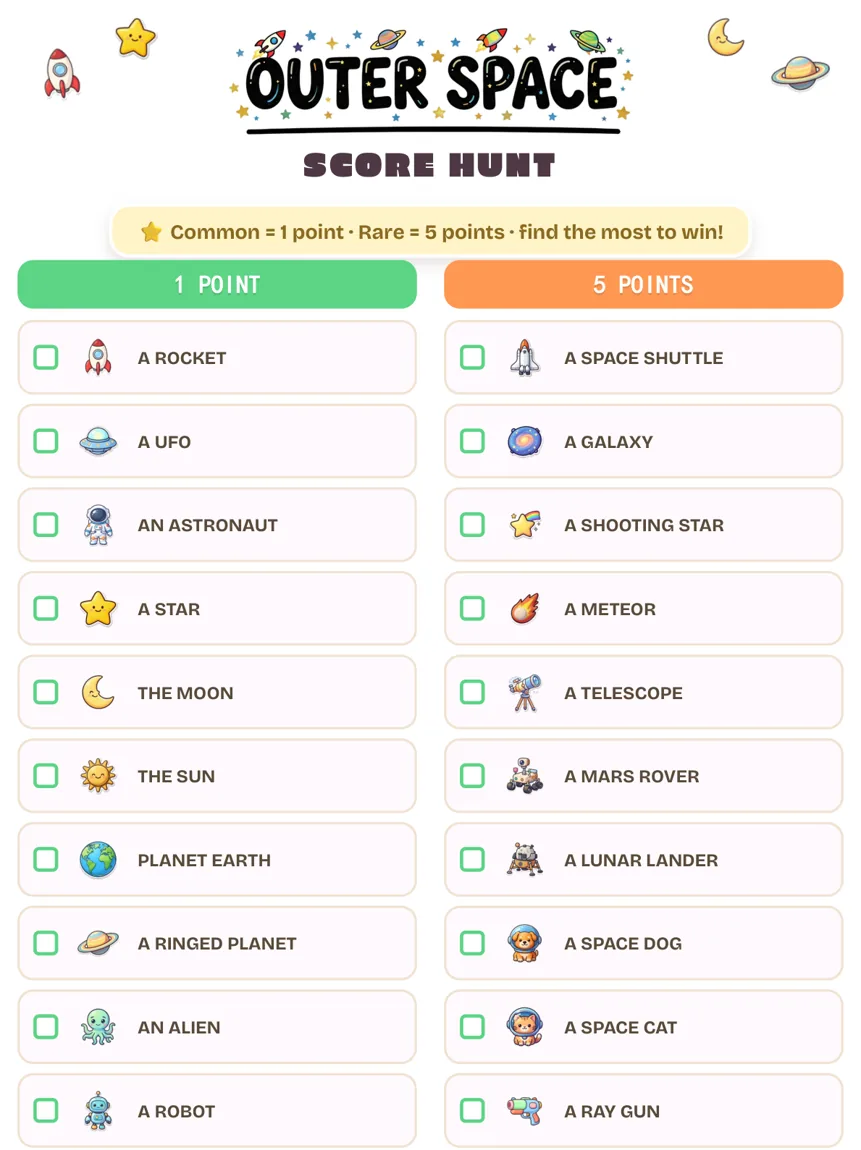
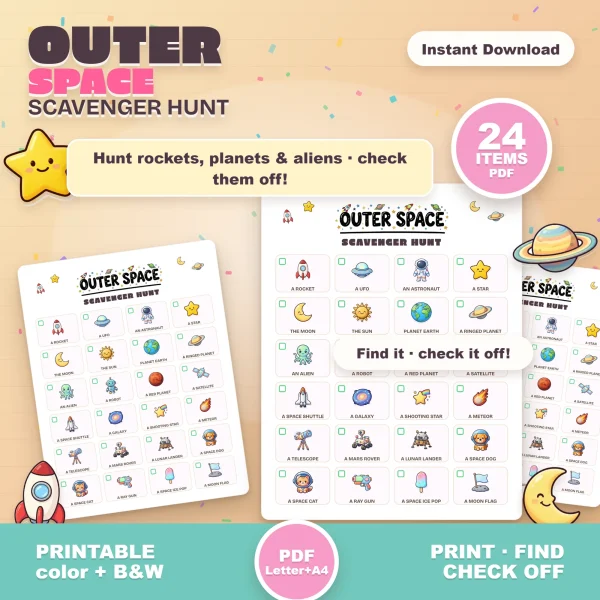
Our Outer Space Scavenger Hunt handles that on its score page. Common finds like a rocket or the moon are worth 1 point, rarer ones like a galaxy or a Mars rover are worth 5, and the most points wins.
Its compact checklist ends with a line to fill in, “I found ___ out of 24 items!”, so a player who stops at nine still has a result to write down.
A timer helps more than a finish line. Our classroom hunt says to set a 15-minute limit and hold to it, and the office and teen photo hunts use the same 15 minutes.
Mixed ages work better in pairs than head to head, especially across a big age gap.
One player reads the line and the other searches, and they swap jobs after three or four finds.
The space pack ends with an I Did It! certificate with lines for a name and the date, which gives even the last player to finish something to take home.
Picture hunts and theme rounds for kids who can’t read yet
Every rule above assumes the players can read the list, and a 4-year-old can’t. The fix is a picture beside every line.
Our Outer Space Scavenger Hunt draws all 24 items, each one with its name in capitals underneath, and the how-to page marks it for ages 3 and up and 2 to 6 players.
Its printed instructions say to head outside. Indoors, though, most of that list only exists as pictures: a UFO on a pair of pajamas, an alien sticker, a rocket on a book cover, a toy robot on a shelf.
So make one rule before the start, that a picture or a toy counts, and the whole sheet works inside on a rainy day.
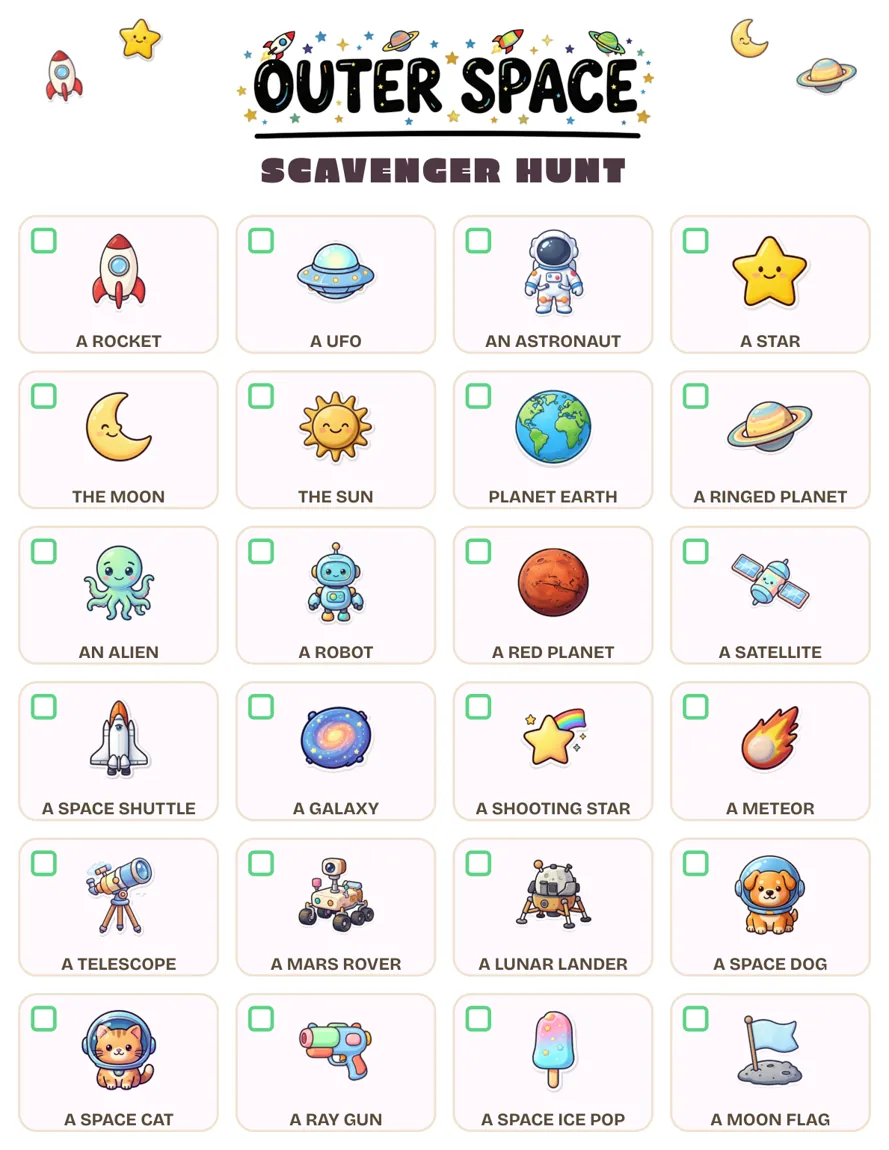
The same 24 items come in three layouts: big picture boxes for the youngest players, a two-column list, and a three-column page with four bonus challenges at the bottom.
Those bonus lines are already written as described items, which makes them straightforward wins indoors: something that glows, something round like a planet, three different stars and something that flies.
For a first hunt with a 3-year-old, cover all but one row of the big grid. Four boxes they can finish beat 24 they can’t.
The how-to page suggests laminating the checklist, so one printout can do the next rainy day as well.
Outer Space Scavenger Hunt comes as four files, color and black-and-white on US Letter or A4, so you can laminate one color copy and print the everyday ones in black and white.
Kids who can’t read can also play a hunt with no list of objects at all.
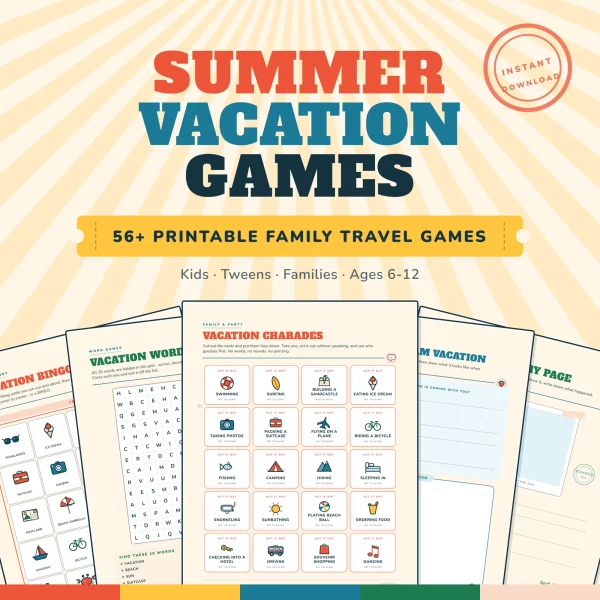
The color hunt in our Family Vacation Games book has them color in each ring first, with an adult reading out the color names, and then find something that color.
Its shape hunt does the same with ten shapes “hiding in plain sight,” in windows, signs, food and buildings. Both pages work in any room of the house.
For a quiet round, have players draw each find next to the ring instead of carrying it over, so nothing leaves its shelf.
Farm, nature and ocean versions of the picture checklist are on our scavenger hunt printables page. When the weather clears, our nature scavenger hunt lists are sorted by place and by season.
Indoor scavenger hunt clues and riddles
Once players can read, you can swap a plain line for a clue that describes what a thing does or where it lives, and leave its name out.
Write the answer before the clue.
Pick the object, check that it’s inside the boundary, and then describe its job in a sentence or two.
Riddle clues for a one-page hunt
A riddle list stays on one sheet, and players solve the lines in any order. It’s still a scavenger hunt; the riddle simply takes the place of the object’s name.
Here are five to adapt:
- A book: “I have pages but I’m not a calendar. Open me for a story.”
- Shoes: “We wait by the door in a pair and go outside on your feet.”
- A clock: “I tell you when, but I never tell you where.”
- A bowl: “I hold your cereal in the morning and your pasta at night.”
- A comb: “I have teeth but I never bite, and I keep your hair neat.”
Read each riddle out loud in the actual room before the game. If two things fit it, either accept both or add a detail that rules one out.
A clock clue about hands won’t work on a digital display, and a basket clue about an open top won’t fit a box with a lid.
Our guide to telling whether a riddle has only one answer walks through that check with brain teasers, and the same test works here.
A chain of hidden clues, or an indoor treasure hunt
A treasure hunt is the other format, and it’s more structured. Each clue leads to the next hiding place, only the last one leads to the prize, and players have to go in order.
Write the chain backward. Start where the prize will be, write the clue that points there, hide that clue at the spot the clue before it describes, and keep going until you reach the one you hand over first.
Number the clues on the back. If one goes missing, you’ll know which one to rewrite.
Where you hide them matters less than you’d think.
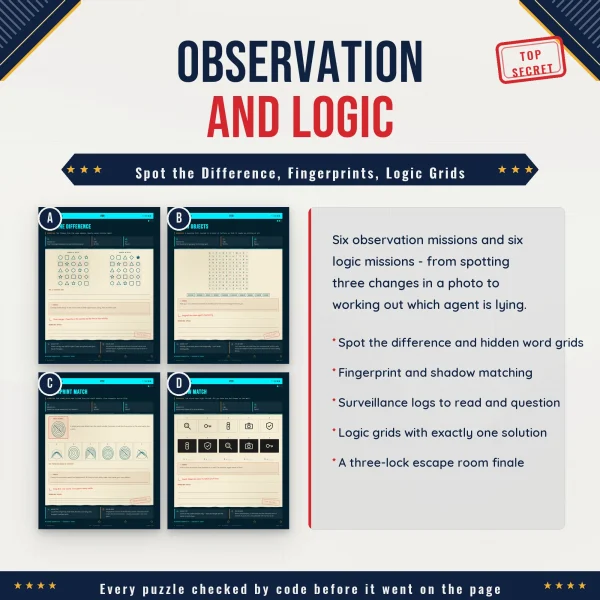
A field note in our Spy Games for Kids book explains why: eyes skip over what they’re not expecting, so things get hidden in plain sight more often than in clever hiding places.
So a clue taped under the edge of a picture frame often stays hidden longer than one tucked in a drawer, and it keeps players out of the drawers too.
For older kids, put the clues in code. The same Doodlora Studio book has a page for inventing a cipher, with three ways to build one.
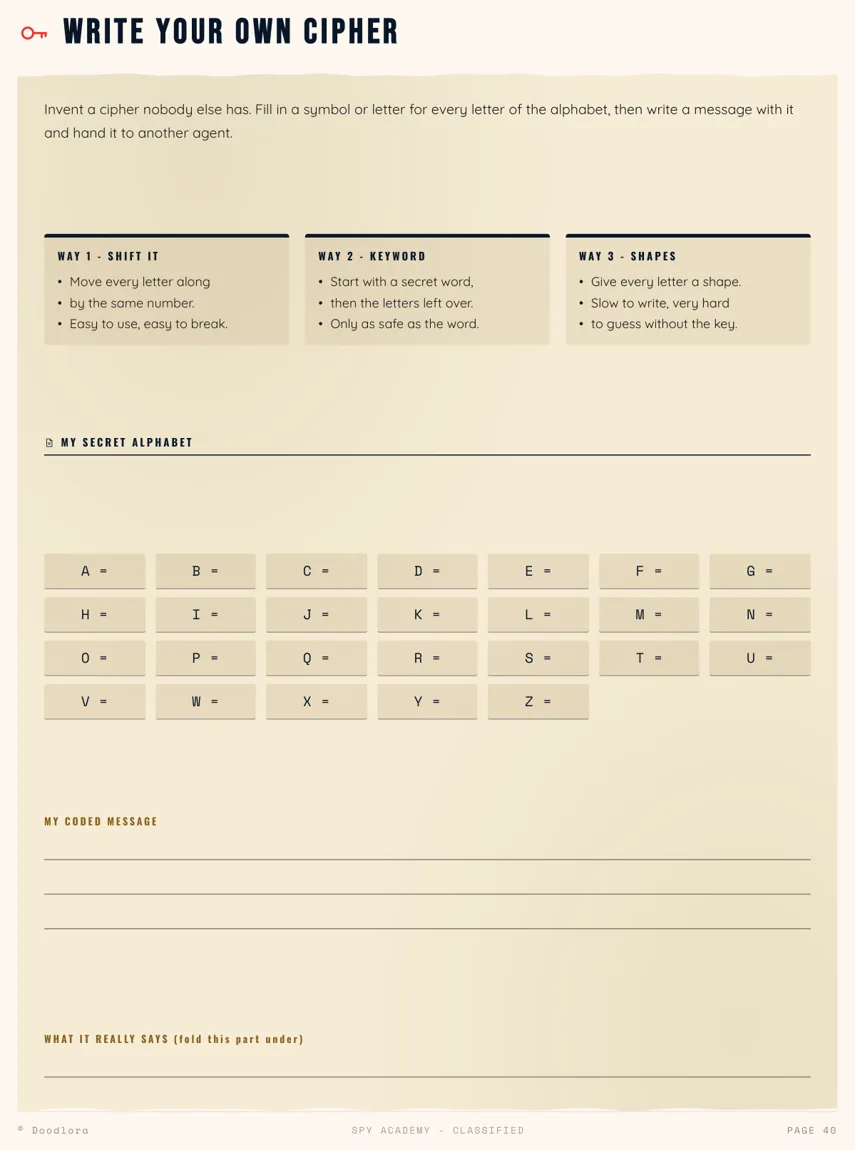
Shifting every letter by the same number is easy to use and easy to break.
A keyword alphabet is only as safe as the word you pick, and giving every letter a shape is slow to write and very hard to guess without the key.
Match the cipher to the youngest codebreaker on the team, since a code nobody can crack ends the hunt at clue two.
A page of four “Top Secret” message cards comes with it, made to be cut out, written in code and hidden around the house.
The Spy Games for Kids book warns that fit-to-page printing shrinks those cards out of alignment, so print them at actual size.
Indoor scavenger hunts for a classroom, an office or a teen party
Away from home, the list, the boundary and the scoring hardly change; what changes is whether players may touch anything.
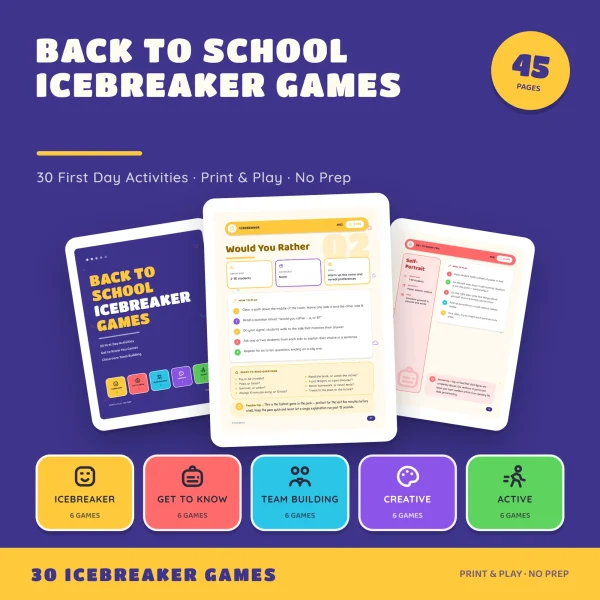
In a classroom, our First Day of School Icebreaker Games run the hunt as a way to learn the room.
The page asks for 10 to 15 things on one list and teams of 3 or 4 working from the same list.
Items stay where they are and teams write down the location, the 15-minute limit holds, and the class goes over the answers together at the end.
The list it suggests includes the tissues, the pencil sharpener, a book you want to read and the class calendar.
Its teacher tip is the best rule for choosing items anywhere: build the list from the things students will ask you about in week two.
In a hotel or an airport, our Family Vacation Games book has what it calls the indoor half of its hunt: 16 things to find without leaving the building.
Every line is something to spot rather than take, like a room number ending in 7, a plant that isn’t real, a sign in two languages or a clock showing another country’s time.
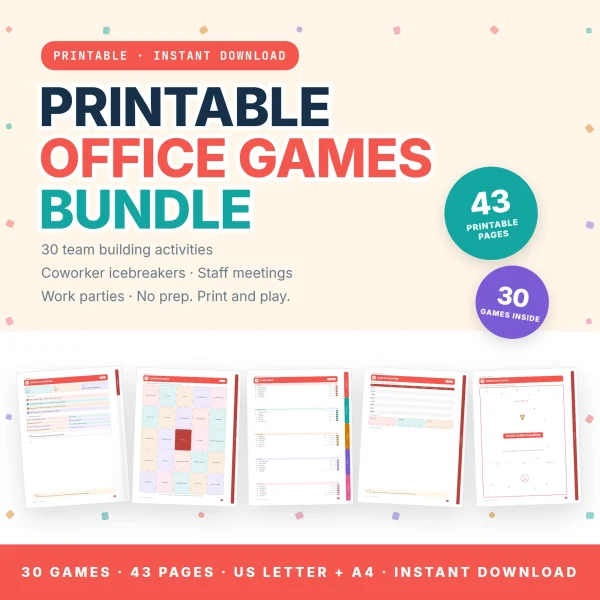
In an office, the hunt in Office Party Games runs about 20 minutes for 4 to 30 people in teams of 3 to 5.
Teams get fifteen minutes to collect or photograph twelve items. Three of the twelve need help from another department, and starters like a photo with someone from finance or a signature from a department head fit that rule.
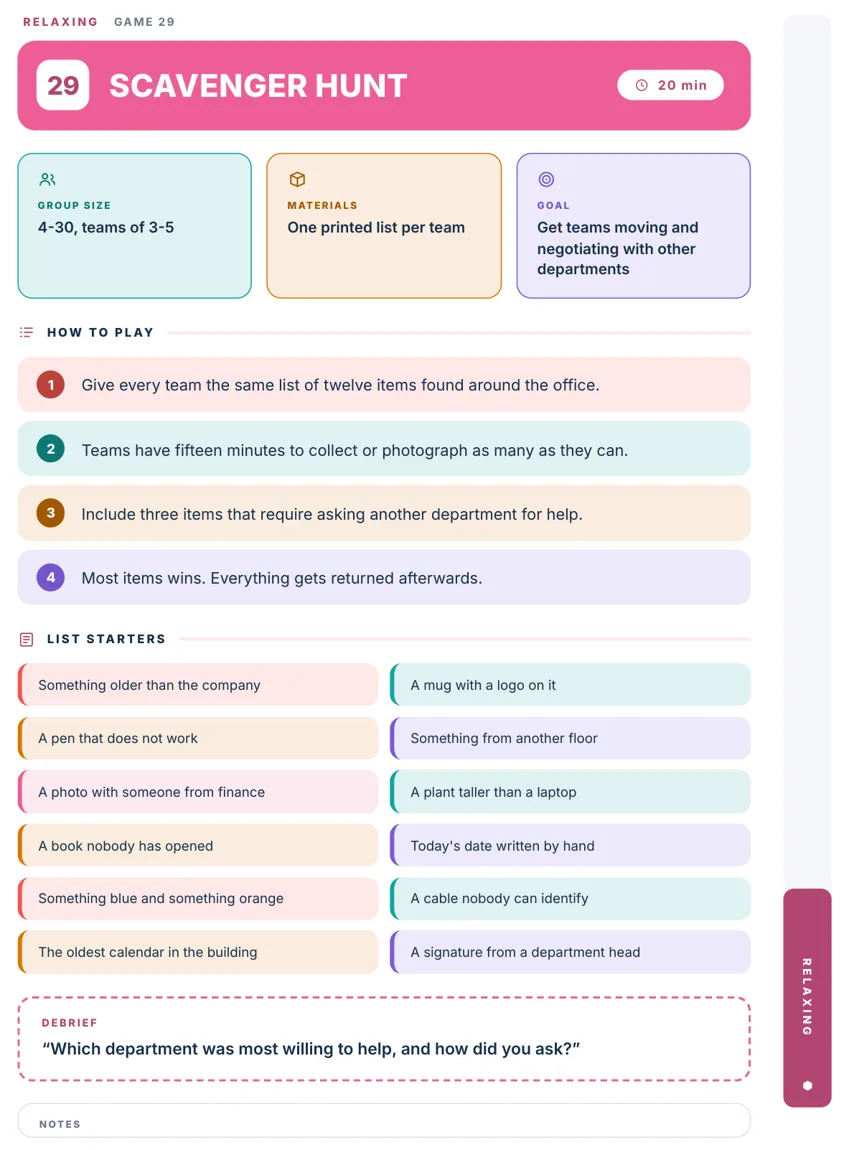
Most items wins, and everything gets returned. The list starters lean on office life: a pen that doesn’t work, a cable nobody can identify, something older than the company.
If the hunt is one game in a longer team afternoon, our icebreakers for coworkers draw on the same office set.
At a teen birthday party, Teen Birthday Party Games turns the hunt into 12 photo challenges, from a selfie with something yellow to a jumping photo with everyone off the ground.
Teams of 2 to 4 get one task card, one phone and a 15-minute timer. Then the photos go up on the biggest screen in the house, and everyone scores them together.
Each challenge has base points, plus bonus points that only count if the whole team agrees. That last rule turns the scoring into part of the party, and a clean sweep of the base points comes to 70.
Printables from this article
Related articles
Printable Scavenger Hunts
Christmas Scavenger Hunt: Clues, Hiding Spots and Ideas
Ready-to-copy rhyming clues, a Christmas morning gift hunt, picture and coded clues for different ages, and hunts for a party, a classroom and a lights walk.
Printable Scavenger Hunts
Nature Scavenger Hunt Ideas: Lists by Place and Season, Plus a Preschool Hunt
Things to find outdoors sorted by place and season, a picture hunt for preschoolers, the rules on taking finds home, and a simple way to score the game.