DIY Escape Room: How to Make One at Home, With Puzzles
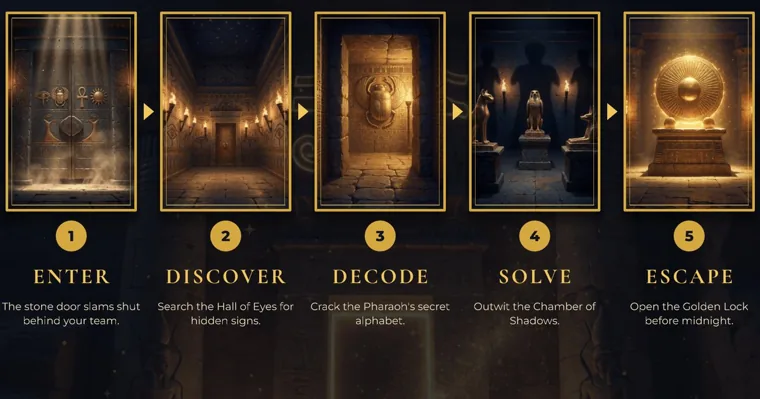
A DIY escape room at home is a short story and a chain of puzzles, where each answer unlocks the next clue and the last few answers make one final code. For a kids’ party, plan one room, a team of two to six, and about 45 minutes of play. The door to the room stays unlocked the whole time. Only boxes, envelopes and pages get “locked.”
Most of the work happens before anyone arrives: writing the story, building the chain backward from the final code, hiding the clues and writing hints. Below is that plan, then 14 escape room puzzles grouped by who’s playing, then what to do when a team gets stuck.
Plan the DIY escape room around the players, the room and the clock
Start with three questions: who is playing, where, and for how long. The answers decide how many puzzles you need and how hard they can be.
| Who’s playing | Team size | Puzzles | Play time | What changes |
|---|---|---|---|---|
| Kids who can’t read yet, with a grown-up on the team | 2–4 | 4–5 | 20–30 min | Picture, counting and jigsaw puzzles only |
| Kids around 8 to 12 at a birthday or sleepover | 2–6, or two teams | 6–10 | 30–60 min | Codes, word puzzles and a final lock |
| A family with mixed ages | Everyone together | 6–8 | 45 min | Easy and hard puzzles side by side |
| Tweens, teens and adults | 3–6 | 8–12 | 45–60 min | Logic grids, number puzzles and a meta clue |
Treat those counts as a starting point. A puzzle a ten-year-old solves in three minutes can stall a six-year-old for ten, so cut puzzles before you cut time. A young player’s frustration builds faster than the excitement of a long game.
For a family spread across ages, our family game night ideas has a section on keeping games fair when the youngest and oldest players are years apart.
How many players fit in one escape room
Four to six players around one table is the comfortable top end. Our Lost Tomb printable escape room is written for 2 to 6 players. Its party mode splits 4 to 6 players into teams of 2 or 3, each with its own clue log. Past six, someone ends up watching.
For a bigger party, run two copies of the same room side by side, or let teams take turns while the others do something else. Give every team its own answer sheet. One shared sheet means one kid holds the pencil and nobody else gets to solve anything.
Which room to use
Pick a room you can clear in ten minutes: a dining room, a playroom or a bedroom with a door. Before you hide anything, walk through it and decide what’s off-limits. Put a sticky note that says “not part of the game” on the TV, the bookshelf with the good china, and anything with a cord.
Then tell the players the boundary out loud. Escape room players open everything. Without a rule, someone will open the medicine cabinet.
Never lock the real door, and never put a child somewhere they can’t walk out of. The “escape” is from the puzzle, not the room. If toddlers live in the house, keep small keys and padlocks where they can’t reach them after the game.
How long it runs, with setup
Plan play time first, then add setup. Our two printable escape rooms say 30 to 60 and 35 to 60 minutes of play, and the Lost Tomb’s game master guide adds about 10 minutes to set up. A homemade room with hidden clues takes longer to set up than a printed one, so hide everything before the guests arrive.
Write a story with an ending the players can see
A story gives the puzzles a reason to exist. It only needs three things: what’s wrong, what the players have to find, and what happens when they find it. “The birthday cake has been locked away and the code is hidden somewhere in this room” is enough for a six-year-old.
Make the ending something physical, because the anticipation of opening it keeps younger players interested. A box that opens, a door to the next room, a bag of prizes with a combination lock, or a certificate that comes out of the last envelope. The Missing Moon Crystal, our printable escape room for kids, ends with a page that says the lock clicks and the crystal is back, then a certificate with spaces for a name, a date and a signature.
Read the story aloud at the start, then start the clock. The Lost Tomb’s start-here page gives the same order: hand the guide to one adult, read the story out loud and start the timer. It gives the players a shared goal before anyone starts tearing through drawers.
Build the puzzle chain so each answer opens the next clue
The chain is what makes an escape room different from a pile of puzzles. Each answer is a number, a word or an object, and it’s useful somewhere else. A count from the first puzzle sets a lock dial, or a word from the third puzzle tells players which book to open.
Design it backward. Decide the final code first, say four digits. Then decide where each digit comes from, and which puzzle hides the clue to that puzzle. Stop when you reach the first clue, the one you hand over at the start.
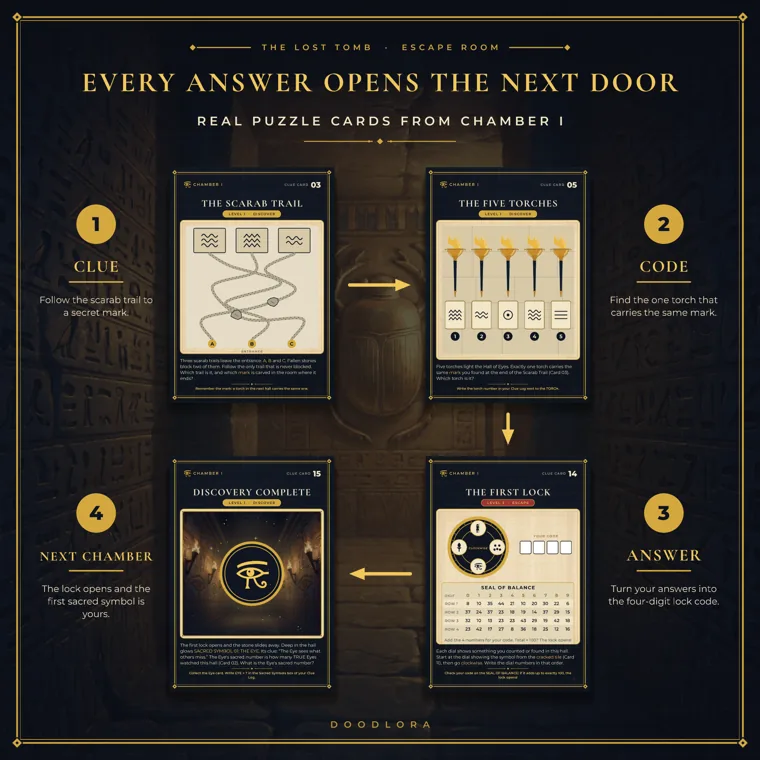
The Lost Tomb is built exactly like this across 60 cards in four chambers of 15. When a card needs an earlier answer, it names the card to look back at, so the team never has to guess. Write the same kind of pointer on your homemade clues: “You’ll need the number from the painting.”
Two layouts work at home:
- One straight line. Clue 1 leads to clue 2 leads to clue 3. Easy to build and easy to follow, but only one or two players can work at a time.
- Two or three branches that meet. Three short chains run in parallel, and their answers feed one final lock. Everyone has something to do, and the final lock brings the group back together.
Mixing puzzle types also spreads the concentration around: a strong reader takes the cipher while a careful counter takes the search. For a group of six, the branched layout is the one we’d pick. The Lost Tomb’s game master guide suggests the same thing for larger groups: each pair takes a few cards and then shares answers, and the lock card brings everything back together.
Test the chain before the party. Solve every puzzle yourself from the clue alone, in order, with the answer sheet out of sight. You’ll find the clue that points to the wrong drawer.
Hide the clues where players can find them
A clue that nobody finds ends the game, so hide for fun, not for difficulty. Tape a clue under a chair seat, inside a book jacket, in a coat pocket or behind a picture frame. Each spot should be somewhere a player can reach without climbing.
Number every clue on the back and keep a list of where each one went. When a team says “we’ve looked everywhere,” check your list before you give a hint. Often the clue has slipped behind a cushion. Hiding in plain sight, riddle clues and coded clues for a whole-house chain are laid out in the indoor scavenger hunt instructions, and they carry over to an escape room unchanged.
For a harder room, hide the clues in stages. The Lost Tomb guide’s harder mode puts its four chapters in four different rooms or envelopes, and only reveals the next location when a lock opens. At home, that means the first clue stays in the dining room and the second room stays shut until the first code works.
Locks for a DIY escape room, and how to play without them
Real combination locks add excitement, and also frustration when one dial sits a number off. A three- or four-digit padlock on a toolbox, a lockable cash box, or a zipper bag with a small luggage lock will all work. Put the locks on containers, never on a room.
You don’t need any locks, though. Three paper versions work for kids:
- Say the code to the game master. In The Missing Moon Crystal, players say the four-digit code out loud, then turn the page to see if the tower agrees. No real lock required.
- A sealed envelope. Write “Open only when you have the 3-digit code” on the front, and the right code on a sticky note inside. Wrong code, back in the envelope.
- A self-check grid. Players check their own code against a grid of numbers and only call the adult in when they’re sure.
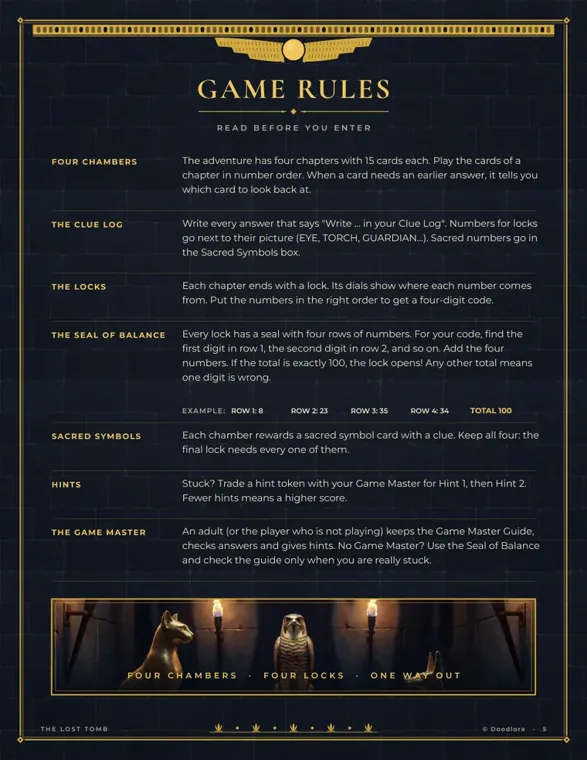
The Lost Tomb uses that last one, which it calls a Seal of Balance. Every lock card prints four rows of numbers. Players find the first digit of their code in row 1, the second in row 2, and so on, then add the four numbers. A total of exactly 100 opens the lock, and any other total means one digit is wrong.
You can copy the idea for a homemade lock. Make a 4-row, 10-column grid, put the right number in each row’s correct column so the four add to a total you choose, and fill the rest with random numbers.
Printable escape rooms when there’s no time to build one
If you have one afternoon, not a week, print one instead. Both of ours run on paper and pencils, and both keep the answers in a separate section for the grown-up.
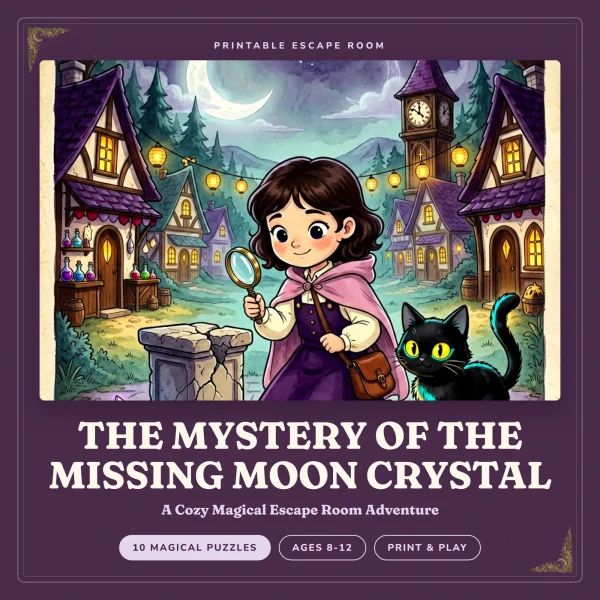
The Missing Moon Crystal is the smaller one, for ages 8 to 12, with 10 puzzles in a 30-page book. Each puzzle gives one number, and the last puzzle tells players which four numbers open the final lock. The book says to print pages 5 to 16 for players and keep pages 27 to 29, the answer key, to yourself.
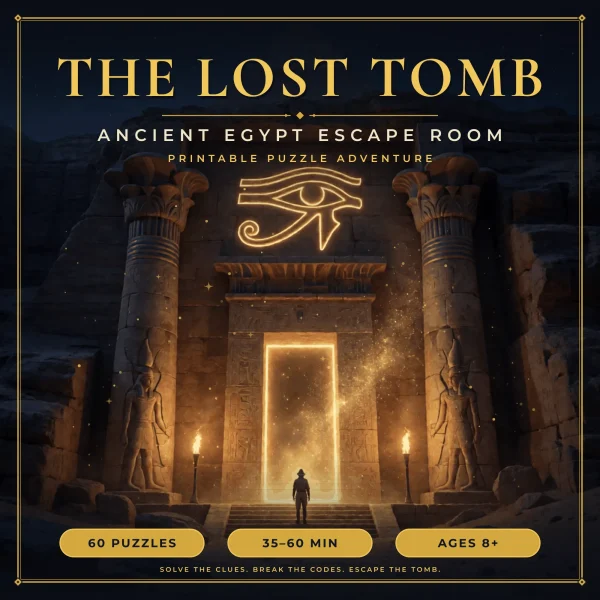
The Lost Tomb is the longer game. It runs 60 puzzle cards across four chambers and five locks, for ages 8 to 14 and 2 to 6 players. A 25-page game master guide has two hints for every card. Its Challenge mode, marked for ages 11 and up, cuts the hints and the time.
Either one also works as a skeleton for your own room. Print the puzzles, then hide the pages around the house instead of handing them over in a stack.
Escape room puzzles for younger kids: find, count and fit
These puzzles need no reading, so a five- or six-year-old can solve them with a grown-up on the team. Each one ends in a number or a picture.
Hidden object count
Prep: 5–10 small paper stars, stickers or toy animals. Setup: Tape them around the room in plain sight, then write the clue “How many stars are hiding here?” Ends: The count is a digit for the lock.
The catch is objects you didn’t put there. If the room already has a star on a pillow, either remove it or count it yourself.
Jigsaw message
Prep: A drawing or a printed number, glued to card stock and cut into 4–6 pieces. Setup: Hide the pieces in different spots. Ends: When the picture is whole, it shows the next hiding place or a digit.
Number the backs of the pieces so you can tell what’s missing. Keep the cuts straight for younger kids, since wavy jigsaw edges take far longer than you’d expect.
Color sequence
Prep: Four colored paper circles taped in different spots, each with a small number on the back. Setup: The clue is a row of four colored dots, for example red, blue, yellow, green. Ends: Players find each circle, flip it, and read the numbers in the clue’s order.
Check that nobody on the team is color-blind before the party. If someone is, add a shape to every color.
Escape room puzzles for kids who read: codes and words
Codes are the heart of most escape rooms. For kids who read comfortably, a code page and a word puzzle can carry most of the game.
Symbol cipher
Prep: An alphabet chart where every letter has a symbol, and a short message written in symbols. Setup: Put the chart in one place and the coded message in another. Ends: The decoded word is a hiding place or a password.
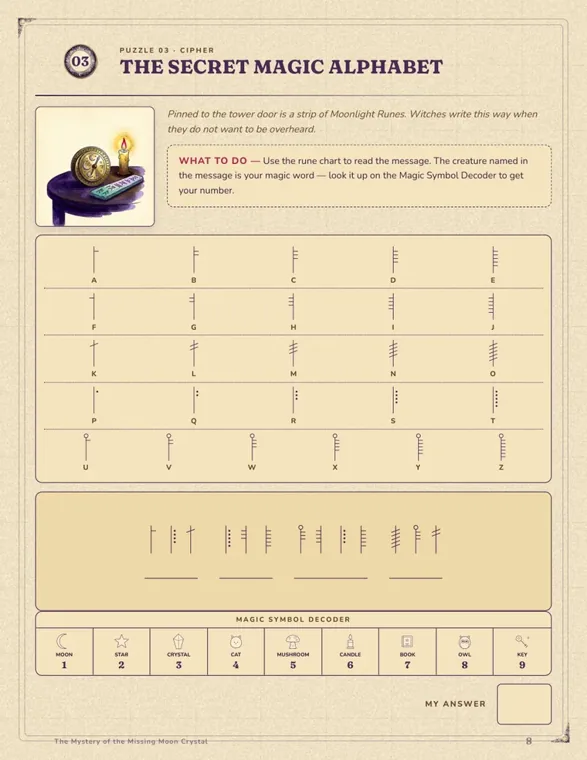
Keep the message short, three or four words. The Moon Crystal’s coded message is four words long, and the decoder row turns one of them into a number. Long messages turn into copying work, and kids lose interest halfway.
Letter shift
Prep: A message where every letter moves the same number of places along the alphabet, such as A becomes D. Setup: Hide the shift number somewhere else in the room as its own clue. Ends: The decoded message.
Write out the alphabet on the clue for younger readers. Counting three letters forward in your head is slow for a new reader. The Lost Tomb’s clue log even keeps a box marked +3 next to SHIFT for its letter-shift card.
Word scramble
Prep: Three or four short words with the letters mixed up, each with a one-line clue. Setup: One sheet, often the first puzzle. Ends: The words, or a number made from them.
The Moon Crystal opens with this kind of puzzle. Each unscrambled word is worth one point per letter. Keep scrambled words to five letters or fewer for a first puzzle, so the game starts with a quick win.
Invisible message
Prep: A white crayon, white paper and watercolor paint. Setup: Write the clue in white crayon. Leave the paint and a brush with a note: “Paint this page.” Ends: The wax resists the paint, and the message appears.
Press hard with the crayon, and test one sheet first. A light hand gives you a message nobody can read.
Riddles
Prep: Three riddles whose answers are objects in the room. Setup: Put each riddle somewhere unrelated to its answer, so the spot doesn’t give it away. Ends: The answer object hides the next clue.
Riddle answers have to be unmistakable. If a riddle could mean the lamp or the clock, tape the next clue to both. Riddles for early readers and harder logic questions for older kids are collected by age in brain teasers for kids.
Mirror writing
Prep: A clue written backward, letter by letter, and a small hand mirror. Setup: Hide the mirror separately. Ends: Held up to the mirror, the message reads normally.
Print it on a computer in a mirrored font if your backward handwriting is shaky. A smudged backward letter can stop the whole room.
Escape room puzzles for older kids and adults: logic and numbers
These take longer and reward careful reading. Save them for the middle of the chain, after players have had a couple of quick wins.
Logic grid
Prep: Four people, four things each person did, and four clues. Setup: Draw a grid with people down the side and activities across the top. Ends: One square names the person you’re looking for.
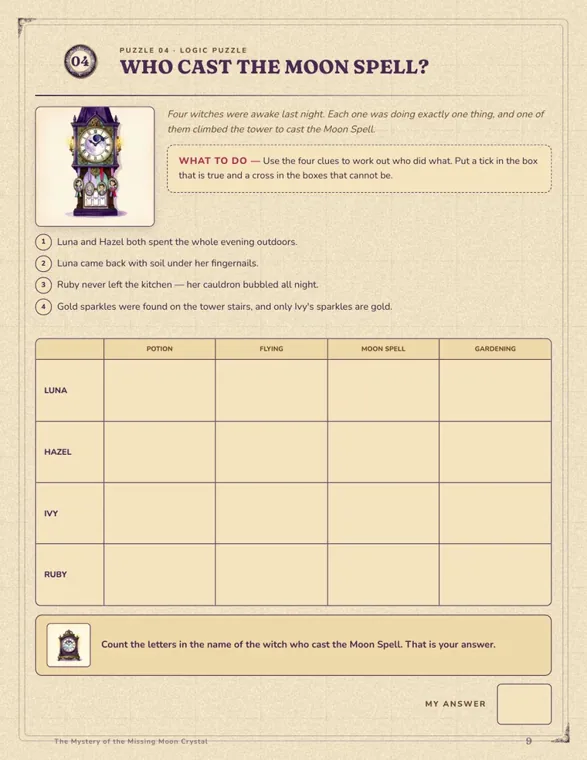
Four by four is enough for kids around 8 to 12, and three by three suits a first try. Make sure the clues allow only one answer by solving the grid yourself with no notes.
Picture equations
Prep: Three or four symbols, each worth a number, and a few sums using them. Setup: Start with a line that uses only one symbol, so players have a way in. Ends: A final sum gives a digit.
The Moon Crystal’s potion puzzle works this way with four bottles. If kids get stuck, point them back to the line with only one kind of symbol.
Order puzzle
Prep: Five items, five numbered spots and four or five clues like “The red book is in the middle.” Setup: Put real objects on a shelf, or draw them. Ends: The number on the last item is the answer.
Real objects on a real shelf make this more fun than a drawing, but players will move them. Take a photo before the game so you can reset the shelf.
Book code
Prep: One book from the room, and a clue like “Page 12, line 3, word 2.” Setup: Leave three or four of these lines, each pointing to one word. Ends: The words form a sentence that tells players where to go.
Use a book with a fixed edition you own, and check every page reference against that exact copy. A different printing of the same book can shift every page.
Final meta clue
Prep: A last clue that tells players which earlier answers to use, and in what order. Setup: Hide it last. Ends: The final code.
The Moon Crystal’s tenth puzzle is a meta clue. Its four “guardians” each describe a puzzle the team has already solved, and the answers go into the lock in the keeper’s order. The trap is sorting the four numbers from smallest to largest. Say in the clue that order matters.
How to give escape room hints without spoiling the game
Write the hints before the party, not in the moment. A good hint restores momentum without taking away the satisfaction of solving. For each puzzle, write two or three: a small nudge, a bigger clue and an almost-there hint. The Missing Moon Crystal’s hint cards use those three levels, and its game master page warns that handing over Hint 3 straight away takes away the best part.
Set a rule for when hints come out. The Lost Tomb gives the players hint tokens. In Standard mode, there are 6 tokens, each trade gets the next hint, and Challenge mode allows only 3. The optional score starts at 100, takes off 5 per hint and adds 10 for escaping before the timer ends. Points give older kids a reason to try once more before asking.
At a party, hide the hint cards around the room and let players trade something for each one. The Moon Crystal suggests this, and it turns a stuck moment into a search instead of an argument. For a sleepover version with this kit, see our sleepover games guide.
When a team is truly stuck, point them back to what they already have. Most stuck teams have the answer on their own sheet and haven’t connected it.
Timing the game and ending it
Use a visible timer, a kitchen timer or a phone face-up on the table. Say how much time is left at the halfway point and with 10 minutes to go. Those two announcements are reminders, not pressure, and they help a team decide whether to keep working on a puzzle or trade for a hint.
Decide in advance what happens when the timer runs out. For kids, let the team finish. The Lost Tomb’s scoring already allows for this: escaping before the timer adds 10 points, and a late finish simply doesn’t get them. A party where the final lock never opens leaves everyone flat.
End with the reveal. Open the box together, hand out the prize or certificate, and take a photo. Then walk through the puzzle chain with the players and show them where the clues were hidden.
To run it again for a second group, reset in the order you built it. The Lost Tomb’s reset notes are a good checklist: collect every card, put each chapter back in order, erase or reprint the clue log, and reset the timer.
When a DIY escape room goes wrong
- One kid solves everything. Split into teams with one answer sheet each, or give that child the hint cards and make them the game master’s helper.
- Ages are far apart. Give the youngest the counting and picture puzzles and the oldest the logic grid. The Lost Tomb’s easier mode does this with its levels, with the younger players on the Level 1 cards. Mixing levels keeps everyone’s attention on the same final lock.
- The room gets turned upside down. Repeat the off-limits rule, and remind them that clues are never hidden somewhere they’d have to break or climb. The Lost Tomb’s play-safe note says it well: careful thinking, not running.
- The answer key goes missing. Keep it in your pocket, not on the table. The printed answer pages in both of our kits are for the grown-up only.
- Printed pages come out the wrong size. Grids and cut-out cards can drift on fit-to-page printing, so print at actual size before you hide anything.
More party games and printables from Doodlora Studio work on the same table.
Printables from this article
Related articles
Printable Party Games
How to Plan a Baby Shower: Timeline, Food & 2-Hour Schedule
A baby shower plan from the first talk with the parents-to-be to the last gift: timing, guest list, budget, venue, a two-hour schedule, safe food and backup plans.
Printable Party Games
How to Plan a Bridal Shower: Timeline, Budget and Schedule
A host's plan for a bridal shower, from the first talk with the bride and co-hosts to the guest list, invitations, a timed party schedule, the gift opening and what to do when something slips.
Printable Party Games
35th Birthday Ideas: Party, Trip, Theme and Gift Ideas
Ways to celebrate turning 35, sorted by how many people the birthday star wants around, with group size, time, prep and the snag to plan for in each.