Children’s Science Activities: Sorting & Measuring for Kids
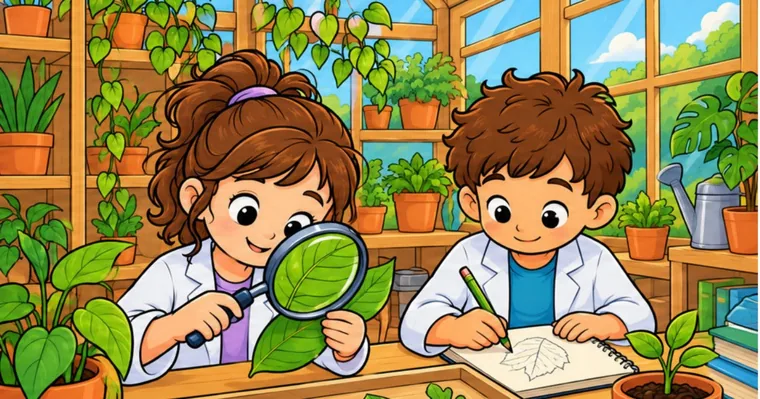
The best children’s science activities ask kids to do what working scientists do all day: look closely, sort things into groups, measure them and write down what they saw. A tray of pebbles, a ruler, a string with a metal washer and a jar of dried beans cover all four, and none of them needs chemicals, heat or batteries. The twelve activities below run from a 15-minute leaf study to a two-week bean jar, and each one lists supplies, steps, a closing question and the snag to expect.
Science activities at home: pick one by age and time
Choose by the child first and the clock second. A three-year-old can sort and splash for ten minutes; an eight-year-old can run a pendulum test with three trials and a written result. Treat the ages in the table as our planning suggestions rather than rules; the times include cleanup. Teaching a preschool class? The preschool weather activities add circle-time weather charts and snow and ice tests, such as freezing a cup of water outside overnight.
| Activity | Ages | Time | Group | What you need |
|---|---|---|---|---|
| Hand lens leaf study | 3+ | 15 min | 1–4 | Leaves, a magnifying glass, paper |
| Shadow tracing | 4+ | 3 short checks over a day | 1–3 | A small toy, chalk or paper, sun |
| Naming three cloud types | 5+ | 10 min a day | 1–4 | A window, a pencil, a log sheet |
| Rock sorting tray | 4+ | 20 min | 1–4 | 10–20 pebbles, an egg carton |
| Magnet hunt | 4+ | 15 min | 1–4 | One large magnet, household objects |
| Sink or float | 3+ | 20 min | 1–3 | A tub of water, 10 objects, towels |
| Length detective | 5+ | 20 min | 1–6 | A ruler or tape measure |
| Coat hanger balance | 5+ | 30 min | 1–3 | A hanger, two cups, string |
| Pendulum timing | 7+ | 30 min | 2–4 | String, washers, tape, a timer |
| Jar rain gauge | 6+ | 1–2 weeks | Family or class | A straight-sided jar, a ruler |
| Bean in a jar | 5+ | 1–2 weeks | Family or class | A clear jar, paper towels, dried beans |
| Observation notebook | 6+ | 10 min a session | Anyone | A notebook, pencil, ruler |
Before the first activity: a four-step routine and a safe supply box
Every activity here follows the same loop, and naming the steps out loud is half the lesson. Ask one question (“Which rocks are heavy?”). Let the child guess before touching anything. Do the looking or measuring. Then record the answer with a drawing, a tally or a number, and talk about whether the guess held up.
Keep the tools in one shoebox so a science session can start in two minutes: a magnifying glass, a ruler, a soft tape measure, measuring cups, string, a few metal washers, clear plastic cups, masking tape, paper and pencils. A kitchen scale is a bonus. Everything in the box is safe to handle, and that is on purpose.
This list leaves out anything that mixes chemicals or household cleaners, uses dry ice, flames or a hot stove, runs on batteries or wall power, or needs a craft knife. Those belong in a supervised lab, not on a kitchen table with a preschooler. Water, salt, ice and food coloring are fine with an adult in the room.
For children under 3, check the small things in the box. The Consumer Product Safety Commission bans children’s products for that age that present “a choking, aspiration, or ingestion hazard because of small parts.” Pebbles, dried beans, paper clips and washers are exactly that size, so keep them for older siblings or hold them yourself.
Science activities for preschoolers: looking closely
Observation comes first because it needs no reading, no numbers and almost no setup. These three work for ages 3 to 6, and older kids can add measurements to any of them.
Hand lens leaf study
Ages 3 and up, about 15 minutes, one to four children. Collect three or four different leaves on a walk, then put them on a white plate. Hand each child a magnifying glass and ask them to find the “lines” on each leaf. Older preschoolers can draw the pattern they see and match each drawing to its leaf.
The snag is focus. Kids hold the lens at arm’s length and see a blur, then give up. Show them to hold the lens close to the eye and bring the leaf up slowly until the veins look sharp. End by asking which leaf had the most lines. If you want a bigger collecting trip, the nature scavenger hunt lists sort finds by place and season, including a look-only list for things that stay outdoors.
Shadow tracing on a sunny day
Ages 4 and up, three short visits on one sunny day. Stand a small toy on a sheet of paper or on the sidewalk in a spot that gets sun all day. In the morning, trace its shadow with chalk or a pencil and write the time. Come back around lunch and again mid-afternoon to trace it in a different color.
Ask the child to predict the next shadow before each visit: longer, shorter, or pointing a new way? The shadow is shortest around the middle of the day and grows again toward evening. The one rule to say every time: never look straight at the sun. Mark where the toy stands, too, because one bump moves every shadow after it.
Naming three cloud types from a window
Ages 5 and up, ten minutes a day for a week. Teach three names: cumulus clouds are puffy heaps with rounded tops, cirrus clouds are thin, wispy streaks, and stratus is a broad, low layer. Once a day at about the same time, the child looks out the same window, writes the date and time, and names the main cloud shape.
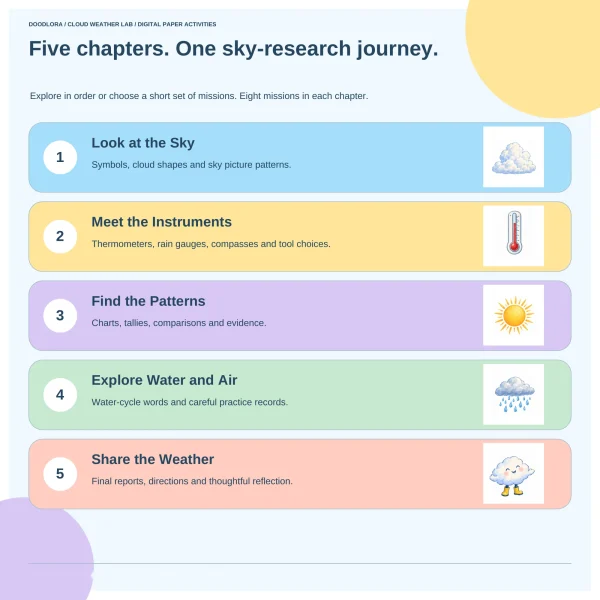
The snag is mixed skies, when two types show up at once. Let the child write both and circle the bigger one. At the end of the week, count which type appeared most. Mission 02 in our Cloud Weather Lab activity pack practices these three names with shape clues, and its window weather journal page has room for four dated observations.
Sorting activities for kids: rocks, magnets and sink or float
Sorting is where observation turns into thinking, because the child has to pick a rule and stick to it. All three activities work at a kitchen table, so they also fill a wet afternoon.
Rock sorting tray
Ages 4 and up, about 20 minutes, one to four children. Gather 10 to 20 pebbles from a yard or park and set out an egg carton. Ask the child to sort the rocks by one rule, such as color, rough or smooth, striped or speckled. Then dump them out and sort again by a different rule.
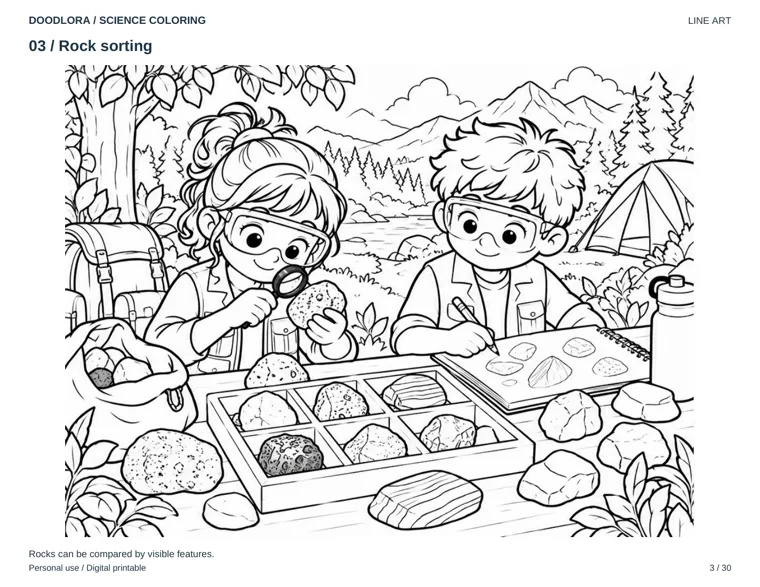
The second sort is the real lesson. Kids often decide there is one correct answer, and seeing the same rocks fall into new groups shows that scientists choose the rule. To finish, ask: “Which rock was hard to place?” A rock that fits two groups is a good thing to draw. Wet a few rocks with a damp cloth at the end, since many colors show up brighter when wet.
Magnet hunt: what sticks?
Ages 4 and up, about 15 minutes. Use one large magnet, such as a magnetic wand or a big fridge magnet, and gather ten objects: a steel paper clip, a spoon, a key, aluminum foil, a coin, a plastic block, a pencil, a sock, a jar lid and a nail. Make two paper circles labeled “sticks” and “doesn’t stick.”
Before each test, the child guesses which circle the object belongs in. The surprise is usually the foil and the coin, which look metal but may not stick, while a steel jar lid usually does. End by asking what the sticking things have in common. Use one large magnet only. The CPSC warns that when high-powered magnets are swallowed, “the ingested magnets can attract each other, or other metal objects, and become lodged in the digestive system,” so small magnet balls and tiles stay out of this game.
Sink or float sort
Ages 3 and up, about 20 minutes, one to three children. Fill a dish tub with water and lay out ten objects: a cork, a coin, a crayon, an apple, a plastic lid, a rock, a sponge, a spoon, a wooden block and a grape. The child sorts them into “will float” and “will sink” piles first, then tests each one.
Keep an adult at the tub the whole time and lay a towel underneath. The interesting moment is the apple, which is big but floats, next to a small coin that sinks. That pair shows size isn’t the rule. Finish by moving each object into its true pile and counting how many guesses were right. On a rainy day, pair this with the indoor games in rainy day activities for kids.
Measuring activities for kids ages 6 to 10: rulers, balances and timers
Measuring is the step that turns “it’s bigger” into “it’s 3 inches longer,” and children from about age 6 can start to do it on their own. Each activity below gives them a number to record and compare.
Length detective
Ages 5 and up, about 20 minutes, works for a small group. Give each child a ruler and a list: a hand span, a shoe, a spoon, a book, a toy car. They guess each length first, measure it, and write both numbers side by side. Older kids can find three things in the room that are longer than 6 inches and three that are shorter.
The common mistake is starting from the end of the ruler. Many rulers have a small gap before the zero line, so point to the zero and line it up with the edge of the object every time. Finish by asking whose guess got closest and whether guessing got easier by the last item.
Coat hanger balance
Ages 5 and up, about 30 minutes, one to three children. Hang a plastic coat hanger from a doorknob or a chair back. Tie a paper cup to each end with string, at the same length. Check that the empty hanger hangs level, and slide a strip of tape along the bar if it tips. Then compare: ten crayons against five coins, a spoon against a pencil.
The child predicts which side will drop, adds the items and watches. Next, they try to make it level by adding small objects to the lighter cup, counting as they go. That count is a real measurement: “the spoon weighs as much as seven paper clips.” Wrap up by lining the objects up from lightest to heaviest.
Pendulum timing
Ages 7 and up, about 30 minutes, best with two to four kids so one can time while another counts. Tape a string to the edge of a table so it hangs freely, and tie one metal washer to the end. Pull it a short way to one side, let go, and count full swings (over and back) in 15 seconds on a phone timer.
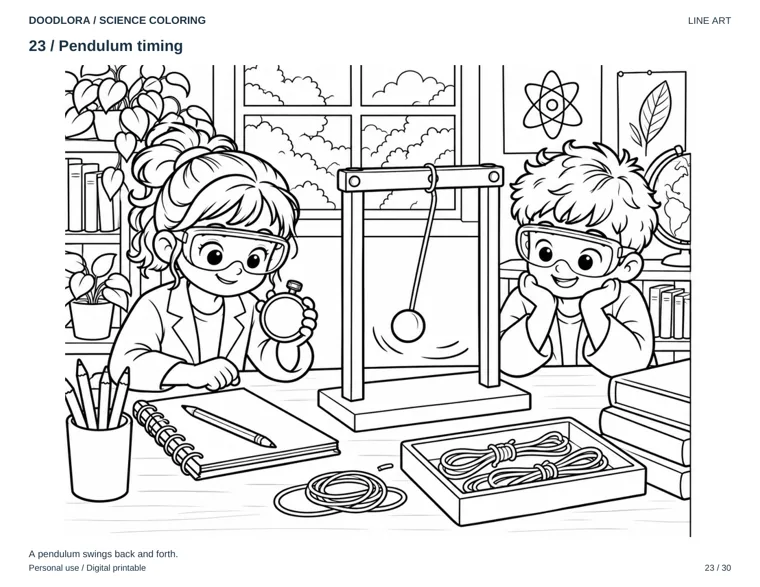
Now change one thing at a time. Run the test again with the string half as long, then with three washers instead of one. Most kids expect the heavier bob to swing faster. It doesn’t: the time of a swing depends on the length of the string, and Wikipedia’s pendulum article notes it “is independent of the mass of the bob.” Keep the swings small, and run each test twice. The snag is changing two things at once, so write one change per row.
Jar rain gauge
Ages 6 and up, one to two weeks, good for a family or class. Use a clear jar with straight sides and a flat bottom; a tapered or curved base makes the readings wrong. Tape a ruler to the outside with its zero line level with the inside bottom of the jar. Set the jar outdoors in an open spot, away from roofs and trees.
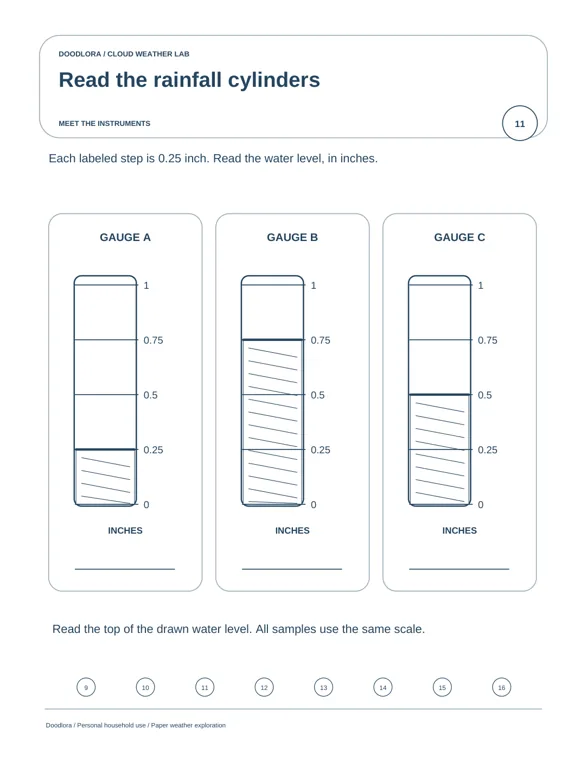
Check at the same time every day, read the water level at eye height, write the number, and empty the jar. Dry weeks are a result too, so record a zero rather than skipping the day. At the end, ask which day was wettest and whether the cloud log from earlier shows anything on those days. Every chart in the worksheet pack uses invented practice data, as its guide says, so real readings will look different.
Recording over days: bean jars and observation notebooks
Long-running activities teach the part of science that’s hardest to show in one afternoon: checking again, on time, and writing down what changed. Both of these suit a family or a classroom shelf.
Bean in a jar
Ages 5 and up, about one to two weeks. Line a clear jar with a folded paper towel, push two or three dried beans between the towel and the glass, and dampen the towel. Set it in a bright spot out of direct heat. Each day the child adds a little water if the towel feels dry, then draws what they see and writes the day number.
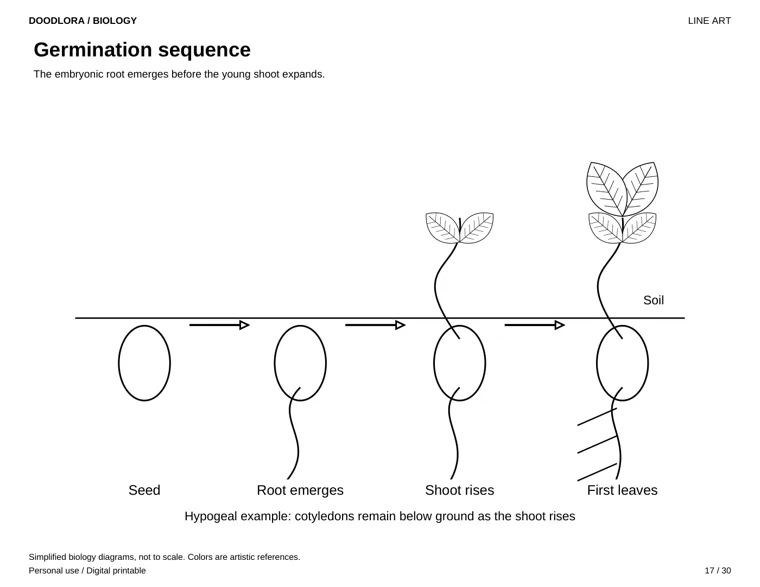
Here’s the snag to warn about. The germination page in our biology pack is labeled as a hypogeal example, where the seed leaves stay below ground. Wikipedia notes that the runner bean germinates that way, while the common bean (Phaseolus vulgaris) “shows epigeal germination,” lifting its seed leaves up into the air. If your jar holds common beans, expect the seed itself to rise, and ask the child to find the difference from the drawing. A soggy towel grows mold, so keep it damp, not dripping.
Observation notebook
Ages 6 and up, ten minutes a session, any group size. A science notebook page needs five lines: the date, the time, a sketch, one measurement and one “I wonder” question. Use it for any activity above. The habit matters more than the drawing, so keep the page simple enough to finish every time.
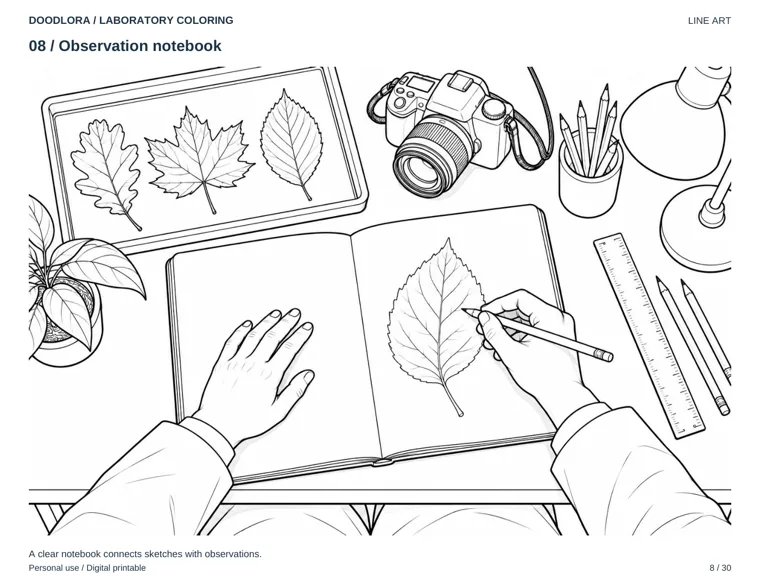
The skill to practice is telling an observation from a guess. “The leaf has a jagged edge” is an observation. “The leaf is from an oak” is a guess unless someone checks. Ask the child to mark guesses with a question mark. Mission 30 in the Cloud Weather Lab pack, “Separate an observation from a guess,” drills exactly this split.
Using science coloring pages as activity sheets
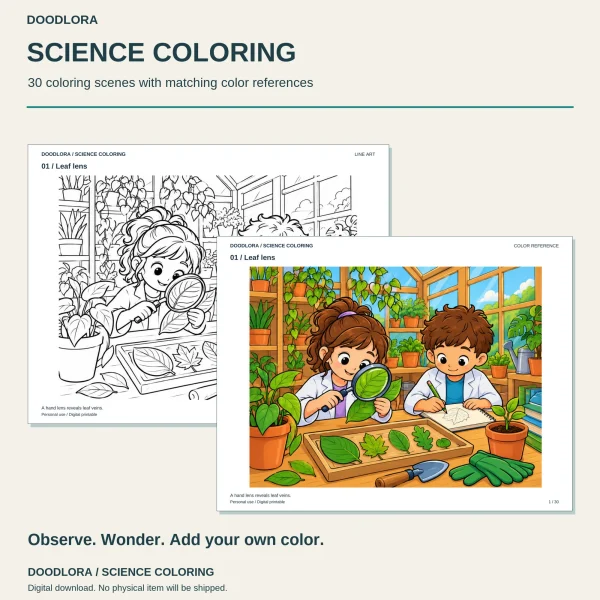
A coloring page works best after the hands-on part, when it gives a child a quiet way to replay what they just did. Match the page to the activity: color the rock sorting scene after a real sort, or the pendulum page after the timing test. Print one page per child, not the whole set.
Our science coloring pages have 30 scenes of the same two cartoon kids, and many line up with this list: leaf lens, rock sorting, magnet and clips, balance, length, pendulum and a ramp. Pages 9 to 12 show a closed circuit, a motor fan, a static balloon and an electromagnet. Treat those four as coloring and conversation only, not as build instructions.
The other packs suit different ages. The pages are AI-assisted drawings, simplified and not to scale, so read them as pictures to color and talk about, not as textbook references.
| Pack | Who it suits | What’s inside |
|---|---|---|
| Science coloring pages | Kids | 30 kid scientist scenes, line art plus a color reference |
| Cloud Weather Lab | Ages 7–10 with adult reading help | 48 pages, 40 weather missions with made-up practice data |
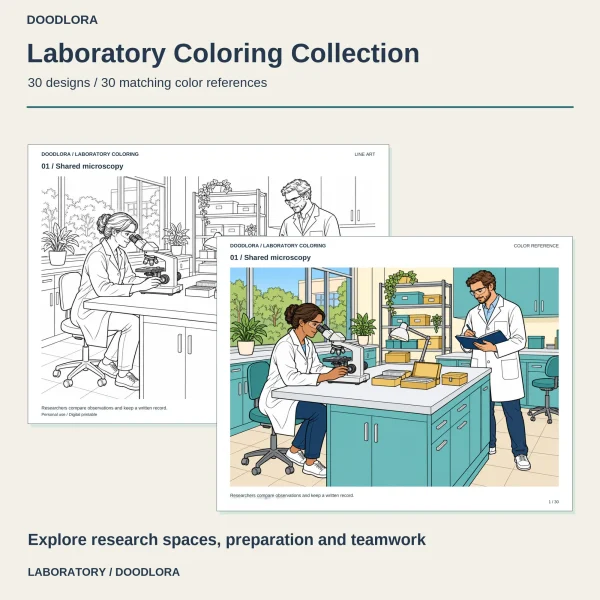
| Scientist coloring pages | Teens and adults | 30 detailed lab scenes of adult researchers measuring and recording |
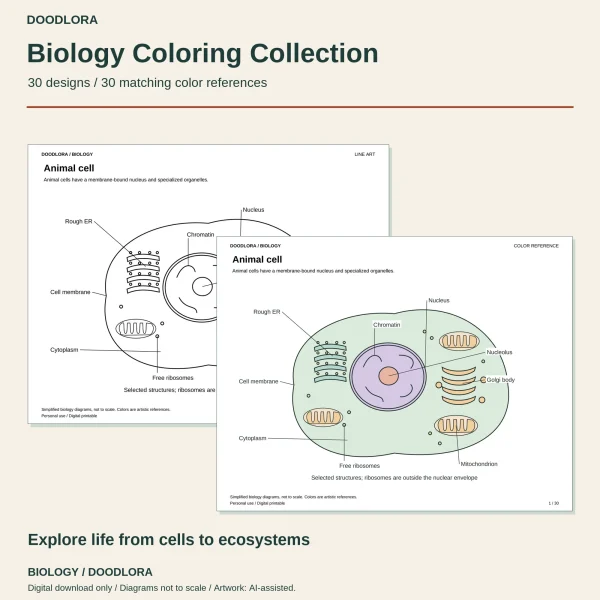
| Biology coloring pages | Teens | 30 labeled diagrams from cells to food webs |
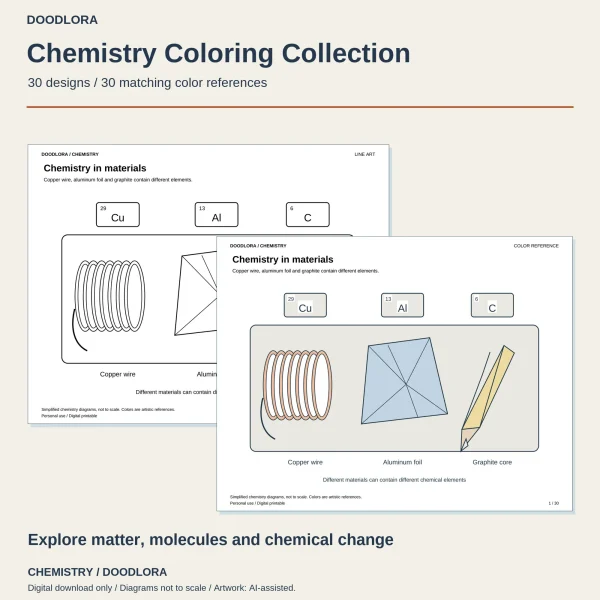
| Chemistry coloring pages | Teens | 30 labeled diagrams of atoms, molecules and mixtures |
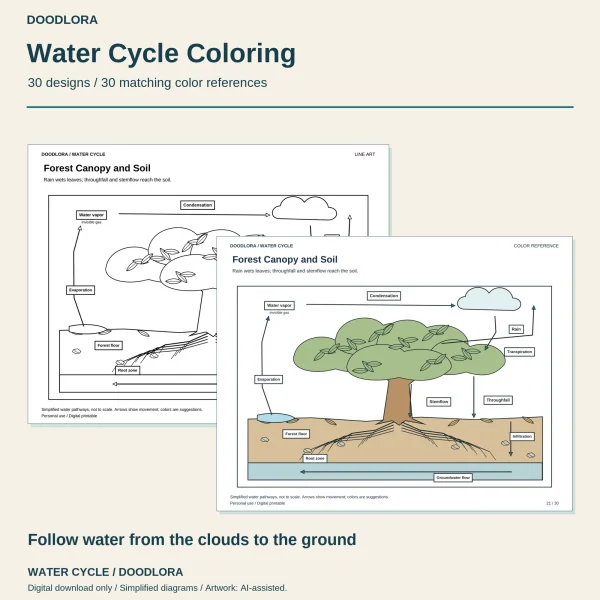
| Water cycle coloring pages | Kids and teens | 30 labeled landscapes showing where water flows |
The chemistry pack is for learning what atoms and molecules look like, not for trying anything. Its last page, a safety station with goggles and labeled storage, carries the line “Coloring illustrations are not instructions to perform unsupervised experiments,” and that’s the right way to use all six packs. For crisp lines, print the science scenes in landscape at actual size; how to print coloring pages covers the printer settings.
Ending a science session: questions that get kids talking
Close every activity with two minutes of talk, even if the result was a mess. Three questions cover most sessions: What did you guess? What happened? What would you change next time? A child who says “I’d use a longer string” has just designed an experiment.
Put the results where everyone can see them, such as a tally on the fridge or the bean drawings in a row. For an evening version of the same habit, the space activities for preschoolers include a moon watch that kids can log night by night, alongside games for circle time.
Printables from this article
Related articles
Kids Activity Books
Thanksgiving STEM Activities: Turkey Challenges for Kids
Nineteen Thanksgiving STEM challenges for home or the classroom, from cup towers and gourd ramps to pattern hunts and coordinate grids, with no flames, chemicals or batteries.
Kids Activity Books
Letter M Craft Ideas: Monkey, Mouse & Mushroom for Preschool
Twelve letter M crafts grouped by who is at the table, from a foil-print moon for one toddler to monkeys swinging on a paper-chain vine for a whole class, with ages, minutes, supplies, steps and where each one tends to go wrong.
Kids Activity Books
Letter R Crafts for Preschool: Raccoon, Rabbit & Rainbow
Eleven letter R crafts grouped by what the child is into, from a sticky tissue rainbow for 2-year-olds to a raccoon shadow puppet, with ages, minutes, supplies, steps and the usual slip.