Space Activities for Preschoolers: Games, Hunts & Moon Watch
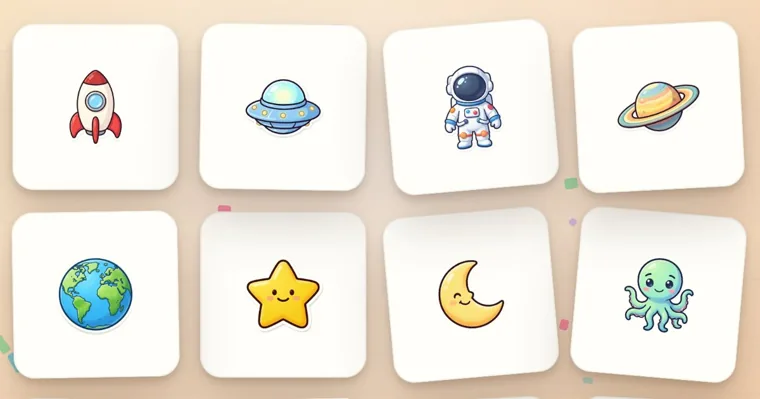
The easiest space activities for preschoolers are picture games: bingo with rockets and planets, a memory match, a hunt for hidden space cards, and a real-or-pretend sort. Add one moving game and one look at the real sky, and a preschooler gets a full space theme without reading a word.
Start from your situation rather than the activity. A class of 18 at circle time, two siblings on a rainy afternoon and one child at bedtime each need something different. So the eleven activities here follow those situations, with a five-day plan at the end. For each one you get the group size, what to print or gather, how to start, how it ends and the moment it most often falls apart. None of the timings come from a stopwatch. They’re estimates for three- to five-year-olds, and your group may run faster or slower.
Choose a space activity by group size and time
“Moves” means children get up and use the floor; “seated” means a table or a rug.
| Activity | Who it suits | Group | Prep | Time | Moves or seated |
|---|---|---|---|---|---|
| Space picture bingo | Class or family | 3 to a whole class | Print cards, cut 25 calling cards | 15 min | Seated |
| Act out the calling card | Circle time | Any | The bingo calling cards | 5 min | Moves |
| Rocket countdown | Transitions | Any | Nothing | 2 min | Moves |
| Memory match | Table time | 2–4 | Print 2 pages on cardstock, cut 24 cards | 10 min | Seated |
| Find the twin | Youngest players | 1–2 | The memory cards | 5 min | Seated |
| Real or pretend? | Small group | 2–6 | The memory or calling cards | 10 min | Seated |
| Color a space bookmark | Quiet time | 1 per bookmark | Print 1–2 pages, adult cuts | 15–20 min | Seated |
| Hidden space card hunt | Home or classroom | 2–6 per adult | Hunt sheet, hidden calling cards | 15 min | Moves |
| Flashlight hunt | Home, dim room | 1–3 | Flashlight, hidden cards | 10 min | Moves |
| Red planet color hunt | Home or class | Any | A Mars card | 5–10 min | Moves |
| Moon diary | Home, evenings | 1–2 | A paper with 14 boxes | 2 min a night | Outdoors |
| A space week | Class or home | Any | Pick from above | 5 days | Mixed |
For a 20-minute block, pair a seated game with a moving one. Bingo followed by the calling-card acting game uses the same cards and gives restless kids a break halfway.
Space games for circle time with a whole group
Big groups need an activity where every child has something to do on every turn. These three run on one set of pictures plus a countdown.
Space picture bingo
Bingo works for 3 children or a whole class and takes about 15 minutes. It teaches listening, matching and waiting for a turn, and non-readers can play because every square is a picture.
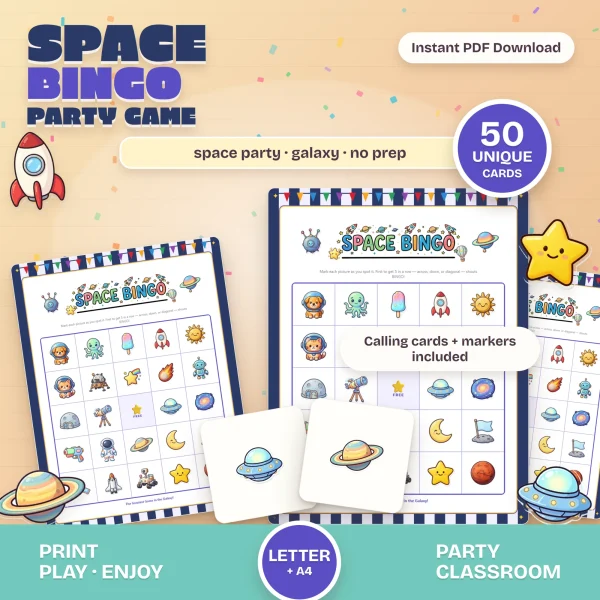
Space Bingo prints as 30 cards or 50, and you can pick cards with plain pictures or cards with a name printed under every picture. There are 25 calling cards, six to a page, plus a page of round markers. For preschool, print the labeled 30-card set for the class. The names help the adult calling, and the pictures do the work for the kids.
Hand out the cards along with the round markers from the file. Coins, buttons or cereal work too, though cereal tends to get eaten. Shuffle the calling cards into a bag, pull one, say the name and hold the picture up. Children cover the match. Show the calling card for a slow count of three before you put it down; a three-year-old needs to see it, not just hear “satellite.”
A card has 25 squares, and the middle one is a free star, which leaves room for 24 of the 25 pictures. That means almost every call lets every child cover something, which keeps small kids busy. It also means lines fill at nearly the same moment, so expect four or five shouts of “Bingo!” on one call. Settle it in advance: every child with a line on that call is a winner. Then go again, this time to four corners.
A few calling cards need a word of introduction: the moon base, the moon flag, the space ice pop and the ray gun. Hold those four up before the first game and name them together. When you call Mars, add “the red planet.” NASA’s Mars facts page explains the name: iron minerals in the Martian dirt rust, and that makes the surface look red.
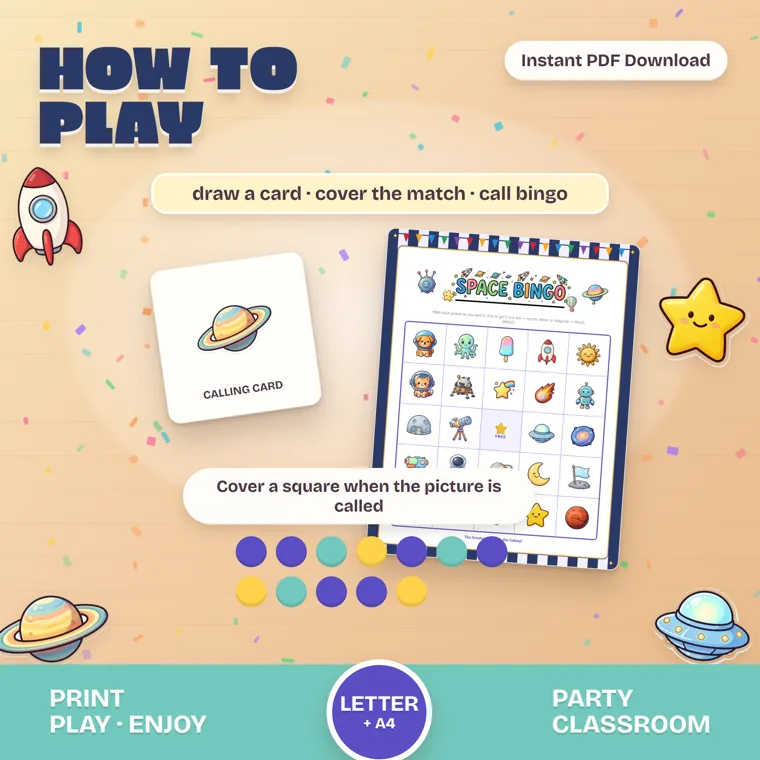
If you’re new to calling, the printable bingo rules explain winning patterns and how to check a card.
Act out the calling card
Run this moving game right after bingo, with the same calling cards. Keep it to about five minutes; the size of the group doesn’t matter.
Pick six or seven cards that are easy to act: rocket, robot, astronaut, UFO, meteor, shooting star and moon. Agree on one move for each before you start. A rocket crouches and jumps, a robot walks with stiff arms, an astronaut takes slow, floaty moon steps, a UFO spins slowly in place. Draw a card, show it, and everyone moves until you call “Freeze!” End on the astronaut, because slow steps calm the room down before the next sitting activity.
Watch out for the spinning. Preschoolers will spin until they fall over, so cap the UFO at a count of five, and keep a clear circle of floor between children.
Rocket countdown
A countdown is a two-minute filler for lining up or the end of circle time, and it needs nothing printed. Everyone crouches low. Count down from 10 together, getting quieter each number, then shout “Blast off!” and jump.
For three-year-olds, start from 5. Counting backward is harder than counting up, and a long countdown loses them before the jump. Once the group can do 10, let one child be the mission leader who counts.
Quiet space activities for one to four children
These suit a center, a sibling pair or one child while a younger one naps. All four are seated, and three of them reuse the same cards.
Memory match with 12 pairs
Two to four children can share one memory game, and a round lasts around ten minutes. Nobody has to get up, which makes it a good pick after the movement games.
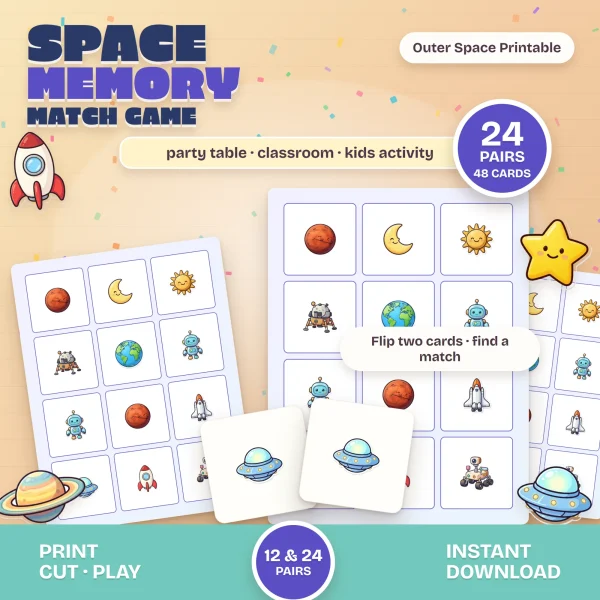
Of the two sets in our Space Memory Match, the smaller one suits preschool. Its 12 pairs fill two pages: the Sun, the Moon, Earth, Mars, a UFO, a rocket, a space shuttle, a satellite, a telescope, a robot, a lunar lander and a Mars rover. Every file has a version with names under the pictures and one without. Use cardstock. Plain paper lets the picture show through a face-down card, and the instructions at the end of the file warn about that too.
Mix the cards up and spread them out picture side down. Each child turns over two cards per turn. Two of the same picture stay with that child, who gets to try again, and a mismatch is flipped back where it was. Play stops once the table is empty.
Where it stalls: 24 cards is a lot for a three-year-old. Start with six pairs (12 cards) in a three-by-four grid, and add pairs once the child is finding them easily. Also decide ahead whether to count pairs at the end. For younger groups, “we found them all” can be the finish, with nobody keeping score.
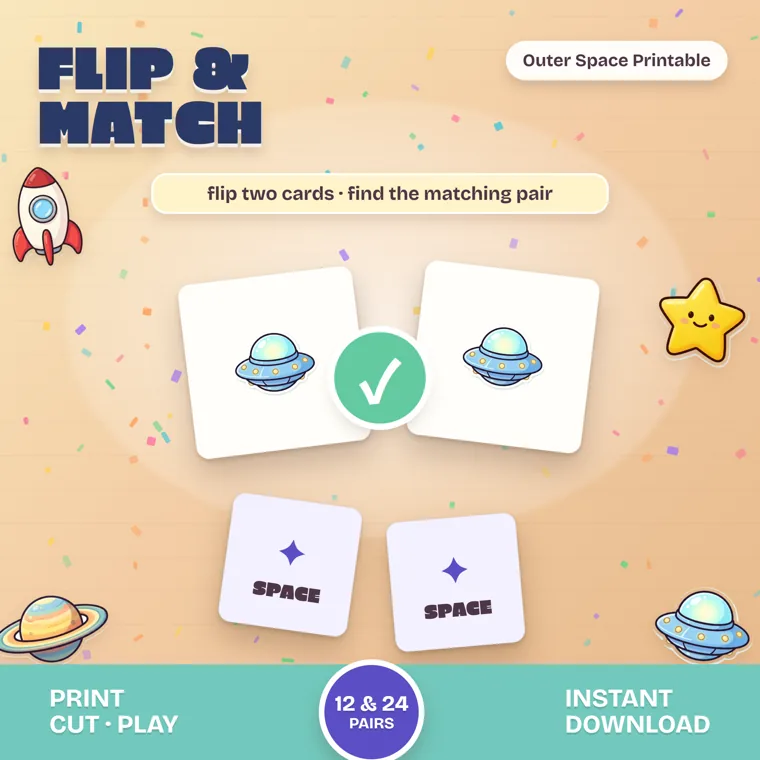
Team play and scoring options are in our memory game rules.
Find the twin
Children who aren’t ready for memory yet, or who get upset when pictures disappear, can start with this warm-up. It takes about five minutes.
Lay one card from each pair face up in a row. Hand the child the matching cards one at a time and ask, “Where’s the other rocket?” The child puts it on top of its twin. When every picture has its twin, flip one row face down and you’re playing real memory.
Real or pretend?
The space cards mix real things with make-believe, and that mix makes a good sorting game for 2 to 6 children. Plan on about 10 minutes.
Use the memory cards or the bingo calling cards. Make two piles with a label on each, “real” and “pretend,” and add a third pile for “not sure.” Hold up a card, let the children decide, and put it on a pile. The Moon, Earth, the Sun, a rocket, a satellite and a telescope go to “real” quickly. An alien, a UFO, a ray gun, a space cat in a helmet and a space ice pop usually go to “pretend.”
The robot and the Mars rover are the interesting ones, so let the children argue. The rover is a real kind of robot that drives on Mars, and the cartoon robot has a smiling face no real one has. The “not sure” pile is where good talking happens. Children don’t have to settle every card for the game to work.
Color a space bookmark
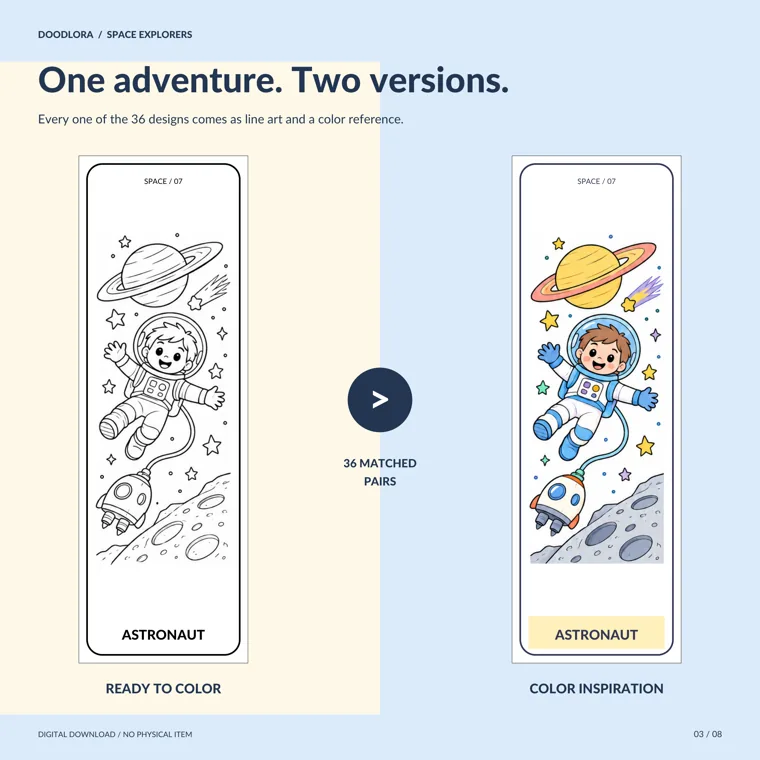
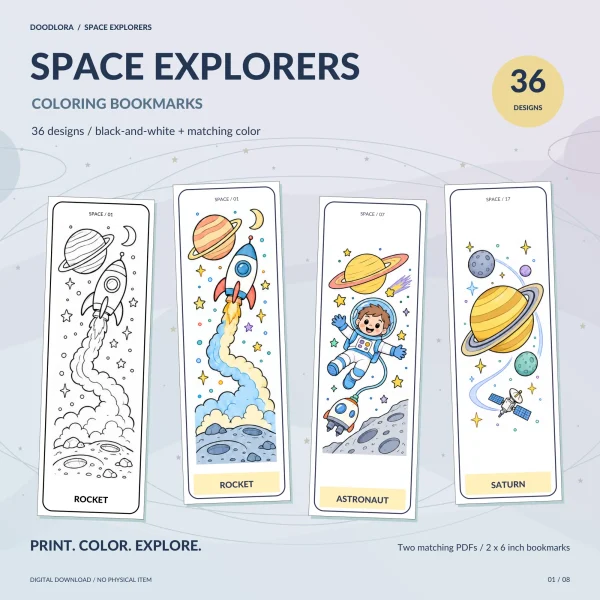
A bookmark is a small enough coloring job that a preschooler actually finishes it, usually in 15 to 20 minutes. The space coloring bookmarks file holds 36 designs, three to a page, each 2 by 6 inches. A second PDF has every design colored in, which you can set on the table as a guide.
Before printing the whole file, send page 2 to the printer and hold a ruler to its test line, which should measure exactly 1 inch. If it comes out short, the printer is scaling the page, so switch off fit-to-page. An adult should cut along each outer rectangle; the file says so too, and narrow strips are hard for small scissors.
Some designs are busy, with lots of tiny stars and craters. For younger children, pick the ones with one big shape, like the single rocket or the astronaut, and let them color only the large parts. A crayon is easier than a fine marker on a 2-inch strip.
Hunting for space things around the room
Hunts get preschoolers walking, looking and checking things off. Plan one adult for every 2 to 6 children, and keep the hunt inside one room or a fenced yard.
Hidden space card hunt
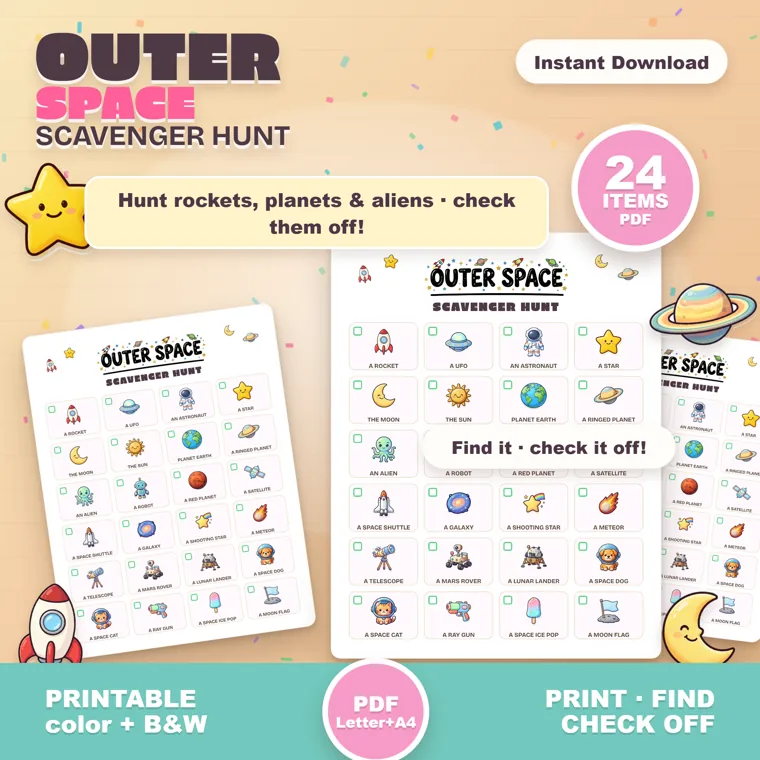
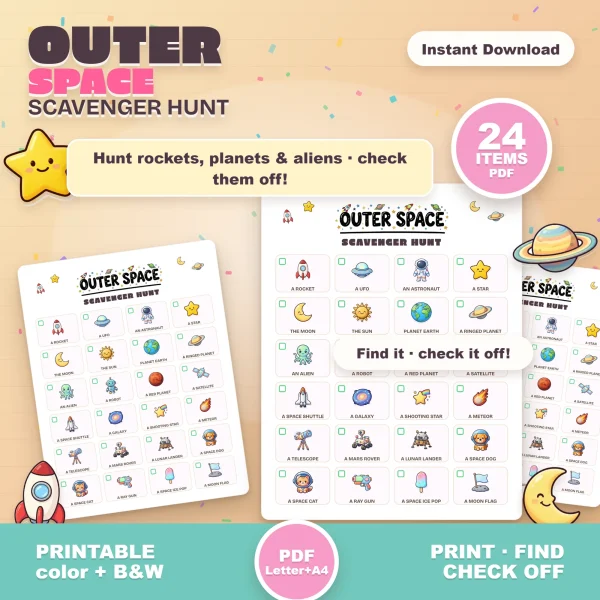
This hunt takes about 15 minutes, and a pair of children can share one sheet. There are 6 pages in the Outer Space Scavenger Hunt: a how-to page, a picture grid of 24 things to find, two list versions, a score page and a certificate headed “I Did It!” Each comes in color and in black and white. For non-readers, use the picture grid, because every item has a picture next to the box.
Watch the instructions on the sheet. The how-to page says to head outside, and one list page says to look around outside, but nobody will find an alien or a ray gun in the yard. The 24 items need to be pictures you hide yourself.
The bingo calling cards solve this. Of the 25 bingo calling cards, 24 match the hunt list exactly: the “red planet” is the Mars card, and the “ringed planet” is the Saturn card. The moon base is the extra one, so leave it out. Tape the cards at a preschooler’s eye level, behind a curtain, under a chair or on a doorframe. When a child finds one, they check off the matching picture and leave the card where it is so others can find it.
The hunt ends when the sheet is full or when the timer runs out. Count the checked boxes together, then write the child’s name and the date on the certificate. The score page gives 1 point or 5 points for each picture, which is too much math for most three-year-olds. Save it for five-year-olds who can add.
Hiding spots and room limits for younger hunters are covered in the indoor scavenger hunt guide.
Flashlight hunt
This works at home in the early evening, for 1 to 3 children, and takes about 10 minutes. Hide eight to ten calling cards in one room, dim the lights and give each child a flashlight. Space is dark, so finding the planets by flashlight feels like a real mission.
Dim the room rather than making it fully dark, and clear toys off the floor first. A preschooler watching the flashlight beam doesn’t watch their feet. Hide cards at knee to shoulder height so nobody has to climb.
Red planet color hunt
Show the Mars card and tell children it’s called the red planet. Then send them to find three red things in the room and bring them back to the rug. Allow 5 to 10 minutes; group size doesn’t matter.
Afterward, try a second color: blue for Earth, or yellow for the Sun and stars. With a big class, have children point to red things from their spots instead of collecting them. Thirty children carrying objects to one rug gets crowded fast.
Moon activities: looking up at the real sky
Pictures are a start, but the Moon is a real space object a preschooler can watch from the window. Both of these take a few minutes and need an adult.
Moon diary
Draw 14 boxes on a sheet of paper and write a date above each one. On every clear evening, go out or look out the window and let the child draw the Moon’s shape in that night’s box. NASA lists eight Moon phases, from new moon through full moon and back, with the whole cycle repeating about every 29.5 days. Two weeks of boxes shows the shape changing night by night.
The Moon won’t always be there at bedtime, and clouds will hide it on some nights. Let the child draw a cloud or an empty sky in those boxes. A blank night is part of the record, and it keeps a child from deciding the diary is broken.
The one rule for sky watching
The Sun is on the bingo cards and the hunt sheet, and children will want to find the real one. Tell them before you go outside: we find the Sun picture, but we don’t look at the real Sun. NASA’s eye safety guidance is plain: looking straight at the Sun isn’t safe without special eye protection made for solar viewing, and ordinary sunglasses aren’t safe for it no matter how dark they are.
A space week for home or class
If you want a theme week, use one activity a day and reuse the same printed cards. Print and cut everything on day one so later days start straight away.
| Day | Main activity | Short add-on |
|---|---|---|
| Monday | Space picture bingo | Rocket countdown |
| Tuesday | Memory match or find the twin | Act out the calling card |
| Wednesday | Hidden space card hunt | Red planet color hunt |
| Thursday | Real or pretend? | Color a space bookmark |
| Friday | Bingo again, to a full card | Hand out hunt certificates |
Start the moon diary on Monday evening at home and keep it going through the next week. By the second Friday, the child has a page showing how the Moon’s shape changed.
Printables from this article
Related articles
Printable Bingo Cards
Space Facts for Kids: Our Solar System, Moon and Stars
The Sun, Mercury to Neptune, the Moon, the stars and life on the space station, with NASA's numbers and simpler lines for preschoolers and early readers.
Printable Bingo Cards
Dinosaur Activities for Preschool: Games, Crafts & Fossils
Thirteen dinosaur activities for three- to five-year-olds, from ice eggs and sand digs to circle-time games, plus dinosaur facts that hold up and fixes for the usual snags.
Printable Bingo Cards
Farm Activities for Preschool: Games, Songs, Crafts, Trips
Thirteen farm activities for preschoolers, grouped by setting, with group sizes, preparation, how to start and finish, and the snag to plan around in each.