Nature Scavenger Hunt Ideas: Lists by Place and Season, Plus a Preschool Hunt
A nature scavenger hunt works best as a short list of things kids can really find where you’re going, at this time of year: seed heads and ant trails in an August backyard, bare-branch nests and muddy tracks in January.
Give school-age kids 8 to 12 items and preschoolers 6 to 8.
Put a picture next to every word for anyone who can’t read yet.
And decide before you leave which finds get picked up and which only get a checkmark.
The lists below are sorted by place, then by season. After them come a picture hunt for preschoolers, the rules parks set on taking things home, and a points system that turns the walk into a game.
Nature scavenger hunt ideas for a backyard, a park or a trail
Where you hunt shapes the list more than anything else.
A list written for a forest trail leaves a backyard hunter stuck at three checkmarks.
Each list has 10 ideas. Cross off the ones that don’t fit your location before you copy it out.
Backyard or schoolyard
- A dandelion, yellow or gone to a white puff
- An ant carrying something
- A spiderweb (look, don’t touch)
- A plant growing out of a crack in the sidewalk
- A leaf with holes chewed in it
- Something that crunches when you step on it
- A puddle or a patch of mud
- Your own shadow
- A seed small enough to sit on your fingertip
- A hole in the ground something might live in
A backyard list leans on small things because the space is small.
Most of these are on or near the ground, so a small child doesn’t have to look far.
City park
- A tree trunk too wide to hug
- Bark that feels rough, and bark that feels smooth
- A seed with wings
- A stump with rings you can count
- Something floating on a pond
- A caterpillar
- A pill bug, the kind that rolls into a ball
- Lichen, the crusty gray-green patches on bark
- A nest, up high
- The tallest tree you can see
Wooded trail
- Moss
- A mushroom growing on a log
- Animal tracks in mud
- A tree with a hole in it
- A fallen tree with new plants growing on it
- A trail blaze painted on a tree
- A seed pod
- A log with its bark peeling off
- A plant taller than you
- A spot where the trail crosses water
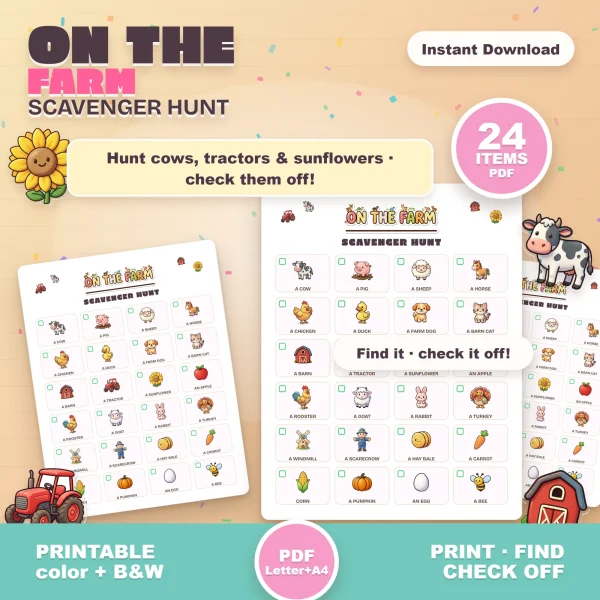
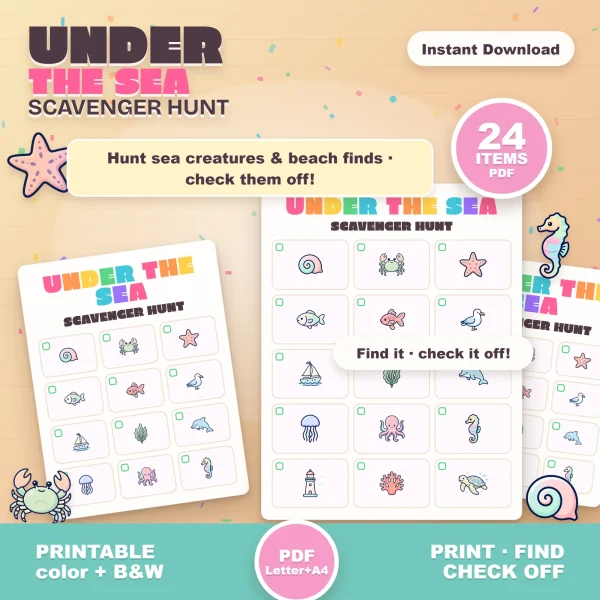
Headed somewhere more specific, like a farm or the beach? Those outings need their own lists. Thirteen of the 24 pictures on our Farm Scavenger Hunt are animals, and ten of the 24 on the Under the Sea Scavenger Hunt are things you could come across on a beach. The rest of our themes are on the scavenger hunts page.
When rain keeps everyone inside, our indoor scavenger hunt guide has a 20-item list for the house and the rules for checking finds without moving them.
Seasonal nature scavenger hunt lists: spring, summer, fall and winter
The same backyard gives you a different list in April than in November.
An item that isn’t out yet is the quickest way to end a hunt early, so check the calendar before you write the sheet.
Spring: a bud about to open, a sprout pushing up through the soil, blossoms on a tree, a bloom smaller than your fingernail, a puddle after rain, an insect sitting on a bloom.
Summer: a firefly at dusk (if you get them where you live), a cricket you can hear but can’t find, the coolest patch of shade, a seed head, dew on a spiderweb in the morning, a line of ants.
Fall: an acorn, a winged seed spinning down, one tree with three colors of leaves on it, a seed that sticks to your socks, geese flying in a V, a pile of raked leaves.
For a fall party, our fall party games guide puts a 16-item hunt like this one beside spotting bingo, with an indoor list for a rainy day.
Winter: tracks in snow or mud, a nest you can see now that the branches are bare, an evergreen, an icicle, your own breath in the cold air, a bud waiting on a bare twig.
Weather makes as much difference as the month does.
After a wet week, puddles and mud are everywhere, and a list full of them is too easy.
After a dry spell, the same items become the hard ones. Keep that in mind for scoring.
Nature scavenger hunt for preschoolers: pictures, fewer boxes, one rule
For preschoolers, the list has to work without reading. That means a picture for every item, fewer items, and a hunting area small enough that you can see them the whole time.
Most 3-year-olds can’t read “pill bug,” but they can match a drawing of one to the real thing under a flowerpot.
A picture with its name underneath does the same job at home, where a visual schedule for kids lines up the steps of a morning or a bedtime.
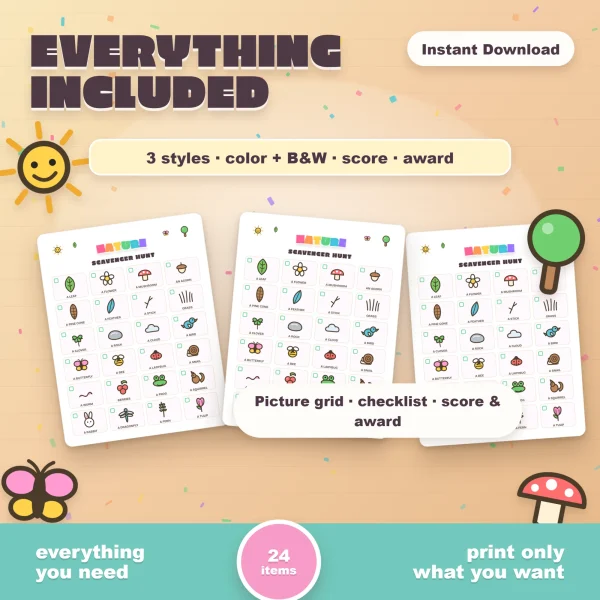
Our Nature Scavenger Hunt is built for that. Each of its 24 items is a simple picture with its name underneath, and the how-to page marks it for ages 3 and up.
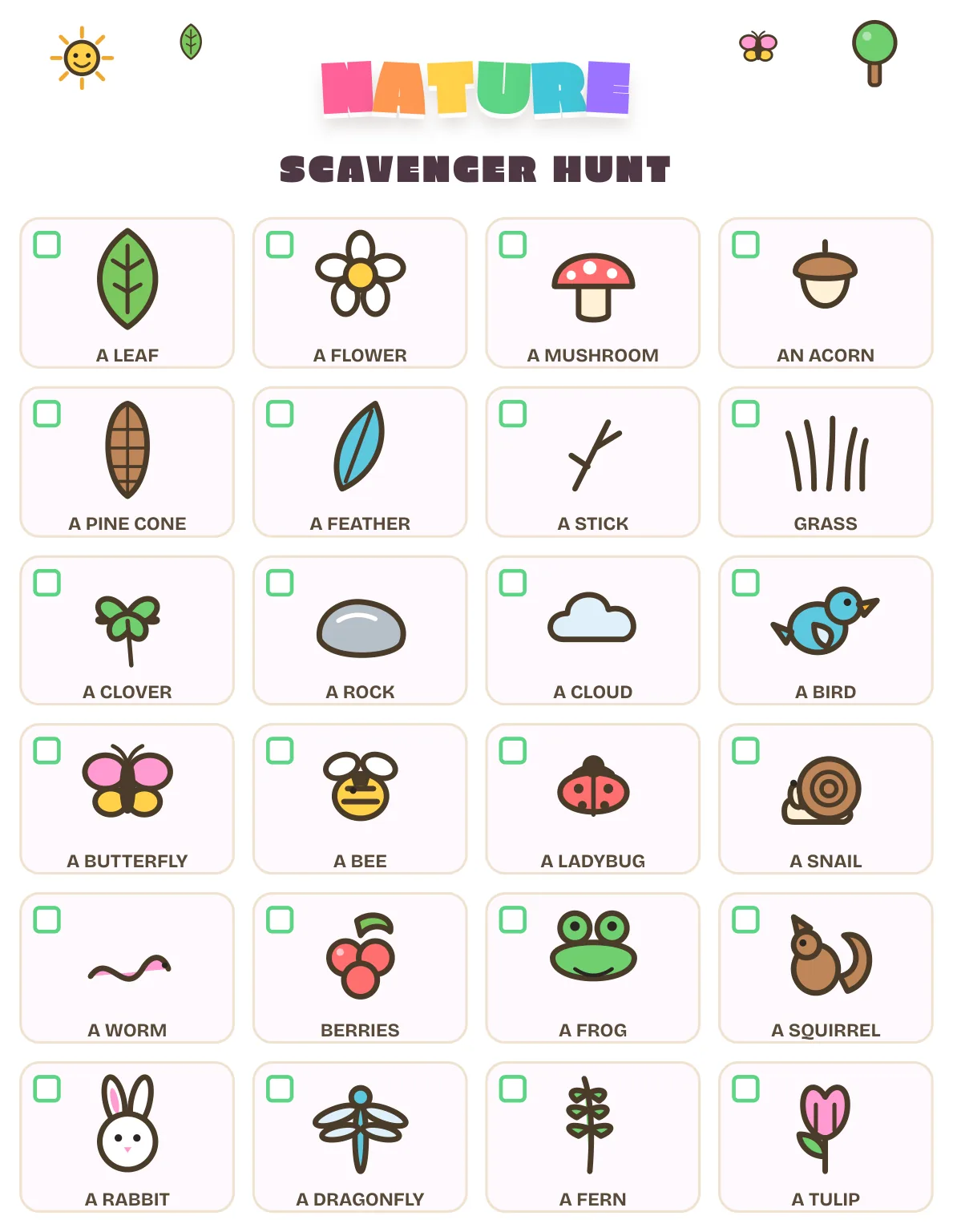
Still, 24 boxes is a lot for a first hunt.
Before you head out, circle 6 to 8 pictures you know are in your yard or park, and call the sheet finished when those are checked. The other boxes can wait for the next walk.
The same start-small idea works for a preschooler’s first memory game: six pairs face up, then four more each time they win.
Walk through the list together before you step outside.
Point at each picture, say its name, and show a real one if you have it, so “acorn” means the thing on the ground and not just a drawing.
Some of the best preschool prompts aren’t objects at all. “Something bumpy,” “something bigger than you” and “something that moves” can be found anywhere, and every child comes back with a different answer.
Hand over the crayon and let them make each checkmark.
A clipboard keeps the sheet flat on a lap or against a tree.
Then give one rule, out loud, before anyone starts: nothing from the hunt goes in your mouth.
Poison Control, run by the National Capital Poison Center, puts it the same way for wild berries: teach children to ask a grown-up before eating or drinking anything.
Look-only finds: what kids can pick up outdoors and what stays put
That rule about mouths is one of several a nature hunt needs. Checking a box is one thing. A pocket full of finds is another, and the answer changes with where you are and what you found.
In a national park, the answer is almost always “leave it.” Federal rules for the National Park System, 36 CFR 2.1, generally bar visitors from taking rocks and minerals. The National Park Service’s Junior Ranger page asks kids to leave plants, rocks and other items as they find them.
The Park Service’s own suggestion fits a scavenger hunt exactly: do a photo scavenger hunt, taking a picture of each find instead of collecting it.
In a state or city park or a nature preserve, read the regulations posted at the entrance before you promise anyone a souvenir.
In your own backyard, it’s your call.
Some finds stay look-only wherever you are:
| Find | Pick it up? | Why |
|---|---|---|
| Mushrooms | No, look only | The National Capital Poison Center says that unless you’re very experienced in mushroom identification, you can’t tell the poisonous ones from the safe ones, and it advises watching children outdoors so they don’t eat them |
| Wild berries | No, look only | The same center warns that wild berries look good enough to eat to a child, and only some of them are safe |
| Anything with legs or wings | No, check it by sight | The Park Service’s advice to kids is to watch animals from a distance and never approach, feed or follow them |
| A plant you don’t know with leaves in groups of three | Don’t touch | The FDA describes poison ivy as having three glossy leaflets on each leaf |
Our own list has a mushroom and a bunch of berries on it, and in our hunt both are for spotting only. Say so when you go over the pictures.
If a child may have eaten a wild mushroom or berries, call Poison Help at 1-800-222-1222. Your call is routed to the poison center that serves your area, at any hour.
Scoring a nature scavenger hunt: points, bonus rounds and teams
Once the rules are set, a plain checklist is plenty for small kids. Older kids and mixed groups usually want some competition. Points add it without making the list longer.
The simplest system gives common finds 1 point and rare ones 5.
The score page in our nature hunt works this way. It splits 20 of the 24 items into two columns, with a leaf in the 1-point column and a mushroom in the 5-point one.
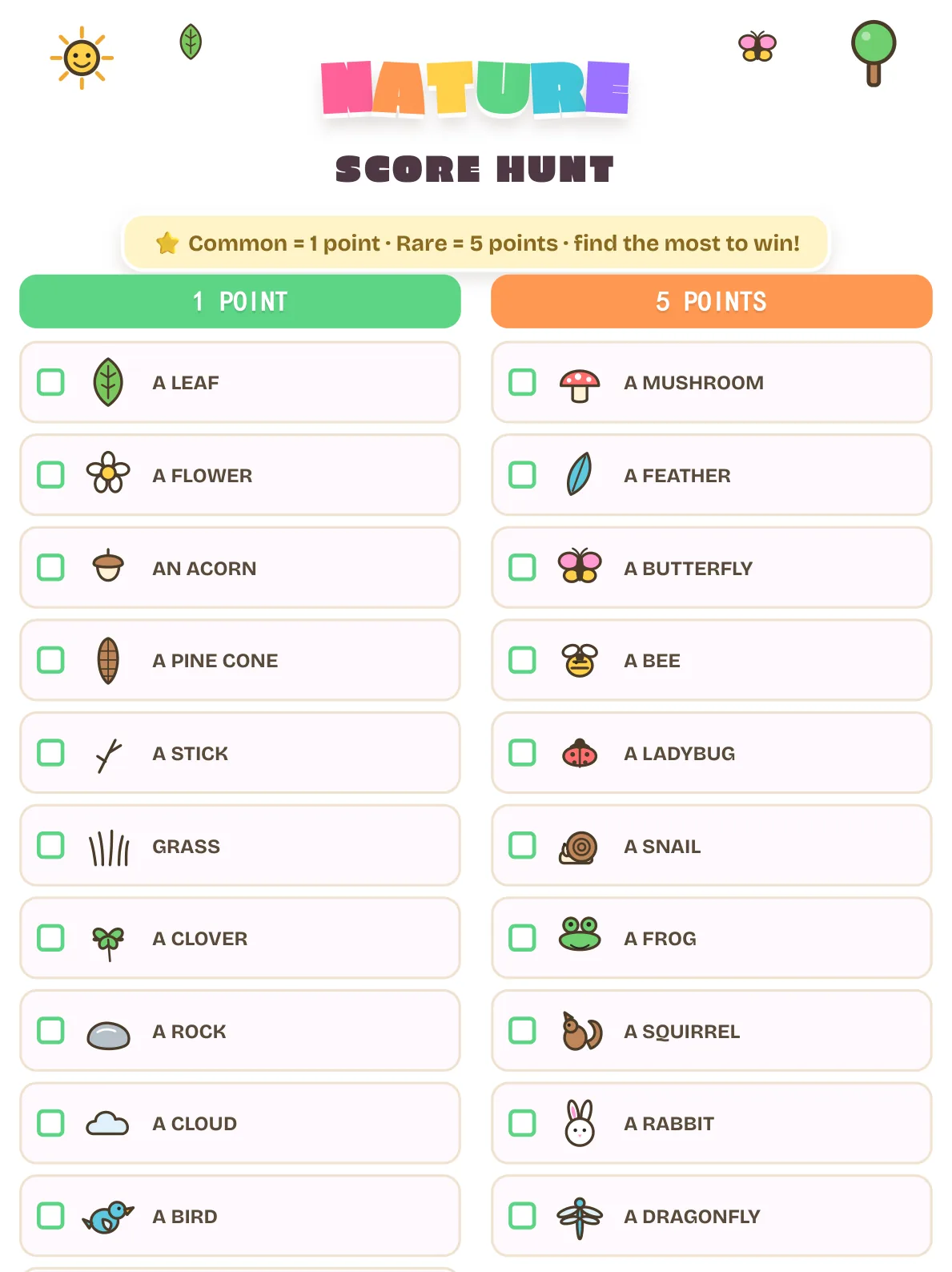
Rare depends on where you are, though, and the sheet can’t know your yard.
If mushrooms come up in your lawn every wet week, a mushroom isn’t a 5-pointer there. Before you hand out the sheets, move items between the columns with a pen.
That way the scoring fits your spot and this week’s weather.
Bonus challenges break a tie and keep fast finders busy. A few to try:
- Something that’s two colors at once
- A place an animal might sleep
- Something that wasn’t here the last time you came
- The smallest living thing you can find
Our compact checklist page ends with four bonus challenges of its own, plus a line to fill in: “I found ___ out of 24 items!”
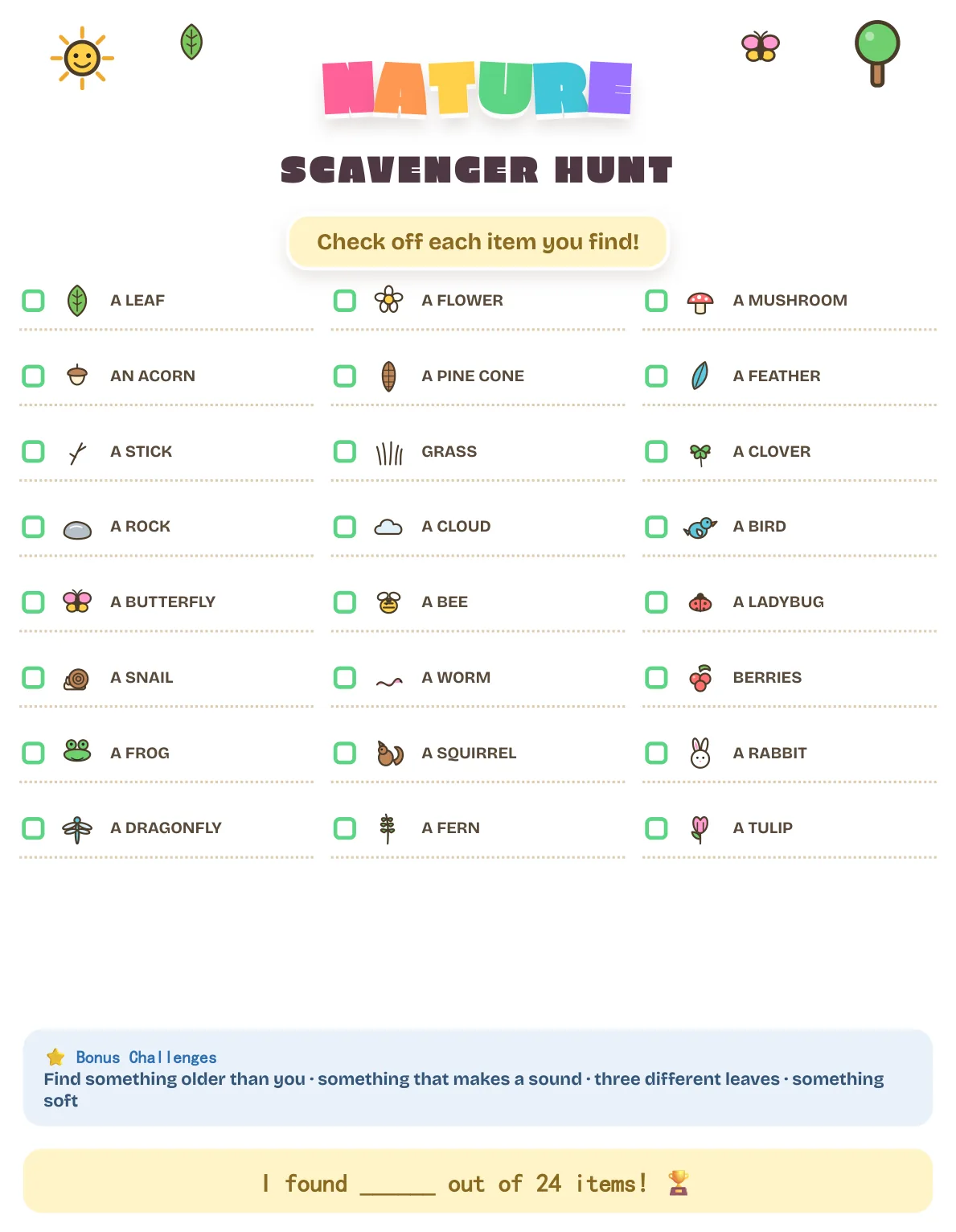
The how-to page gives the game as 2 to 6 players. With a bigger group, pair kids up and give each pair one sheet, so there’s always someone holding the pencil and someone looking.
Set a time limit and a meeting spot you can all see. Agree on both before anyone runs off.
The last page of the set is an I Did It! Nature Explorer certificate, with lines for a name and the date, for the end of the hunt.
After the nature scavenger hunt: tick check, count-up and coloring
The hunt isn’t quite over when the time runs out.
A few jobs are left once everyone’s back inside.
Start with a tick check. The CDC says ticks live in grassy, brushy or wooded areas, and many people pick them up in their own yard or neighborhood.
On children, the CDC lists these places to check:
- Under the arms
- In and around the ears
- Inside the belly button
- Behind the knees
- In and around the hair
- Between the legs
- Around the waist
The CDC also notes that showering within two hours of coming indoors has been shown to lower the risk of Lyme disease.
If anyone brushed against a plant you think was poison ivy, the FDA’s advice is to wash the skin with soap and cool water as soon as possible. The oil can also stick to clothes, pets and tools, so those need a wash too.
Then comes the count-up.
Add the points, fill in the “I found ___” line, and hand out the certificates.
The black-and-white file gives the hunt a second life at the table. It draws the same 24 items as plain outlines, which saves ink when you print a stack and leaves every picture ready to color in afterward.
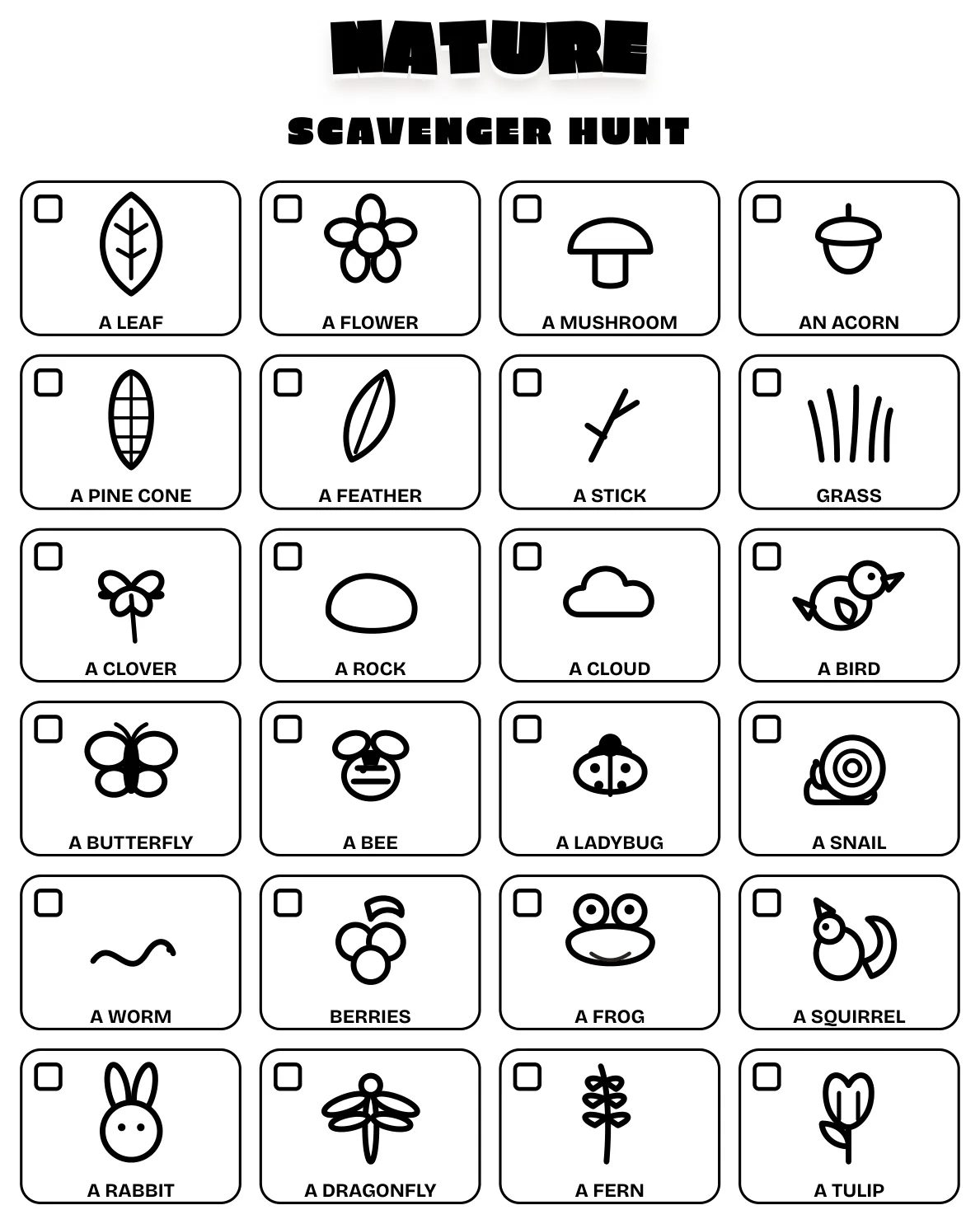
To reuse a sheet, slip it into a sheet protector or laminate it and check boxes with a dry-erase marker, as our paper guide suggests for charts you’ll reuse. The hunt comes in both US Letter and A4, so print the one that matches the paper in your printer.
A sheet you keep has one more use.
Take it back to the same park next season and hunt again, and you’ll have a record of what changed.
Printables from this article
Related articles
Printable Scavenger Hunts
Christmas Scavenger Hunt: Clues, Hiding Spots and Ideas
Ready-to-copy rhyming clues, a Christmas morning gift hunt, picture and coded clues for different ages, and hunts for a party, a classroom and a lights walk.
Printable Scavenger Hunts
Indoor Scavenger Hunt: A 20-Item List, Clues and Rules
An original household list, a few riddle clues and a plan for keeping the hunt within the rooms you choose.