Weather Activities for Preschool: Snow & Seasons for Kids
Weather activities for preschool work best as a short daily check plus one bigger activity. Start each morning with a look out the window, then add a snow measurement, a weather walk or a game, depending on what the sky is doing that day. In winter, every outdoor activity needs a time limit and a warm room to come back to; the safety section near the end covers both.
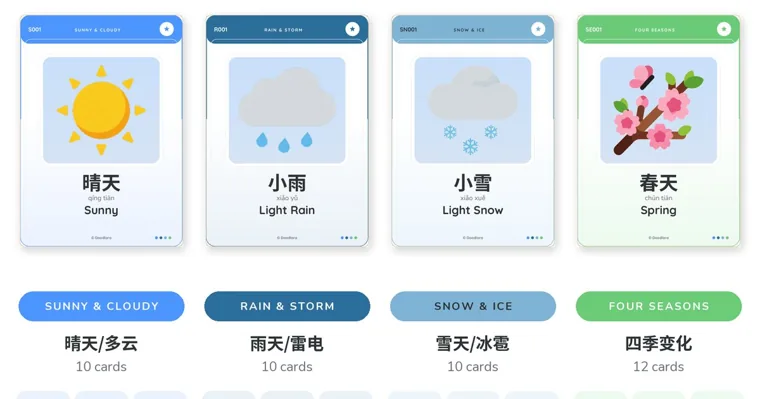
The group sizes and times below are our planning suggestions for 3- to 5-year-olds, so stretch or trim them for your children. Several activities use pages from our bilingual weather flashcard set. Every word in it is printed in Chinese characters, pinyin and English, and you can use the pages in English only.
Pick a weather activity by situation
Choose by place first, then by how many children you have. The outdoor ones only work on the right kind of day, so keep two or three indoor games ready as a backup. On days too cold to go out at all, our rainy day activities for kids add indoor games that burn off energy.
| Activity | Where | Group | You need | Time |
|---|---|---|---|---|
| Weather window check | Indoors | Whole class or one child | A window, a drawing sheet | 5 minutes |
| Weekly weather chart | Indoors | Whole class or one child | One chart per week | 5 minutes a day |
| Weather reporter | Indoors | 1 to 3 reporters | Report sheet, a pretend microphone | 10 minutes |
| Measure the snow | Outdoors | 2 to 6 children | Light-colored board or tray, ruler | 10 minutes |
| Melt a cup of snow | Outdoors, then indoors | Whole class | Clear plastic cups, marker, tray | 5 minutes, then a few hours |
| Freeze water outside | Outdoors overnight | Whole class | Plastic cups, a night below 32°F | 5 minutes, then overnight |
| Catch snowflakes | Outdoors | 1 to 4 children | Dark paper, a magnifier | 10 minutes |
| Weather detective walk | Outdoors | 4 to 6 children per adult | Checklist, clipboard | 15 minutes |
| Rain walk | Outdoors | Small group | Raincoats, boots | 10 to 15 minutes |
| Weather bingo | Indoors | Up to 4 players or 4 teams | Bingo boards, calling cards, counters | 15 minutes |
| Dress-up spinner | Indoors | 2 to 6 children | Spinner page, paper clip, pencil | 10 minutes |
| Weather memory | Indoors | 2 to 4 children | 12 cut-out cards | 10 minutes |
| Weather trail board game | Indoors | 2 to 4 players | Board page, a die, markers | 15 minutes |
| Seasons in order | Indoors | One child or a small group | Seasons wheel page, crayons | 10 minutes |
| Seasons puzzle | Indoors | 1 or 2 children per puzzle | Cut puzzle pieces | 10 minutes |
| Seasons diary | Indoors | One child at a time | Diary page | 10 minutes each season |
Daily weather check-ins at circle time
A daily check is the backbone of a preschool weather unit. It takes five minutes, works for one child or twenty, and gives every other activity something to point back to.
Weather window check
Open the curtains at circle time and give everyone 30 seconds of quiet looking. Then go around the circle: each child names one thing they see, like gray clouds, wet sidewalks or a bird on the fence. At home, this fits well at breakfast with one child.
Page 41 of our flashcard set, “What’s the Weather Today?”, has a line for the date and temperature, a big four-part box for drawing the view, and eight weather pictures to circle. A row of three faces (happy, okay and not great) asks how the child feels. One child can do the sheet each day while the rest of the group talks.
The eight pictures leave out a few winter regulars. There’s heavy snow but no light snow, and no windy picture, so on those days ask the child to draw it in the box instead of circling the nearest thing. Finish by having one child say the weather in a full sentence: “Today is cloudy and cold.”
A weekly weather chart
A chart turns the daily check into something children can count. Hang one where the whole group can see it and fill in one row a day.
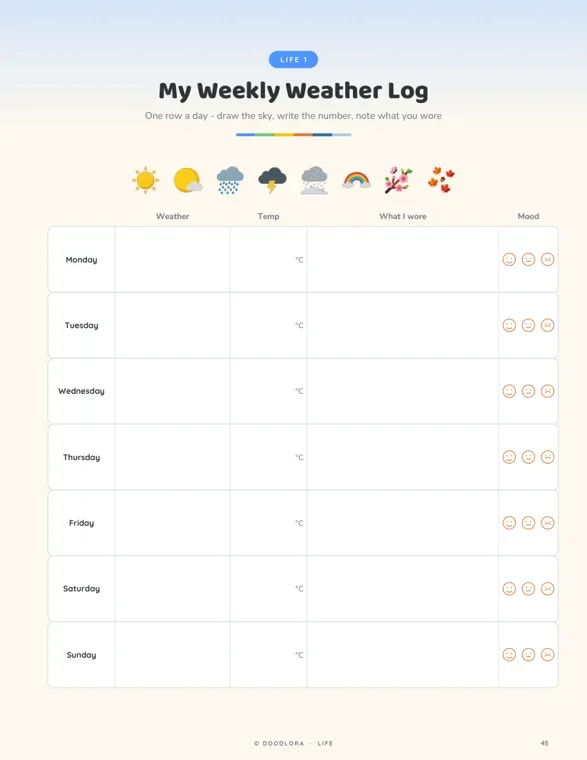
Our weekly weather log on page 45 has seven rows, Monday to Sunday, with columns for the weather, the temperature, what I wore and a mood face. Children draw the sky in the first box. An adult writes the temperature, read from an outdoor thermometer or the morning forecast.
The temperature column is printed with °C only. For an American classroom, write °F next to each number by hand, or cover the little C with a sticker before you copy the page. At school, the Saturday and Sunday rows stay blank, so either send the chart home on Friday or ignore those two rows.
On Friday, count the drawings together. “How many sunny days did we have? How many snowy ones?” That one question is the payoff of the whole week.
Be the weather reporter
Children love standing in front of the group with a pretend microphone. Pick one to three reporters a day and rotate so everyone gets a turn during the unit.
Page 52, “Little Meteorologist,” has a TV screen to draw on and a short script with blanks: today’s date, today’s weather, the temperature, what to wear and one tip for the day. The temperature line has both °C and °F. Preschoolers can’t fill in the blanks themselves, so an adult writes while the child draws the TV picture and then reads the report aloud with help.
Keep the report about today. The page title says “forecast,” but young children do better describing what they can see out the window than guessing tomorrow. End with applause, and let the reporter choose who reports next.
Hands-on snow and ice experiments
Snow days give you the best experiments of the unit. Each one below takes ten minutes outside, which fits between warm-up breaks.
Measure the snow like a weather observer
This one copies how real weather observers measure snow. The National Weather Service office in the Quad Cities tells its volunteer observers to set a light-colored board flat on the ground, push a yardstick straight down until it reaches the board, and measure away from drifts. Its instructions also say to avoid spots sheltered by buildings or trees.
For a preschool group, a white cutting board or a baking tray works as the board. Set it in an open spot before the snow starts. When it stops, two to six children take turns pushing a ruler straight down into the snow on the board, and an adult reads the number. Observers record new snow to a tenth of an inch, but whole inches are plenty for preschoolers.
The common mistake is putting the board right outside the door or under the porch roof. That’s the sheltered spot the National Weather Service warns about, and it will show less snow than the open yard. Write the number on your weekly chart when you come back in.
Melt a cup of snow
Fill a clear plastic cup with snow and draw a line on the cup at the top of the snow. Bring it inside on a tray and ask the group: when this melts, will the water reach the line? Let each child guess, then leave the cup on a shelf.
Check after lunch or before going home, and mark the water line with a second color. The water sits well below the first line. Weather observers record the two separately: the National Weather Service lists new snowfall and the “liquid equivalent” of that snow as different measurements.
Don’t press the snow down when you fill the cup. Packed snow and loose snow give different results, so fill every cup the same loose way if you’re comparing several.
Freeze water outside overnight
Check the forecast for a night that drops below 32°F. The Icy card in our flashcard set gives 14–32°F for icy weather, so it’s a handy number to show children. Fill a few plastic cups with water, drop a leaf or a small plastic toy into one, and set them outside before going home.
Next morning, go out together and look before touching. Are the cups frozen all the way through, or just on top? If they didn’t freeze, the night wasn’t cold enough, and that’s a real result worth writing on the chart. Bring one frozen cup inside and watch it melt during the morning.
Use plastic cups, not glass jars, so nothing breaks if a cup slips on the cold pavement.
Catch snowflakes on dark paper
This works during a light, dry snowfall. Put a sheet of black or dark blue construction paper outside for a few minutes first so it gets cold; snow melts fast on warm paper. Then one to four children hold their sheets out at arm’s length and look closely with a magnifier.
Ask them to count the arms on a flake. Snowflakes grow from a tiny six-sided crystal, so many have six arms, though Wikipedia’s snowflake article notes that fewer than 0.1% show the ideal six-fold shape. Most of what lands will be broken pieces or clumps, and that’s normal. Tell children in advance so they aren’t disappointed.
Breath melts flakes in a second. Have children hold the paper away from their faces and look without blowing. Wet, heavy snow sticks together in clumps, so save this one for a drier snowfall.
Weather walks outside
A walk lets children use more than their eyes. Keep groups small enough that one adult can hear every child.
Weather detective walk
Give the walk a job: the children are detectives solving the case of today’s weather. Take four to six children per adult on a 15-minute loop around the building or yard.
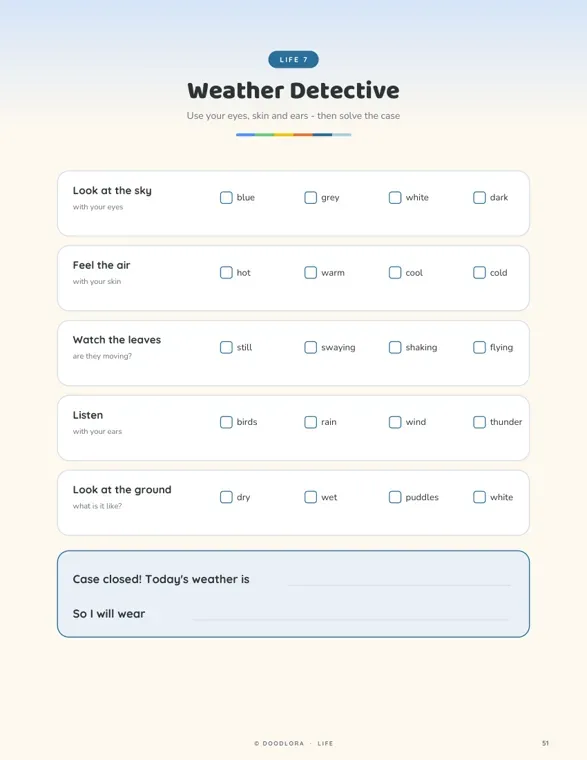
The Weather Detective page (page 51) has five checks, each with four boxes. The sky is blue, gray, white or dark. The air feels hot, warm, cool or cold. Leaves are still, swaying, shaking or flying. You might hear birds, rain, wind or thunder, and the ground is dry, wet, puddled or white. At the bottom, the case closes with “Today’s weather is . So I will wear .”
The adult carries the sheet on a clipboard and ticks the boxes as children call out answers. In winter, the trees may be bare, which makes “watch the leaves” hard. Look at an evergreen, a flag or the dry leaves on the ground instead, or tie a ribbon to the fence before you head out. Back inside, fill in the case-closed lines together.
For a longer outing with lists to tick, our nature scavenger hunt ideas include a winter list and a picture hunt for preschoolers.
Rain walk
Rain boots and raincoats turn a gray day into an activity. Walk a short loop for 10 to 15 minutes, listen to rain on an umbrella, and use a stick to see how deep the puddles are.
Set one rule before you leave: if anyone hears thunder, the walk ends and everyone goes straight inside. The National Weather Service says there is no safe place outside when thunderstorms are around, and that hearing thunder means you are likely within striking distance. Its slogan is easy for young children to repeat: “When Thunder Roars, Go Indoors.”
When you come back, boots come off at the door and wet clothes get changed before the next activity.
Weather games with flashcards
Games give a weather unit its repetition without feeling like drill. The ones below use pages from our weather flashcard set.

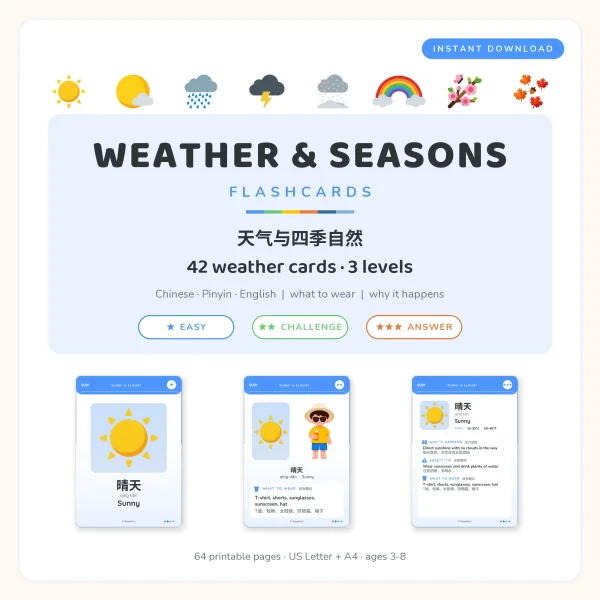
The set covers 42 weather words, each on three cards. Level 1 shows a picture and the name, and the set’s own guide matches it to ages 3 to 5. Each name appears three ways: simplified Chinese characters, tone-marked pinyin, and the English word. In an English-only classroom, just read the English line. For bilingual families, the same cards teach both languages at once.
Twelve of the 42 cards are about seasons. Eight of those are dates from the traditional Chinese calendar, such as Start of Spring and Winter Solstice. Most American preschoolers won’t know them, so set those eight aside for flashcard practice with younger children, but read the bingo tip below before you do.
Weather bingo
Bingo works for up to four children, or four teams of two or three. Print the four boards, cut out a set of Level 1 cards to call from, and give everyone a small cup of counters, like pom-poms or cereal.
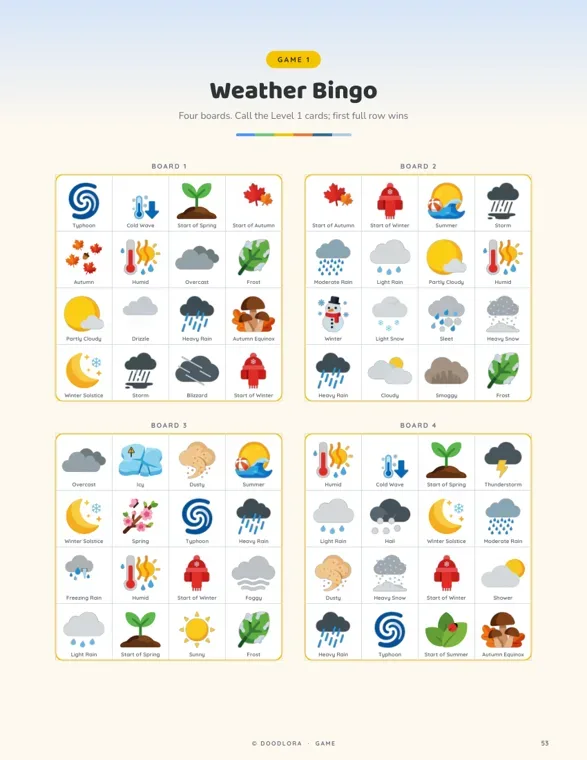
Shuffle the cards, hold one up and say its name. Players cover the matching picture. The page’s rule is that the first full row wins. With 3-year-olds, play until everyone has a row, so no one sits out.
The bingo squares carry the picture and an English label, without Chinese. Several squares are Chinese calendar dates; Board 1 alone has five of them, including Autumn Equinox and Start of Winter. If you took those eight cards out of the calling pile, those squares can never be covered, so either keep all 42 cards in the pile for bingo or let children cover those squares at the start as free spaces. Our printable bingo rules cover calling and checking a win.
Dress-up spinner
This game connects the weather to getting dressed, which is the part preschoolers actually use every morning. Two to six children can play in about ten minutes.
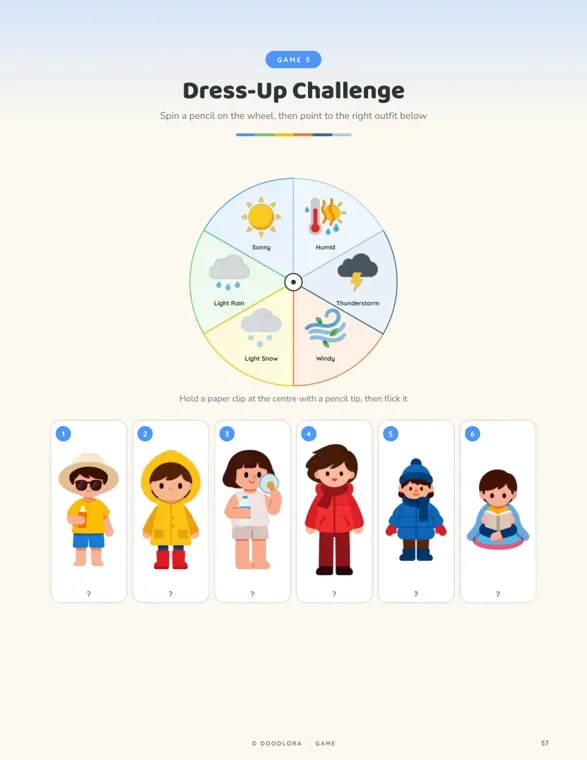
The Dress-Up Challenge on page 57 has a wheel with six weather slices: sunny, humid, thunderstorm, windy, light snow and light rain. Below it are six numbered children, among them a sun hat with sunglasses, a yellow raincoat, a red coat with a scarf and a blue puffy coat with a hat. You hold a paper clip at the center with a pencil tip and flick it. The child then points to the outfit for that weather.
Flicking the paper clip is hard for 3-year-olds. Let an adult hold the pencil while the child flicks. One “outfit” is a child reading on a cushion indoors, which fits the thunderstorm slice; say aloud that the right clothes for a thunderstorm are indoor clothes. For a bigger version, bring a dress-up box with hats, mittens and sunglasses and let children put on the real thing.
Weather memory
Page 54 has 12 cards that make six pairs: sunny, thunderstorm, moderate snow, icy, dusty and start of summer. Cut them out, shuffle them face down, and take turns turning over two at a time. Two to four children can play in about ten minutes.
Twelve cards suit 4- and 5-year-olds. For 3-year-olds, start with three pairs, or play with the cards face up and just look for matches. Our memory game rules have more ways to scale the game up or down.
Weather trail board game
Page 56 is a board with 18 weather squares between START and FINISH. Players roll a die and move. On each square, they name the weather in Chinese and English. A right name earns one extra step, and naming one thing to wear earns another. A wrong answer sends the player back one square.
In an English-only group, ask for the English name and the clothing idea. With 3-year-olds, drop the “go back one” rule, because losing ground over a wrong word ends the game in tears more often than it teaches. Two to four players finish in about 15 minutes.
Seasons activities for preschool
Seasons are the slow part of a weather unit. These three activities teach the order of the year and give children a reason to come back to the topic in spring.
Put the seasons in order
Page 43 shows four season pictures to number 1 to 4, starting with spring, and then a wheel to write the season names into, going clockwise. Preschoolers can point and number with help, and an adult writes the names on the wheel. One child or a small group takes about ten minutes.
The cards and pages say “autumn,” which most American children call “fall.” Tell them both words mean the same season.
Seasons puzzle
Page 58 has a picture for each of the four seasons, with dashed lines to cut along. Cut the pieces in advance, ideally from cardstock, and give one or two children a puzzle each.
Mixing all four seasons into one pile is too much for most preschoolers. Start with one season’s pieces, then add a second picture once the first goes together easily.
Seasons observation diary
The seasons diary on page 49 has a box for each season with four prompts: I see, I hear, I wear and I eat, plus space to draw. Fill in the winter box now, one child at a time, with the adult writing what the child says.
This page takes a whole school year to finish. Keep it in each child’s folder and pull it out again in spring, so the child can compare what they wore and saw in winter with what they see now.
Keeping outdoor weather time safe in the cold
Cold-weather activities are only fun when children come back in warm. The American Academy of Pediatrics points out that children lose heat faster than adults because their bodies are smaller, and that they’re less likely to come inside on their own when they’re having fun. Plan the breaks for them.
The AAP’s winter safety advice comes down to a few steps:
- Dress children in several thin layers.
- Insulated boots, mittens or gloves, and a hat are essential.
- Change wet clothes right away.
- Set limits on time outside and give regular indoor breaks to warm up.
- Avoid playing outside when the temperature or wind chill is below -15°F; at that point, exposed skin begins to freeze within minutes.
Watch fingers, toes, ears and noses, the places the AAP says are most likely to get frostbite. Frostbitten skin may hurt or burn, then go numb and turn white or pale gray. If you suspect it, bring the child inside to warm up gently and don’t rub the skin.
The snow experiments in this list take about ten minutes outside, so they fit between those warm-up breaks. When the AAP’s cutoff rules out going outside, switch to the indoor rows of the table at the top.
Printing the weather flashcards for a preschool group
The Chinese–English Weather and Seasons Flashcards come as two 64-page PDFs, one for US Letter and one for A4, with the same content in each. The printing guide on page 63 suggests white cardstock of 200 to 250 gsm (about 80 to 110 lb cover) for the cards and plain printer paper for the worksheets and games. Print at Actual Size, not Fit to Page, so the cards come out at 3.5 x 5 inches.
For preschool, print Level 1 first. The guide also suggests a corner-rounder punch, which makes the cards easier on small hands and helps the deck last. A few pages use British spellings, which won’t matter to children who aren’t reading yet.
Printables from this article
Related articles
Printable Flashcards
Pattern Activities for Preschool: AB to Growing Patterns
Fourteen pattern activities for preschoolers, ordered from first AB rhythms to growing number patterns, with what to prepare, how long each takes and where kids get stuck.
Printable Flashcards
What Is a Ten Frame? How to Fill One and 8 Activities
How a ten frame works, why five on top and two below reads as seven, what age to start, and eight short activities with players, time and setup.
Printable Flashcards
Telling Time Activities: How to Teach Time to Kids by Stage
Fifteen clock activities sorted by stage, from an hour-hand-only clock to elapsed time on a number line, each with ages, players, time, supplies and the mistake to watch for.