Rainy Day Activities for Kids: Snow Day & Quiet Indoor Games
Rainy day activities for kids work best as a rotation: one game that burns energy, one quiet table activity, then a bigger project that fills the afternoon. A snow day or a school closure stretches longer than a wet Saturday, so plan three or four blocks instead of one big event.
Start by clearing one patch of floor for moving around and one table for paper. Print anything you need the evening before a storm is forecast, while the printer and the paper supply are still sorted. The times below are our planning estimates, so shorten or extend a block to match the children in front of you.
Pick an activity for the day you’re having
| Situation | Try this | Players | Rough time | What you need |
|---|---|---|---|---|
| Kids bouncing off the walls | Freeze dance, Simon Says, obstacle course | 2 or more | 10–20 minutes | Music, open floor, cushions |
| One child, quiet house | Word search, code pages, polar observation notes | 1 | 15–30 minutes | Printed pages, pencil |
| Siblings of different ages | Word search race with different levels | 2–4 | 10 minutes a round | Same theme, different grids, a timer |
| A group snowed in together | Printable escape room or a mystery case | 1–6, in teams | About an hour | Printed pages, scissors, an adult with the answers |
| A long gray afternoon | Blanket fort, invisible ink, string telephone | 1–4 | 30–60 minutes | Blankets, lemon juice, paper cups, string |
When the whole house is open for play, an indoor scavenger hunt fits almost any row of this table. That guide has picture lists for kids who can’t read yet and clue chains for older ones.
Indoor games that burn energy
Moving games come first on most rainy days. A short burst of running around makes the quiet table activities later much easier to start.
Freeze dance
Freeze dance is the American name for musical statues. One adult controls the music. Everyone dances while it plays, and when the music stops, players must freeze in position.
Anyone who wobbles or keeps moving is out. A version described on Wikipedia gives each player a sheet of newspaper to dance on, and the sheets are torn in half every time the music stops. Play until one dancer is left, then let the winner run the music for the next round.
The common snag is the youngest child getting knocked out first every time. With a wide age spread, skip elimination and let anyone who moves do a silly pose before rejoining.
Simon Says
Simon Says needs three or more players and no equipment. One player is Simon and gives instructions such as “jump in the air” or “touch your toes.” Players follow an instruction only when it starts with “Simon says.”
A player who follows a command without “Simon says,” or misses one that has it, is out. The last player still following correctly wins, and becomes Simon for the next round.
Fast commands make the game, so warn a new Simon that a long pause between orders makes it too easy.
Indoor obstacle course
An obstacle course turns a hallway or living room into a route. Mark a start line with painter’s tape, then add stations: crawl under a table, step between couch cushions, walk a tape line heel to toe, and toss a rolled pair of socks into a basket.
Time each child on a phone stopwatch and let them try to beat their own time. Racing a personal best keeps an older child from flattening a younger one.
Keep every station on the floor. Climbing onto chairs or sofa arms is where indoor courses go wrong, so set that rule before the first run.
Sock basketball
Sock basketball suits a small room or a child who can’t run around. Roll pairs of socks into balls and put a laundry basket a few steps away. Each player gets five throws a turn, and every sock that lands in the basket is a point.
Move the basket farther back after each round. When the socks are all in the basket, the game also ends with the laundry put away.
Quiet table activities for one child
These are the activities to reach for when one child needs to sit down, or when a younger sibling is napping. Each one has a clear stopping point, so a child can finish a page and walk away.
Winter word search puzzles
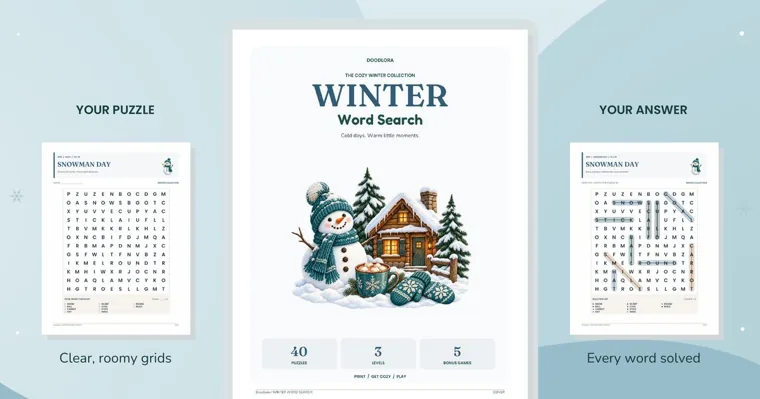
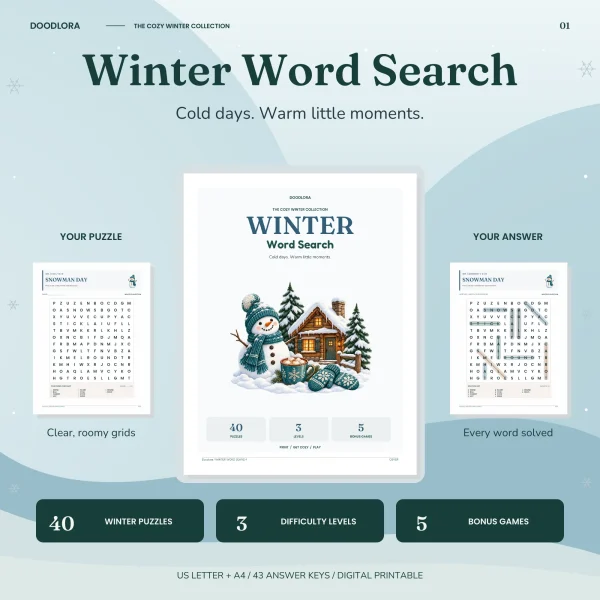
A word search is the easiest quiet start because a child can see how many words are left. Our Winter Word Search book has 40 themed puzzles in three levels. The 12 Easy puzzles use a 12 × 12 grid with 10 words. The 16 Medium puzzles use 15 × 15 grids with 12 words, and the 12 Hard puzzles use 20 × 20 grids with 16 words.
The trap is the jump from Easy to Medium. On Easy pages, words run right, down, or down-right on a diagonal. Medium and Hard words can run in all eight directions, including backward, so tell a child about backward words before they decide the puzzle is broken.
The answer keys sit at the back of the book, one for each puzzle ID. Print those pages for yourself rather than for the child.
Secret codes and ciphers
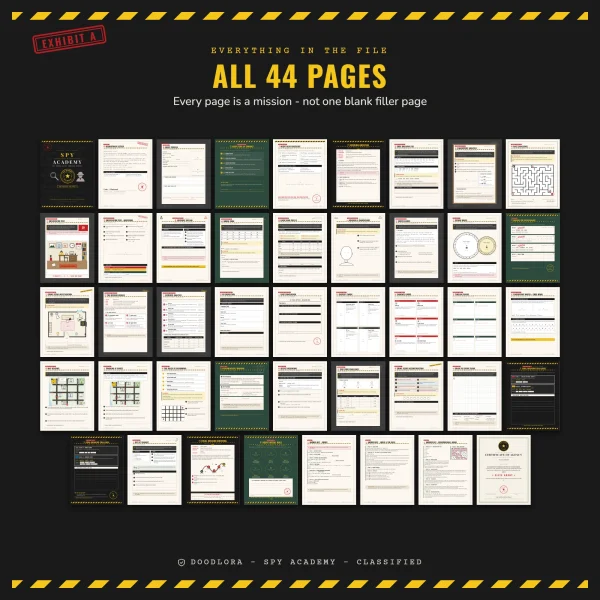
Code-breaking suits a child who reads well and likes a challenge with an answer at the end. Our Spy Academy activity book teaches three codes in order: a Caesar cipher on page 7, Morse code on page 13, and a cut-out cipher wheel on page 17. Page 18 then gives three intercepted messages, each using a different one of those codes.
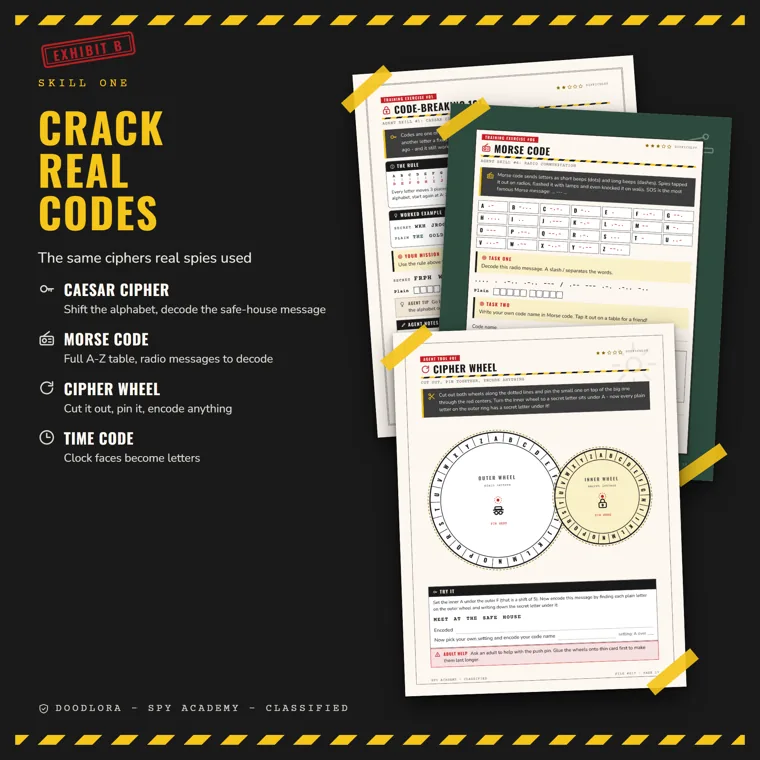
The cipher wheel is the one part that needs an adult. The two wheels are pinned together with a push pin, and the page itself asks for adult help with the pin. Gluing the wheels onto thin card first makes them last through more than one afternoon.
When a child finishes a message, the answers are on page 41. Two children can also take turns: one encodes a message with the wheel, and the other decodes it.
Polar animal observation notes
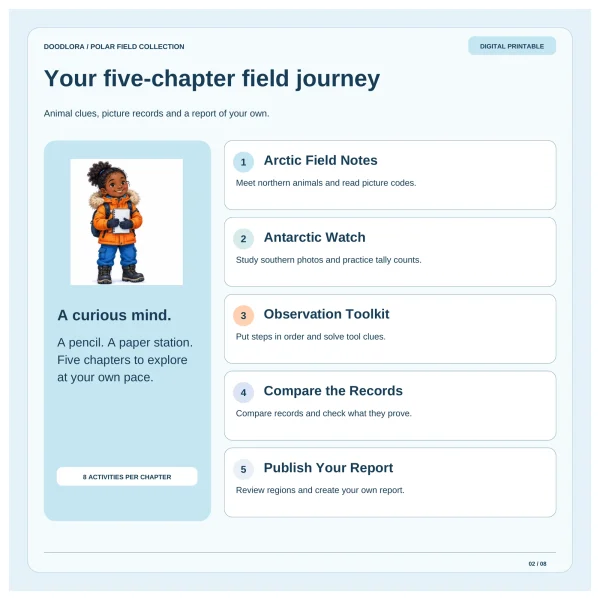
Observation pages give a curious child something to count, compare and explain. Our Polar Animal Observation pack has 40 notes and eight support pages in each version, with a separate 15-page guide that holds the answers. The guide says it is designed for ages 7 to 10, with an adult helping with reading as needed.
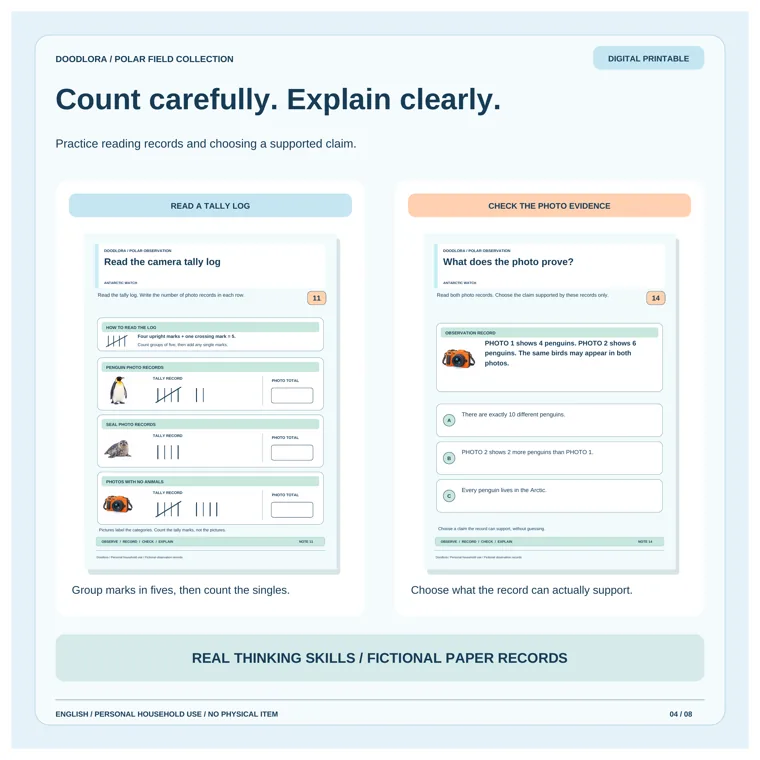
Note 11 is a good first page. Four upright marks with one crossing mark count as five, and the child writes a total for each row.
Note 14 is where children slip. It says one photo shows 4 penguins and another shows 6, and that the same birds may appear in both photos. A child who adds them up and picks “exactly 10 different penguins” has missed that line, so read the record aloud together before they choose.
Tangram puzzles
Tangram puzzles work for a child who would rather move pieces than write. A tangram set has seven pieces, and the goal is to fill a silhouette with all seven without overlapping them.
Start with a puzzle card that shows the colored pieces, then move to a plain silhouette. When a child stalls, suggest placing the two large triangles first; the beginner tangram walkthrough has more hints that leave the solving to the child.
Games for siblings and a snowed-in group
When cousins or neighbors are stuck inside together, a shared goal keeps the group in one room. These activities give everyone the same problem and an ending they can see. For a group that would rather act than solve, charades for kids needs nothing but a stack of prompts and a little floor space.
Word search races
A word search race turns a quiet page into a game for two to four players. The Winter Word Search book has five bonus games, and three of them work as races.
- Snowflake Sprint: print the same puzzle for each player and set a 3-minute timer. Each correct word earns 1 point, the most words wins, and a tie is a shared win.
- Cocoa Dash: everyone gets puzzle W15, The Cocoa Kitchen, with a 5-minute timer and 12 target words. A player who finds all 12 records the time. Among full grids, the fastest time wins.
- Frosty Word Hunt: a 60-second hunt on a grid with no word list. The host checks 12 target words against the bonus answer key, and other words don’t score.
Every player needs the same page for a fair race. With a big age gap, give the younger child an Easy page and the older child a Hard one, then score each against their own last round instead of against each other.
Thirty-second memory test
A memory test fits two players and five minutes. Page 10 of the Spy Academy book shows a room picture to study for 30 seconds. When the timer rings, the player turns the page and answers eight questions from memory, such as how many pictures hang on the wall and what time the clock shows.
The answers are on page 43. One child holds the timer while the other studies, then they swap. Looking back at the picture ends the turn.
Printable escape room
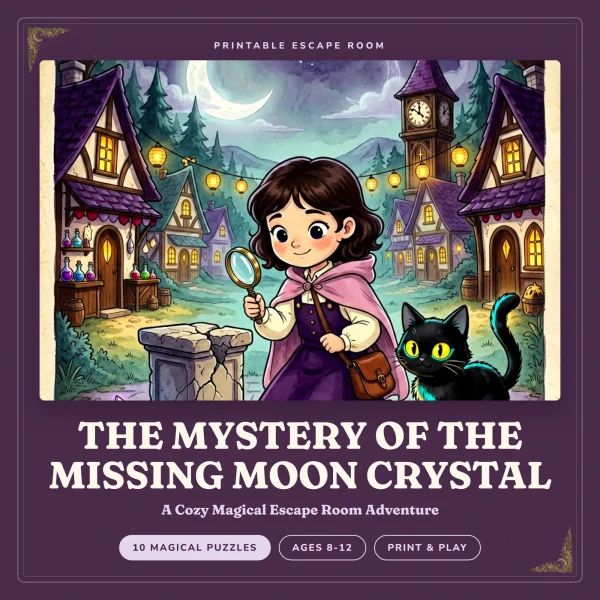
An escape room is the big group project on this list. In our Missing Moon Crystal escape room, players solve ten different puzzles: word, number, cipher, logic, maze, pattern, word search, ordering, riddles and a final clue. Each of the first nine puzzles gives one number, and Puzzle 10 says which four numbers open the lock and in what order.
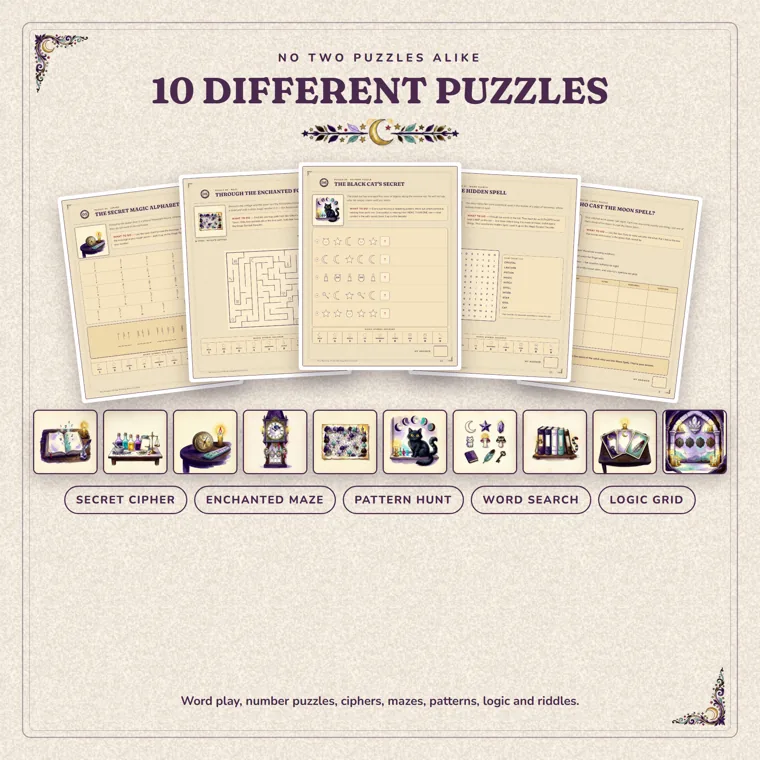
Players can work alone, in pairs, or in teams. Each team needs its own recording sheet, page 5. The book’s How to Play page says to print pages 5 to 16 for the players and keep the answer key, pages 27 to 29, for the adult. The cover marks it for ages 8 to 12, and the print guide expects 30 to 60 minutes for most children in that range.
The 11 hint cards on pages 21 to 26 each come in three levels. Hand out one level at a time; the game master page warns that a team given Hint 3 straight away loses the best part.
The most useful check is on page 29. Puzzles 1 to 9 use every digit from 1 to 9 exactly once, so a repeated number on a recording sheet always means a mistake somewhere. When a team writes the same digit twice, send them back to those two puzzles before the final lock.
A mystery case with suspects
A mystery case suits two or three older children who like to argue over clues. The Spy Academy book has a four-part case, The Missing Medals, on pages 20 to 23. Pages 24 to 27 are a cut-out kit with suspect cards, six evidence cards and timeline cards.
Lay the suspect cards on the table and turn one face down when the group rules that suspect out. The evidence cards get sorted into real clues and red herrings first. Children who skip that sort usually accuse the wrong suspect, because some evidence is a false trail on purpose. When the group agrees, it writes its verdict on page 23 and checks the official solution on page 42.
Projects for a long afternoon
A project that takes an hour gives a snow day its middle. These three use household things, and two of them need an adult for one step.
Blanket fort
A blanket fort is the classic rainy day project because the building is the activity. Drape a sheet or blanket between two chairs or over a table, weigh the edges down with books, and add cushions inside.
Agree on when it comes down before the first blanket goes up. A fort that has to vanish at dinner causes less trouble when everyone knew that from the start. The finished fort is also a good place for the quiet pages above.
Invisible ink messages
Invisible ink takes about as long as the waiting allows. Page 12 of the Spy Academy book uses lemon juice, milk or baking-soda water, a cotton swab or toothpick, and white paper. The child writes a message with the “ink” and lets it dry until the writing disappears.
To read it, an adult warms the paper gently with a hair dryer or holds it near a lamp, and the message turns brown. The page says heating must always be done with an adult, and children should never use a candle or a stove alone.
Have the child copy the message onto a scrap first. A message that never shows up is a lot less frustrating when they still know what it said.
String telephone
A string telephone gives two children a private line between rooms. Page 38 of the Spy Academy book lists two paper cups, about 15 feet (5 meters) of string, a sharp pencil and a partner.
An adult pokes a small hole in the bottom of each cup with the pencil. The string goes through each hole with a fat knot inside the cup. The two children walk apart until the string is tight, and one talks while the other listens with the cup over an ear.
A slack string, or one touching a wall or door frame, kills the sound. If nothing comes through, pull the string straight before giving up.
When the indoor day goes wrong
Most rainy day trouble comes from the same few problems. Each has a quick fix.
- The kids are bored in ten minutes. Switch type, not just activity. After a quiet page, go to a moving game, and after a moving game, sit down for something on paper.
- An older sibling finishes first and takes over. Give each child a different level of the same thing: an Easy word search beside a Hard one, or the polar notes beside the code pages.
- A child is stuck and close to tears. Give the smallest hint first. The escape room’s hint cards are written in three levels for exactly this reason.
- The answers keep getting spoiled. Print the answer pages separately and keep them with you. In the escape room, Puzzle 10’s final code is on a page for the grown-up only.
- The printouts come out the wrong size. Print at 100% or Actual Size, not “Fit to page,” and match the US Letter or A4 file to your paper.
- Ink is running low. The escape room, the Spy Academy book and the polar pack each come with a lower-ink version, so print those for a long day.
Printables from this article
Related articles
Kids Activity Books
Secret Agent Activities for Kids: Spy Codes, Clues & Party
Spy codes, invisible ink, Kim's Game, a string laser maze and a case to solve, with player counts, timings, supplies and the snags to plan around.
Kids Activity Books
Math Puzzles for Kids With Answers, Sorted by Grade
Ready-to-use math puzzles from kindergarten to middle school, each with its answer, plus how to run them as a home warm-up or a classroom center.
Kids Activity Books
Quiet Time Activities for Kids: Bin and Quiet Book Ideas
How to swap a dropped nap for an hour of quiet time, with a starting length, a timer, a rotating bin and solo activities sorted by age, from board books to build-and-play mats.