 1 / 10
Chemistry Coloring Pages: 30 Labeled Diagrams of Atoms, Molecules, Mixtures and Reactions
Thirty labeled chemistry diagrams built from circles, bonds and particle boxes, covering what matter is made of, how atoms join into molecules and what happens when things dissolve, separate or react. Every page has a numbered color version to follow or ignore.
$3.99
Buy any 3 or more printables and save 20% at checkout.
- Download right after payment — link works for 30 days, up to 5 downloads
- Files arrive as a ZIP with your license PDF inside
- Secure checkout by Stripe · Refund policy
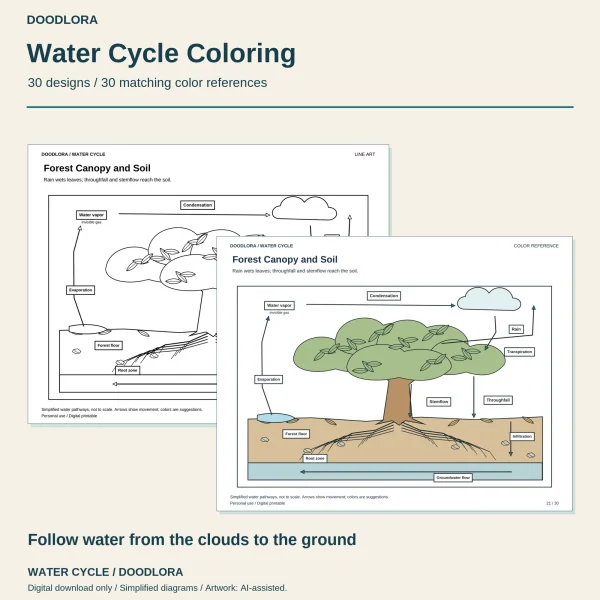
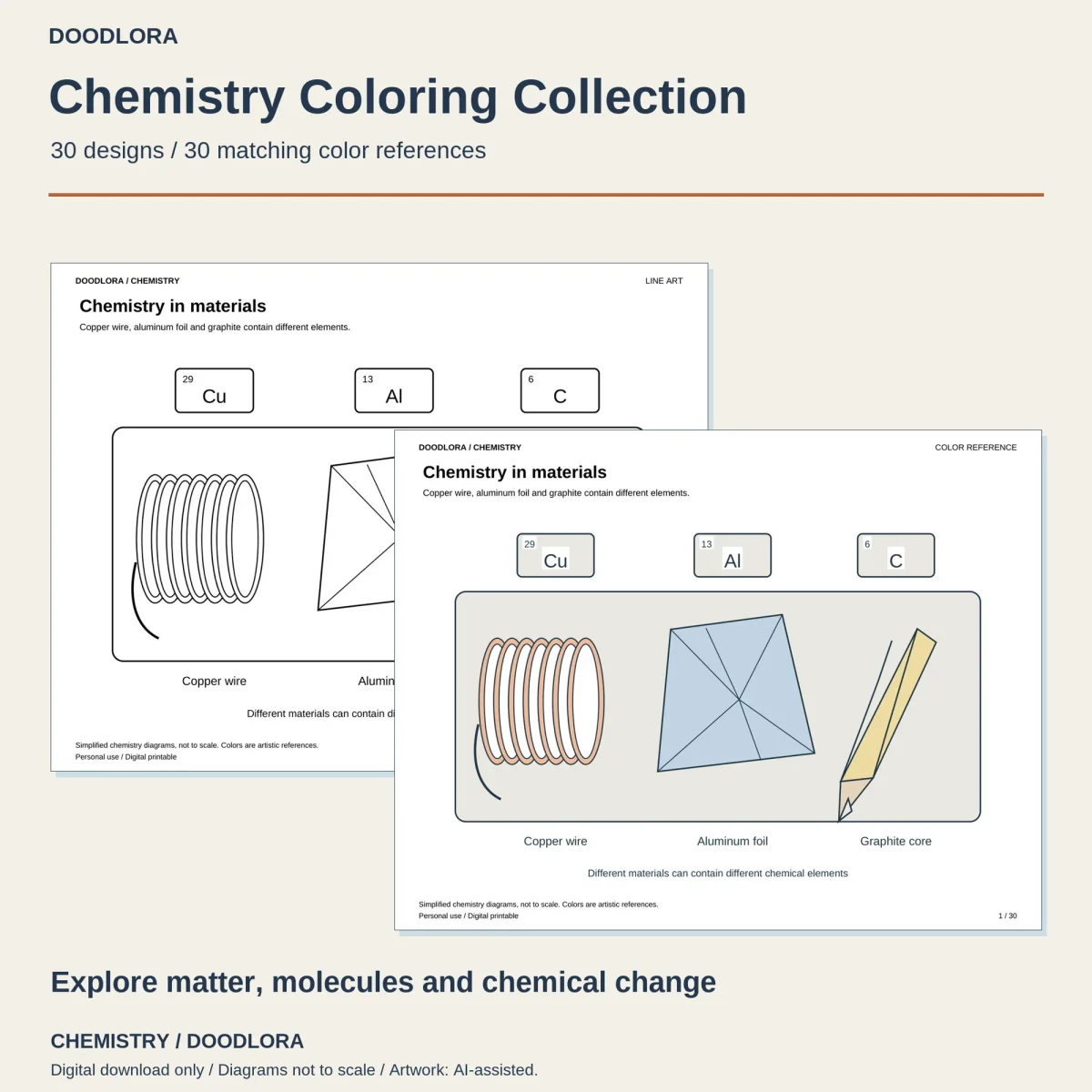
These chemistry coloring pages turn atoms, molecules and mixtures into simple shapes you can fill: circles with element letters inside, straight bonds, grids of ions and glass beakers holding particles. Each of the 30 landscape pages is one labeled diagram with a title, a short sentence above it and a caption below. Nothing has a face, and the few everyday objects, like the pencil on page 1 and the bottle on page 25, are drawn as plainly as the molecules.
The 30 diagrams, grouped
| Pages | Topic |
|---|---|
| 1–5 | Copper, aluminum and pencil graphite with their element tiles, solid, liquid and gas drawn with the same 12 particles, elements versus compounds, mixtures, and a periodic table map of the first 20 elements |
| 6–10 | Carbon-12 with its atomic and mass numbers, a neon atom’s two electron shells, the three hydrogen isotopes, sodium and chlorine forming ions, and a salt crystal lattice |
| 11–15 | A bent water molecule at 104.5 degrees, straight carbon dioxide, methane with wedge and dashed bonds, oxygen and nitrogen with double and triple bonds, and graphite next to diamond |
| 16–17 | Balancing the formation of water atom by atom, and two energy curves, one for a reaction that releases energy and one that absorbs it |
| 18–23 | Salt pulled apart by water molecules, a saturated beside an unsaturated solution, paper chromatography, a filter funnel, crystals forming as water leaves a dish, and a solution diluted to twice the volume |
| 24–30 | A pH scale from 0 to 14, bubbles in sparkling water, a water drop on a surface, a polyethylene chain, ordered versus disordered solids, iron in dry and moist air, and a lab bench with a coat, goggles and labeled storage |
Pictures of what happens, not a lab manual
Pages 19 to 24 show glassware: beakers, a funnel clamped to a stand above a flask, and a shallow dish. They’re drawn as pictures of the idea on the page, with labels like “Solvent front” and “Clear filtrate,” and no amounts, timings or supplies. The caption under the water formation diagram says outright that it shows atoms rearranging and is not a procedure, and the rusting page compares two conditions without a timeline.
What fills fastest and what takes patience
The molecule pages are quick, with a few large atoms each. The salt lattice on page 10 has more than 30 small ion circles, and the saturated solution on page 19 packs a beaker with tiny solute circles and a pile of crystals at the bottom. Letters such as Na+, Cl-, H and O are printed inside the circles, so you’ll be coloring around them.
Using the color references
In the color file, oxygen atoms are peach, hydrogen is pale blue, sodium is lavender and chloride is green, and oxygen and hydrogen keep those colors from one page to the next. The pH page gets a rainbow band, and the caption under it says the colors are illustrative, not a real indicator chart. Print the line-art PDF in landscape at Actual Size, and switch to Fit to printable area only if the edges get clipped. The A4 PDFs hold the same 30 diagrams.
Questions
- Is there a full periodic table to color?
- Not a full one. Page 5 is a periodic table outline with only elements 1 to 20, hydrogen to calcium, filled in, and a note on the page says later elements are left off the map.
- Do the pages tell you how to do any of the lab work shown?
- No. The beakers, filter funnel and evaporating dish are drawings to color, with no steps, amounts or supply lists. The start-here notes describe the set as learning illustrations, and several page captions repeat that the drawing is a model, not a procedure.