Thanksgiving STEM Activities: Turkey Challenges for Kids
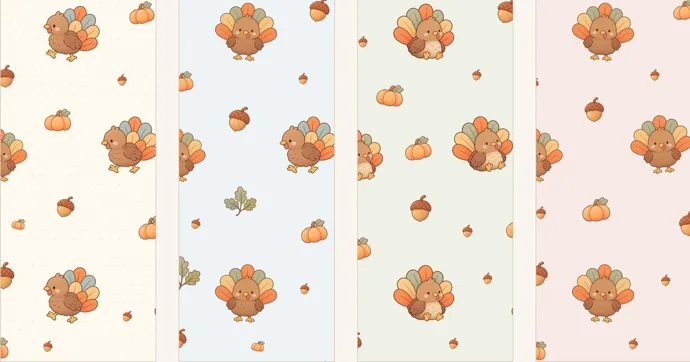
Thanksgiving STEM activities for kids work best when each one asks a single question a child can test: Will the cup tower hold the turkey? How many pennies sink the foil boat? Which gourd rolls farthest? Pick by where you are. A classroom with 25 minutes gets a building challenge, a kitchen full of cooks gets the measuring jobs, and a quiet table after dinner gets the pattern and grid puzzles.
Every activity here uses paper, cups, tape, string, water, a scale or measuring cups. None needs a flame, a chemical reaction, a battery or a hot glue gun, so a child can do the hands-on part while an adult stays nearby. The ages, group sizes and times are our planning suggestions, not tested results; stretch or shorten them to fit your kids.
Pick a Thanksgiving STEM activity by place and age
| Where you are | Activity | Ages | Time | Main supplies |
|---|---|---|---|---|
| Classroom or long table | Paper cup turkey tower | 5+ | 20 min | Paper cups, index cards |
| Classroom or long table | Toothpick turkey that stands up | 5+ | 20 min | Toothpicks, play dough |
| Classroom or long table | Turkey trap design challenge | 6+ | 30–45 min | Recycling bin, tape, string |
| Kitchen counter or sink | Foil boat challenge | 6+ | 20 min | Foil, tub of water, pennies |
| Hallway or floor | Gourd ramp race | 4+ | 15 min | Board, books, small gourds |
| Table | Feather straw race | 4+ | 10 min | Craft feathers, straws, tape |
| Table | Craft stick catapult | 6+ | 25 min | Craft sticks, rubber bands, pom-poms |
| Kitchen, while dinner cooks | Pumpkin string guess | 4+ | 10 min | String, scissors, pumpkins |
| Kitchen sink | Fall produce sink or float | 3+ | 15 min | Tub of water, produce |
| Kitchen counter | Measuring cup puzzle | 5+ | 10 min | Rice, measuring cups |
| Kitchen counter | Kitchen scale lineup | 5+ | 10 min | Scale, produce |
| Classroom or party table | Estimation jar | 5+ | All day | Jar, dried corn or beans |
| Quiet table | Feather pattern tail | 4+ | 15 min | Turkey coloring page, crayons |
| Quiet table | Mirror test on a turkey | 6+ | 15 min | Front-facing turkey page, small mirror |
| Quiet table | Find the repeat in a pattern | 6+ | 15 min | Turkey pattern paper |
| Quiet table | Count and graph the turkeys | 5+ | 20 min | Turkey pattern paper, graph sheet |
| Quiet table | Paper feather sort and measure | 4+ | 15 min | Paper feathers, ruler |
| Older kids | Read a bead chart like a map | 8+ | 20 min | Bead chart page, highlighter |
| Older kids | Code a pixel turkey | 8+ | 30 min | Graph paper, colored pencils |
Before the Thanksgiving STEM challenges: ages, food and what to skip
Thanksgiving falls on the fourth Thursday of November, which is November 26 in 2026. That leaves the week before for classroom versions and the day itself for the kitchen ones. If a child would rather help with the meal than test anything, the kitchen jobs in Thanksgiving activities for kids keep small hands busy away from the stove.
Many turkey building ideas online use marshmallows, whole grapes, gumdrops or popcorn as connectors. HealthyChildren.org, from the American Academy of Pediatrics, lists marshmallows, whole grapes, popcorn and “hard, gooey, or sticky candy” among foods to keep from children until 4 years of age or older. With toddlers or preschoolers at the table, use play dough or soft clay instead, and keep the food for eating at a seat.
The same AAP list puts coins, marbles and toys with small parts among household items to keep away from young children, which matters for the foil boat and the estimation jar.
Skip anything with a flame, a hot tool or a chemical fizz. That rules out candle experiments, vinegar volcanoes, potato or fruit batteries and hot glue for kids. Masking tape, glue sticks and play dough do every joining job below.
Thanksgiving STEM challenges for building and engineering
These work as stations in a classroom or as a cousins’ challenge at a long table. Give a fixed set of supplies and a timer, then let each team test, fail and rebuild. The talk at the end matters more than the winner.
Paper cup turkey tower
Ages: 5+ · Group: teams of 2–3 · Time: about 20 minutes · You need: 20 paper cups and 5 index cards per team, a small stuffed turkey or a turkey coloring page taped to a card
The challenge is to build the tallest tower that can hold the turkey on top for ten seconds. Cups can stand up or upside down; cards make floors between layers. Teams get eight minutes to build and one test each, then two minutes to fix and a second test.
The trap here is speed. Young builders stack one tall column that falls when the turkey goes on. Ask after the first test: which tower stood, and how wide was its bottom compared with its top?
Toothpick turkey that stands up
Ages: 5+, with an adult watching · Group: 1–2 per kit · Time: about 20 minutes · You need: 30 toothpicks, a walnut-sized ball of play dough cut into small pieces, a paper plate as the base
Children join toothpicks with small balls of dough to build a turkey shape: a body, two legs and a fan of tail “feathers.” It has to stand on its own for a count of ten. Triangles hold their shape and squares fold, which kids discover after the first collapse.
Toothpicks are pointed, so keep this one at a table and count them back in at the end. For a younger child, swap toothpicks for short pieces of straw or pipe cleaner.
Turkey trap design challenge
Ages: 6+ · Group: 1–3 per trap · Time: 30–45 minutes, or over two days · You need: a box of clean recycling (cereal boxes, tubes, cups), tape, string, scissors, a small toy turkey
Kids design a trap that catches a toy turkey without hurting it. They sketch first, label the parts, then build. A good trap has a trigger, something the turkey “touches” that drops a door or tips a box.
Finish with a demonstration: each builder walks the turkey in and explains what should happen. When a door doesn’t drop, ask what would make the string pull harder. Most fixes are a shorter string or a lighter door.
Foil boat challenge
Ages: 6+ · Group: 1 per boat · Time: about 20 minutes · You need: a 12-inch square of aluminum foil per child, a tub or sink of water, a cup of pennies or dried beans
Each child folds a boat from one square of foil, sets it on the water and adds pennies one at a time until it sinks. Record the count, then try again with a new design. Wide, flat boats with low sides usually beat tall, narrow ones, and children can see why when the water starts lapping in.
Coins are on the AAP list of household items to keep from young children. If there’s a toddler in the room, use larger dried lima beans and keep the cup on the counter, not on the floor.
Forces and simple machines with fall things
These three need floor space or a clear table. They show how slope, push and lever length change how far something goes.
Gourd ramp race
Ages: 4+ · Group: 2–6 · Time: about 15 minutes · You need: a board or a large flat piece of cardboard, a stack of books, three or four small gourds or mini pumpkins, masking tape
Lean the board on two books and roll each gourd down from the same line. Mark where each one stops with tape and the child’s initial. Then add a third book and roll them again.
Bumpy gourds wobble off the side, which is half the fun. Round mini pumpkins roll farther than lumpy ones. Ask children to predict which will go farthest before every roll, and to explain whether the higher ramp changed the answer.
Feather straw race
Ages: 4+ · Group: 2–4 racers · Time: about 10 minutes · You need: a craft feather and a drinking straw per child, masking tape for start and finish lines on a smooth table
Children blow through the straw to push their feather from start to finish without touching it. Then try a second round with a folded paper “feather” and compare. The real feather lifts and drifts; the folded paper slides.
Give each child their own straw and keep straws out of shared use. Racers who blow hard and fast lose control, so the discussion question writes itself: did gentle puffs or big blows work better?
Craft stick catapult
Ages: 6+ · Group: 1–2 per catapult · Time: about 25 minutes · You need: 7 craft sticks, 3–4 rubber bands, a plastic bottle cap, tape, pom-poms, a paper target
Stack five sticks and band them at both ends. Slide that stack between two more sticks banded at one end only, tape the bottle cap to the top stick, then press and release. The stack is the fulcrum: slide it toward the cap and the launch gets shorter and higher; slide it back and it gets longer.
Use soft pom-poms only, and set the rule before the first launch: aim at the target on the floor, never at a person. Measure each launch in craft-stick lengths or with a tape measure and write it down.
Kitchen measuring jobs while dinner cooks
These keep kids at the counter and away from the stove. No heat or knives are involved; an adult can hand over the produce and stay with the cooking.
Pumpkin string guess
Ages: 4+ · Group: 1–6 · Time: about 10 minutes · You need: a ball of yarn or string, children’s scissors, two or three pumpkins of different sizes
Each child cuts a piece of string they think will wrap exactly once around the fattest part of a pumpkin. Then wrap it and see: too short, too long or just right. Older kids can lay their strings on a ruler and write the distance around in inches.
Most first guesses come up short, because a pumpkin looks smaller than it is around the middle. Let them try again on the second pumpkin and see whether the first one taught them anything.
Fall produce sink or float
Ages: 3+, with an adult at the sink · Group: 1–4 · Time: about 15 minutes · You need: a sink or tub of water, a towel, items such as an apple, a potato, a mini pumpkin, a pear, a carrot and an ear of corn
Before each item goes in, children guess “sink” or “float” and sort the items into two piles on the towel. Then test one at a time and move anything that surprised them. A two-column chart taped to the cabinet turns it into a record.
Keep children within arm’s reach any time there’s water in a tub, even a shallow one. Finish by asking whether size predicted the answer. Children usually expect the big things to sink, and a pumpkin can upset that idea quickly.
Measuring cup puzzle
Ages: 5+ · Group: 1–2 · Time: about 10 minutes · You need: a bowl of uncooked rice, a nested set of measuring cups, a tray to catch spills
Ask how many quarter cups fill one cup, then let children find out by scooping. Then move on to the half cup and the third cup. Write each answer down: 4 quarters, 2 halves, 3 thirds. That’s fractions, learned with their hands.
A child who scoops a heaped cup gets a different answer. Show them how to level the scoop with the back of a butter knife or a straight piece of card. Use a tray, because rice goes everywhere.
Kitchen scale lineup
Ages: 5+ · Group: 1–3 · Time: about 10 minutes · You need: a kitchen scale, five or six pieces of produce such as an apple, an onion, a potato, a pear and a mini pumpkin
First, children line up the produce from lightest to heaviest using only their hands. Then weigh each item and rearrange the line. Older children can write the weights in ounces or grams and work out the difference between the lightest and heaviest.
Hand-guessing gets close but rarely right, especially with two items that look alike. That’s the point to discuss: why do we need a tool to be sure?
Estimation jar
Ages: 5+ · Group: a whole class or family · Time: guesses all day, counting about 15 minutes · You need: a clear jar with a lid, dried corn kernels or dried beans, slips of paper
Fill the jar, close the lid and let everyone write a guess with their name. At the end, count together in groups of ten, which is faster and easier to check than counting by ones. The closest guess picks the next family game.
Keep the lid on. Dried corn and beans are small enough to fit in a toddler’s mouth, so the jar lives on a high shelf between guesses.
Patterns, symmetry and graphs on turkey printables
These are quiet-table jobs for after the meal or for the last stretch of a school day. Each one starts with a printed page and ends with a child explaining what they found. Print the line art pages at actual size.
Feather pattern tail
Ages: 4+ · Group: 1 per page · Time: about 15 minutes · You need: a turkey coloring page with a large tail, two or three crayon colors
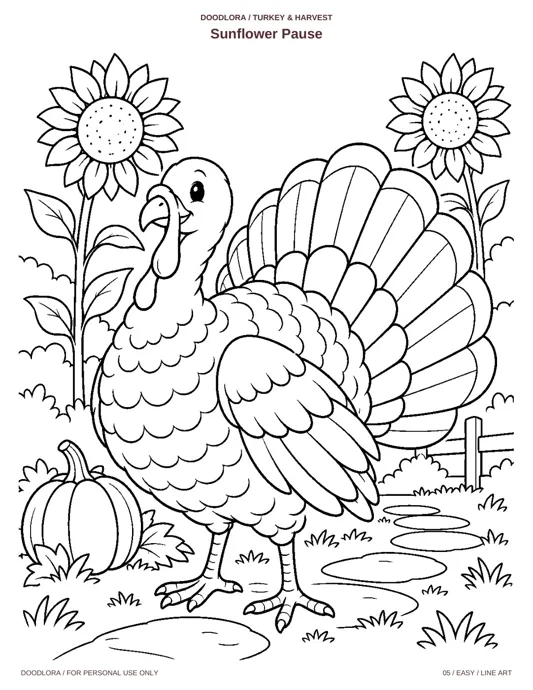
Children choose two colors and color the tail feathers in a repeating order: orange, brown, orange, brown. Once they can say the pattern out loud, add a third color for an ABC pattern or try orange, orange, brown.
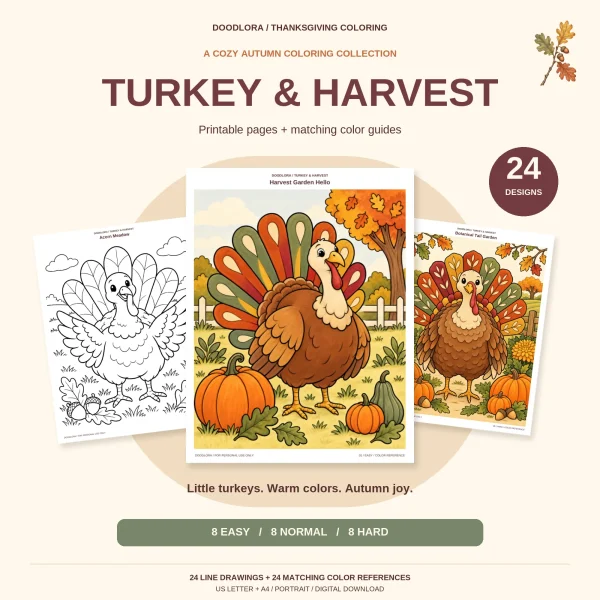
The Sunflower Pause page in our turkey coloring pages is page 9 of the US Letter book, one of the Easy designs. Its tail fans out behind the bird in large separate feathers. That gives a small hand enough room to color each one before moving to the next.
Where the tail runs out, the pattern sometimes doesn’t end neatly. Ask children what would come next if the turkey had one more feather.
Mirror test on a front-facing turkey
Ages: 6+ · Group: 1 per page · Time: about 15 minutes · You need: a front-facing turkey page, a small hand mirror or a fold line, a pencil
Fold the page down the middle of the turkey, or stand a mirror on the center line. Children check whether the left half matches the right half and circle any spot where it doesn’t.
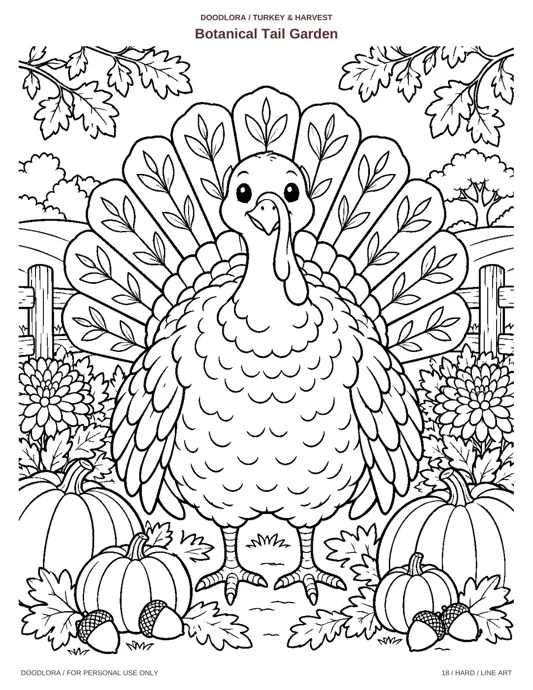
Botanical Tail Garden, page 35 of the same book and one of the Hard designs, works well for this. The tail has a center feather with five more fanned out on each side. The face is close to mirrored, but the wattle drapes to one side of the beak. Children who spot that have found the difference between “almost symmetric” and “symmetric.”
Coloring both halves to match is the natural next step. That’s slow work on a Hard page, so for younger kids, color only the tail.
Find the repeat in a turkey pattern
Ages: 6+ · Group: 1–2 per sheet · Time: about 15 minutes · You need: a printed sheet of turkey pattern paper, a pencil, a sheet of tracing paper or a clear plastic sleeve
Repeating wallpaper is built from one tile copied edge to edge. Children look for the smallest block that repeats: find one turkey, then find the next one that faces the same way and sits in the same spot among its neighbors.
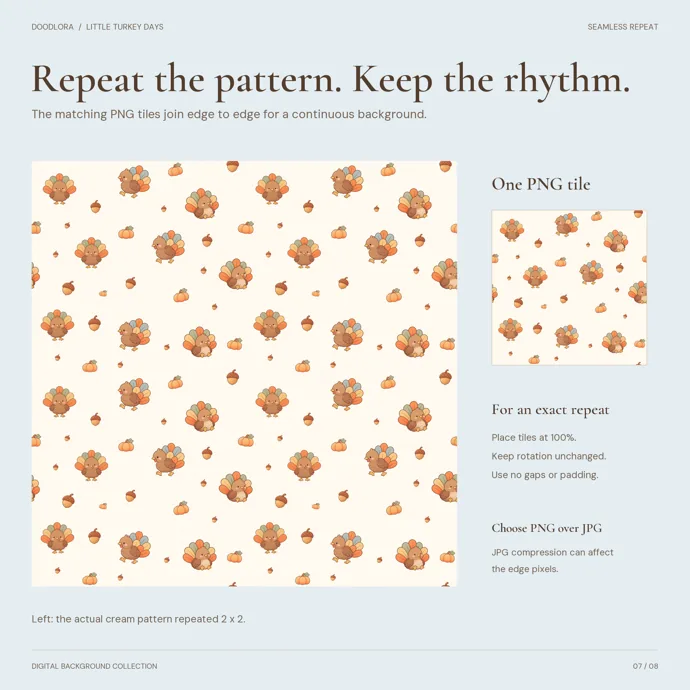
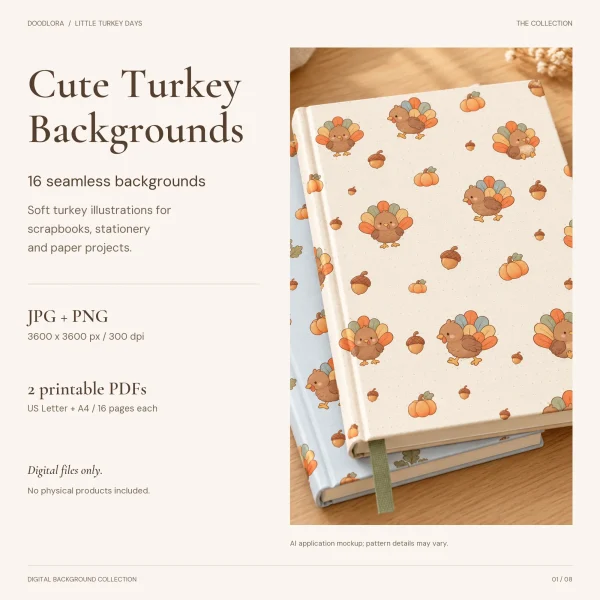
Our Thanksgiving backgrounds come with seamless PNG tiles, and this listing image shows the cream design tiled two by two. Print the cream page from the US Letter PDF (page 1) and ask kids to outline one full tile. Then show them the picture above and check.
The trap is that the same turkey pose shows up more than once inside a single tile. A child who stops at the first matching turkey has found a pose, not the repeat. Ask them to check that the pumpkins and acorns around it match too.
Count and graph the turkeys
Ages: 5+ · Group: 1–3 · Time: about 20 minutes · You need: one printed turkey pattern page, three crayons, a simple bar graph sheet or graph paper
The cream pattern has three kinds of turkey: one facing you with its wings out, one walking sideways and one sitting with its feet sticking out. Children tick each turkey with a crayon color for its pose, then count each color and draw a bar for each.
Pumpkins and acorns can become a second graph. Ask which is the most common thing on the page, and whether the answer would change on a bigger sheet. Turkeys cut off at the edge of the page cause arguments, so decide before counting whether a half turkey counts.
Paper feather sort and measure
Ages: 4+ · Group: 2–6 · Time: about 15 minutes · You need: 20–30 paper feathers cut from colored paper in three lengths, a ruler, two hula hoops or yarn circles for a Venn diagram
Children sort the feathers first by color, then by length, then into a two-circle Venn: “orange” in one circle, “long” in the other, long orange ones in the middle. Older kids measure each feather to the nearest half inch and line them up shortest to longest.
Cut a few feathers that are almost the same length. Those are the ones that make children reach for the ruler instead of guessing by eye.
Coordinate grid challenges for older kids
Third to fifth graders who finish everything else fast are ready for these. Both use rows and columns the way a map uses grid squares.
Read a bead chart like a map
Ages: 8+ · Group: 1–2 · Time: about 20 minutes · You need: one printed bead pattern tile page, a highlighter, a pencil
A fuse bead chart is a coordinate grid. Columns are numbered across the top, rows down the side, and every colored square is one bead with a color code inside.
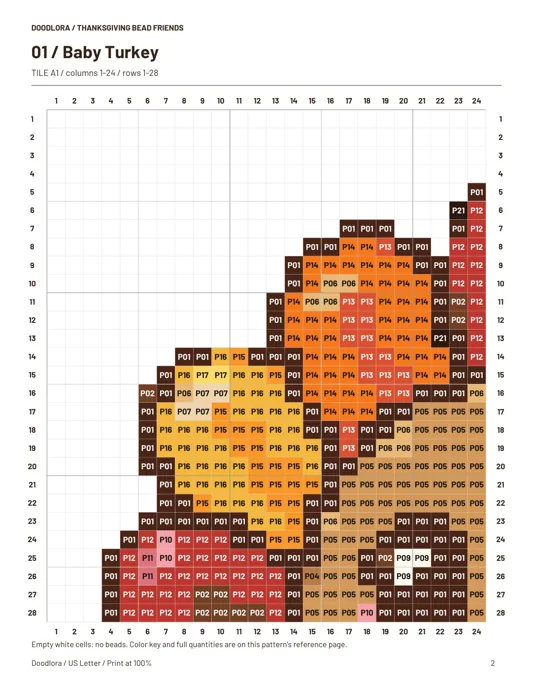
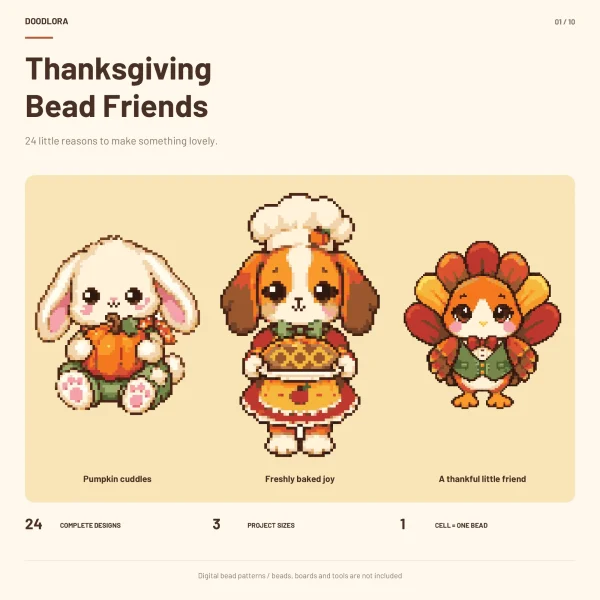
Page 2 of the Small book in our Thanksgiving fuse bead patterns is tile A1 of the Baby Turkey, covering columns 1–24 and rows 1–28. Give children three questions: what code sits at column 20, row 25; which row is the first to have any color; and how many P01 squares are in row 8. The answers are P09, row 5 and four. The pack’s own guide says columns increase left to right and rows increase top to bottom, so start there.
You don’t need beads for this. Should a child want to build it later, the pack’s guide says small beads are not suitable for children under 3 and that adults should handle the hot tools. The whole Baby Turkey takes 1,402 beads in 18 colors across six tiles, which is a weekend project, not a 20-minute one.
Code a pixel turkey
Ages: 8+ · Group: pairs · Time: about 30 minutes · You need: graph paper with large squares, colored pencils, a pencil
Each child designs a small turkey on a 12 by 12 grid, then writes the “code” for it as a list: row 3, columns 5–8, brown. They swap lists with a partner, who rebuilds the turkey from the code alone. Compare the two pictures.
Mistakes show up fast. A partner reads “row 3” from the bottom instead of the top, and the turkey comes out upside down. Agree on where row 1 is before anyone starts writing code. That’s the same rule a real bead chart has to spell out.
Running Thanksgiving STEM stations with a class or a crowd
With a class of 20–25, set up four or five stations and rotate every 12–15 minutes. Mix one messy station (the foil boat), one floor station (the ramp), one building station and one quiet printable station, so not every group is at the water at once. One adult at the water station is enough; the paper stations can run on a printed card.
At home with a mix of ages, give the youngest child the sink-or-float tub or the pattern tail. Hand the older cousins the cup tower or the pixel turkey. A six-year-old and a ten-year-old can share the foil boat if one folds and the other counts.
End every activity with the same three questions: What did you guess? What happened? What would you change? Writing the answers on a sticky note and adding it to a “Thanksgiving lab” poster gives the activity a clear finish.
When the experiments are done and everyone wants to just play, the Thanksgiving games work for the table and the backyard. A turkey that has to hide before dinner is its own design problem: the turkey disguise ideas walk through the school project many first and second graders bring home in November.
Printables from this article
Related articles
Kids Activity Books
Children’s Science Activities: Sorting & Measuring for Kids
Twelve hands-on science activities built on looking, sorting, measuring and recording, with ages, time, supplies, a wrap-up question and the snag to watch for in each.
Kids Activity Books
Letter M Craft Ideas: Monkey, Mouse & Mushroom for Preschool
Twelve letter M crafts grouped by who is at the table, from a foil-print moon for one toddler to monkeys swinging on a paper-chain vine for a whole class, with ages, minutes, supplies, steps and where each one tends to go wrong.
Kids Activity Books
Letter R Crafts for Preschool: Raccoon, Rabbit & Rainbow
Eleven letter R crafts grouped by what the child is into, from a sticky tissue rainbow for 2-year-olds to a raccoon shadow puppet, with ages, minutes, supplies, steps and the usual slip.