How to Create a Personal Growth Plan: Template & Example
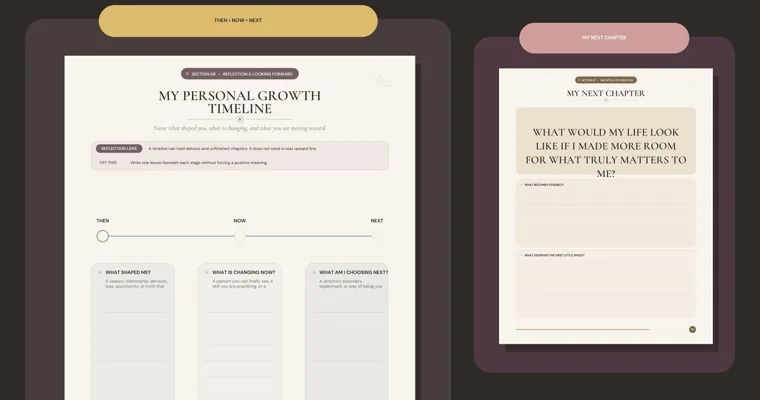
To create a personal growth plan, write down where you are now, pick one to three areas you want to grow in, give each area one goal, turn each goal into a habit with a fixed time slot, and review the plan every week and every month. The first three steps fit into one sitting of about an hour. The last two take a few minutes a day and a short check-in each weekend. The review is the step most plans skip, and it’s the one that keeps a plan alive after the first rough week.
Below, each step comes with what to write, roughly how long it takes and where it tends to go wrong. A filled-in 90-day example sits near the end, so you can see what a finished plan looks like on one page.
What you need before you start a personal growth plan
A personal growth plan needs very little: a pen, a notebook or a few printed pages, and the calendar you already check every day. A pencil helps for the first draft, because your goals will change wording at least once. Set aside 60 to 90 minutes for steps one to three, somewhere you won’t be interrupted. If you’ve never kept a planner, our guide on how to use a planner covers the daily five-minute setup that step four builds on.
Plan for 90 days, not a year. That’s our suggestion for a first plan: three months is long enough to see whether a habit holds, and short enough that the goals stay concrete. A five-year vision tends to stay vague, and a one-month plan ends before most habits settle in.
You can write it alone. If you have a friend or partner who’d check in with you, name that person in the plan now, because step three asks for a support person.
Step 1: Take stock of where you are now
Taking stock means a quick, honest snapshot before you set any goal. Without it, goals come from whatever felt urgent this morning. Give it 15 to 20 minutes.
Start with four ratings from 1 to 10: mood, energy, stress and how connected you feel to yourself. Then answer three short questions in a sentence each: what feels hardest right now, what you hope becomes clearer, and what feeling a little better would look like. After that, list the parts of your life you might work on, such as health and energy, relationships, work or study, learning a skill, home, and rest. Next to each one, write one line about how it’s going.
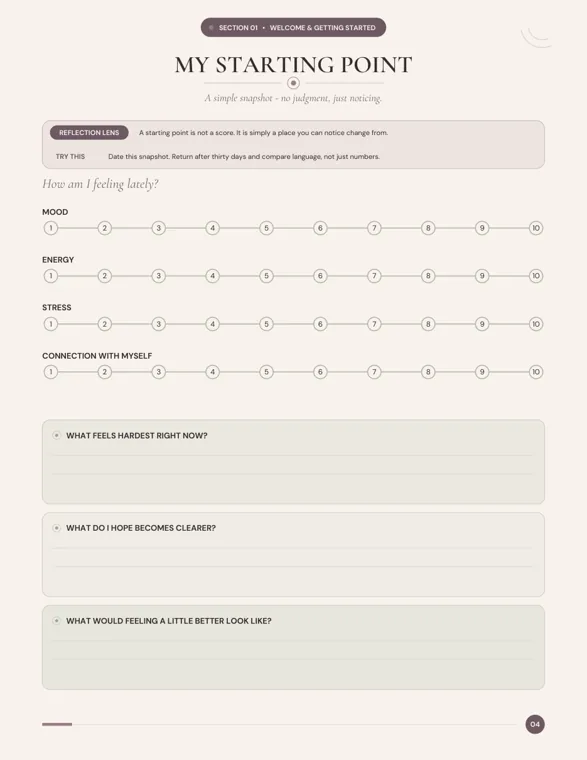
The trap here is treating the numbers as a grade. A 4 for energy isn’t a failure. It’s a place to measure change from. Date the page, and when you come back to it later, compare the words you used as well as the numbers. “Tired by 3 pm every day” turning into “tired on Thursdays” is real progress that a score might hide.
Step 2: Choose a direction and one to three growth areas
Choosing a direction means deciding what this season is for before you decide what to do. Look back at your snapshot and ask which two or three areas would change your ordinary week most if they improved. Those are your growth areas. Keep it to three at most, because every area competes for the same evenings and weekends.
Values make the choice easier. Circle five words that matter to you, such as health, family, creativity, security or growth. Then make three short lists: what you want more of, what you want less of, and what you want to protect. Our guided journal gives this a page of its own (page 10), and its values page on page 9 asks you to name one small behavior that would make each value visible. That small behavior often turns out to be your first habit.
Watch for areas that come from pressure rather than from you. “Get promoted” may matter, but if it’s on the list only because a sibling just was, it won’t hold up past week two. Ask whether you’d still pick that area if nobody else ever saw the plan.
Step 3: Write one goal for each growth area
A goal in a personal growth plan should describe what changes in an ordinary week, not only a finished result. “Read more” is a wish. “Read 20 pages on four evenings a week, so I finish one book a month” tells you what to do on a Tuesday.
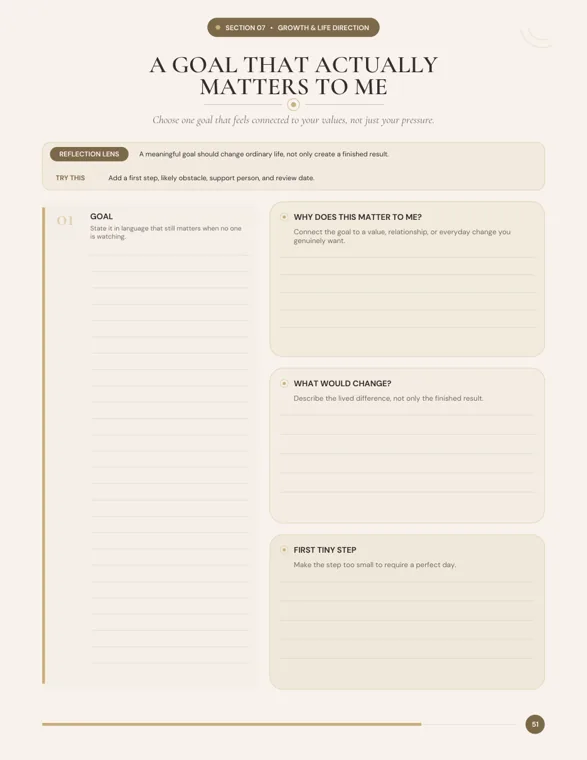
For each area, write these lines:
- The goal, in one sentence you’d still care about if no one was watching.
- Why it matters, tied to one of your values.
- What would change in a normal week if it worked.
- How you’ll know it’s working, something you could actually notice, such as falling asleep before 11 or speaking for five minutes without notes.
- The first tiny step, small enough to do on a bad day.
- The likely obstacle, the support person and a review date.
Two mistakes show up here again and again. The first is a goal that depends on other people, like “get a raise.” Split it into the result you hope for and the action you control, such as “finish the certificate course by the end of the quarter.” The second is a first step that’s really a project. If the first step is “overhaul my diet,” shrink it to “buy fruit for the week on Sunday.”
If you’d rather fill in printed pages than build the plan in a blank notebook, our guided journal covers steps one to three in its Welcome, Know Yourself and Growth sections, and it comes in a fillable copy too.
Step 4: Turn each goal into a habit with a time slot
A goal only moves when it has a place in your day. For each goal, write the habit as what, when, where and how long: “Walk for 20 minutes after lunch, from the office door to the park and back.” Then write a minimum version for bad days, such as “walk to the end of the block.” The minimum keeps the habit alive when the full version isn’t possible.
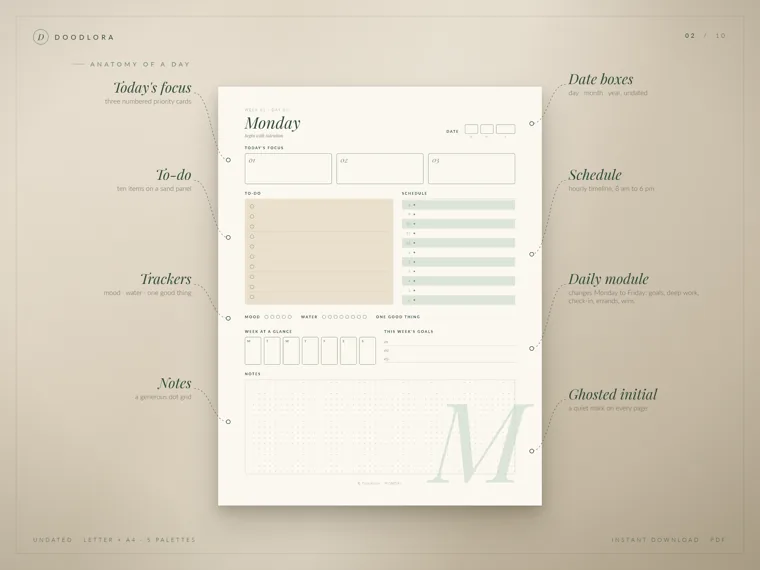
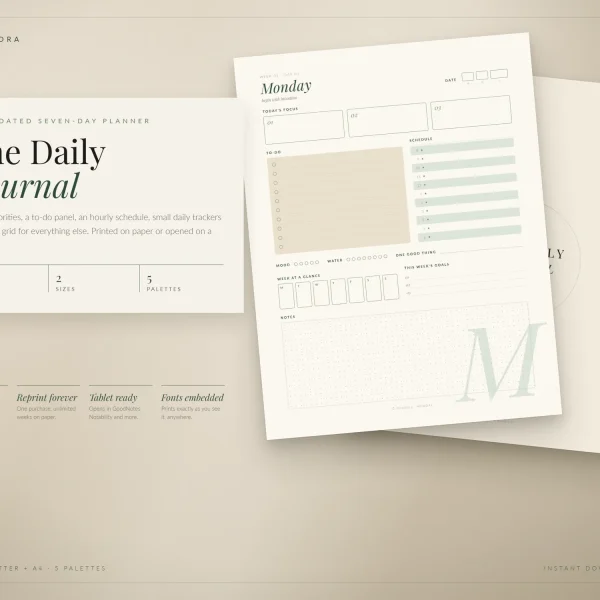
Put the habit into the calendar or planner you look at every morning, not on a separate list. On a daily planner page, one of the three “today’s focus” boxes can hold the growth habit, and the hourly schedule shows whether there’s actually room for it. If the only free slot is late at night, the habit will lose to tiredness. Fit it into a morning routine or an evening routine you already have instead.
Start with one habit, even if you have three goals. Add the second after two weeks, once the first one happens without much thought. Three new habits on the same Monday is the most common way a plan collapses in its first month.
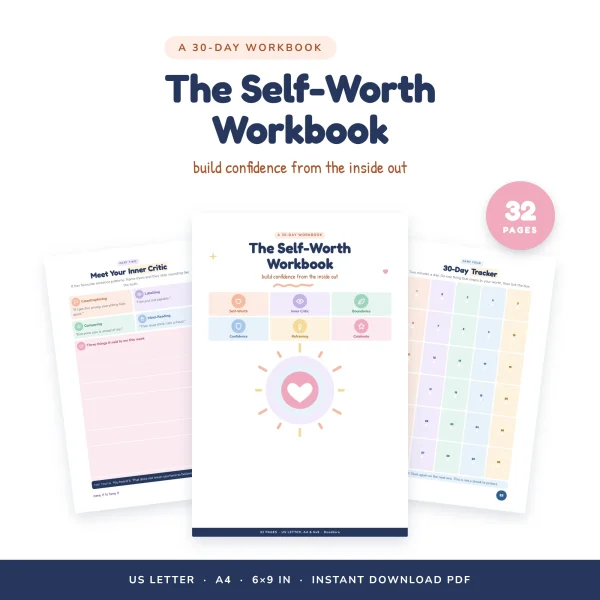
If your growth area is confidence or self-worth, a structured 30-day workbook can stand in for steps three and four. Our self-worth workbook suggests 15 to 20 minutes a day. It opens with a 12-statement check-in on page 7, keeps a two-minute daily tracker on page 23, and comes back to a 30-day review on page 28.
Step 5: Review the plan every week and every month
Reviewing is what turns a list of goals into a plan that adapts. Without a review, a missed week feels like failure. With one, it’s information.
Every week (10 to 15 minutes, for example on Sunday): count how many times each habit happened, note what got in the way, and decide whether to keep it, shrink it or move it to a different time slot. The weekend page of our daily planner ends with three prompts that fit this well: what went well, what to let go, and next week’s focus.
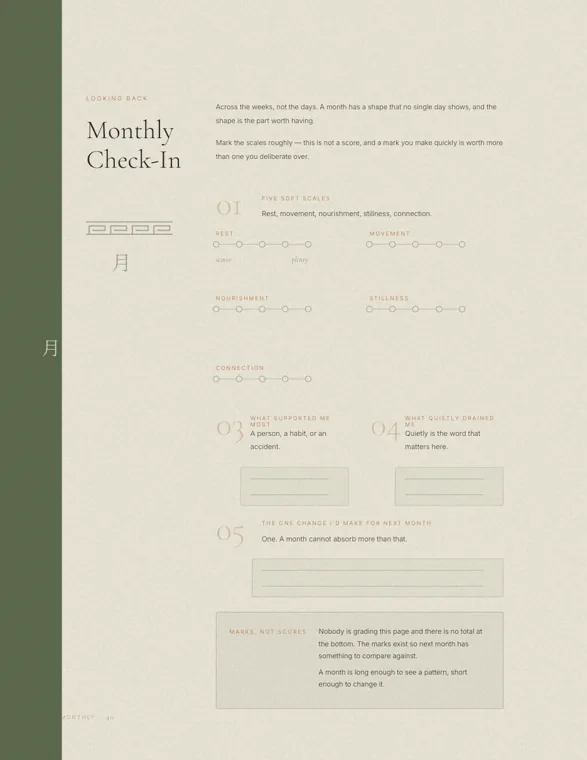
Every month (about 20 minutes): look at the shape of the month rather than single days. Rate a few areas roughly, write down what supported you most and what quietly drained you, and choose only one change for next month. A month can’t absorb five changes at once.
At 90 days: redo your step one snapshot, then compare it with the dated first one. Write down which habits stuck, which goal you’d keep for the next 90 days and which one you’re done with. A then, now and next timeline, like the one on page 57 of the guided journal, is a simple way to see the whole stretch on one page.
A personal growth plan example for 90 days
Here’s what a finished plan can look like. This is a made-up example for illustration, written for someone who chose energy, learning and relationships as growth areas.
| Area | Goal | Weekly habit | Bad-day minimum | How I’ll know |
|---|---|---|---|---|
| Energy | Have steady energy through the afternoon on workdays | 20-minute walk after lunch, Monday to Friday | Walk to the end of the block | Not reaching for a snack at 3 pm most days |
| Learning | Hold a five-minute conversation in Spanish by the review date | 20 minutes of practice on four weekday mornings | Review ten flashcards | Talking through a five-minute practice chat without switching to English |
| Relationships | See close friends more than once a month | One message or call to a friend every Thursday | Send one text | At least two meetups on the calendar each month |
The plan starts with the walk only. The Spanish practice joins in week three, and the Thursday message in week five. The review date for all three goals sits in the calendar 90 days after the start. For the language goal, our guide on how to learn a new language has a fuller schedule.
When a personal growth plan stalls
Most plans stall for one of three reasons, and each has a simple fix.
You missed a week
Restart at the next scheduled slot. Don’t try to make up the missed sessions, because doubling up turns one bad week into two. The 30-day tracker in our self-worth workbook prints the same rule under its boxes: miss a day, start again on the next one.
Everything feels urgent
Go back to step two and cut to one area for the next 30 days. The other areas stay on the page, just not on the calendar yet.
Writing about it brings up heavy feelings
A personal growth plan is a planning tool for everyday life, not treatment. If the reflection pages bring up feelings that are hard to handle, put the plan aside and talk with a doctor or a licensed mental health professional. A daily writing habit can still help afterward. Journaling for beginners has gentle prompts if a blank page feels like too much.
Frequently asked questions
How long should a personal growth plan be?
A first personal growth plan fits on one or two pages: a dated snapshot, one to three goals with their why, one habit for each goal, and review dates. If it runs longer, it usually has too many goals.
How many goals should a personal growth plan have?
One to three. Start working on only one of them, and add the next after about two weeks, once the first habit happens without effort.
Is a personal growth plan the same as a personal development plan?
The two names are often used for the same thing. “Personal development plan” shows up more often at work and school, where it usually centers on job skills, while a personal growth plan can also cover health, relationships and rest. The five steps are the same either way.
Do I need a template?
No. A notebook works fine if you write the same headings each time. Printed pages help when you want the questions laid out for you. You can find all our journals and planners on the Doodlora Studio home page.
Printables from this article


Related articles
Printable Planners
How to Build a Workout Plan: Weekly Schedule & Template
A step-by-step way to turn a fitness goal into a weekly workout schedule, with 3-, 4- and 5-day sample weeks, a logging routine and simple rules for progressing, resting and restarting.
Printable Planners
How to Create a Home Maintenance Checklist: Monthly & Yearly
A step-by-step way to build a home maintenance checklist that fits your house, with monthly, quarterly, seasonal and yearly jobs and where the safety intervals come from.
Printable Planners
Self Care Ideas for Mental Health: Relaxing Habits & Tracker
Sixteen small, non-clinical self-care habits sorted by what you need, from sleep and walks to boundaries and a joy list, plus a low-pressure weekly check-in.