Self Care Ideas for Mental Health: Relaxing Habits & Tracker
Self care ideas for mental health work best when they’re small enough to do on a bad day and specific enough to put on a calendar. The National Institute of Mental Health (NIMH) describes self-care as “taking the time to do things that help you live well and improve both your physical health and mental health.” So skip the spa-day version. Pick two of the 16 habits below, do them for one week, and check them off as you go.
Everything here is everyday upkeep for adults, not treatment. The last section covers when to talk to a professional and how to reach the 988 Lifeline.
| Self-care idea | Time | What you need | Good for |
|---|---|---|---|
| Fixed wake-up time | No extra time | An alarm | Tired all week |
| Real lunch and water in reach | 20 minutes | A glass and a calendar block | Afternoon slumps |
| Three 10-minute walks | 30 minutes, split | Shoes | No time to exercise |
| A winter ritual | 10 to 30 minutes | A ritual list | Dark evenings |
| A hands-on hobby | 20 to 30 minutes | Pencils, a puzzle or yarn | Racing thoughts |
| One album, start to finish | 30 to 45 minutes | Headphones | Evenings you scroll |
| One task outside | 10 to 20 minutes | A coat | Days stuck indoors |
| Worry time | 5 to 10 minutes | Paper | Worries that loop |
| One low-effort message | 2 minutes | Your phone | Feeling cut off |
| Boundaries written down | 15 minutes | A pen | Saying yes too often |
| A week of screen counts | 2 minutes a day | Your phone’s screen-time report | Losing evenings to the phone |
| A joy list | 15 minutes once | A page | Flat days |
| Tidy one corner | 10 minutes | A bag or a box | Feeling stuck |
| An hour off on the calendar | 1 hour | Your calendar | Weeks with no gaps |
| Decide what can wait | 5 minutes | A to-do list | Overloaded days |
| Close the day with what you did | 3 minutes | A notebook | Nights you replay the day |
Self-care basics: sleep, food, water and movement
The first four self care ideas look boring, and that’s the point. NIMH lists exercise, regular meals and water, and sleep before anything else on its own list of self-care tips. When these slip, the relaxing ideas further down get much harder to use.
Keep one fixed wake-up time
NIMH’s advice on sleep is to “Stick to a schedule, and make sure you’re getting enough sleep.” The easiest anchor is the time you get up, because you control the alarm and you don’t control when you fall asleep. Pick a wake-up time you can keep on Saturday as well, and hold it for two weeks. Bedtime tends to move earlier on its own once mornings are fixed.
The common mistake is sleeping in two extra hours on Sunday to catch up, which makes Monday night harder. NIMH also points out that blue light from screens “can make it harder to fall asleep,” so the phone is the first thing to put away at night. Our night routine ideas lay out a full wind-down if you want more than one change.
To see whether it’s working, page 14 of our 4-Week Self-Care Journal is a sleep tracker with two weeks of boxes for when you fell asleep, when you woke, total hours and quality. Its prompt is “Track two weeks and find your pattern,” and two weeks is about right.
Eat a real lunch and keep water in reach
Regular meals are the self-care idea most people drop first on a busy day. NIMH’s wording is “Eat healthy, regular meals and stay hydrated,” and it adds that caffeine and alcohol can affect mood, so cutting back helps some people. Put a 20-minute lunch block on your calendar, and keep a full glass where you work instead of in the kitchen.
Don’t turn this into a diet. The habit is eating at roughly the same times, not eating perfectly. If deciding what to eat is the hard part, our guide on how to meal plan walks through picking a week of dinners with a simple rotation and two backup meals for busy nights.
Walk for ten minutes, three times a day
NIMH notes that “Just 30 minutes of walking every day can boost your mood and improve your health.” It also says small amounts add up, so you don’t need one 30-minute block. Three 10-minute walks, one after each meal, get you there.
The usual trap is all-or-nothing thinking: no time for a full workout, so no movement at all. A walk around the block counts. So does walking laps while you’re on a phone call.
Borrow a winter ritual for dark evenings
Seasonal rituals give dark evenings a shape, and they help most from November on, when it’s dark by dinner. The winter Small Rituals page in our Seasonal Wellness Journal (page 31) prints six to choose from: soak the feet before bed, make one long soup, sit with the lamp low, keep the neck covered, sleep before eleven, and read something you have already read. Three more boxes are left blank for your own.
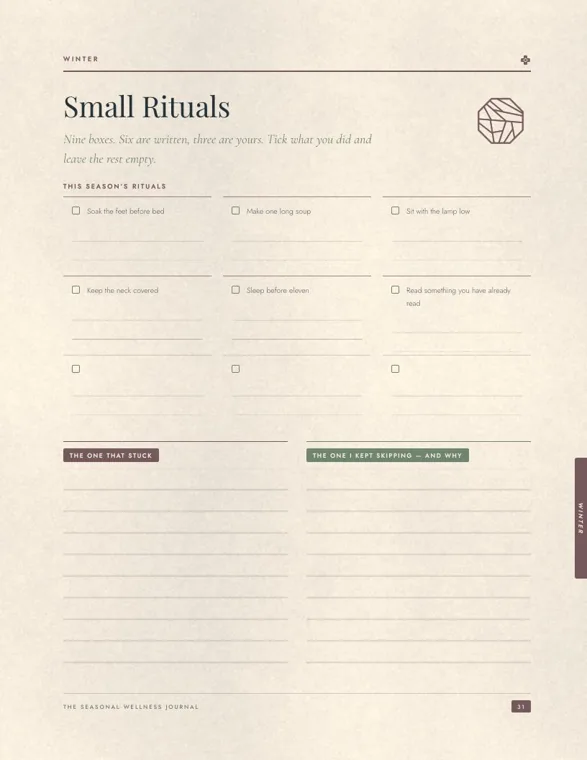
The page’s instruction is to “Tick what you did and leave the rest empty,” which takes the pressure off doing all nine. Choose one or two and notice which one you avoid. The “one I kept skipping — and why” box below the grid is often more useful than the checkmarks, because the reason is usually time, not willpower.
Relaxation activities for mental health when your head is full
Once the basics are in place, relaxation activities help on the evenings when your thoughts keep looping. NIMH suggests scheduling “listening to music, reading, spending time in nature, and engaging in low-stress hobbies.” What these share is that they have no score and no deadline, and that is why they work.
Pick up a hands-on hobby
Coloring, a jigsaw puzzle, knitting or a model kit keeps your hands busy enough that your mind slows down. Give it 20 to 30 minutes at the same time each evening, and keep the supplies out so starting takes no setup.
Pick something easy. A coloring page with tiny, detailed sections can turn into another task you’re failing at. Big shapes and a few colors are more relaxing. Our coloring tips cover choosing a page and fixing mistakes when color goes outside the lines.
Listen to one album, start to finish
Choose an album you already like, put on headphones, and lie down or sit somewhere other than your desk. Most albums run 30 to 45 minutes. That’s long enough to settle and short enough to fit before dinner.
Shuffle is the catch. A shuffled playlist on your phone turns into skipping tracks and then scrolling. Playing a whole album in order, with the phone face down, keeps it a break.
Take one ordinary task outside
Spending time in nature doesn’t need a hike. Take something you were going to do anyway outdoors: eat lunch on a bench, make a phone call while walking around the block, or fold laundry on the porch. Ten to 20 minutes is plenty.
In colder months, people cut this short because they head out underdressed. The autumn Body & Breath page in our seasonal journal has a rule that fits: “Put something warm on before you feel cold.” Keep a coat and hat by the door so going out takes one step.
Book a daily worry time
Worry time gives anxious thoughts a set slot instead of the whole day. Page 12 of our self-care journal describes it in two lines: “Book 5-10 minutes a day for worry. Outside it, tell yourself: save it for then.” Pick the same time each day, write the worries on paper when it starts, and stop when the timer goes off.
The tricky part is the rest of the day. When a worry shows up at 2 p.m., jot one word on a sticky note and leave it for the slot. We’d also avoid putting worry time right before bed, since that’s when worries are hardest to set down.
Self-care with other people, and away from them
Self-care isn’t only time alone. NIMH’s list ends with “Stay connected,” and the same list says to learn to say “no” when you’re taking on too much. The next three ideas cover both sides: reaching out, and protecting your time.
Send one low-effort message
NIMH suggests reaching out “to friends or family members who can provide emotional support and practical help.” Waiting until you have the energy for a long call means it rarely happens. A two-minute message works instead: a photo, a “saw this and thought of you,” or a question about something they mentioned last time.
Page 16 of the self-care journal is a Social Connection Log with columns for who you reached, what you did and how you felt. At the bottom it asks when you felt most alone and “Who I want to reach out to next week.” Writing a name there is a small commitment that’s easy to keep.
Write your boundaries before you need them
Boundaries are easier to hold when you’ve decided them on a calm day. The My Boundaries page in our self-care journal (page 24) splits them into four kinds: digital, social, time and emotional. Each comes with prompts such as “When I answer work messages” and “How I answer last-minute asks.”
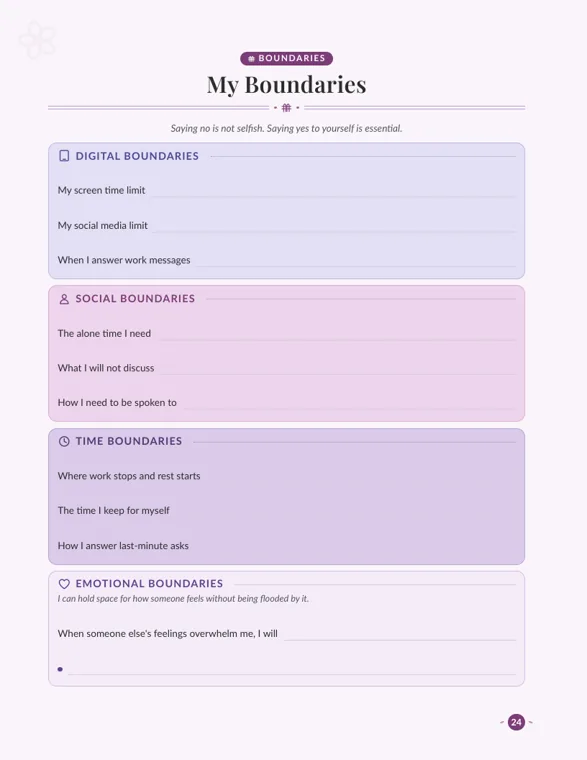
Fill in one line per section, not all twelve at once. The mistake to avoid is writing a rule you’ll break by Wednesday. “Never check email after 5” usually fails. “After 7, I only open messages marked urgent” has a better chance. When a new request lands, your answer is already written down.
Count your screen hours for one week
Most people guess their screen time low, so count it before trying to cut it. Your phone already has a built-in screen-time report. Copy the daily total and the social media figure into a log each night, which takes about two minutes.
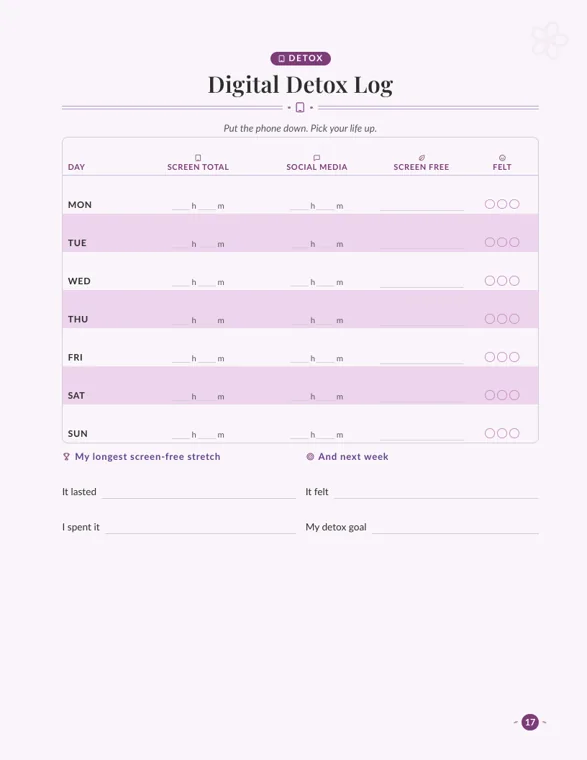
Page 17 of the journal is this log, with hours and minutes for each day, a screen-free column and a mood rating. At the bottom it asks for your longest screen-free stretch and how you spent it. Don’t change anything during the counting week. Once you have real numbers, set one limit and write it on the boundaries page under “My social media limit.”
Small self-care ideas for a flat or heavy day
Some days, the basics feel like too much. These five ideas are for days like that. Each takes little energy, and most take less than 15 minutes.
Build a joy list on a good day
A joy list is a page of small things that reliably lift your mood, written on a good day so you have it on a bad one. Page 9 of our self-care journal starts you off with “sunshine – coffee – a good song – a text from a friend – the smell of rain – a warm hug – a quiet morning,” followed by 15 blank lines.
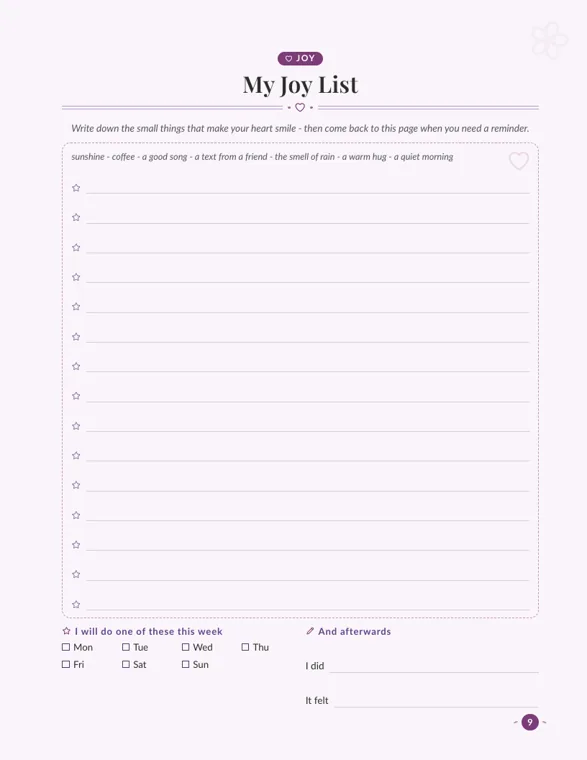
Keep every item small enough to do in ten minutes. “A week at the beach” doesn’t help on a Tuesday, but “the bakery on Third Street” might. Below the list, the page has day boxes for “I will do one of these this week,” then two lines for what you did and how it felt. Choose the day ahead of time, or the list just sits there.
Tidy one small corner
When a whole room feels like too much, clear one drawer, a nightstand or the passenger seat of the car. Set a timer for ten minutes and stop when it rings, even if you’re on a roll.
The pitfall is scope creep. Tidying the drawer leads to the closet, and an hour later you’re worn out and the room looks worse. One corner, done, is the goal.
Put an hour off on the calendar
NIMH recommends scheduling regular times for healthy activities you enjoy. Treat an hour off like an appointment. Block it on your calendar with a name, and decide what you’ll do before it starts. Your joy list is a good place to pick from.
An unplanned hour off tends to fill up with laundry and email. If you live with other people, tell them when it is, so it doesn’t get taken over by their plans.
Decide what can wait
When everything feels urgent, NIMH’s advice is simple: “Decide what must get done now and what can wait.” Write your to-do list, circle the three things that truly have to happen today, and move the rest to tomorrow or later in the week. This takes about five minutes.
The hard part is accepting that the moved items are fine where they are. Our guide on how to use a planner has a five-minute daily plan and a weekly review, which keeps the moved tasks from getting lost.
Close the day with what you got done
NIMH suggests trying “to appreciate what you have accomplished at the end of the day.” Before bed, write down three things you finished, and count the small ones. “Answered the dentist’s email” counts, and so does “ate lunch.”
A done list sits close to a gratitude habit, and NIMH’s tip there is to “Be specific.” If you’d like prompts that go beyond tasks, our gratitude journal prompts include a set for hard days.
How to track a week of self-care without making it homework
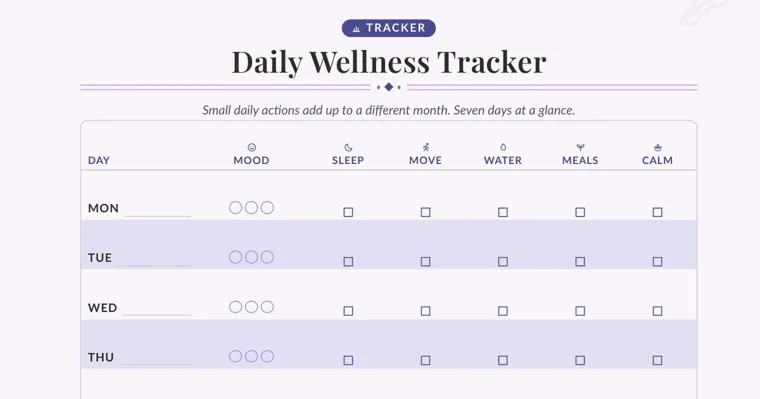
A simple tracker helps you see which self care ideas actually stick, as long as it doesn’t become a score to beat. Page 3 of our 4-Week Self-Care Journal is a Daily Wellness Tracker for seven days. It has six columns: mood, sleep, move, water, meals and calm. Mood gets three circles, for good, ok and low, and the other five get a check box.
At the bottom of the page, it asks for “Boxes ticked this week” out of 42, “The one I kept up best” and “The one to strengthen next week.” The 42 is six columns times seven days, so the mood circle counts as a box. Don’t aim for 42. Choose the two ideas from this list you’re trying, mark those columns, and judge the week by them alone.
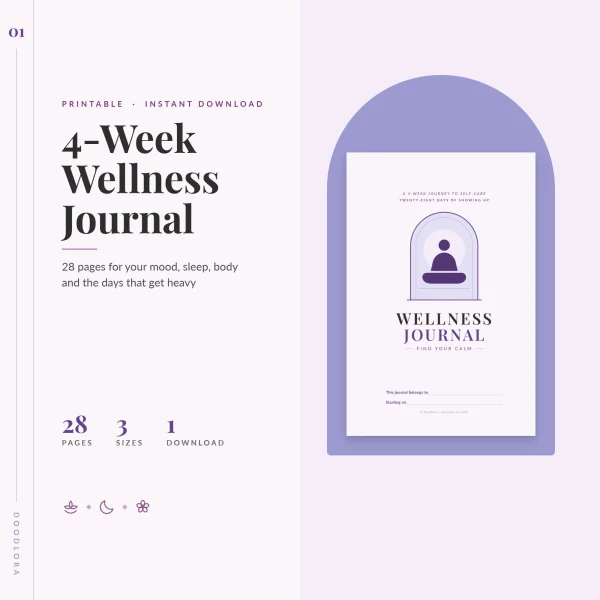
The journal is 28 pages, and its cover reads Wellness Journal. It comes as US Letter, A4 and a 6 x 9 in booklet, with the same pages in each. Its printing guide suggests doing the weekly pages on a Sunday evening. If you want a fresh set each week, print pages 3 to 6, 14 to 19 and 26 four times. Set the printer to Actual size or 100% rather than “Fit to page,” which cuts into the margins. The pages print their own soft lilac background, so use white paper. Every color is chosen to stay readable in grayscale.
When self-care isn’t enough
NIMH says self-care “can play a role in maintaining your mental health,” and it can help support treatment if you have a mental illness. It isn’t a replacement for professional help, and neither is a journal page.
NIMH advises seeking professional help “if you are experiencing severe or distressing symptoms that have lasted 2 weeks or more.” Its examples include trouble sleeping, changes in appetite, difficulty getting out of bed because of mood, trouble concentrating and losing interest in things you usually enjoy. A primary care provider is a good first call. They can refer you to a psychologist, psychiatrist or clinical social worker.
If you or someone you know is struggling or having thoughts of suicide, call or text the 988 Suicide & Crisis Lifeline at 988, or chat at 988lifeline.org. NIMH notes the service is free, confidential and available 24 hours a day, 7 days a week. In a life-threatening situation, call 911.
Printables from this article

Related articles
Printable Planners
How to Build a Workout Plan: Weekly Schedule & Template
A step-by-step way to turn a fitness goal into a weekly workout schedule, with 3-, 4- and 5-day sample weeks, a logging routine and simple rules for progressing, resting and restarting.
Printable Planners
How to Create a Home Maintenance Checklist: Monthly & Yearly
A step-by-step way to build a home maintenance checklist that fits your house, with monthly, quarterly, seasonal and yearly jobs and where the safety intervals come from.
Printable Planners
Easy Time Management Tips for Work, Students and Parents
Simple time management habits you can start on an ordinary weekday, sorted for desk jobs, students and busy households, with the snag to watch for in each.