Community Helpers for Kids: List, Jobs and Activities
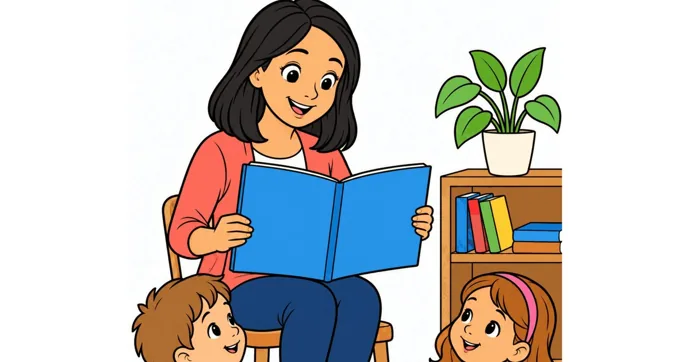
A community helper is anyone whose job makes daily life in a town work for other people: the firefighter, the nurse, the mail carrier, the cashier who bags your groceries and the custodian who mops the school hallway. For young children, the whole topic fits into three questions. What does this person do? Where do they work? What do they use? A child who can answer those three for a handful of helpers has the idea, and everything else in a community helpers unit is practice.
Below you’ll find a plain-language way to explain it, a list of 20 helpers with their jobs, workplaces and the clues kids can spot, and activities sorted by age for preschool, kindergarten and first and second grade. Each activity says how many children it suits, how long it takes, what to prepare and how to wrap it up.
What is a community helper? An explanation kids understand
The simplest definition for a four-year-old is “a person whose job is helping other people in our town.” Older children can handle a little more: a community is the people who live, work and go to school near each other, and a community helper does work that the rest of that community needs.
Three points keep the idea from getting muddled:
- It’s about the work, not the outfit. A firefighter wears gear you can spot from across the street, but a cashier or a scientist may look like anyone else. Teach “what do they do” first and “what do they wear” second, or children decide that only people in uniforms count.
- Helpers are men and women. Say “firefighter,” “police officer” and “mail carrier,” not “fireman,” “policeman” or “mailman.” When you show pictures, mix them up: a woman on the fire crew, a man as the nurse.
- Children are community helpers too. Holding a door, feeding the class fish and picking up litter on the playground all count. Ending a lesson on “how do you help?” turns the topic from a list of strangers into something a child can do.
Community helpers list: what they do, where they work and how kids spot them
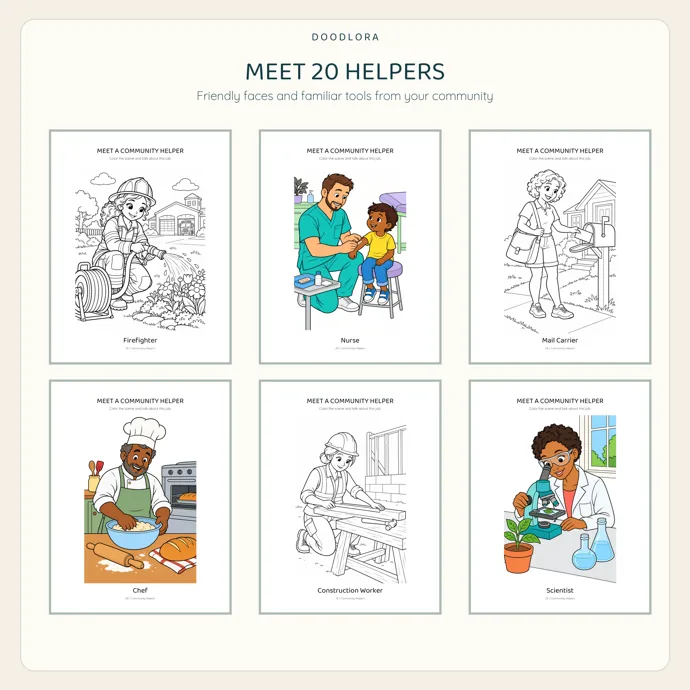
Twenty helpers is a good full list for a preschool or kindergarten unit, and it matches the twenty helper pages in our community helpers coloring pages. For a first week, pick five or six that your child actually sees, such as a teacher, a doctor, the mail carrier and the person at the grocery checkout, and add the rest later.
The “how kids spot them” column is about clues a child can notice. Uniforms and vehicles differ from town to town, so check what your local fire trucks, police cars and mail trucks look like before you describe them.
Helpers who keep people safe and healthy
| Helper | What they do | Where they work | How kids spot them |
|---|---|---|---|
| Firefighter | Put out fires, rescue people and teach fire safety | Fire station, out on calls | Helmet, heavy coat and boots, fire truck, hose |
| Police officer | Keep people safe, direct traffic, help people who are lost or need help | Police station, patrol car, on foot or bike in the neighborhood | Uniform, badge, police car |
| Doctor | Check how your body is working and help you get well | Doctor’s office, clinic, hospital | Stethoscope, white coat or scrubs |
| Nurse | Care for patients, give medicine and shots, clean and bandage cuts | Hospital, doctor’s office, school nurse’s office | Scrubs, thermometer, bandages |
| Dentist | Check and clean teeth and fix cavities | Dental office | Mask, small mirror, toothbrush, the big reclining chair |
| Veterinarian | Take care of sick and hurt animals | Animal clinic or hospital, farms | Stethoscope, a pet on the exam table |
Helpers at school and the library
| Helper | What they do | Where they work | How kids spot them |
|---|---|---|---|
| Teacher | Help children learn to read, count and get along | School classroom | Books, whiteboard, a classroom full of kids |
| Librarian | Help people find books and information | Library, school library | Book cart, library desk, story time |
| Bus driver | Drive children and other riders safely from stop to stop | On the school bus or city bus | The big steering wheel, the bus |
| Custodian | Keep the building clean and working | School, office building, hospital | Mop, bucket, cart, keys |
Helpers who bring us food
| Helper | What they do | Where they work | How kids spot them |
|---|---|---|---|
| Farmer | Grow fruits and vegetables and raise animals | Farm, orchard, greenhouse | Tractor, barn, boots, basket of vegetables |
| Chef | Cook meals for other people | Restaurant kitchen, school cafeteria | Apron, tall white hat, pots and pans |
| Cashier | Ring up what you buy and bag it | Grocery store, shops | Register, scanner, checkout lane |
Helpers around town
| Helper | What they do | Where they work | How kids spot them |
|---|---|---|---|
| Mail carrier | Bring letters and packages to homes and businesses | Post office, then walking or driving a route | Mailbag, mail truck, your mailbox |
| Sanitation worker | Collect trash and recycling and take it away | Garbage or recycling truck, all over town | The truck, bins at the curb |
| Construction worker | Build and fix houses, roads and buildings | Building sites | Hard hat, safety vest, tools |
| Mechanic | Find what’s wrong with cars and fix them | Garage, auto repair shop | Wrench, a car lifted up high |
| Hair stylist | Cut, wash and style hair | Salon, barbershop | Comb, scissors, the spinning chair |
| Pilot | Fly airplanes to take people and packages places | Airplane cockpit, airport | Pilot hat and uniform, the airplane |
| Scientist | Ask questions and run tests to find answers | Lab, outdoors, hospitals, universities | Lab coat, goggles, microscope |
A trap to watch with this list: young children often decide a helper “lives” at work. Ask “where does the firefighter go at the end of the day?” once or twice, and point out that helpers have families and homes like everyone else.
Picking activities by age
The same topic plays very differently at three and at seven. This table shows what each age group can realistically do and roughly how long to plan for, by our planning estimate.
| Age / grade | Main goal | Plan each activity for | Works best with |
|---|---|---|---|
| Preschool, ages 3–5 | Name a few helpers and match each to one tool | 10–15 minutes | Real objects, dress-up, coloring and talking |
| Kindergarten, ages 5–6 | Match helpers to tools and workplaces, sort them | 15–25 minutes | Matching pages, pretend-play stations, a visitor |
| 1st–2nd grade, ages 6–8 | Explain why a community needs each helper, write about it | 20–40 minutes | Maps, interviews, thank-you letters, puzzles |
A full unit usually runs one to two weeks in a classroom. At home, spreading it over a few weekends of errands works just as well.
Community helpers activities for preschool (ages 3–5)
Preschoolers learn helpers through their hands. Keep each activity short, use real objects where you can, and repeat the same five or six helpers until children name them without help.
Who uses this? Tool basket
- Group size: 1–6 children
- Time: about 10 minutes
- Prepare: a basket of safe, real or toy objects, such as a toy stethoscope, a wooden spoon, a toothbrush, an envelope, a picture book and a toy hammer, plus a picture of each helper
- How it works: Pull one object out at a time. Ask “who uses this?” and let the children guess, then set the object on the matching helper’s picture. Ask one follow-up for each, such as “what does the dentist do with a toothbrush?”
- How to finish: Each child picks one object, names the helper and acts out the job for a few seconds.
Keep sharp kitchen tools and real medical items out of the basket. A wooden spoon stands in for the chef just as well as a knife.
Dress-up and pretend play
- Group size: 2–6 children at a time
- Time: 15 minutes, or a whole free-play center
- Prepare: hats, aprons, a bag, a clipboard, a toy steering wheel, empty food boxes
- How it works: Set up one simple scene, such as a store with a “register” and food boxes, or a vet clinic with stuffed animals. Children take turns being the helper and the customer or patient.
- How to finish: Ask each child “what job did you do?” and “who did you help?”
Rotate roles so the same child isn’t always the doctor, and let any child try any hat. A boy who wants to be the nurse and a girl who wants to drive the fire truck are both doing the activity exactly right.
Color and talk
- Group size: any, each child with a page
- Time: 10–15 minutes
- Prepare: one helper page per child, crayons
- How it works: While children color, ask about the scene: who is the helper helping, what tools can you see, where is this happening? The talking matters more than the coloring.
- How to finish: Hang the pages in a row and walk past them together, naming each helper.
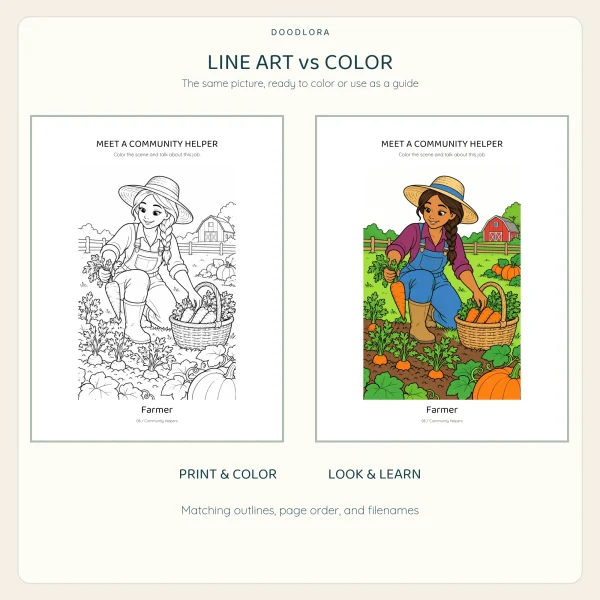
Our coloring set puts every helper in a scene with someone they’re serving, like the nurse bandaging a boy’s arm, the vet listening to a puppy’s heart and the bus driver at the wheel, so there’s always something to talk about. If a child struggles to hold a crayon for a full page, our coloring tips cover which tools suit which ages.
For a hands-on project like paper hats or a cardboard mail truck, see our community helpers crafts, which sorts craft ideas by helper.
Kindergarten community helpers activities (ages 5–6)
Kindergartners can sort, match and remember more. This is a good age to add workplaces and to invite a real helper in.
Match the tools
- Group size: whole class or one child, each with a page
- Time: 15 minutes
- Prepare: printed matching pages, pencils and crayons
- How it works: Children draw a line from each helper to the right tool, then color the pictures. Before they start, name every tool on the page out loud, because a coiled fire hose or a book cart isn’t obvious to every five-year-old.
- How to finish: Go over the answers together, and ask “what else might this helper use?”
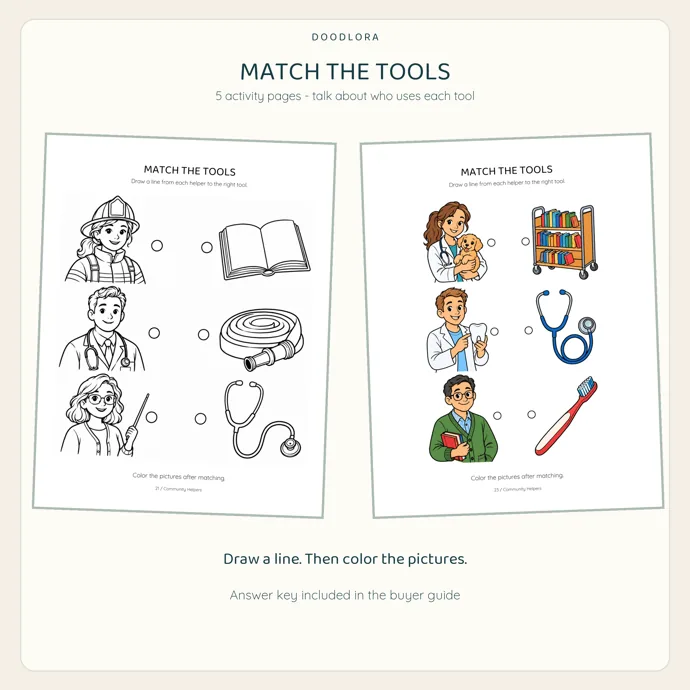
The coloring set has five of these pages, pages 21 to 25, each with three helpers and three tools, and the answer key is in the included buyer guide. Page 21, for example, pairs the firefighter with the hose, the doctor with the stethoscope and the teacher with the open book.
Where do I work? Sorting game
- Group size: 2–8 children
- Time: 15–20 minutes
- Prepare: large drawings or photos of four or five places, such as a school, a hospital, a fire station, a farm and a store, and small helper pictures cut out ahead of time by an adult
- How it works: Children take turns placing each helper on the place where they work. Talk through the tricky ones: a nurse can work at a hospital or at a school, and a doctor can be in a small office instead of a hospital.
- How to finish: Each child chooses one place and names everyone who works there.
The tricky ones are the point of the game. When a child says “the nurse goes at the hospital,” and another says “our school has a nurse,” both are right, and that’s the conversation you want.
Helper visit or interview
- Group size: whole class
- Time: 20–30 minutes for the visit, plus 10 minutes the day before
- Prepare: invite a parent, grandparent or local helper. The day before, help the class think of three or four questions, such as “what do you use every day?” and “what’s the hardest part of your job?”
- How it works: The guest talks for a few minutes and shows a tool or two, then children ask their questions.
- How to finish: The class makes a group thank-you card, with each child drawing one thing they learned.
Many fire departments and libraries do school and preschool visits, and some police departments do too. Call ahead and ask what they usually bring and how long they stay. Mention the children’s ages, since a visit pitched at second graders may be too long for a room of four-year-olds.
Community helpers activities for 1st and 2nd grade (ages 6–8)
Older children can explain why a town needs each helper, write about it and solve problems with it. Activities can run longer, and more of the work can be independent.
Map the helpers in your neighborhood
- Group size: individual or pairs
- Time: 30–40 minutes, plus a walk or drive if you can manage one
- Prepare: large paper, pencils and crayons, and a short list of places nearby: the school, a fire station, a post office, a grocery store, a library
- How it works: Children draw a simple map of their street or school area and mark where each helper works. Ask them to add one helper they’ve never noticed before, such as the crossing guard at the corner or the person who fixes the streetlights.
- How to finish: Pairs swap maps and find one helper on the other map that’s missing from their own.
What will you be? Draw and write
- Group size: any
- Time: 20 minutes per page
- Prepare: draw-and-write pages and pencils
- How it works: Children draw themselves doing a job they’d like, then finish a sentence about it. First graders can write a few words. Second graders can write a full sentence or two.
- How to finish: Children share their page with a partner or the class.
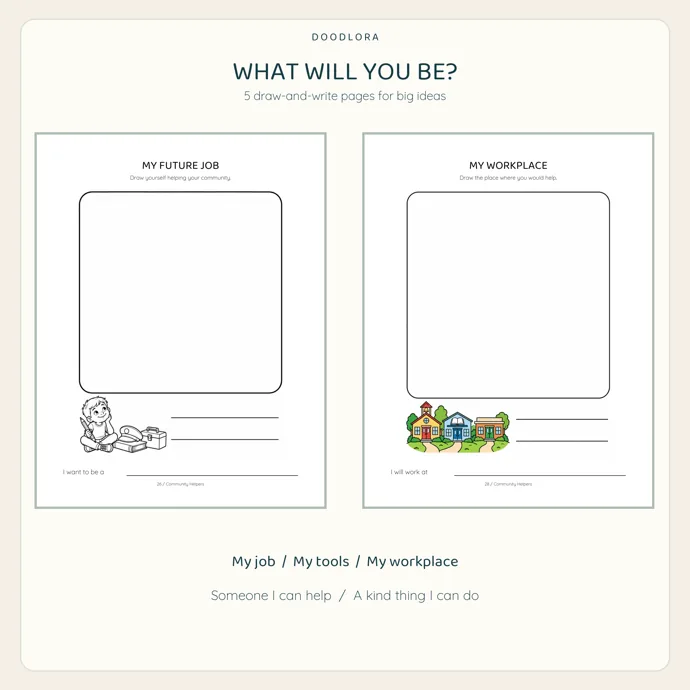
The coloring set has five of these pages, 26 to 30. Page 26 asks for a future job (“I want to be a”) and page 28 for a workplace (“I will work at”), and the others cover tools, someone the child can help and a kind thing they can do. For children who aren’t writing yet, a grown-up can write down their words while the child draws, which is what the buyer guide suggests too.
Thank-you letters
- Group size: whole class or one child
- Time: 20–30 minutes
- Prepare: paper or cards, envelopes, a short list of real helpers at school or nearby
- How it works: Each child picks one real helper, such as the custodian, the cafeteria cook, a bus driver or the school nurse, and writes three sentences: who you are, what you noticed them doing, and thank you.
- How to finish: Deliver the letters in person if you can. Seeing the custodian read a thank-you note does more for the lesson than any worksheet.
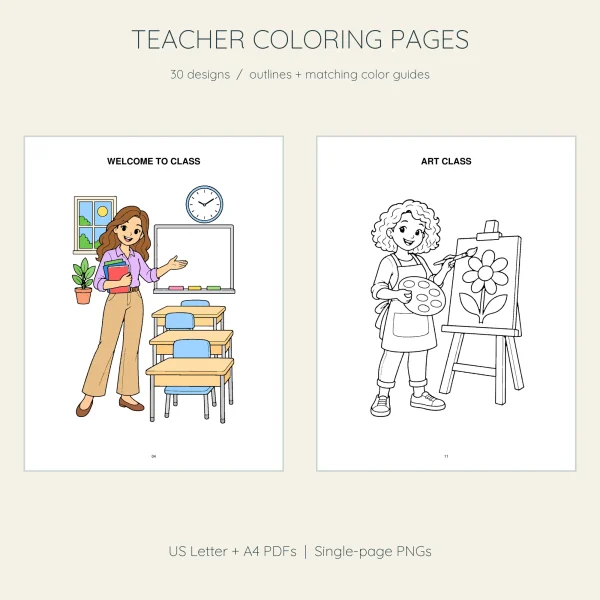
For teachers specifically, our teacher coloring pages include thank-you designs with a blank card or letter space where a child writes the message.
Pretend dispatch-desk puzzles
- Group size: individual or pairs
- Time: 15–20 minutes per mission
- Prepare: printed mission pages and pencils
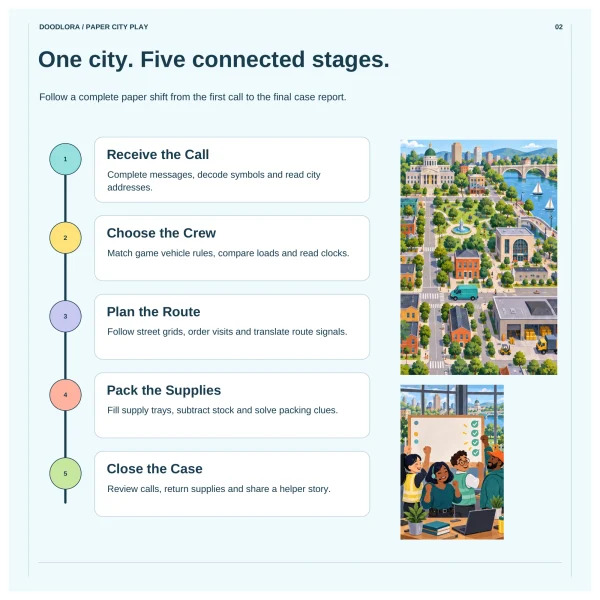
- How it works: Children play a team that gets calls for help around a made-up city and decides who goes, which route to take and what supplies to pack.
- How to finish: Check answers against the key and have children explain their route choice.
Our community helpers activities book works this way. It is a 48-page pretend city, with a four-person team, 40 missions, grid maps, clocks and supply counting, and a separate answer guide. The jobs are deliveries and supplies in an invented town, not police, fire or medical work, and the book says plainly that it is a paper game, not emergency training. It suits children who can read a simple grid map and a clock, which makes it a better fit for second grade than for preschool.
Teaching community helpers at home
Parents have one big advantage over a classroom: real helpers show up in everyday errands. You don’t need a formal unit at all.
- Name helpers on errands. At the grocery store, the post office, the vet or the dentist, ask “who’s helping us right now, and what are they using?”
- Watch for the trucks. Garbage day, the mail truck and a passing fire engine are each a two-minute lesson. Ask where the truck is going and what the people inside will do there.
- Read library books. Ask your librarian for picture books about jobs. That’s a community helper lesson in itself.
- Pick one helper per weekend. Talk about them, color a page, and finish by thanking a real one you meet.
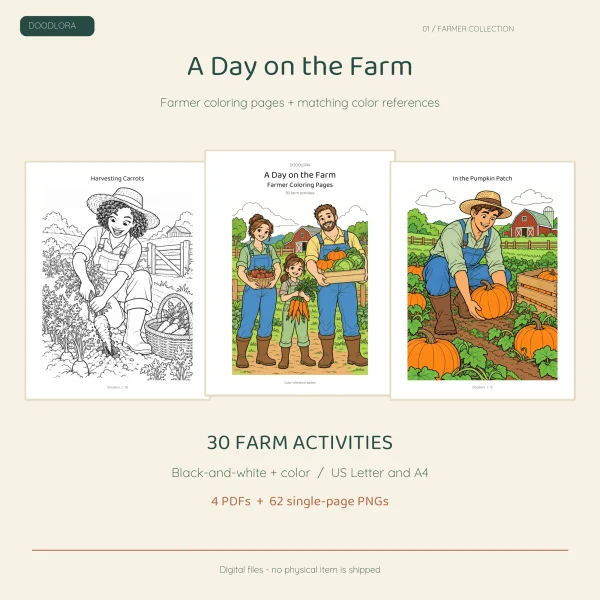
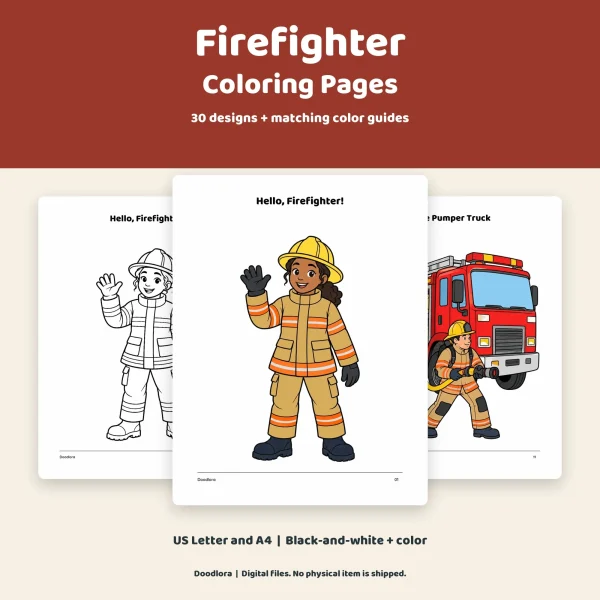
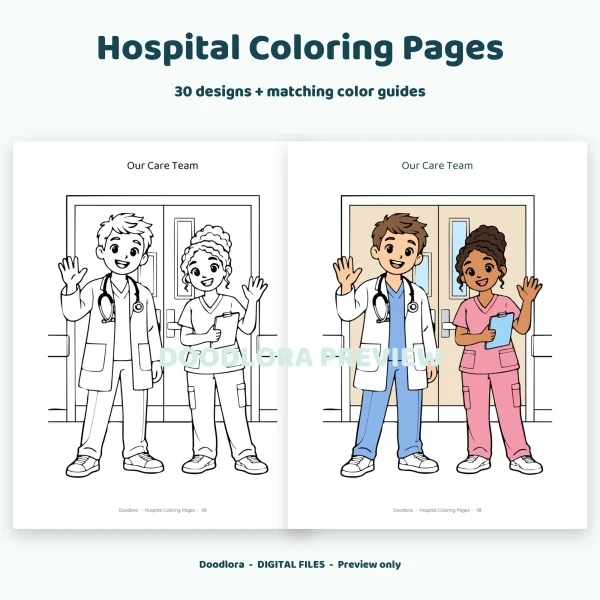
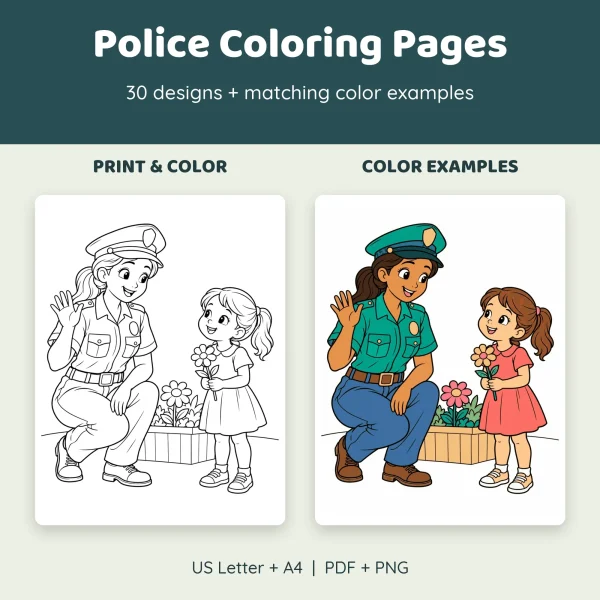
If your child gets attached to one job, a whole book about it holds their interest longer than a mixed set. We have 30-design sets for firefighters, police officers, hospital staff, chefs and farmers, plus the teacher set above. You can see them all together on our community helpers theme page.
Common problems and how to handle them
“Only men are firefighters.” Children pick this up early. Use gender-neutral job names every time, and show pictures with a mix. In our coloring set, the firefighter, mail carrier, construction worker and scientist are women, and the nurse and chef are men.
A child is afraid of police, doctors or hospitals. Some children have had a frightening hospital stay or a family experience that makes a cheerful police lesson hard. Don’t push. Let the child pick a different helper to focus on, and keep the talk on what the helper does day to day.
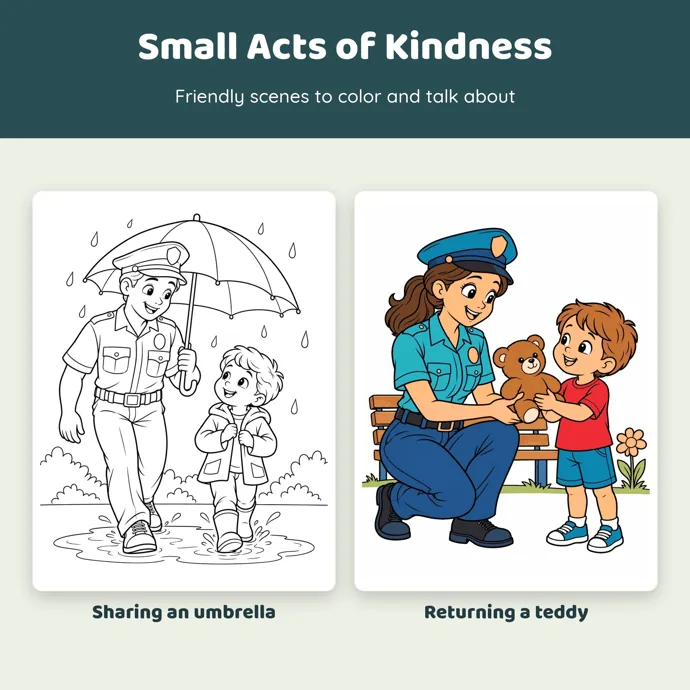
Everyone wants to be the doctor. In pretend play, use a simple rotation: write the roles on cards and let children draw one, then swap after five minutes.
The list gets too long. Twenty helpers is a lot for a three-year-old. Start with the five or six your child sees, and add one a week.
Safety lessons get mixed in. A firefighter visit naturally leads to fire safety, and a police lesson may lead to questions about emergencies. For anything about calling 911 or what to do in a fire, use what your local fire department or school teaches, word for word. Our firefighter coloring book ends with six safety reminder pages, and they work best colored alongside that lesson, not in place of it.
Printables for a community helpers unit
The community helpers coloring set covers most of the activities above in one download: 20 helper scenes, 5 Match the Tools pages and 5 draw-and-write pages, in a black-and-white version for coloring and a color version to show what a finished page can look like. It comes in US Letter and A4. A personal license covers printing copies for your own class or for one school’s own activities.
Pair it with one job set if a child or a class has a favorite, and with one of the crafts linked in the preschool section when you want something to build.
Printables from this article

Related articles
Printable Coloring Pages
World Kindness Day: Random Acts, Activities & Kindness Week
World Kindness Day falls on November 13 every year. Here is who started it, plus random acts of kindness for home, the classroom, the neighborhood and young kids, each with how long it takes, what to gather and how to wrap it up.
Printable Coloring Pages
How to Draw a Race Car Step by Step (Formula, Kart, Rally)
A side-view formula car in nine pencil steps, the few parts you swap to turn it into a kart, rally car, stock car or buggy, wheels at an angle, and a race number that looks painted on.
Printable Coloring Pages
Community Helpers Crafts: Firefighter, Police, Mail & More
Fourteen community helper crafts sorted by helper, age and time, from paper plate firefighter hats to a class map, with what to prepare and where each one goes wrong.