How to Build a Workout Plan: Weekly Schedule & Template
A workout plan is a weekly schedule that names your training days, what you do on each one, and how you will add a little more over time. To build one, write a single goal, count the days and minutes you really have, split them between cardio and strength work, then log every session and change one thing at the end of each week.
The steps below work for a first plan at home or in a gym. If you have a chronic health condition, are pregnant or recently gave birth, or haven’t exercised in a long time, ask your doctor before you start. This guide is about scheduling, not medical advice.
What you need before you build a workout plan
Gather four things before you fill in a single day. A plan built without them usually looks good on Sunday and falls apart by Wednesday.
- A normal week on paper. Work hours, school runs, commute and late nights. Training has to fit around these, not the other way round.
- One goal in one sentence. Step 1 covers how to write it.
- A place to log. A notebook, an app or a printed workout plan template. Pick one and keep it in your bag.
- The gear you already own. Walking shoes are enough for cardio. For strength, your body weight, a chair and a pair of dumbbells cover every exercise in this guide.
Step 1: Write one workout goal with a finish date
The goal decides what fills the week. “Run 5K without stopping by March 1” puts running on most training days. “Do 10 push-ups from the floor” puts upper-body strength work on two or three days. A plan that chases five goals at once gives each of them too few sessions.
Keep one primary goal and, at most, two supporting ones. Give the block a fixed length, such as eight weeks. That is long enough to see whether the plan suits you and short enough that rewriting it doesn’t feel like failure.
Decide now how you will measure the goal. A number you can check today and again at the end (minutes, reps, a weight or a tape measurement) tells you more than how a workout felt. If your goal still reads like “get in shape,” the fitness section of our SMART goal examples shows how to rewrite it with a number and a date.
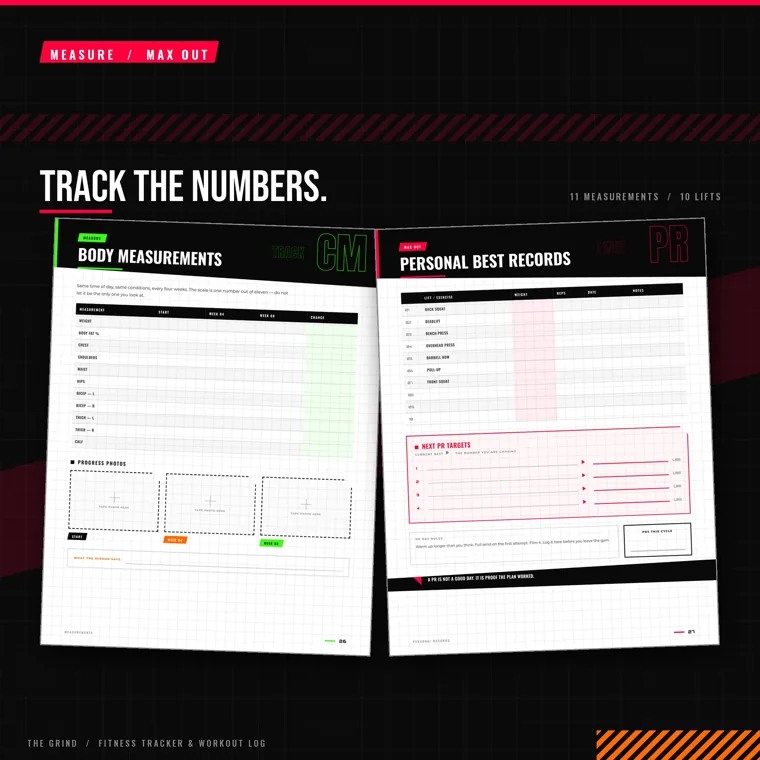
The Grind Workout Journal sets this step up on page 4: boxes for a primary goal, supporting goals, start date, target date and number of weeks, plus a “the numbers” line for today versus target and a box for non-negotiables. Its back pages give you somewhere to check the goal: page 26 lists eleven body measurements, taken at the start, week 4 and week 8, and page 27 tracks personal records.
Step 2: Count the days and minutes you actually have
The minimum to plan around comes from the U.S. Department of Health and Human Services. Its Physical Activity Guidelines for Americans, 2nd edition, says adults should do at least 150 minutes (2 hours and 30 minutes) to 300 minutes (5 hours) a week of moderate-intensity aerobic activity. The alternative is 75 minutes (1 hour and 15 minutes) to 150 minutes a week of vigorous-intensity aerobic activity, or an equivalent combination of the two.
The same guidelines say aerobic activity should preferably be spread throughout the week. They add that adults should also do muscle-strengthening activities that involve all major muscle groups on 2 or more days a week. Those two lines are the frame for every sample week below.
Turn 150 minutes into sessions you can picture: five 30-minute sessions, four of about 38 minutes, or three of 50. Now look at your normal week and write down every day you could train. Then cross one off. A plan that fits your worst normal week is the one you will still follow in week six.
If 150 minutes is far from where you are now, start lower. The guidelines put it plainly: some physical activity is better than none. For strength work, they suggest that beginners can start with just 1 day a week at a light or moderate level of effort, then build to 2 days, and possibly more than 2.
Step 3: Split the weekly workout schedule between cardio, strength and stretching
Most first plans need three kinds of training. The HHS guidelines describe aerobic activity as large muscles moving rhythmically for a sustained period, which makes your heart beat faster and has you breathing harder than normal.
| Type | Examples | How often in your plan |
|---|---|---|
| Aerobic (cardio) | Brisk walking, running, bicycling, jumping rope, swimming | Most training days, until the weekly minutes add up |
| Muscle-strengthening | Squats, push-ups, rows, hip hinges, planks | 2 or more days a week, covering all major muscle groups |
| Flexibility | Stretching for the hips, legs, back and shoulders | A few minutes after cardio or strength sessions |
Flexibility has no weekly target in the adult key guidelines, so treat it as the cool-down rather than a session of its own. Older adults have one extra line in the guidelines: their weekly activity should include balance training as well as aerobic and muscle-strengthening activities. Standing on one leg next to a counter is an easy way to add it.
Two placement rules keep the week workable. Leave at least one day between strength sessions that train the same muscles. Put the longest cardio session on the day with the most free time, usually a weekend morning.
Step 4: Choose the exercises for each strength day
A beginner strength day needs five movements: a squat, a push, a pull, a hip hinge and a core exercise. Together they cover the legs, hips, back, chest, shoulders, arms and abdomen. Two sessions that alternate (A and B) keep the week from feeling repetitive.
| Strength A | Strength B |
|---|---|
| Squat (or sit-to-stand from a chair) | Reverse lunge or step-up |
| Push-up (against a wall, a counter or the floor) | Dumbbell overhead press |
| One-arm dumbbell row | Band or towel row |
| Glute bridge | Dumbbell Romanian deadlift |
| Plank | Side plank or dead bug |
Start each session with about five minutes of easy movement, such as marching in place or a slow walk. Our sample weeks use 2 sets of each exercise for the first two weeks, then 3. Choose a weight or version you can do with clean form on every rep, and end each set while you could still do one or two more.
Step 5: Lay out a weekly workout plan for beginners (3, 4 or 5 days)
Each sample below reaches 150 minutes of moderate cardio and at least 2 strength days. The minutes are planning targets, so shift any session to another day as long as the strength days stay apart.
3-day workout plan
| Day | Session | Minutes |
|---|---|---|
| Monday | Strength A, then brisk walk or bike | 30 + 50 |
| Wednesday | Brisk walk, bike ride or swim, then stretching | 50 + 10 |
| Friday | Strength B, then brisk walk or bike | 30 + 50 |
| Other days | Rest or an easy walk | — |
Three days is the hardest version to keep, because each session runs 60 to 80 minutes. If you can’t protect that much time, the 4-day week below spreads the same work into shorter blocks.
4-day workout plan
| Day | Session | Minutes |
|---|---|---|
| Monday | Strength A, then cardio | 40 + 25 |
| Tuesday | Brisk walk, run-walk or bike | 40 |
| Thursday | Strength B, then cardio | 40 + 25 |
| Saturday | Longer walk, hike or bike ride, then stretching | 60 + 10 |
| Other days | Rest | — |
This is the easiest week to fit around a full-time job. Monday and Thursday sit three days apart, so the same muscles get a full break between strength sessions.
5-day workout plan
| Day | Session | Minutes |
|---|---|---|
| Monday | Lower-body strength (squat, lunge, Romanian deadlift, glute bridge, plank), then walk | 40 + 10 |
| Tuesday | Cardio | 45 |
| Wednesday | Upper-body strength (push-up, row, overhead press, band row, side plank), then walk | 40 + 10 |
| Thursday | Cardio | 45 |
| Saturday | Strength A, then cardio and stretching | 30 + 40 + 10 |
| Friday, Sunday | Rest | — |
The 5-day split adds a third strength day. Saturday’s full-body session overlaps with both Monday’s and Wednesday’s muscles, so keep its weights a notch lighter.
Step 6: Log every session on the day you train
Logging turns a schedule into a plan you can adjust. Write down what you actually did right after each session: date, exercises, sets, reps, weight, cardio minutes and how hard it felt. Memory rounds up, and a log written two days later can’t tell you whether to add weight.
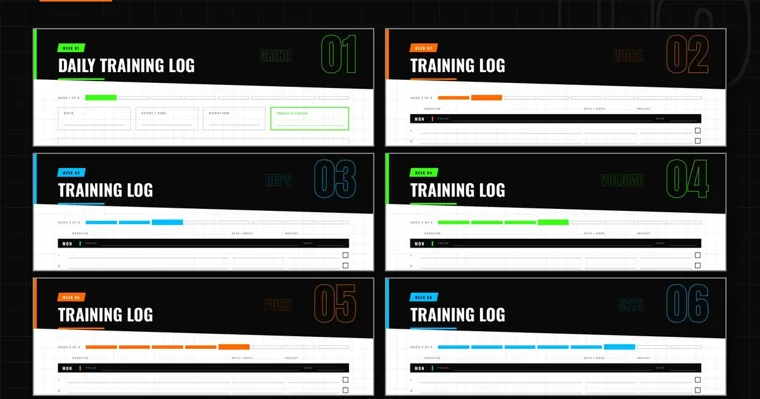
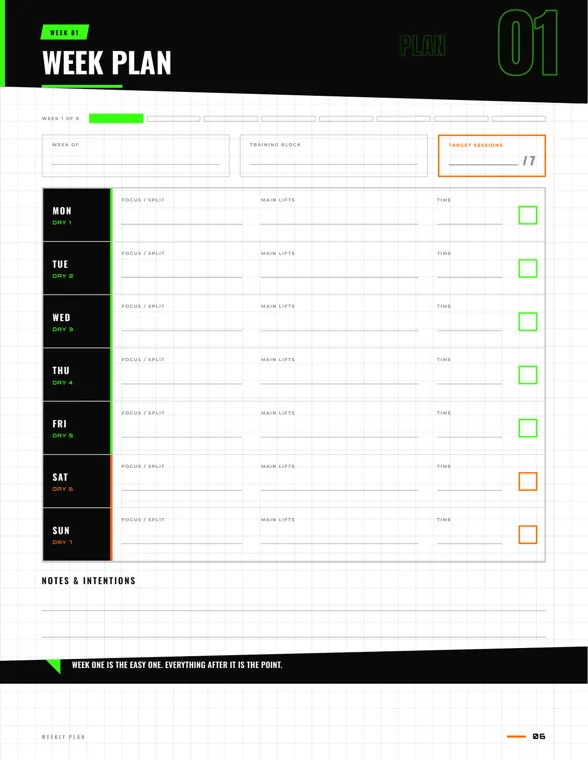
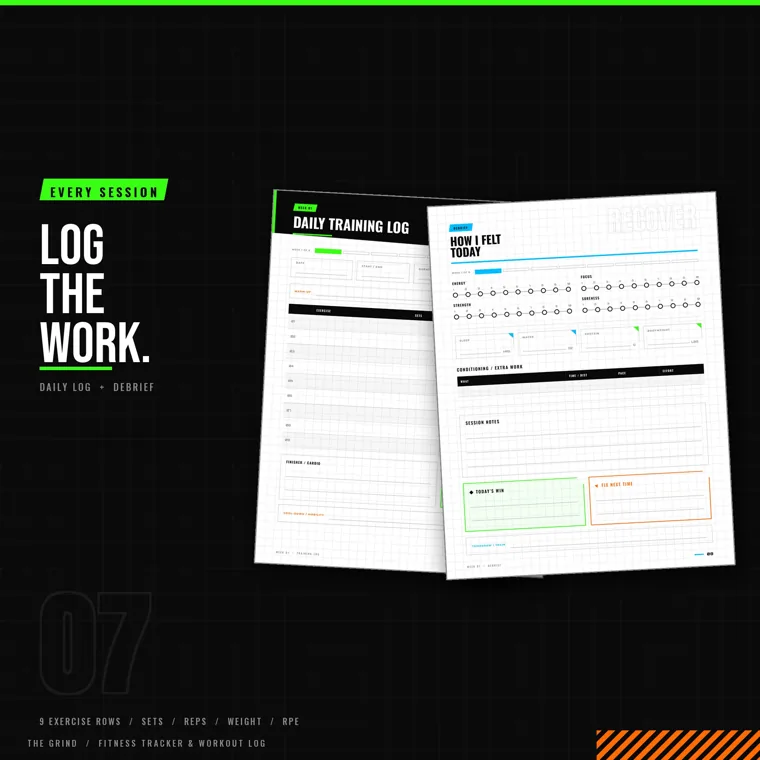
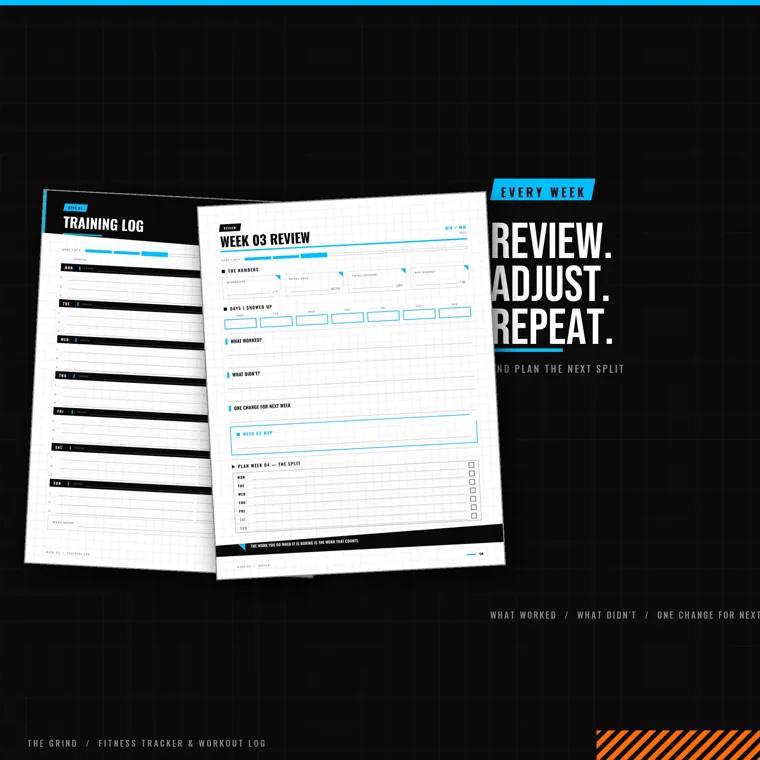
Week 1 of The Grind Workout Journal has five pages. Page 6 is the week plan and page 7 is the daily training log, with date, start and end time, duration, today’s focus, a warm-up line and nine exercise rows for sets, reps, weight and RPE (your own rating of how hard the set felt). Page 8 rates energy, strength, focus and soreness from 1 to 10 and has a box for conditioning or extra work, which is where cardio minutes go. Pages 9 and 10 sum up the week and ask what to change.
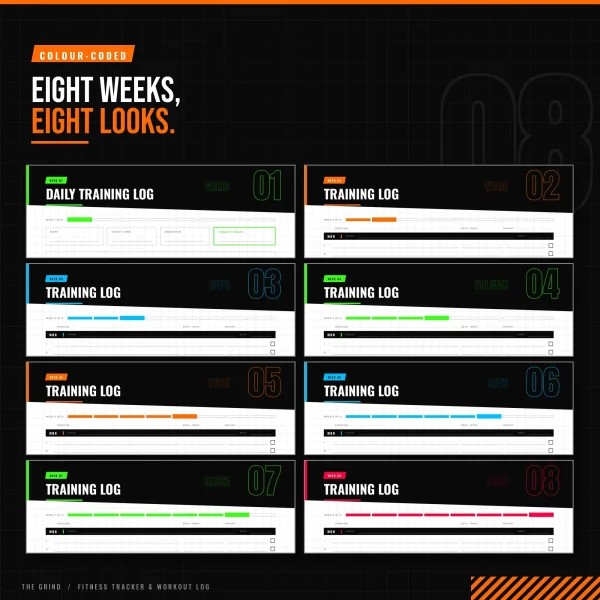
Weeks 2 to 8 switch to one log page and one review page per week (pages 11 to 24). That log gives each day only three exercise rows, which won’t hold a five-exercise strength day. Reprint page 7 for strength days and keep the weekly page for cardio and the overview. The file’s own how-to page (page 3) says to reprint the weekly pages as often as you need.
Two printing notes save trouble. The weight boxes are marked in pounds, so convert first if your dumbbells are labeled in kilograms. Several pages are full black, including the cover and the “why I train” page, so skip them or print them in grayscale and keep your ink for the log pages.
Step 7: Add a little each week after the weekly review
Progress in a beginner plan comes from small, planned increases. The HHS guidelines describe it for strength training: increase the number of days slowly, and raise the intensity slightly each week until it becomes moderate or greater.
Change one thing per week, never three. Good single changes are one more set on each exercise, five more minutes on one cardio session, or a little more weight on a lift where every set felt manageable. If last week’s log shows missed reps or a soreness score that stayed high, repeat the week instead.
The review pages in weeks 2 to 8 make this a five-minute job. Each one asks for workouts, total sets, total volume, average energy and the days you showed up, then “what worked,” “what didn’t” and one change for next week. Write that one change into the next week’s log before Monday.
Watch one trap on page 25, which rolls the eight weeks into one chart of training volume. Volume (sets × reps × weight) only counts strength work. A week where you added cardio minutes and held your lifts steady will look flat on that chart, even though you did more.
When to take a rest day or an easy day
Rest days are part of the plan, not gaps in it. Every sample week above has at least two, and none of them puts strength work for the same muscles on back-to-back days.
Take an extra easy day when your log says so. If page 8 shows low energy and high soreness on the same morning, swap the session for a 20-minute walk and some stretching, then pick the plan back up the next day. Short sleep and a hard week at work are good reasons too. Sharp pain during an exercise is a reason to stop that exercise, not to push through it.
How to restart a workout plan after missing a week
Missed sessions don’t need to be made up. Doubling up the next week is how a short break turns into an injury or a long one. Go back to the last week you finished in full and repeat it, or drop one week further back if you were away for more than two weeks.
Decide your restart rule before you need it. The 30-day challenge page in the journal (page 29) has a line that starts “If I miss a day, I…”, and filling it in during week 1 means you won’t be bargaining with yourself later. Even a 10-minute walk on a busy day keeps the habit alive, and the guidelines are clear that some activity beats none.
If the whole schedule keeps slipping, the problem is usually the number of days, not you. Cut one training day and keep the rest. Our guide to using a planner has a section on what to do when you skip days, and a workout plan can sit inside a wider personal growth plan if fitness is one of several goals this year.
Frequently asked questions
How many days a week should a beginner work out?
Three to five days works for most beginners, as long as the week adds up to 150 minutes of moderate cardio and 2 strength days. Pick the number you can keep in a busy week. The 4-day sample above is the easiest to fit around full-time work.
Can I do cardio and strength training on the same day?
Yes. Every sample week here pairs them. Do the strength work first while you are fresh, then the cardio, and finish with a few minutes of stretching.
How long should I follow a workout plan before changing it?
Run the same plan for a full block, such as four to eight weeks, and make only the one small weekly change from your review. Rewrite the whole plan when the block ends or when your goal changes.
Printables from this article
Related articles
Printable Planners
How to Create a Home Maintenance Checklist: Monthly & Yearly
A step-by-step way to build a home maintenance checklist that fits your house, with monthly, quarterly, seasonal and yearly jobs and where the safety intervals come from.
Printable Planners
Self Care Ideas for Mental Health: Relaxing Habits & Tracker
Sixteen small, non-clinical self-care habits sorted by what you need, from sleep and walks to boundaries and a joy list, plus a low-pressure weekly check-in.
Printable Planners
Easy Time Management Tips for Work, Students and Parents
Simple time management habits you can start on an ordinary weekday, sorted for desk jobs, students and busy households, with the snag to watch for in each.