How to Learn a New Language: Tips for Learning on Your Own
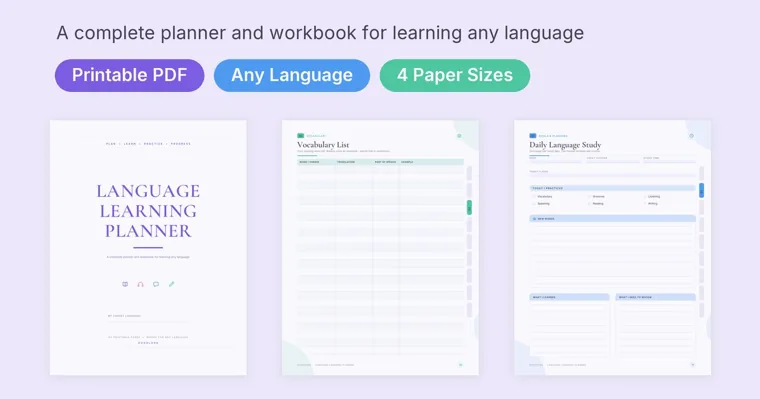
To learn a new language on your own, choose one goal you can check in about 90 days, study for 20 to 45 minutes on most days, and split that time between new words, listening, speaking, reading and writing. Log your minutes and look back once a week, so a missed week shows up on paper while it’s still easy to fix.
How long the whole thing takes depends mostly on which language you pick and how many hours you put in. The steps below start with realistic time estimates, then cover a daily plan, practice for each skill, progress tracking and what to do when you stall. We picked the daily minutes below as a starting plan; no study set them.
How long it takes to learn a language
The most quoted estimates come from the U.S. Department of State, whose Foreign Service Institute trains diplomats in foreign languages. Its timelines show the time usually expected for a student to reach a score of 3 in speaking and listening on the Interagency Language Roundtable (ILR) scale. A typical week in that program is 23 hours of class plus 17 hours of self-study.
| FSI category | Typical length | Class hours | Some languages on the list |
|---|---|---|---|
| Category I, “languages close to English” | 24–30 weeks | 552–690 | Spanish, French, Italian, Portuguese, Dutch |
| Category II | About 36 weeks | 828 | German, Indonesian, Swahili |
| Category III, “hard languages” | About 44 weeks | 1,012 | Russian, Hindi, Greek, Polish, Vietnamese |
| Category IV, “super-hard languages” | 88 weeks | 2,200 | Arabic, Mandarin, Cantonese, Japanese, Korean |
Read the table as a ladder, not a deadline. The State Department says the real time varies with natural ability, earlier language study and time in the classroom, and its students study full time with teachers. For a self-learner, the useful part is the ratio: Japanese or Korean takes roughly three times the class hours of Spanish.
Plain arithmetic shows why a steady habit matters more than a big start. At 30 minutes a day, 690 hours of study works out to 1,380 days, close to four years. You don’t need ILR level 3 to use a language, though. Introducing yourself, ordering food and following a slow conversation come much earlier, and those are the goals worth setting first.
Mandarin learners should add handwriting to the plan early. Stroke order, grid paper and a practice routine for characters are in how to write Chinese characters.
Step 1: Set a language goal you can check in 90 days
Those FSI hours are why “become fluent” makes a poor first goal: it’s years away, and you can’t tell whether you’re on track. A useful goal names a situation, a skill and a date. “Order dinner and ask two questions in Spanish before our trip on May 10” can be tested. “Get better at Spanish” can’t.
Start from the reason you’re learning, because it decides which skill comes first:
- A trip in a few months: greetings, numbers, food, directions and a few phrases for when you get lost. Put speaking and listening first.
- Talking with a partner’s family or a grandparent: introductions, family words and questions about daily life. Plan a short weekly call as your test.
- A high school or college class: follow the course, and add 10 minutes of listening a day on top of homework.
- Work: the words and documents of your job. Reading and writing may come before small talk.
- A New Year’s resolution with no fixed reason: pick one milestone, such as a 5-minute conversation about yourself by the end of March.
Page 7 of our language learning planner turns that wish into a SMART goal with five questions: what exactly will I do, how will I know it is done, is this realistic for my week, why does this matter to me, and by when. Under them are five checkboxes for action steps, a target date and a line for a reward.
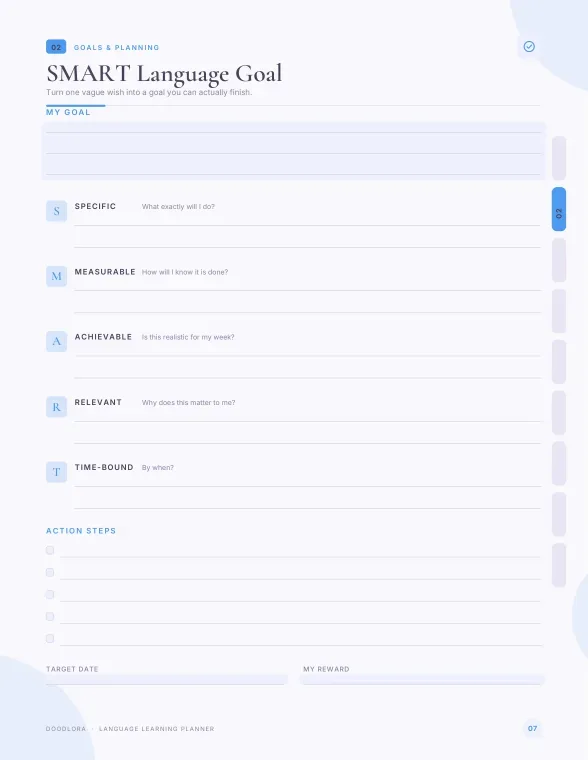
Split the 90 days into three monthly targets. Month 1 could be greetings, numbers and the first 100 words. Month 2 could be describing your day, and month 3 a 10-minute talk with a tutor or a friend. If month 1 slips, move the dates; don’t drop the goal.
Step 2: Plan 20 to 45 minutes a day
A goal with a date needs time on the calendar, and short daily sessions are easier to keep going than one long session a week. We’d plan 20 to 45 minutes on most days, with a 10-minute fallback for the days that fall apart. The daily study page in our planner puts it plainly: “Ten honest minutes still counts.”
| Your week | Daily time we’d plan | What fits in it |
|---|---|---|
| Full-time job or young kids at home | 15–20 minutes, plus one longer weekend session | Words on the commute, one listening clip, three sentences before bed |
| Student or retiree with free afternoons | 45–60 minutes | A full session plus a TV episode with target-language subtitles |
| Trip or move in under three months | 30–45 minutes | Mostly speaking and listening, with phrase drills every day |
Hang the session on a fixed point in your day: the morning coffee, the bus ride, the quiet stretch after the kids go to bed. If you’re not sure which end of the day has room, our morning routine ideas and night routine ideas both lay out short daily blocks you can borrow a slot from.
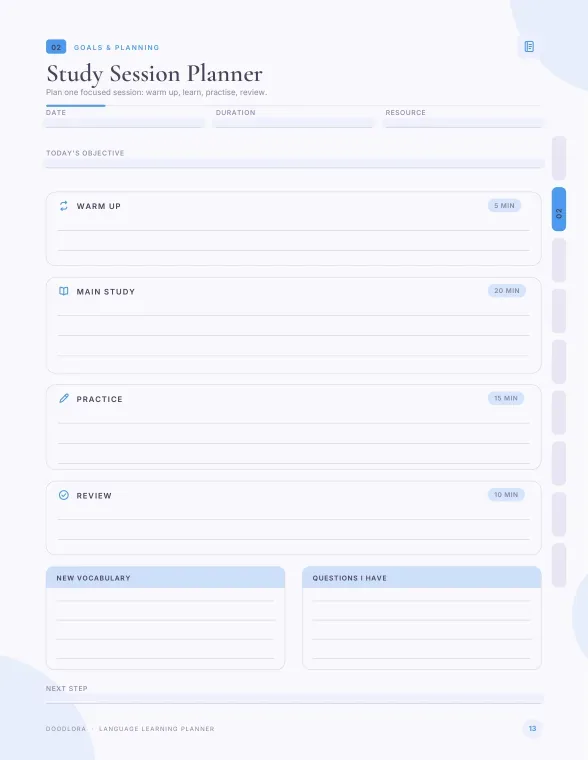
Inside each session, follow the same four parts so you don’t spend the first ten minutes deciding what to do. The session page in our planner splits 50 minutes into a 5-minute warm-up, 20 minutes of main study, 15 minutes of practice and a 10-minute review:
- Warm up: say yesterday’s new words out loud, or replay a clip you already know.
- Main study: one grammar point or one set of new words from your course, textbook or app.
- Practice: use what you just learned. Write five sentences about your own life, talk to yourself for a minute, or shadow a recording.
- Review: note what didn’t stick, the questions you have, and the first thing to do next time.
Give each day of the week one focus, so no skill gets left out for a month. One rotation: words and listening on Monday, speaking on Tuesday, grammar and writing on Wednesday, listening on Thursday, speaking on Friday, reading or a show on Saturday, and the weekly review on Sunday.
The planner’s suggested first week follows the same order. Day 1 is your details and your reason, day 2 your goals and 90-day plan, day 3 the first weekly plan and day 4 an hourly schedule. From day 5 on you fill one daily study page per study day and start a vocabulary list.
Step 3: Learn the words you’ll actually use first
In the first months, much of the main study slot goes to vocabulary, so pick words by what you’ll need to say, not by the order a word list prints them in. Four habits keep a word list useful:
- Start with the words that hold sentences together: pronouns, question words, core verbs, time words and connectors. Our language learning journal gives the 100 most common words 20 pages, five per page, with space to write each word three times and a sentence of your own.
- Learn whole phrases early: greetings, polite words, asking for help, directions, shopping and ordering. A phrase gets you through a real exchange; a single word usually doesn’t.
- Say it before you write it: the journal’s guide asks you to look at the picture, say the word aloud and then write it. Its 40 picture themes, from fruits to technology, have 12 words per page.
- Put words where you’ll see them: day 4 of the journal’s 30-day challenge is labeling ten things in your home with sticky notes.
Review on a schedule instead of rereading the whole list. Check each new word the next day, again a few days later and again the following week, and send anything you miss back to the next day’s pile. Flashcard apps built on spaced repetition do this scheduling for you; on paper, a column of review dates does the same job.
The trap is collecting words you never use. Put each new word into a sentence about your own life the same day, ideally one you’ll say out loud. “I have two sisters” in your new language is easier to remember than an example from a textbook about someone you’ve never met.
Step 4: Train your listening and speaking
Words stay half-learned until you hear them at normal speed and say them yourself, so listening and speaking need their own time every week, not just leftovers. For a lot of self-learners these are the skills that get skipped, because a book and a pen feel safer.
Listening: play the same clip more than once
Choose audio a little above your level: podcasts for learners, children’s shows, or short videos made for your target language. Listen once for the general idea, then again for the words, and write down what you missed. That second pass is where the new words come from.
Use subtitles in the language you’re learning, not in English. Count the minutes even when you understand very little at first; the listening log in our journal says exactly that. A clip worth a third listen goes on the next day’s warm-up.
Speaking: talk before you feel ready
The common mistake is waiting until you “know enough” to speak, which never quite arrives. Three solo drills get you talking from week one:
- Shadowing: play a short clip and speak along with it, about half a second behind, copying the rhythm before you worry about meaning.
- 60-second topics: set a timer and talk about your morning, your family or last weekend without stopping. Afterward, look up the words you wished you’d had.
- Recording yourself: record a minute, listen back and note one thing to fix. Keep the first recording so you can compare it a few months later.
Then find real people. A paid tutor, a language exchange partner who wants to learn English, or a conversation group at a library or community college all work. Before each talk, plan how you’ll open and close, five things to say and five questions to ask.
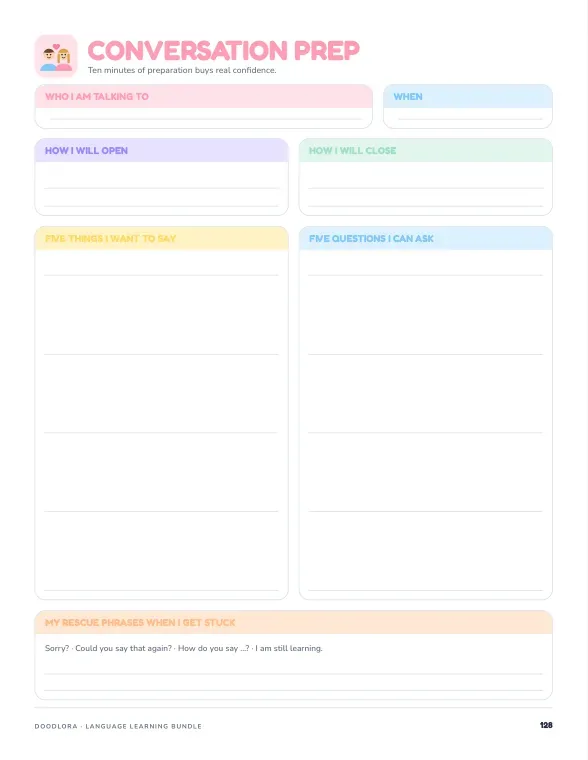
The rescue phrases on that journal page are “Sorry?”, “Could you say that again?”, “How do you say …?” and “I am still learning.” Learn those four before your first conversation. With them, getting lost turns into a request for help instead of the end of the talk.
Step 5: Read and write a little every day
Reading and writing give you time to think, which makes them the place where the grammar from your main study turns into sentences you can check. Short and daily works better here too.
Reading: choose texts with few unknown words
Our journal’s rule of thumb: if a page has more than about ten words you don’t know, it’s too hard for now, so find something easier and come back later. Read a section through first and underline as you go; stopping at every word kills the reading. Look the words up afterward and copy the useful ones into your list.
Real-world reading can start on day one. The journal’s reading challenge lists twelve things in rough order of difficulty, from a street sign, a menu and a food label up to a recipe, a short news article and a whole short story. Children’s books and graded readers sit in the middle of that range.
Writing: three sentences, then corrections
Write three sentences a day about what you did, how you feel and what’s next. Write first and correct second, never at the same time, as the writing page in our planner advises. For grammar, write the rule in your own words, then build sentences that use it.
Get corrections from a tutor, an exchange partner or a teacher, and log every corrected mistake with the right version and a new example. The planner’s error log sorts mistakes into vocabulary, grammar, pronunciation, spelling and word order, which shows you which kind keeps coming back. Once a month, write a short message to a real person and send it.
Step 6: Track your minutes and review every Sunday
Tracking is how you know whether the daily plan from Step 2 is moving you toward the 90-day goal from Step 1. Write down the minutes after each session, then add them up once a week and once a month.
On Sunday, spend about 15 minutes on a weekly review: hours studied, days studied, new words, your biggest win, your biggest problem and next week’s focus. The habit tracker in our planner has 31 days across seven rows (vocabulary, grammar, listening, speaking, reading, writing and review), so a skill you’ve ignored for two weeks is easy to spot. To run the same Sunday check on the rest of your week, see how to use a planner, which walks through a full weekly review.
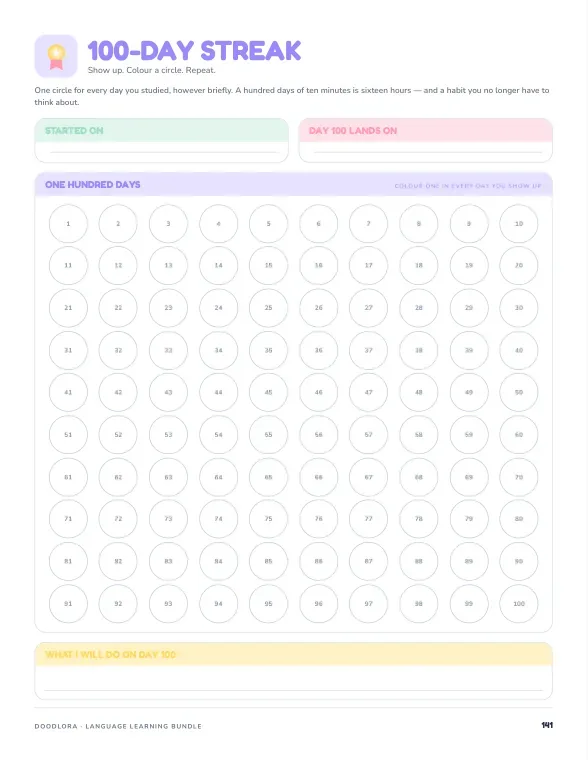
Milestones show progress that minutes can’t. The planner’s milestone page lists twelve, including learning 100 and then 500 words, introducing yourself, ordering food, a 5-minute conversation, writing a paragraph and watching an episode without subtitles. Date each one as you reach it.
Every three months, rate each skill again. The journal’s level check uses the six levels from A1 to C2 that many language courses and exams use, with eighteen statements to tick, and asks you to tick one only when it’s true on a bad day. That rule keeps one good conversation from setting your level too high. Both workbooks are printable PDFs from Doodlora Studio, so you can reprint the tracking pages each month.
What to do when you get stuck or fall behind
Even with a plan and a tracker, almost everyone hits a missed week or a flat month. Neither means the method failed; each has a simple fix.
You missed a few days or a few weeks
Don’t try to make up the lost time with double sessions. Pick up where you left off, using the 10-minute version for the first week back. Spend that week reviewing the last two weeks of words before adding new ones. The habit tracker in our journal has a blunt rule worth borrowing: missing one day is an accident, so don’t miss two in a row.
Your progress feels flat
Flat months are normal after the beginner stage, when each new word adds less than the first hundred did. Check the numbers before you judge it: total hours, words learned, conversations had. Then compare your first recording with a new one. If it really has stalled, move up to slightly harder listening, or set a new 90-day goal with a different skill at the front.
You understand a lot but can’t speak, or the reverse
Lopsided skills usually come from lopsided time. Look at two weeks of your log, then give the weak skill half of every session for the next two weeks. If speaking lags, add a 60-second topic to every warm-up. If listening lags, play one clip a day at least twice through.
Frequently asked questions
Can you really learn a language on your own?
Yes, for vocabulary, reading, listening and much of the grammar, and free and paid courses, apps and books cover those well. Speaking is the part that needs other people sooner or later. Plan on a tutor, an exchange partner or a conversation group by your second or third month, even if it’s just one 30-minute talk a week.
What is the easiest language for English speakers to learn?
By the Foreign Service Institute’s list, the Category I languages take the least class time, 24 to 30 weeks: Danish, Dutch, French, Italian, Norwegian, Portuguese, Romanian, Spanish and Swedish. The easiest one for you also depends on how often you’ll hear it, read it and get to use it.
How many minutes a day should I study a new language?
We’d plan 20 to 45 minutes on most days and accept 10 minutes on bad ones. A short session done six days a week keeps words fresher than one long session on the weekend, and it’s much easier to fit around work, school or kids.
Printables from this article
Related articles
Printable Party Games
How to Plan a Baby Shower: Timeline, Food & 2-Hour Schedule
A baby shower plan from the first talk with the parents-to-be to the last gift: timing, guest list, budget, venue, a two-hour schedule, safe food and backup plans.
Printable Party Games
How to Plan a Bridal Shower: Timeline, Budget and Schedule
A host's plan for a bridal shower, from the first talk with the bride and co-hosts to the guest list, invitations, a timed party schedule, the gift opening and what to do when something slips.
Printable Flashcards
Pattern Activities for Preschool: AB to Growing Patterns
Fourteen pattern activities for preschoolers, ordered from first AB rhythms to growing number patterns, with what to prepare, how long each takes and where kids get stuck.