Morning Routine Ideas: Easy Morning Routines for Busy Days
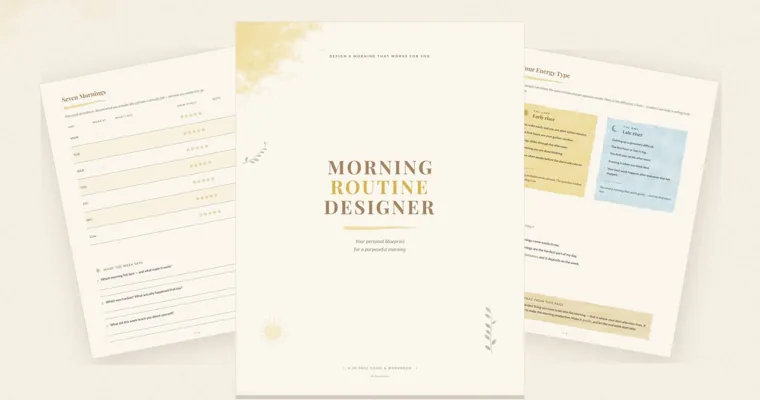
The best morning routine ideas are the ones that fit the time you really have before the day claims you. For most weekday mornings that means one small, fixed change you can keep, like opening the curtains, drinking a glass of water and writing down the one thing that matters today. Longer routines of 30 or 45 minutes work when you have the time and start easily, but they are a poor first step for a parent, a night owl or anyone on an early shift.
The ideas below are grouped by situation. Each one lists the time it takes, what to set up and where it usually goes wrong. The last two sections cover how to start a routine and what to do when one falls apart.
Pick a morning routine idea by situation
Start with the row that sounds most like your weekday, then read that section first.
| Your mornings | Time to add | Start with | Watch out for |
|---|---|---|---|
| Out the door fast | 10 minutes or less | Curtains, water and one written priority | Adding a second habit in the first week |
| Kids to get ready | 10 minutes before they wake | A quiet ten minutes, then the kids join breakfast or a stretch | Planning around a child who wakes early |
| Working from home | 15–20 minutes | A walk around the block, then three priorities on paper | Opening email before you’ve planned anything |
| Early shift | Close to zero on work days | Clothes, bag and breakfast set out the night before | Copying a 45-minute routine onto a 5 a.m. start |
| Not a morning person | 20 minutes | Stillness, tea and a few pages of a book | Putting your hardest task first |
| Slow mornings, or you wake easily | 30–45 minutes | Journaling, movement, planning and a real breakfast | Doing every step from day one |
Ten-minute morning routine ideas for tight weekdays
A short routine is easier to keep because it doesn’t need a free hour. Each idea here fits inside the time you already spend getting ready.
Curtains, a glass of water and one written priority
Time: 10 minutes. You need: a glass by the sink, a pen and a sticky note or notebook.
Open the curtains as soon as you’re up and drink a glass of water. Then take one minute to think of something you’re glad about, and write down the one thing that has to happen today. This is the shortest of the five starting routines in our Morning Routine Designer workbook, which suggests it for tight mornings, small children and night owls. For that one minute, our gratitude journal prompts include a set of two-minute prompts for busy days.
Where it sticks: the written priority gets skipped first. Keep the pen and paper where the water is so both happen in the same spot.
Fold one step into getting ready
Time: no extra minutes. You need: nothing new.
Attach the new step to something you already do every day. Think through the day’s priority while you brush your teeth, or stretch while the shower warms up. A step tied to an existing action has a fixed time, and “after I brush my teeth” is easier to keep than “sometime in the morning.”
Where it sticks: if you pick an action that moves around, such as breakfast on some days and not others, the new step moves with it. Choose something you do every single morning.
One song you love while the coffee brews
Time: 3–4 minutes. You need: a playlist or speaker set up before bed.
Play one song you like while the kettle boils or the coffee maker runs. It costs no extra time and gives the morning a clear start. It’s also a good first habit for someone who has tried longer routines and dropped them.
Where it sticks: hunting for the song on your phone turns three minutes into fifteen of scrolling. Queue it the night before, or use a speaker that plays the same playlist each time.
Night-before setup that makes a morning routine easier
A lot of morning friction comes from small decisions, like what to wear and where the keys are. Ten minutes in the evening takes those decisions out of the morning.
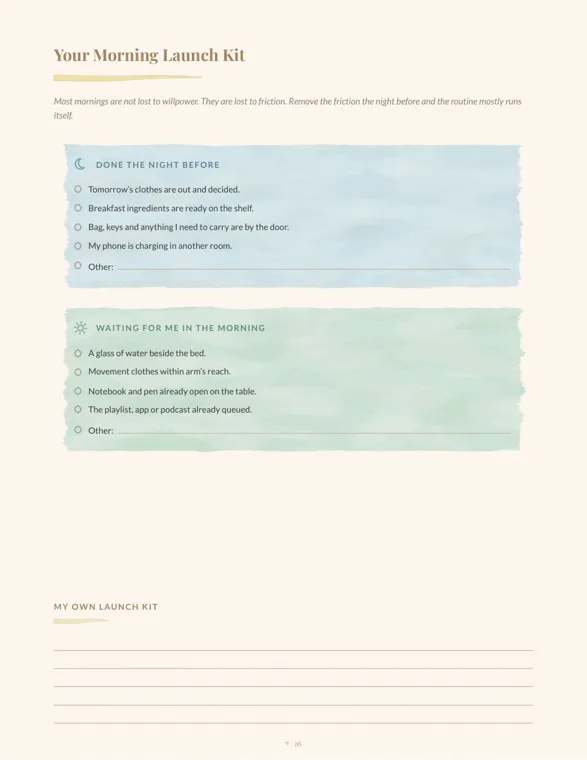
Clothes, bag and keys decided the night before
Time: about 10 minutes in the evening. You need: a spot by the door.
Pick tomorrow’s clothes and lay them out. Put your bag, keys and anything you need to carry by the door. Check that breakfast ingredients are on the shelf. The morning then starts with fewer choices about what to wear, what to eat and what you forgot.
Where it sticks: doing it at 11 p.m. when you’re already tired. Do it right after dinner or when you get home, while you still have energy to decide.
Charge the phone in another room
Time: a minute at night. You need: a charger outside the bedroom and a separate alarm clock if your phone is your alarm.
Leave the phone charging in the kitchen or hallway overnight. Reaching for it before you’re out of bed is an easy way to lose the first half hour, and you can’t reach for a phone that’s in another room. The 10-minute template in our evening routine planner starts with the same step: phone on charge, out of reach.
Where it sticks: your phone is also your alarm. A basic alarm clock solves it. Otherwise put the phone across the bedroom so you have to stand up to turn it off.
Leave the morning’s tools where you’ll see them
Time: 2 minutes at night. You need: whatever your routine uses.
Set out what your routine needs before bed. Put a glass of water beside the bed, workout clothes within reach, a notebook and pen open on the table and the podcast or playlist already queued. When the tools are in place, the routine needs fewer decisions and less willpower.
Where it sticks: setting out tools for a routine you haven’t chosen yet. Decide on one step first, then set out only what that step needs.
Morning routine ideas for parents getting kids out the door
Parents have the least control over the morning, so the routine has to survive interruptions. These three ideas work with the household rather than against it.
Ten minutes before the house wakes
Time: 10 minutes. You need: an alarm set ten minutes earlier and a plan for those minutes.
Get up before the children and use the time for one thing: coffee by the window, a few lines in a notebook or a short stretch. This is usually the quietest part of a family morning.
Where it sticks: an earlier alarm only works if bedtime moves too. If a child regularly wakes earlier than you do, skip this idea and use the next one.
Bring the kids into one part of the routine
Time: 5–10 minutes. You need: a song, a spot on the floor or a shared breakfast.
Choose the part of your routine that can include children, such as stretching on the floor, music in the kitchen or breakfast at the table together. Keep the quiet parts for later in the day. Children who need their own list of morning steps often do better with pictures, and our guide to a visual schedule for kids shows how to start with one stretch of the day.
Where it sticks: trying to journal or plan with a toddler on your lap. Pick something you can still finish if you’re interrupted three times.
Ask for ten protected minutes out loud
Time: 10 minutes. You need: a partner or older child who knows the plan.
Tell the household what the time is for and when it ends, for example “I’m reading until 6:40, then I’m all yours.” Ten minutes is a reasonable thing to ask for, and saying when it ends makes it easier for others to wait.
Where it sticks: asking only in your head. If nobody knows the minutes are protected, they’ll fill them.
Morning routine ideas for working from home
Without a commute, the morning tends to run straight into work. These ideas give the workday a clear start.
A walk around the block before work
Time: 10–15 minutes. You need: shoes and a jacket by the door.
Walk around the block before you sit down, and treat it as the trip to work. Coming back through the door is the signal that the workday has started.
Where it sticks: weather. Decide on a rainy-day version now, such as ten minutes of stretching on the floor, so a wet morning doesn’t end the habit.
Three priorities and a look at the calendar before email
Time: 5 minutes. You need: paper and your calendar.
Before you open email or chat, write down three priorities for the day and check the calendar once. Decide what the day is for before other people’s messages decide it for you.
Where it sticks: opening the laptop to check the calendar and landing in the inbox. Check the calendar on your phone or a paper planner, then open the laptop.
Decide when work starts and count backward
Time: 5 minutes, once. You need: a pen.
Write down the time you wake and the time work actually starts. The gap between them is your whole routine, and every step has to fit inside it. Give each step at least five minutes, and leave two or three minutes of slack between steps.
Where it sticks: a start time that keeps sliding. If 9:00 turns into 9:20, the routine grows to fill the gap and the plan stops meaning anything.
Morning routine ideas for early shifts and dark mornings
An early shift leaves almost no time at home, so most of the routine moves to the night before. Work days and days off can follow different versions.
Alarm across the room
Time: no extra minutes. You need: an alarm you can’t reach from bed.
Put the alarm on the far side of the room so you have to get up to switch it off. Turn on a light once you’re standing, and go straight to the next step instead of back to bed.
Where it sticks: a second alarm on the nightstand “just in case.” It becomes the snooze button.
Breakfast set out before bed
Time: 5 minutes at night. You need: a shelf or a spot in the fridge.
Set out breakfast ingredients, or make breakfast to take with you, the night before. A rushed or skipped breakfast is one of the common ways an early morning falls apart.
Where it sticks: planning a breakfast that still needs cooking at 5 a.m. Choose something you can eat as it is or take with you.
A short version for work days and a long one for days off
Time: 10 minutes on work days, 20–45 on days off. You need: two written versions of your routine.
Write both versions down. On work days, keep one or two steps, such as water and one written priority. On days off, add the rest at a slower pace. A ten-minute routine you keep is worth more than a forty-minute one you drop.
Where it sticks: treating the short version as a failure. It’s still part of the plan, and it keeps the habit going on busy days.
Longer morning routine ideas when you have 20 to 45 minutes
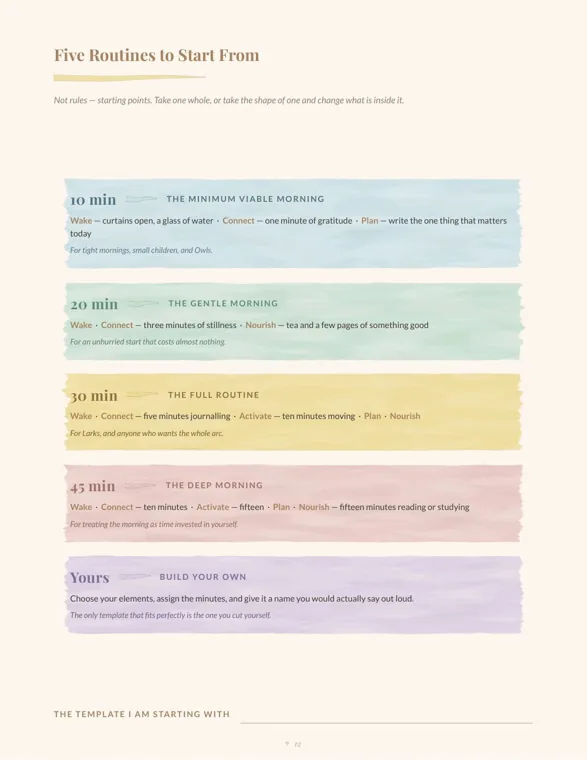
Longer routines suit people who wake easily or have slow mornings. They also work for weekends. In the workbook’s three longer templates, the 30-minute one adds movement and planning to the 20-minute one, and the 45-minute one keeps the same steps but gives the quiet time, movement and reading more minutes.
The 20-minute gentle morning for night owls
Time: 20 minutes. You need: tea or coffee and a book you like.
Get up, sit still for three minutes, then make tea and read a few pages of something you enjoy. If you’re slow to wake, this kind of routine works better than one that asks for focus right away. Leave demanding work until later in the day.
Where it sticks: reading on your phone. A paper book or e-reader keeps the twenty minutes from turning into the news.
The 30-minute routine with journaling, movement and a plan
Time: 30 minutes. You need: a notebook, space to move and breakfast you can make quickly.
Journal for five minutes, then move for ten. A walk, floor stretches or yoga all count. Write down the day’s plan and finish with breakfast. People who are alert soon after waking can put movement and planning early, while their attention is still free.
Where it sticks: starting all four steps at once. Begin with one step for a week, then add the next.
The 45-minute morning with time to read or study
Time: 45 minutes. You need: a quiet spot and the book or course material ready the night before.
Spend ten minutes on something calm, such as a gratitude list or quiet sitting. Move for fifteen minutes, plan the day, then read or study for fifteen. This routine works when your mornings are free and you want time for a book, a class or a language.
Where it sticks: a 45-minute routine leaves no room for a bad night or a late start. Keep a 10-minute version for those days.
How to start a new morning routine without changing everything
Start with one change, keep it for a week, then add the next. Changing everything at once leaves too many new things to remember on a tired morning.
Begin by writing down one ordinary weekday morning as it is, from the alarm to the moment you leave or start work. Note what feels rushed, what you enjoy and what you’d remove. The answers show you which idea above fits your morning.
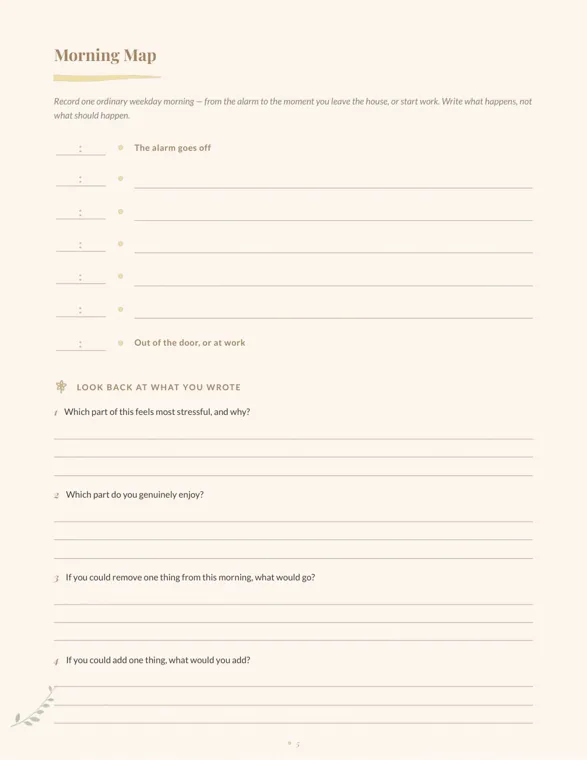
Then choose one step and decide exactly when it happens, what you’ll set out the night before and how you’ll mark it done. A tick on a calendar is enough. Keep that one step for seven days before you add anything. A seven-day log helps here: write down when you woke, what you did and how it felt, then look back at the week before adding a second step.
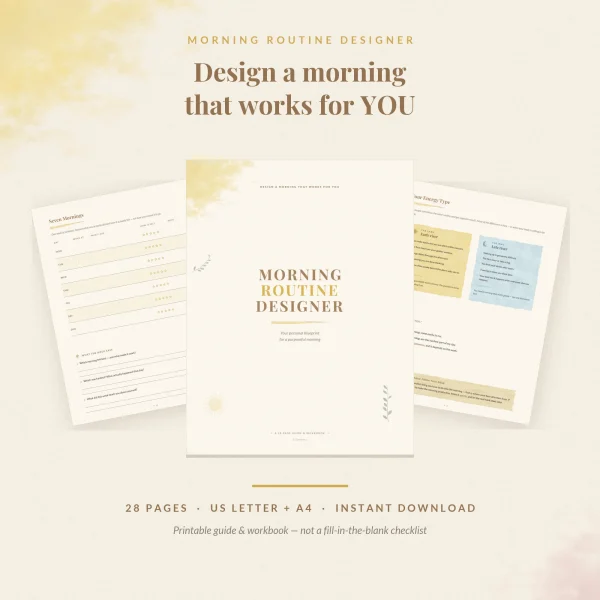
The Morning Routine Designer is a 28-page printable workbook that walks through these steps. It includes the morning map, the five starting routines, a seven-morning log and a quarterly review page meant to be reprinted four times a year.
When a morning routine falls apart
Every routine breaks down sooner or later, so plan for it before it happens. Each of these problems has a small fix.
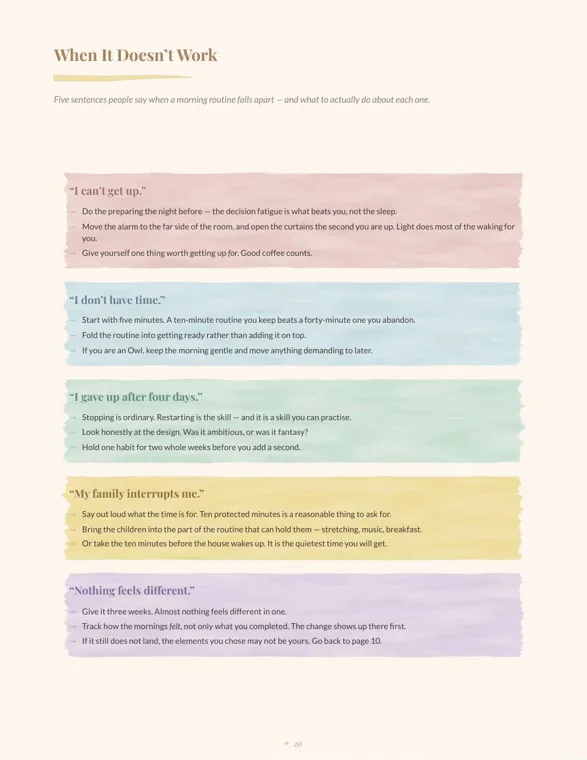
You keep hitting snooze
Move the alarm across the room and do your night-before setup, so getting up means walking into a ready morning. Give yourself one thing worth getting up for. A good cup of coffee counts.
You quit after four days
Stopping is common. Look at the plan honestly and ask whether it was realistic. Then cut it back to one step and keep that step for two full weeks before adding another.
You missed three mornings in a row
Don’t try to catch up by doubling tomorrow’s routine, because that turns one missed morning into two bad ones. Just go back to the plan the next day. If you miss three days or more in a row, the plan is asking too much. Pick a smaller first step and start again.
Printables from this article

Related articles
Self-Help Workbooks
Night Routine Ideas: Evening & Bedtime Routine for Adults
Evening and bedtime routine ideas for adults, grouped by who's home, how late work runs and how much time is left, with what to set up and where each one slips.
Printable Party Games
How to Plan a Baby Shower: Timeline, Food & 2-Hour Schedule
A baby shower plan from the first talk with the parents-to-be to the last gift: timing, guest list, budget, venue, a two-hour schedule, safe food and backup plans.
Printable Party Games
How to Plan a Bridal Shower: Timeline, Budget and Schedule
A host's plan for a bridal shower, from the first talk with the bride and co-hosts to the guest list, invitations, a timed party schedule, the gift opening and what to do when something slips.