How to Create a Home Maintenance Checklist: Monthly & Yearly
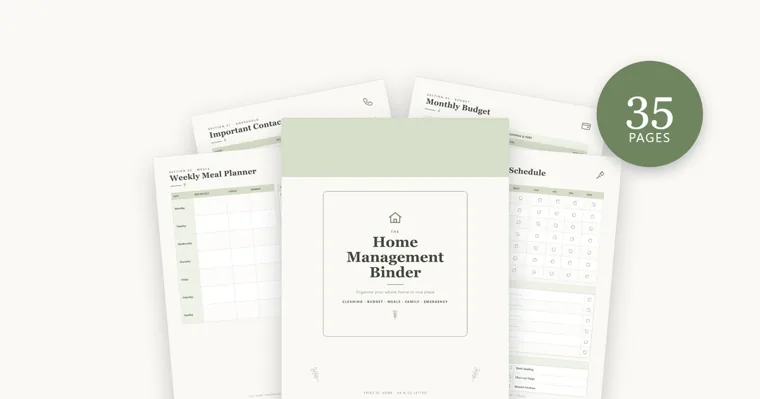
To create a home maintenance checklist, walk through your house and list the equipment it actually has, give each item a frequency, then sort the jobs into monthly, quarterly, seasonal and yearly lists you can check off. Setting it up takes one afternoon. The step that matters most is getting the safety intervals from official sources, such as the U.S. Fire Administration’s advice to test smoke alarms every month, rather than from a generic list. Below are the six steps, a table of the intervals that agencies do publish, and how to keep a log so you know what was done and when.
What you need before you start the checklist
Set aside a couple of hours on a day when you can get into the basement, the attic hatch and the space behind the dryer. Bring a notebook or a printed page, a pen, a flashlight and your phone for photos of labels.
Gather the paperwork you already have: appliance manuals, the receipt or invoice from the last furnace or AC service, and the home inspection report if you bought the house. Manuals matter more than any general list. Fire and energy agencies keep pointing you back to the manufacturer’s instructions, and the manual is where those instructions live.
If you can’t find a manual, the model number on the label is usually enough to look it up later. Write the number down during the walk-through, so you don’t have to pull the washer out from the wall a second time.
Step 1: Walk the house and list what it actually has
Start at the front door and go room by room, then outside. A generic checklist will tell you to clean a chimney you don’t have and skip the sump pump you do have. Your own list starts from what’s in the house.
Note these as you go:
- Safety devices: every smoke alarm and carbon monoxide (CO) alarm, which room it’s in, and whether it runs on a 9-volt battery, a sealed long-life battery or the house wiring.
- Heating and cooling: furnace, boiler, heat pump or central AC, plus the filter size printed on the filter’s edge.
- Water: the water heater (tank or tankless), the main water shutoff, and any visible pipes under sinks.
- Laundry: the dryer, its vent duct and where the vent comes out on the outside wall.
- Outside: gutters, roof, windows and doors with caulk or weatherstripping, decks and the yard.
- Other systems: fireplace or wood stove, ceiling fans, sump pump, garage door.
Write down the year each item was installed when you know it. Smoke alarm replacement depends on the alarm’s age, not on the month, and a 10-year mark is easy to lose track of.
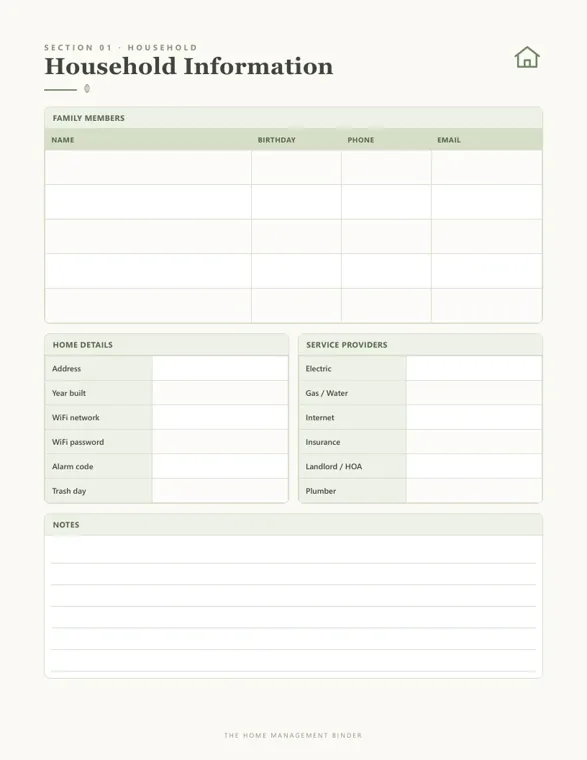
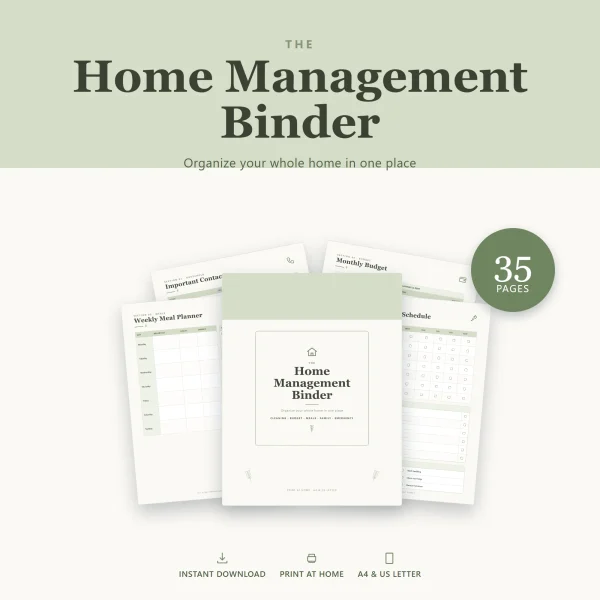
Our home management binder opens its household section with this page. The service providers box has rows for electric, gas and water, internet, insurance, landlord or HOA, and a plumber. Fill those in during the walk-through, because the phone number you need during a leak is the one you didn’t write down.
Step 2: Give each item a frequency from a source you trust
Every item on your list needs a “how often.” Some of those intervals are published by U.S. government agencies or the National Fire Protection Association (NFPA), a nonprofit that publishes fire safety codes and standards. Copy those exactly. For everything else, the frequency is a judgment call based on your house, your trees and your weather.
Here are the intervals we could find in the agencies’ own words:
| Job | How often | Who says so |
|---|---|---|
| Test smoke alarms | Every month | U.S. Fire Administration (USFA) |
| Replace 9-volt smoke alarm batteries, or the backup battery in a hardwired alarm | At least once a year | USFA |
| Replace smoke alarms with 9-volt batteries or hardwiring | Every 10 years | USFA |
| Replace sealed long-life battery smoke alarms | Per the manufacturer’s instructions | USFA |
| Test CO alarms | At least once a month; replace per the manufacturer | NFPA |
| Clean or replace furnace, AC and heat pump filters | Once a month, or as the manufacturer recommends | U.S. Department of Energy, Energy Saver Guide |
| Drain a quart of water from a tank water heater | Every 3 months, following the manufacturer’s directions | Department of Energy |
| Clean the dryer lint filter | Before and after each cycle | USFA |
| Have heating equipment and chimneys cleaned and inspected by a professional | Every year | USFA |
| Review your emergency supply kit and replace expired items | Every year, and as needed | Ready.gov (FEMA) |
Gutters, caulk, the roof and the deck have no official calendar. A house under oak trees needs its gutters cleared more often than one in an open lot. Put those jobs where they make sense for your house and adjust after a year of notes.
When the manual and a general list disagree
Follow the manual. The USFA’s own smoke alarm advice says to care for alarms according to the manufacturer’s instructions, and the Energy Saver Guide says “or as recommended” next to its filter interval. Your checklist should say which filter you have and what its maker says.
Step 3: Build the monthly home maintenance checklist
Once every item has a frequency, the monthly list is the short one you’ll actually look at every few weeks. Keep it to jobs that take a few minutes each, so the whole round fits into a single short session.
A monthly list for a typical house looks like this:
- Press the test button on every smoke alarm and every CO alarm.
- Pull the HVAC filter and hold it up to the light. Clean it or swap it if it looks clogged.
- Run the dryer and check outside that the vent cover opens. The USFA lists this check in its dryer fire safety advice, along with looking behind the dryer for lint and for a crushed or damaged vent.
- Look under the kitchen and bathroom sinks for drips or damp spots.
Pick a fixed day, such as the first Saturday of each month, and put it in whatever calendar you already check. If two adults share the house, assign the monthly round to one person. A list owned by “whoever notices” usually gets skipped.
The dryer lint filter isn’t on this list because it’s an every-load habit, not a monthly job. Put a note on the dryer instead of on your checklist.
Step 4: Add quarterly and seasonal jobs
Quarterly and seasonal jobs are the easiest ones to lose, because three months is long enough to forget whether you did something. Tie each one to a month, not to a season name.
The quarterly job with a published interval is the water heater. The Energy Saver Guide says to drain a quart of water from a tank water heater every 3 months to remove sediment, following the manufacturer’s directions. Put it in the same four months every year, for example January, April, July and October. The water coming out of the drain valve is hot, so read the heater’s manual first.
Seasonal jobs follow the weather where you live:
- Spring: clean gutters after the trees finish dropping seeds and blossoms, wash windows, check caulk around tubs and windows.
- Summer: schedule AC service if you didn’t do it in spring, clean the grill, look over the deck.
- Fall: book the yearly heating inspection, clean gutters again after leaves fall, seal drafts around doors and windows.
- Winter: switch ceiling fans to clockwise, check that snow isn’t blocking outdoor vents.
Ceiling fan direction comes straight from the Energy Saver Guide: counterclockwise in summer for a wind chill effect, clockwise in winter to push warm air down from the ceiling. Many fans have a small switch on the motor housing.
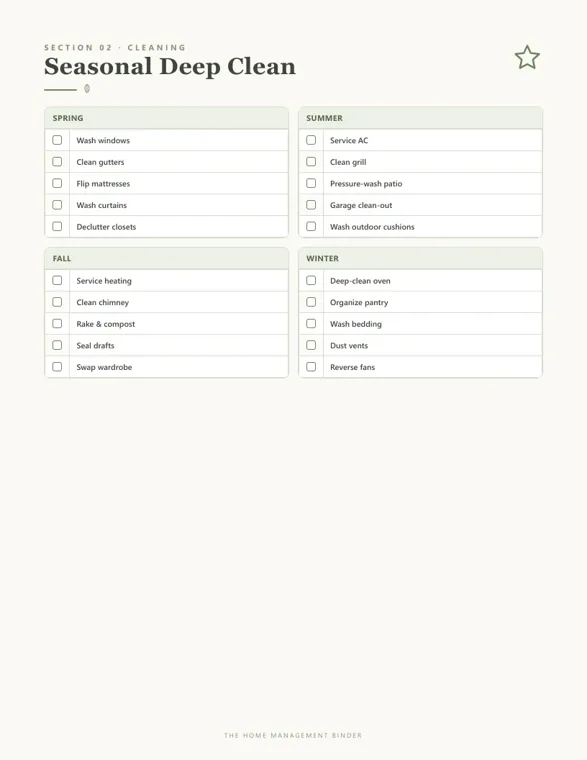
The seasonal deep clean page in our binder already splits 20 tasks across the four seasons, with clean gutters in spring, service AC in summer, service heating and clean chimney in fall, and reverse fans in winter. You can use it as your seasonal list and cross out what doesn’t apply to your house.
Step 5: Set up the yearly home maintenance checklist
The yearly list is short but expensive to forget. Several of its jobs involve a professional, so put them in a month when contractors are easier to book, before the first cold week rather than during it.
A yearly list usually covers:
- Have the furnace, boiler or wood stove and any chimney cleaned and inspected by a professional, as the USFA recommends for heating equipment every year.
- Replace 9-volt batteries in smoke alarms and the backup batteries in hardwired alarms.
- Check the install year of every smoke alarm. Mark any that are near 10 years old for replacement, unless it’s a sealed long-life model, which you replace when its maker says.
- Go through your emergency supply kit. Ready.gov says to replace expired items and re-think your needs every year as your family changes.
- Inspect the roof from the ground with binoculars, and check the attic for daylight or damp spots.
Batteries and alarm ages are easy to lose in a busy year. Writing the year next to each alarm on your list turns “every 10 years” from a guess into a date.
Step 6: Put the checklist on paper and log what you do
A checklist tells you what’s due. A log tells you what you actually did, when and what it cost. You need both, because next spring you won’t remember whether the water heater got drained in January.
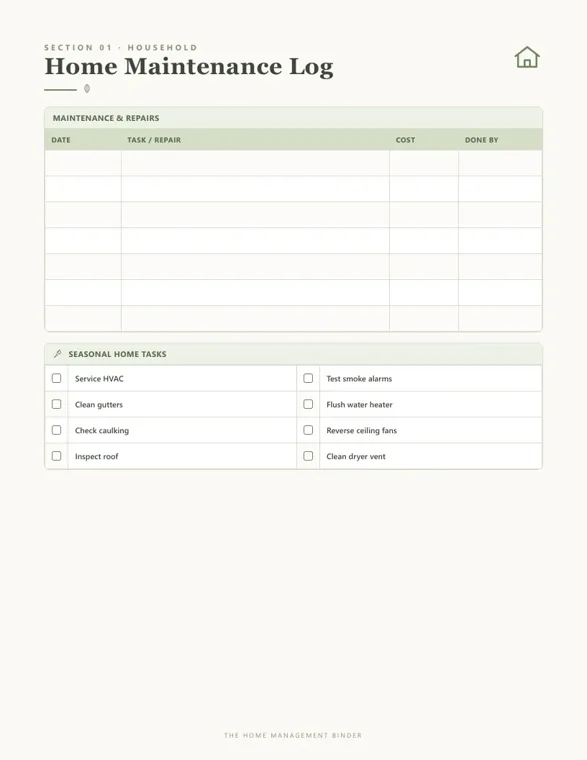
Page 9 of our binder is a home maintenance log. The top table has columns for date, task or repair, cost and who did it. Below it, a seasonal home tasks box lists eight jobs with checkboxes: service HVAC, test smoke alarms, clean gutters, flush water heater, check caulking, reverse ceiling fans, inspect roof and clean dryer vent.
One catch with that box: it has no frequency column, and “test smoke alarms” sits in a seasonal list. The USFA says monthly. Write “monthly” next to it, add CO alarms and the HVAC filter in the blank rows above, and pencil the month next to each seasonal job. The printed list is a starting point, not your schedule.
Keep the log with the rest of the household paperwork. Print the pages single-sided, three-hole punch them and file the maintenance log right behind the household information page, so the contractor numbers and the work history sit together.
The cost column is worth filling in every time. After a year, add it up and you have a real figure for home repairs. Our guide on budget categories people forget to include shows how to set aside a twelfth of a yearly cost each month, which suits a furnace inspection or gutter cleaning.
Who handles what in a shared or rented home
A checklist only works when each job has a name next to it. In a rental, many items belong to the landlord, so find out which ones before you take them on. Your lease or a quick message to the landlord or property manager will say who replaces the furnace filter and who books the yearly heating inspection. Tenants can usually still test the alarms, clear the lint filter and report leaks.
In a family home, kids can take on some of the simple jobs. A school-age child can carry the flashlight on the monthly round, help wipe down vents or hold the ladder steady while you check gutters from the ground. Alarm testing, the water heater and anything on a ladder should stay with an adult. Our list of age-appropriate chores has ideas for what each age can handle around the house.
Keeping the home maintenance checklist going
The checklist fails when it lives in a drawer. Put the monthly date on the same calendar you use for bills, and look at the seasonal list once a month during that same session. If you already do a weekly review, our guide on how to use a planner shows how to fold household pages into that routine.
Missing a month isn’t a disaster for most jobs, but don’t skip the safety items. If the monthly round slips, do the alarm tests that week and catch up on the rest later. After the first full year, read through your log. Jobs you never needed can move to a longer interval, and anything that broke between checks deserves a shorter one.
Frequently asked questions
How often should you test smoke alarms and CO alarms?
Test smoke alarms every month, according to the U.S. Fire Administration. The NFPA says to test CO alarms at least once a month and replace them according to the manufacturer’s instructions. Put both on your monthly list.
What should be on a monthly home maintenance checklist?
A monthly list usually covers testing smoke and CO alarms, checking the HVAC filter, confirming the dryer’s outside vent cover opens and looking under sinks for leaks. Keep it to jobs that take a few minutes each.
How long does it take to create a home maintenance checklist?
Plan on one afternoon: a walk-through to list what the house has, an hour with the manuals to set frequencies, and some time to write out the monthly, seasonal and yearly lists. After that, the monthly round takes a short session.
Printables from this article
Related articles
Printable Planners
How to Build a Workout Plan: Weekly Schedule & Template
A step-by-step way to turn a fitness goal into a weekly workout schedule, with 3-, 4- and 5-day sample weeks, a logging routine and simple rules for progressing, resting and restarting.
Printable Planners
Self Care Ideas for Mental Health: Relaxing Habits & Tracker
Sixteen small, non-clinical self-care habits sorted by what you need, from sleep and walks to boundaries and a joy list, plus a low-pressure weekly check-in.
Printable Planners
Easy Time Management Tips for Work, Students and Parents
Simple time management habits you can start on an ordinary weekday, sorted for desk jobs, students and busy households, with the snag to watch for in each.