Night Routine Ideas: Evening & Bedtime Routine for Adults

A night routine works when it’s short, starts at about the same time most nights and ends with the same few steps before bed. For most adults that means setting a start time by counting back from the alarm, ending the workday on purpose and keeping the first version to 10 or 20 minutes. A full hour can come later, once the short one holds.
Find the row in the table below that sounds like your weeknights and read that section first. Each idea says roughly how long it takes, what to set up while you still have energy, and the spot where it tends to slip. The sleep figures come from the National Heart, Lung, and Blood Institute (NHLBI), part of the National Institutes of Health.
Which night routine fits your weeknights
| Your weeknights | Length to start with | First steps | Set up earlier | Where it slips |
|---|---|---|---|---|
| Home late from work | 15–20 minutes | Close out work, phone on a charger outside the bedroom, lights down | A charger and a paper book where you’ll see them | Checking email “once” on the couch |
| Kids to put to bed first | 20 minutes, started about 15 minutes after their lights-out | Tidy one surface, a short handoff with your partner, read | The kids’ own bedtime routine | Using the quiet time for every chore in the house |
| Working from home | 10–30 minutes | A short walk to end the workday, then put work things away | Shoes and a jacket by the door | The laptop left open on the kitchen table |
| Only 15 minutes before bed | 10–15 minutes | Phone away, three lines in a notebook, lights down | A notebook and pen by the bed | Adding a fourth step in the first week |
| A free hour most nights | 45–60 minutes | Walk or bath, journal, plan tomorrow, read | Gaps between the steps | Starting with the full hour on night one |
| Going to bed earlier this winter | Your current routine, started earlier | Move the start time and drop one late habit | A fixed wake-up time | A weekend that pushes everything back |
Start a night routine from your wake-up time
Every routine on this list starts with the same sum: when your alarm goes off, and how much sleep you’re aiming for. The NHLBI says experts recommend that adults sleep between 7 and 9 hours a night. Count back from your alarm to get a lights-out time, then count back again by the length of your routine to see when the wind-down has to begin.
With a 6:30 a.m. alarm and eight hours as the target, lights-out is 10:30 p.m., and a 20-minute routine starts at 10:10. The NHLBI also suggests going to bed and waking up at the same time every day, and keeping the weekend difference to no more than about an hour. A routine that starts at 10 on Tuesday and at 1 a.m. on Saturday has to restart every Monday.
Page 11 of our Evening Routine Designer workbook asks for two times before anything else: when work really ends, “not the official one,” and when your evening truly begins. It also suggests leaving 10 to 15 minutes of slack between blocks. That gap is easy to cut on paper and hard to do without on a weeknight.
A night routine also sets up the next morning. For the other end of the same night, including clothes, bags and keys set out before bed, see these morning routine ideas.
Night routine ideas for when you get home late from work
When the commute eats the early evening, the routine has to be short and has to start when you walk in, not at 10:45 when you remember it.
Close the workday in five minutes
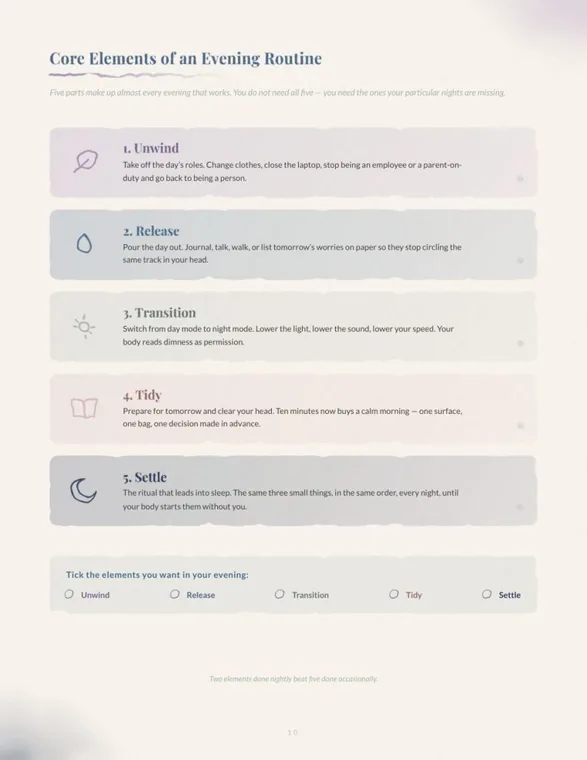
Change out of work clothes, write tomorrow’s first task on paper and close the bag. It takes five minutes and a notebook that lives in that bag. Our workbook calls this part Unwind: take off the day’s roles and go back to being a person.
The snag is the phone in your pocket. One work message after dinner reopens the whole day, so mute work notifications at the same moment you change clothes.
A lighter late dinner and a ten-minute kitchen reset
Late commuters often eat late. The NHLBI suggests avoiding heavy or large meals within a few hours of bedtime, says a light snack is okay, and advises against alcoholic drinks before bed. If dinner can’t move earlier, make it smaller and have the bigger meal at lunch.
Then give the kitchen ten minutes: dishes in, one counter wiped, tomorrow’s lunch box out. The 30-minute template in our workbook opens with exactly this kitchen reset. Where it slips is a ten-minute tidy that grows into a deep clean, so set a timer and stop when it rings.
Phone on a charger outside the bedroom
Plug the phone in somewhere you can’t reach from bed, like the kitchen or a hallway shelf. It takes a minute, plus a basic alarm clock if your phone is also your alarm. The NHLBI recommends using the hour before bed for quiet time and avoiding bright artificial light, such as from a TV or computer screen, because the light may signal the brain that it’s time to be awake.
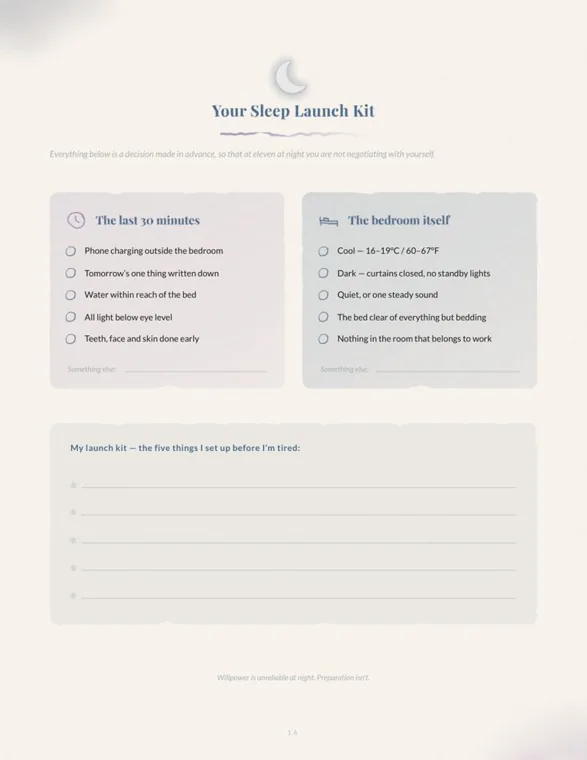
The usual problem is the alarm. If you’ve always woken to your phone, buy the clock before you try this, or the phone will be back on the nightstand by Thursday.
Bedtime routine for adults after the kids are asleep
Parents usually get two evenings: the children’s, and then whatever is left. The NHLBI advises a set bedtime and a bedtime routine for children. A fixed kids’ bedtime also gives your own routine a fixed start.
Run the kids’ routine from picture cards
Cards for bath, pajamas, teeth and a story let younger children see the next step without you calling it out each time. To put printed cards in your family’s own bedtime order, follow the steps for a visual schedule for kids, which handles evenings as well as mornings. Start your own 20-minute routine about 15 minutes after their lights-out, which leaves room for the first request for water.
Two minutes for tomorrow’s handoff
If you share the house with a partner, settle tomorrow in two minutes: who does drop-off, what’s for dinner, which forms need signing. Do it at the kitchen counter, not in bed. Our workbook lists difficult conversations at night among eight common interrupters, and a quick handoff can drift into a bigger argument at 10 p.m. Park anything heavy for the weekend.
Tidy one surface instead of the whole house
Once the kids are down, the pull is to clean everything. Pick one surface, such as the kitchen table or the spot by the front door, and clear only that. The Tidy card on page 10 of our workbook puts it as “one surface, one bag, one decision made in advance.” Toys can wait for a morning sweep into a basket, unless they’re somewhere someone could trip in the dark.
Evening routine ideas for working from home
At home, no commute ends the workday, so the first job of an evening routine is to make one.
A ten-minute walk to end work
Put your shoes on when work ends and walk around the block, or to the end of the street and back. It takes about ten minutes; keep shoes and a jacket by the door so there’s nothing to look for. Our workbook’s page of common problems suggests a physical signal like this for nights when you can’t switch off.
The NHLBI suggests spending time outside every day when possible, and avoiding intense exercise in the hour before bed. So take the walk when work ends, not right before sleep. Rain and early winter darkness are where this one slips. Decide on an indoor version ahead of time, such as a change of clothes and a few minutes of stretching.
Put the laptop away, not just shut
Close the laptop, then put it in a bag or a drawer. If your desk is in the bedroom, cover the screen and move the charger to another room. The bedroom checklist in our workbook ends with “nothing in the room that belongs to work.” Where it gets hard is a laptop that doubles as your TV. Watch shows on a different device, or in a different room.
A worry list before you brush your teeth
Write the things still going around your head on one sheet, with the first step for each one tomorrow. It takes five minutes, a pen and paper kept by the sink or the bed. Our workbook’s page of common problems puts this before teeth-brushing for nights when your mind won’t stop.
If you’d rather write something steadier, our gratitude journal prompts include two-minute prompts that fit the same slot. The list can turn into a planning session at midnight, so give each worry one line and stop.
A 15-minute night routine, or a full hour
How much time you have shapes the routine more than anything else. Page 12 of our workbook sets out four starting routines, at 10, 20, 30 and 45 minutes, plus a blank row for your own, and tells you to start one step below what you think you can manage.
15 minutes: phone away, three lines, lights down
The 10-minute version is three steps: phone on charge out of reach, three lines in a notebook, lights down. With 15 minutes, add teeth and face, which the workbook’s launch-kit page suggests doing early, and five minutes of a paper book in bed.
What usually breaks this is a fourth step in the first week. The workbook’s own rule is that two elements done every night beat five done now and then.
An hour: walk or bath, journal, plan, read
The 45-minute template lists a walk or bath, journaling, planning tomorrow, skin and teeth, reading and a few slow breaths. Add 10 to 15 minutes of slack between steps and it fills an hour. For something screen-free that isn’t reading, coloring fits this slot; our guide to blending colored pencils suits a slow page worked over several evenings.
To build your own instead of taking a template, page 10 splits an evening into five parts: Unwind, Release, Transition, Tidy and Settle. You don’t need all five. Pick the ones your nights are missing.
The hour is the first thing to go after a late meeting. Write down a 15-minute version as well, and use it on short nights instead of skipping the routine altogether.
Our Evening Routine Planner is the 28-page workbook these page numbers come from, in US Letter and A4. It has you map your current evenings, pick or build a routine, log seven nights and then adjust.
Moving bedtime earlier for winter or the new year
Darker evenings and January resolutions are when a lot of people try to get to bed earlier. Moving lights-out works better when the start of the routine moves with it, and when something comes out of the evening before anything new goes in.
Drop one late habit first
Page 7 of our workbook lists eight interrupters to check against the past week. They include screens within an hour of bed, caffeine after 2 p.m. and no clear end to the working day.
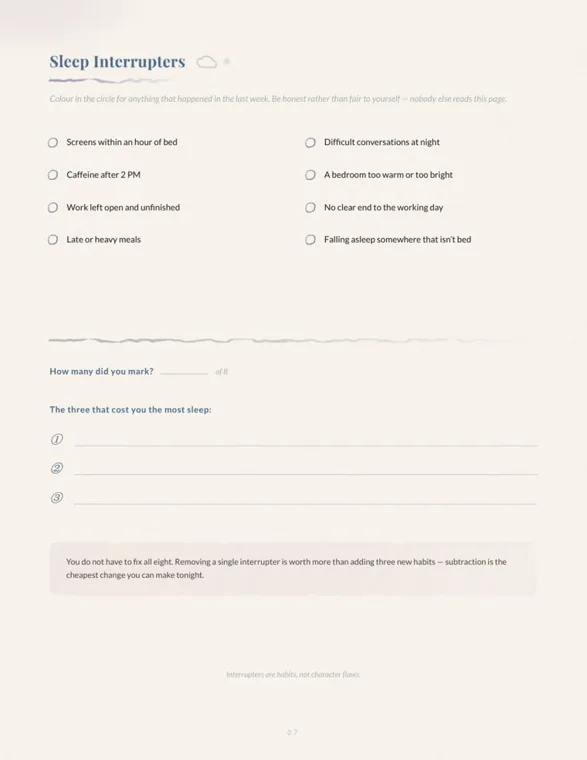
On caffeine, the NHLBI notes that its effects can last up to 8 hours, so a cup of coffee in the late afternoon can make it hard to fall asleep at night. That includes tea, soda and chocolate, which the NHLBI lists alongside coffee. The workbook’s line is that removing one interrupter is worth more than adding three new habits.
Decide whether you need to stop or to empty your head
Page 6 sorts people into two rough types. A Moon feels tired early but resists going to bed, and needs permission to stop. A Wave has a mind that keeps moving at night and needs an outlet, such as writing, talking or moving.

For a Moon, the earlier-bedtime fix is a fixed stop time with the TV off. For a Wave, it’s the worry list from the work-from-home section, done half an hour earlier than before.
Hold the wake-up time on weekends
An earlier bedtime only lasts if the morning stays put. The NHLBI’s suggestion is to keep weeknights and weekends within about an hour of each other. Friday is where this slips: a late Friday leads to a late Saturday, and Sunday night’s routine starts with you wide awake.
When a night routine stops working
Every routine has bad weeks. These are the three most common, with what to change.
You lie awake anyway
Page 22 of our workbook has a four-step reset for these nights. Get up after twenty minutes, keep the light low and the task dull, don’t check the time, and keep your wake-up time anyway.

A worksheet won’t fix sleep trouble that goes on night after night for weeks. That’s worth raising with a doctor.
You skip it three nights running
A late meeting, a sick child or a friend who calls at ten will break the routine sometimes. As the workbook puts it, a missed night isn’t a broken streak; it’s one night. Go back to the 10-minute version for a few nights instead of starting over from scratch.
Nothing feels different
Page 19 has a seven-night log with a star rating for each night, and it suggests tracking how you wake rather than how fast you fall asleep. Page 24 describes three stages over roughly six weeks and calls six weeks an average, not a deadline. When the clocks change in November, the seasonal review on page 25 is a good moment to look again; the workbook says to print it four times a year. For more printable planners and workbooks, start from the Doodlora Studio home page.
Printables from this article

Related articles
Self-Help Workbooks
Morning Routine Ideas: Easy Morning Routines for Busy Days
Eighteen morning routine ideas grouped by how much time you have and who else is in the house, with the setup each one needs and the spot where it usually breaks.
Printable Party Games
How to Plan a Baby Shower: Timeline, Food & 2-Hour Schedule
A baby shower plan from the first talk with the parents-to-be to the last gift: timing, guest list, budget, venue, a two-hour schedule, safe food and backup plans.
Printable Party Games
How to Plan a Bridal Shower: Timeline, Budget and Schedule
A host's plan for a bridal shower, from the first talk with the bride and co-hosts to the guest list, invitations, a timed party schedule, the gift opening and what to do when something slips.