Refrigerator Temperature: Fridge and Freezer Settings
Your refrigerator should be at 40°F (4°C) or below, and your freezer at 0°F (-18°C). Those are the numbers the FDA gives for home food storage. The catch is that the dial inside your fridge almost never shows either one, so the only way to know your real fridge temperature is to put a thermometer in it and read it.
| Appliance | Keep it at | In Celsius |
|---|---|---|
| Refrigerator | 40°F or below | 4°C or below |
| Freezer | 0°F | -18°C |
The rest of this page covers where the thermometer goes, how often to look, what to change when the reading is off, how a simple log helps, and how to decide what to keep after the power goes out.
Why 40°F is the line for a fridge
Cold doesn’t kill the bacteria that make people sick. It slows them down. The FDA notes that at room temperature those bacteria can double every 20 minutes, and chilling food is one of the best ways to slow that growth. Above 40°F (4°C), the slowing starts to wear off.
Some bacteria still grow below 40°F. The FDA names Listeria as one that can grow at refrigerator temperatures, which is why wiping up spills and keeping food covered matter even in a cold fridge. A correct temperature buys you time. It doesn’t make food last forever.
The freezer works differently. At 0°F (-18°C), food stays safe for as long as it stays frozen. What changes over months is texture and flavor, not safety.
The dial is not a thermometer
Most fridges have a knob numbered 1 to 5 or 1 to 9, or a display with “colder” and “warmer” settings. The FDA points out that few refrigerator controls show the actual temperature. A “4” on one brand and a “4” on another can sit at very different temperatures, and a fridge set the same way can run warmer in a hot kitchen in summer.
So the setting is something you adjust, and the thermometer is what tells you whether the adjustment worked. The FDA suggests a freestanding appliance thermometer, one for the fridge and one for the freezer, and calls them generally inexpensive. Any plain appliance thermometer that reads in the range you need will do the job. If you want somewhere to write the readings down, our refrigerator temperature log has a fridge page and a freezer page, covered further down.
How to check your fridge temperature
Where to put the thermometer
Put the fridge thermometer on a middle shelf, toward the center, not in the door. The FDA says the door is warmer than the rest of the fridge, which is why it tells you to keep eggs in their carton on a shelf instead of the door rack. A thermometer in the door will read warm and send you chasing a problem you don’t have.
Keep it out of the direct blast from the cold-air vent, and don’t bury it behind a wall of jars. You want the temperature the food is sitting in.
In the freezer, set the second thermometer between packages in the main compartment. If your freezer is a separate chest or upright unit in the garage or basement, it gets its own thermometer too.
When to read it
Read the thermometer when the door has been shut for a while. First thing in the morning, before anyone grabs breakfast, works well. A reading taken right after the kids have stood with the door open for two minutes, or right after you’ve unloaded a week of groceries, will look warmer than the fridge really is.
How often depends on your situation:
- New fridge, new thermometer or a setting you just changed: check once a day for several days until the reading stays steady.
- Everything has been fine for weeks: a quick look once or twice a week is enough for most homes.
- A second fridge in the garage, an old fridge, or a freezer full of meat you bought in bulk: check more often, especially in very hot or very cold weather, because garages swing more than kitchens do.
- A household where several people share the kitchen: agree on one time of day and one person who writes it down, or nobody does.
When the reading is off
The fridge reads above 40°F (4°C)
Turn the setting one step colder, then leave it alone. A fridge takes hours to settle after a change, so read the thermometer again the next morning before you touch the dial a second time. Turning it all the way down at once is how milk ends up frozen.
Before you blame the setting, look for the usual causes:
- The fridge is packed tight. The FDA warns against overpacking because cold air has to circulate around the food. Clear a path in front of the vents.
- The door isn’t sealing. A jar or a drawer that sticks out can hold the door open a crack.
- The door gets opened a lot. After a party or a big cooking day, the reading can climb for a while and then recover.
- You just loaded a lot of warm groceries. Wait until the next morning before deciding anything.
Hot leftovers are not the problem people think. The FDA says putting hot food in the fridge doesn’t harm the appliance. Leftovers should go in within 2 hours, and dividing them into smaller containers helps them cool faster than one deep pot.
If the fridge stays above 40°F (4°C) after a couple of setting changes and the seal looks fine, check the manual for your model or call the maker’s service line. A fridge that can’t hold temperature isn’t a settings problem anymore.
The fridge is too cold
Anything near 32°F (0°C) will start freezing the water in your food. Lettuce turns limp and dark, milk gets slushy, and eggs can crack. If that’s happening, turn the setting one step warmer and recheck the next morning. Aim to stay comfortably under 40°F (4°C), not as close to freezing as the fridge can manage.
The freezer reads above 0°F (-18°C)
A freezer a few degrees above 0°F (-18°C) right after you’ve added a lot of room-temperature food will usually pull back down by the next day. If it stays high, check the door seal and frost buildup, make sure nothing blocks the vent, and turn the setting one step colder. Food in a freezer reading 40°F (4°C) or warmer is no longer frozen, and that’s the line the FDA uses for deciding what to keep after an outage (see below).
Keeping a fridge temperature log at home
Most kitchens get along fine with a glance at the thermometer. A written log earns its place when one of these is true:
- You have a second fridge or chest freezer that nobody opens daily, so a slow failure can go unnoticed for a week.
- The fridge is older and you want to know whether it’s starting to drift.
- Several people use the kitchen and you want one record instead of everyone guessing whether it was fine yesterday.
- You just had an outage or a repair and want to watch the next few weeks closely.
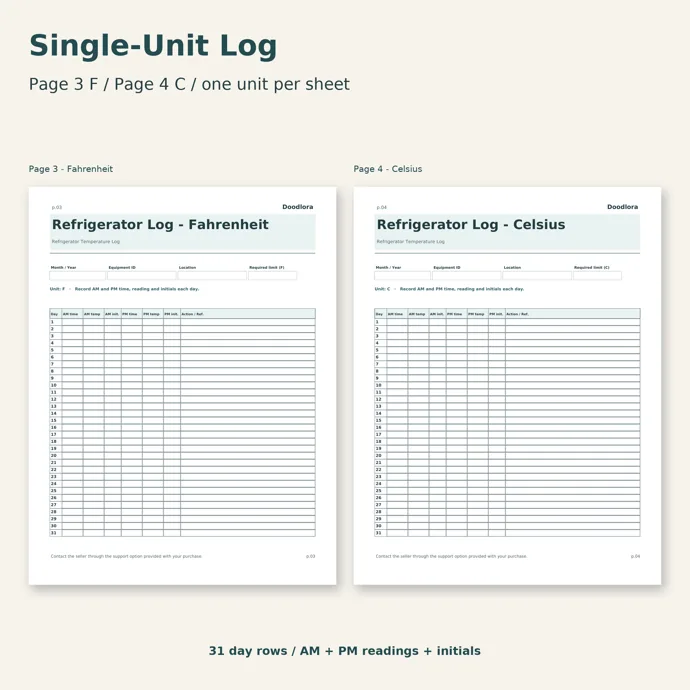
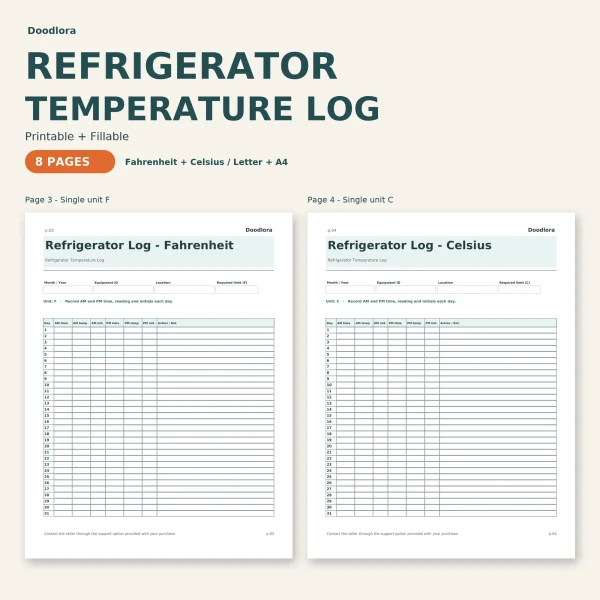
Our printable refrigerator temperature log has 8 pages. Page 3 is a single-fridge sheet in Fahrenheit and page 4 is the same sheet in Celsius. Each one has 31 day rows and eight columns: the day, then the time, temperature and initials for a morning check, the same three for an evening check, and an Action / Ref. column for a short note.
Here’s how to set it up so it actually gets used:
- Fill in the header first. Each page has boxes for month and year, equipment ID and location. The equipment ID can be as simple as “kitchen” or “garage.”
- Write your limit in the “Required limit” box. None of the pages print a target, so at home write 40°F on the Fahrenheit page or 4°C on the Celsius page.
- Cross out the days your month doesn’t have. Every sheet runs to 31.
- Write in the unit printed on the page. The log doesn’t convert anything, so a Celsius reading on the Fahrenheit page is the easiest mistake to make.
- Keep it where the checking happens. Tape it inside a cabinet door near the fridge, with a pen, and you’ll fill it in.
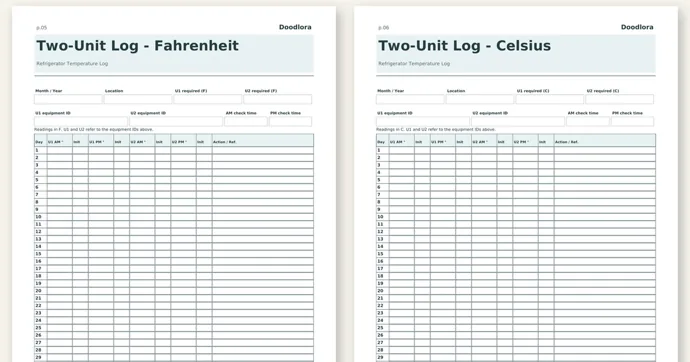
You don’t have to use both daily checks. If once a day is all your household needs, use the AM columns and leave the PM ones blank. If you have two fridges, pages 5 and 6 put both on one sheet, with separate equipment IDs, limits and readings for U1 and U2.
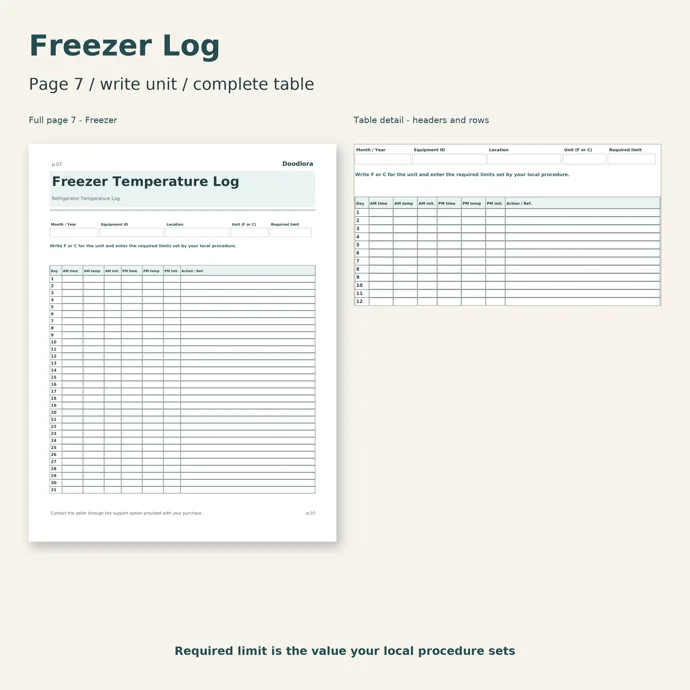
Page 7 is the freezer log. It has the same columns as the single-fridge page, but you write F or C at the top yourself, along with your limit of 0°F or -18°C.
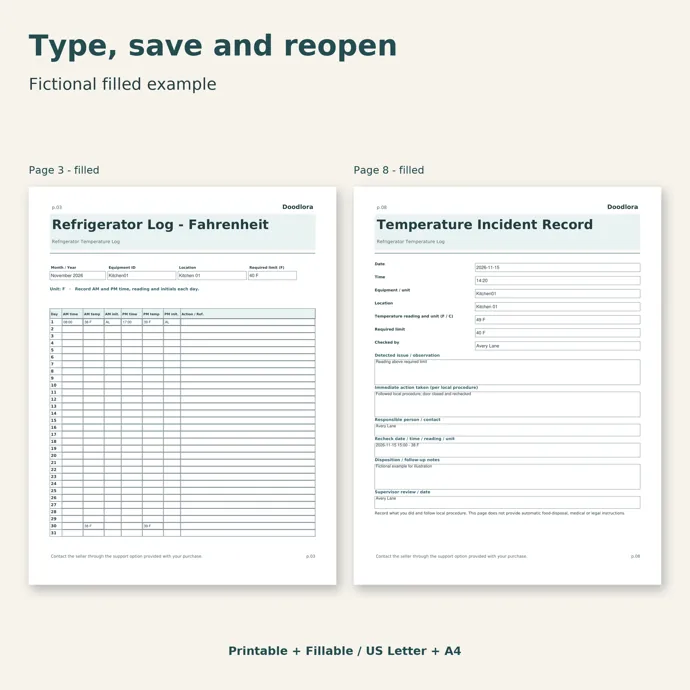
Page 8 is a temperature incident record for the day something goes wrong. It has spaces for the date and time, which unit, the reading and the limit, what you noticed, what you did, and a recheck time and reading. At home that might be the morning you found the garage freezer at 20°F (-7°C), what you threw out, and what the thermometer said once it had been running again for a day.
The log comes as printable PDFs and fillable PDFs, in US Letter and A4, each in a color version and an ink-saver version. The fillable files let you type the readings and save the file if you’d rather keep it on a computer than on paper.
If you’re already keeping a home maintenance checklist, add “check the fridge and freezer thermometers” to the monthly list and file the log with it. More printable trackers are in our trackers and checklists shop.
What to do in a power outage
Before the power goes out
If a storm is coming and you have some warning, the FDA suggests freezing water in quart-size sealable plastic bags and putting them in both the freezer and the fridge. They act as ice packs and help everything stay cold longer.
While the power is out
Keep the fridge and freezer doors closed as much as you can. According to the FDA:
- An unopened refrigerator keeps food cold for about 4 hours.
- A full freezer holds an adequate temperature for about 48 hours if the door stays shut.
Every time someone opens the door to “just check,” those numbers shrink. This is where a thermometer you can read through a quick crack of the door, or one you checked right before the outage, pays off.
After the power comes back
Check the thermometers before you use any food. The FDA’s rules, in order:
- Freezer with a thermometer: if it reads 40°F (4°C) or below, the food is safe and can be refrozen.
- Freezer without a thermometer: check each package. Food that still has ice crystals or is at 40°F (4°C) or below is safe to refreeze or cook. You can’t judge it by how it looks or smells.
- Refrigerator: food should be safe if the power was out for no more than 4 hours and the door stayed shut. Throw out perishable food such as meat, poultry, fish, milk, eggs and leftovers that sat above 40°F (4°C) for 4 hours or more.
- Not sure how long it was warm? The FDA’s answer is plain: don’t take the chance. Throw the food out.
The hardest part is usually step 4. If nobody knows when the power went out, or the thermometer wasn’t in the fridge, you don’t have the facts to keep the food. A reading written on the log before bed and another the next morning can be the difference between keeping a freezer full of food and guessing.
Once things are back to normal, keep an eye on the readings for a few days to make sure the fridge and freezer have pulled back down to 40°F (4°C) and 0°F (-18°C).
A colder fridge helps the rest of the kitchen
A fridge at the right temperature only protects food for so long. Leftovers still have a limit, and planning meals around what’s already in there is the easiest way to use food before it reaches it. The walkthrough on how to meal plan begins with exactly that: open the fridge and freezer, note what needs using soon, then build the week’s dinners around it.
Frequently asked questions
What temperature should a refrigerator be?
At 40°F (4°C) or below. Running it a few degrees under 40°F gives you some margin for door openings and warm days, without getting so close to 32°F (0°C) that food starts to freeze.
What should the freezer temperature be?
0°F (-18°C). Food kept frozen at that temperature stays safe, though quality slowly drops over months.
Is 0°F the same as -18°C?
Close enough for a freezer. 0°F works out to about -17.8°C, and the FDA rounds it to -18°C. In the same way, 40°F is about 4.4°C, which the FDA lists as 4°C.
What number should my fridge dial be on?
There isn’t a single answer, because the numbers mean different things on different models. Start in the middle, put a thermometer on a middle shelf, and adjust one step at a time until it reads 40°F (4°C) or a little below.
Why does the fridge door feel warmer?
It is warmer. The door shelves sit closest to the room air and get the most exposure every time you open it. Keep milk, eggs and leftovers on the inside shelves and use the door for condiments.
Printables from this article
Related articles
Printable Invitations & Cards
What Is a Golden Birthday? Meaning, Ages and Party Ideas
Your golden birthday is the year you turn the same number as the day of the month you were born. Find yours from the day, not the month, plan around the number, and say what it means on the invitation.
Printable Invitations & Cards
Christmas Pregnancy Announcement Ideas: Holiday Card Wording
Pick the reveal by who you're telling: something private and small for your partner on Christmas morning, a stocking or a gift box at the family gathering, a job for an older child, a quick joke for friends, and a card or phone image for everyone far away.
Printable Invitations & Cards
How to Wrap a Gift: Easy Steps, Ideas and Gifts From Santa
Cut paper that goes around the box with about 2 inches to spare and reaches a little past halfway up each end, tape the seam on the bottom, then fold each end in like an envelope: sides in, top down, bottom up.