Transportation Activities for Preschool: Theme Crafts, Games
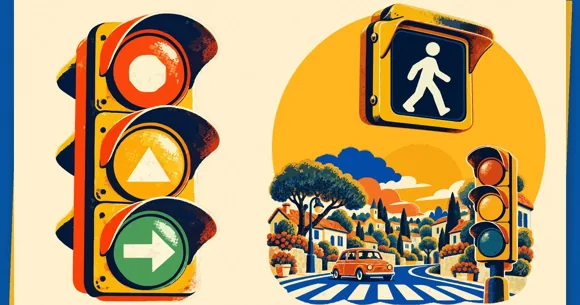
Transportation activities for preschool start with something most three- to five-year-olds already know well: the car seat, the school bus at the corner, the garbage truck on Tuesday morning. A transportation theme lets them count, trace letters, paint, run and pretend with vehicles they can already name. That’s a big head start. Most of the 16 ideas below don’t need more than toy cars from the bin, paper, tape and a few printed pictures.
Each activity lists the age range, how many children it suits, the time it takes, the supplies, how to run it, how to wrap it up and the one problem most likely to trip it up. Treat every minute count as a rough plan for three- to five-year-olds rather than a measured result; a sleepy Monday group may need half of it.
Pick a transportation activity by time and space
Start with how long you’ve got and how much room there is. “Prep” is what you’ll do before the children arrive.
| Activity | Kind | Group | Time | Prep | Mess |
|---|---|---|---|---|---|
| Parking lot number match | Math | 1–4 | 10–15 min | Draw a lot, label cars | Low |
| Number train | Math | 1–3 | 10 min | Cut 10 paper cars | Low |
| Smallest to biggest | Math | 1–6 | 5–10 min | Gather or print vehicles | Low |
| Name bus | Letters | Any | 15 min | Print one bus per child | Low |
| Letter roads | Letters | 1–4 | 10 min | Tape or draw big letters | Low |
| The Wheels on the Bus with props | Letters, music | Whole group | 5–10 min | Make verse cards | Low |
| Tire track painting | Art | 2–4 per table | 15–20 min | Paint, paper, smocks | High |
| Shape vehicle collage | Art | Up to 6 per adult | 15 min | Precut paper shapes | Medium |
| Color a vehicle | Art | Any | 10–15 min | Print line art | Low |
| Red light, green light | Movement | 4 to a class | 5–10 min | Print STOP, PAUSE, GO | Low |
| Tape road drive | Movement | 2–8 | 15 min | Tape a road loop | Low |
| Chair bus | Pretend play | 4–10 | 15–20 min | Line up chairs | Low |
| Fire station | Pretend play | 3–6 | 20 min | Print gear pictures | Low |
| Ramp race | Science | 2–4 | 15 min | Board and books | Low |
| Roll or slide? | Science | 1–6 | 10 min | Gather objects | Low |
| Foil boats | Science | 2–4 per tub | 20 min | Tub of water, foil | Wet |
A 30-minute transportation block works well as one table activity, one movement game and one short song. Tire track painting followed by red light, green light gives children a chance to sit, then run, then settle again.
If your class first needs to learn which vehicles go on land, on water and in the air, start with our types of transportation for kids guide. Its sorting and picture card games pair well with the activities here.
Transportation math activities: counting, numbers and size
These three use toy vehicles children already like to handle. Counting cars doesn’t feel like a lesson. It’s just play, so a reluctant counter will often keep going for a long time.
Parking lot number match
Ages 3–5 · 1–4 children · 10–15 minutes
Supplies: a sheet of poster board or the lid of a big box, a marker, 5 to 10 toy cars, masking tape or round dot stickers.
Draw a row of parking spaces and write a numeral in each, 1 to 5 for three-year-olds and up to 10 for older children. Put a matching numeral on a strip of tape on each car roof. For children still learning numerals, draw dots next to each number so they can count instead of reading. The child picks a car, says the number and drives it into its space.
To finish, call “closing time” and let the cars leave one by one while everyone counts down. Mix up the roof labels and play again with the same lot.
Watch for: small toy cars and loose wheels around younger siblings. The Consumer Product Safety Commission’s small-parts rule bans toys for children under 3 that have pieces small enough to fit entirely inside its test cylinder. If a baby or toddler shares the room, play at a table and count the cars back into the bin when you’re done. Don’t skip that count.
Number train
Ages 3–5 · 1–3 children · 10 minutes
Supplies: 10 paper rectangles for train cars, one paper engine, a marker, large pom-poms or cotton balls.
Write 1 to 10 on the cars and set the engine at the left end of the table. The child finds car 1 and parks it behind the engine, then car 2, and so on. Once the train is in order, the child loads each car with the matching number of pom-poms.
The train’s ready to leave the station when every car is loaded. Let the child push the whole line along the table while reading the numbers aloud.
Watch for: tiny pom-poms in the mouths of children who still test things that way. Use big cotton balls, or have them draw dots on each car with a crayon instead. Crayon dots can’t be swallowed.
Smallest to biggest
Ages 3–5 · 1–6 children · 5–10 minutes
Supplies: five vehicles of different sizes, either from the toy bin or the same vehicle picture printed at three or four widths.
Lay the vehicles in a jumble and have the child park them in a row, the tiniest first and the largest last. Use the words as they go: small, bigger, the biggest, the longest. For a quick check at the end, ask the child to close their eyes while you swap two vehicles, then let them fix the line.
Watch for: mixed signals about what “big” means. A toy bus that’s smaller than a toy truck is still a bigger vehicle in real life, and children argue both ways. Printing one picture at several widths removes that mix-up and makes the lesson only about size on the table.
Transportation literacy activities: names, letters and songs
Letters stick better when there’s a vehicle attached. All three of these work for children who can’t read yet.
Name bus
Ages 3–5 · any group size · 15 minutes
Supplies: one printed school bus with a blank window panel per child, crayons, a highlighter, letter stickers if you have them.
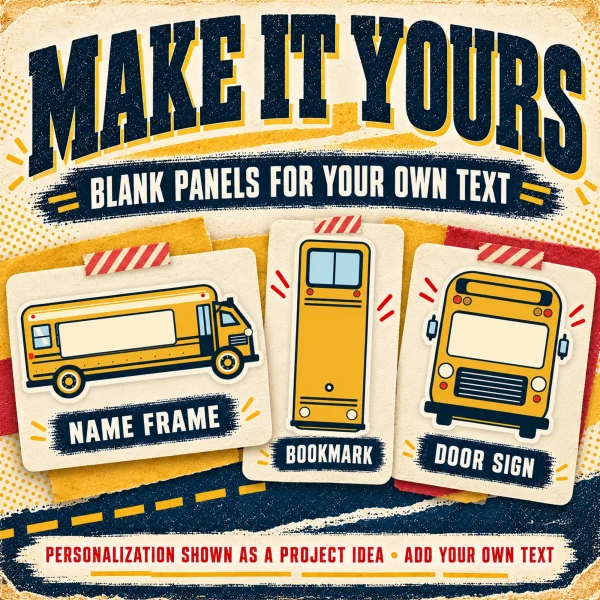
Our School Bus Clipart includes a blank name frame, design 07, which is a side-view bus with a long empty cream panel where the windows would be. The guide suggests printing the buses 7 to 10 inches wide, which leaves room for a name in big letters. Write each child’s name lightly in highlighter for tracing, or let older children copy it from a card or spell it with letter stickers. Then they color the bus.
Hang the finished buses above the cubbies or coat hooks, so each child can find their own bus by its name every morning.
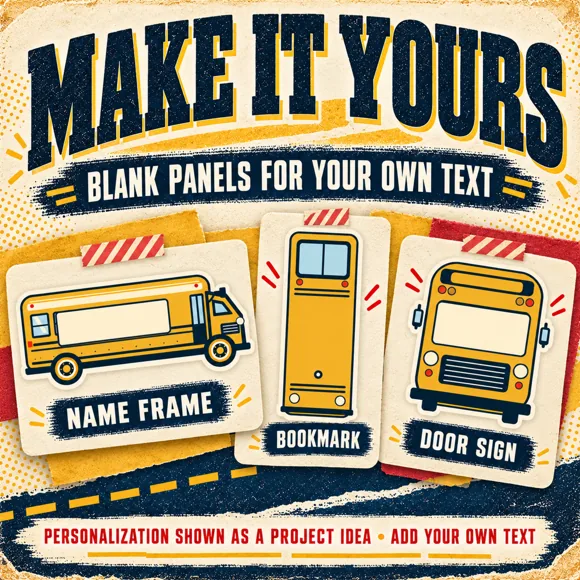
Watch for: the blank panel is part of the picture, not a box you can type into once it’s printed. Type the names in your design program before printing, or print the panel blank and write by hand. Long names like Alexandria get cramped, so print those buses wider or use a nickname the child already answers to.
Letter roads
Ages 4–5 · 1–4 children · 10 minutes
Supplies: painter’s tape or a large sheet of paper and a thick marker, small toy cars.
Make a few capital letters big enough to drive on, either with tape on the floor or in marker on paper. Show the starting point with a dot. The child drives a car along each stroke in the order you’d write it, saying the letter’s sound at the start. When a letter is done, the car parks on the dot of the next one.
Watch for: curves. Tape makes neat straight letters like E, H, L and T, but it won’t bend into a tidy curve. Use tape for the straight letters and paper for C, S and O.
The Wheels on the Bus with picture props
Ages 3–4 · whole group · 5–10 minutes
Supplies: a bus picture, one card per verse with a simple drawing (wheels, wipers, horn, doors, babies, parents), and enough cards for each child or pair.
Hand out the verse cards before you sing. When a child’s verse comes up, they stand and hold their card high while everyone does the motions. The open-door bus in the school bus clipart, design 06, makes a ready-made card for the doors verse. End with the babies’ verse sung slowly and quietly, which brings the volume down before the next activity.
Watch for: families sing different verses. There isn’t one right list. Decide on yours before handing out cards, and make only as many verse cards as you plan to sing so nobody waits through the whole song for a turn that never comes.
Transportation crafts for preschoolers
These three transportation crafts go from wet and messy to quiet and tidy. Keep cutting to child-safe scissors or let an adult do it, and use glue sticks or tape; craft knives and hot glue guns stay out of preschool crafts. Our crafts for preschoolers guide covers table setup and cleanup for any craft.
Tire track painting
Ages 3–5 · 2–4 children per table · 15–20 minutes, plus drying time
Supplies: washable tempera paint on paper plates, toy cars and trucks with different wheels, large paper, smocks, wipes, a dish tub of soapy water for the cars.
Tape the paper to the table so it doesn’t slide. Each child rolls a vehicle through a plate of paint, then drives it across the paper in loops, zigzags and straight lines. Put two kinds of vehicles side by side and ask which one left stripes and which left a plain line.
When the paper is full, the vehicles drive straight into the tub of soapy water. An adult scrubs the wheels before the paint dries in the axles.
Watch for: smooth plastic wheels leave a flat smear, not a track. They’re disappointing. Test each vehicle on scrap paper before the children start, and keep only the ones with chunky treads.
Shape vehicle collage
Ages 3–5 · up to 6 children per adult · 15 minutes
Supplies: paper rectangles, squares, triangles and circles in several sizes, glue sticks, a sheet of paper per child, crayons.
Precut the shapes, or let four- and five-year-olds cut straight strips with child-safe scissors while you cut the circles. Show how two rectangles make a bus or a truck, circles become wheels and a triangle turns into a sail. The children build their own vehicle, glue it down and draw the windows and a driver.
Finish by asking each child to name the shapes they used. That quick shape review also gives you a caption to write under each picture.
Watch for: wheels glued in midair. It’s a common sight. Draw a road line across the bottom of each sheet before you hand it out, so the vehicles have something to sit on.
Color a vehicle
Ages 3–5 · any group size · 10–15 minutes
Supplies: printed line art pages, crayons or washable markers.
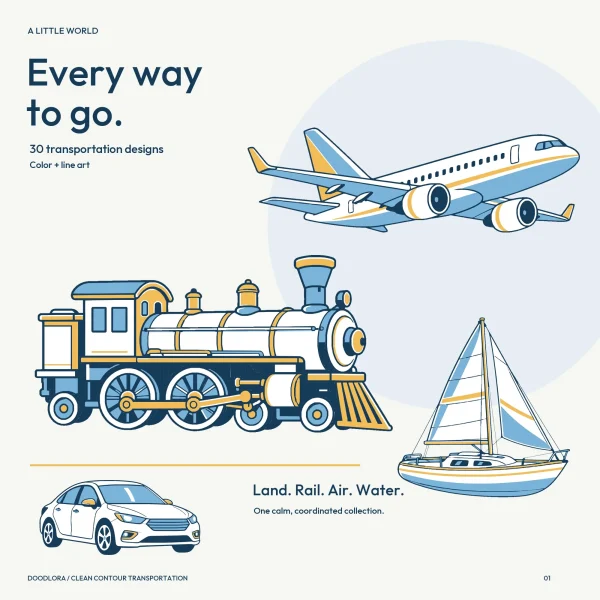
Our Transportation Clipart comes in color and as navy line art with open interiors, the same 30 designs twice. Print one line art vehicle per page, large and in landscape, and let the child color it. While they work, ask where the vehicle is going and write their answer under the picture. Short dictated sentences give children an early link between talking and print.
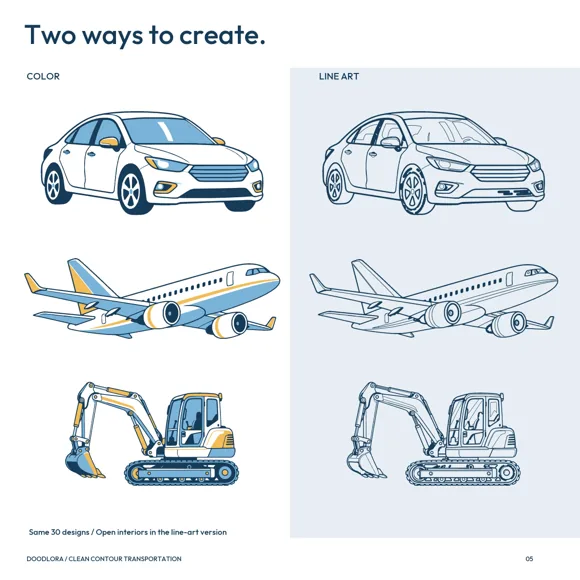
Watch for: detail too small for a crayon. The line art keeps seats, wheel spokes and cab windows, and the guide in the download notes that detailed line work may need enlarging. For three-year-olds, choose designs with big open areas and fill the whole page. Children who want to draw instead can follow our steps for how to draw a fire truck.
Gross motor transportation games
Both of these need a cleared floor, a hall or a playground. They’re the ones to reach for when the room’s getting restless. Wiggles happen.
Red light, green light with STOP, PAUSE and GO cards
Ages 3–5 · 4 children to a whole class · 5–10 minutes
Supplies: a STOP card, a PAUSE card and a GO card, an open space with a start line.
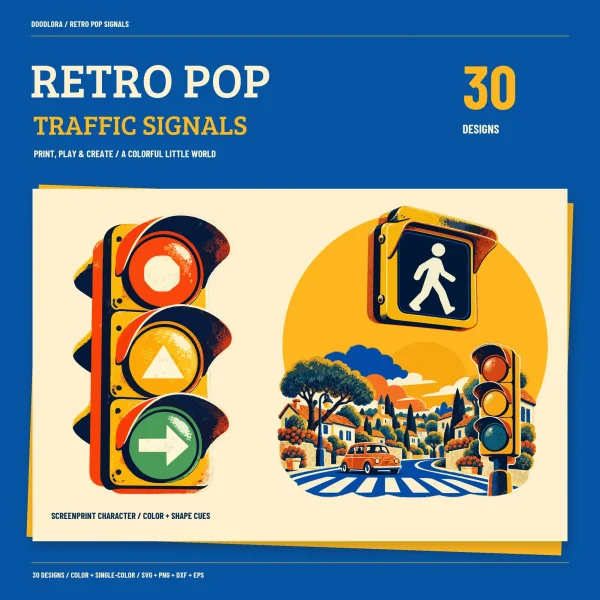
Our Traffic Light Clipart includes three blank rule cards headed STOP, PAUSE and GO in red, yellow and green. The guide suggests printing the rule cards 3 to 4 inches wide, which is far too small to see across a gym, so print each card the full width of a page for this game. Stand at the far end and hold up one card at a time. GO means walk or run toward you, PAUSE means tiptoe in slow motion, and STOP means freeze.
A child who moves on STOP takes one giant step back rather than sitting out. Preschoolers stay in the game that way, and nobody’s stuck on the bench for ten minutes. The first child to reach you becomes the next card holder.
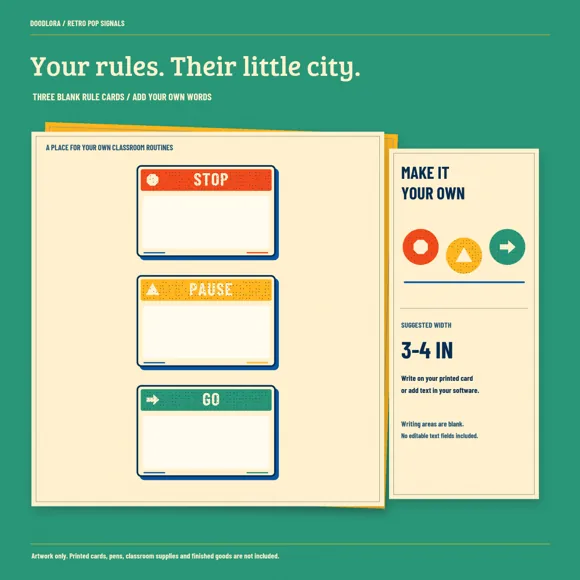
Watch for: two points from the guide in the download. Print the color version, since the single-color designs don’t show which light is lit. Each heading also carries a shape, an octagon on STOP, a triangle on PAUSE and an arrow on GO, so a child who mixes up red and green can go by the shape. The all-lit and smiling stoplights in the same set are decorative and don’t show a real signal, so leave them out of this game.
Tape road drive
Ages 3–5 · 2–8 children · 15 minutes
Supplies: painter’s tape, white paper strips for a crosswalk, paper plates as steering wheels, a STOP card from the game above.
Tape a big road loop on the floor with a crosswalk at one side and a few parking spaces at the end. Each child holds a paper plate steering wheel and walks the road as a car. Put the STOP card at the crosswalk so drivers stop, count to three and go on. When it’s time to finish, everyone parks in a space and turns off the engine with a loud click.
Watch for: head-on crashes. Make the road one-way and tape an arrow at the start; the dashed route arrow in the school bus clipart, design 16, prints nicely for this. This is pretend driving, not a lesson on crossing real streets. The traffic light guide itself notes that its signals are for decoration and teaching and don’t replace local road rules.
Transportation dramatic play
Pretend play lets children use the words from every other activity: ticket, driver, stop, siren, hose. Set it up once and let it run in a corner for several days.
Chair bus
Ages 3–5 · 4–10 children · 15–20 minutes
Supplies: chairs in rows of two with an aisle, one chair at the front for the driver, a paper plate steering wheel, paper tickets, a printed bus sign for the front.
The front-view bus door sign in the school bus clipart, design 09, makes a sign for the front of the chair bus, with the blank windshield panel left for the route name. The driver calls out each stop: the library, the park, grandma’s house. Passengers hand over tickets, ride, and get off at the stop they choose.
The last stop is the bus depot, where everyone helps carry the chairs back to the tables. Don’t let the driver skip that part.
Watch for: everybody wants to drive. Change drivers at every stop, and have the new driver come from the back row so the turns rotate without a fight.
Fire station pretend play
Ages 3–5 · 3–6 children · 20 minutes
Supplies: printed pictures of a fire hydrant, a helmet and boots, a jump rope or pool noodle for a hose, a big box or a row of chairs for the truck.
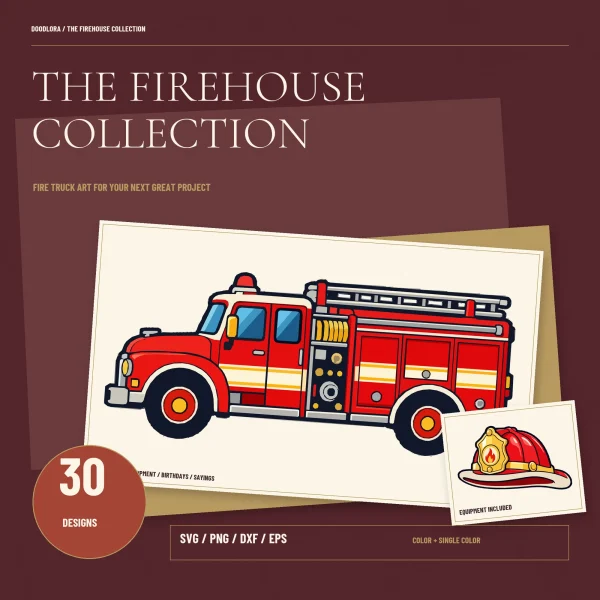
The Fire Truck Clipart has six smiling cartoon fire trucks plus station gear, including a helmet, hose, hydrant and boots. Tape the hydrant picture low on a wall, tape a smiling truck to the front of the box or chairs and pin up the helmet as the station sign. Ring a bell for a call. The crew pulls on pretend boots, rides to the scene, hooks the hose to the hydrant and sprays.
Back at the station, the crew rolls up the hose and lies down on mats until the next bell. For hats to go with the game, our community helpers crafts include a paper plate firefighter hat and a cardboard box fire truck.
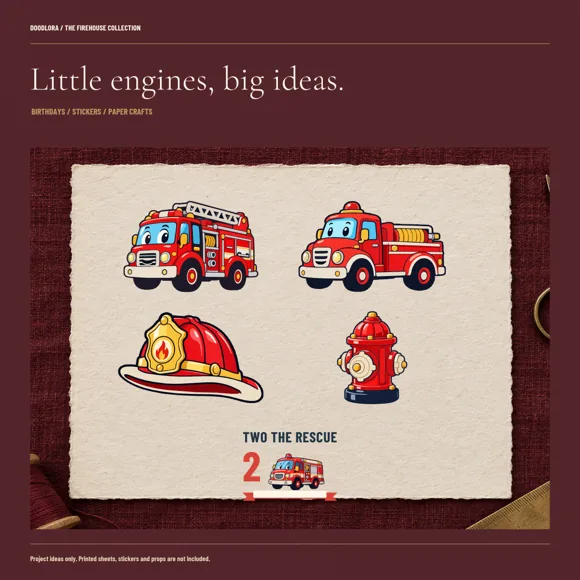
Watch for: the gear set also includes an axe and a fire extinguisher. Leave the axe picture out for this age. You won’t miss it. Print only the friendly pieces you actually need for the game.
Transportation science activities: ramps, wheels and boats
These three ask a simple question and let the children find the answer by testing. Ask them to guess before every try, since the guess is where the science happens.
Ramp race
Ages 3–5 · 2–4 children · 15 minutes
Supplies: a wide board or a piece of stiff cardboard, a stack of books, three or four toy cars, masking tape.
Rest one end of the ramp on a single book. Let a car roll down and mark where it stops with a piece of tape. Add a book and ask whether the car will go farther or stop sooner this time, then try it. After three or four heights, look at the row of tape marks together.
Watch for: carpet. Cars won’t roll far off a ramp onto a rug, and the race ends in a heap at the bottom. Run the ramp onto a hard floor, and use a wide board if two cars race side by side.
Roll or slide?
Ages 3–5 · 1–6 children · 10 minutes
Supplies: the ramp from the race, a toy car, a block, a ball, a spool, a crayon, a small book, two trays.
Hold each object at the top of the ramp and ask, “Will it roll or slide?” Let it go and put it in the roll tray or the slide tray. Finish by asking what all the rolling things have in common. Children usually spot that they’re round, which is the reason vehicles have wheels.
Watch for: the crayon breaks the rule. Lying sideways it rolls, and pointing downhill it slides. Let the children try both directions. That surprise is the best moment of the activity, so don’t explain it ahead of time.
Foil boats
Ages 4–5 · 2–4 children per tub · 20 minutes
Supplies: a dish tub of water on a towel, squares of aluminum foil about the size of a sheet of paper cut in half, plastic counting bears or large wooden blocks.
Show how to fold up the edges of a foil square to make a boat. The child floats it, then adds counting bears one at a time and counts until the boat sinks. Children can then rebuild their boat in a different shape and try to beat their own number.
Finish by lining up the boats and their bear counts on the towel. An adult stays at the tub the whole time and empties it as soon as the activity is over.
Watch for: tall, narrow boats tip over quickly. They’re top-heavy. Wide, flat boats with low sides hold far more bears, so show a wide one first if the first round ends in frustration.
Printing pictures for a transportation theme
Most of these activities run on toys and paper, and a few printed pictures make them easier: the STOP, PAUSE and GO cards, a name bus per child, line art to color and the fire station pieces. All four clipart sets come as PNG and SVG files, so you’ll print only the pieces you need at the size you want. Our guide to how to use clipart explains print sizes and file types.
Our Personal License lets you use them as a teacher with your own students, and the fire truck set also offers a Commercial License. The transportation set also has a one-page sheet of 30 small vocabulary cards, which the types of transportation guide uses for its sorting and memory games.
For more preschool themes built the same way, try our farm activities for preschool and weather activities for preschool.
Printables from this article
Related articles
Clipart & SVG Cut Files
How to Draw a Truck: Easy Pickup, Big Rig and Cartoon
Split a pickup into three parts before you draw a single wheel: a bed, a cab and a hood. Keep the roof about 2.2 wheels tall and the bed rail level with the hood, and the truck looks right even before the details go on.
Clipart & SVG Cut Files
How to Draw a Train: Steam Engine, Cars and Tracks
Split the page into a 10-square grid, lay a long boiler tube across the middle, set a box cab at the back and a tall stack at the front, hang two big driving wheels under the cab end, then couple cars behind and run the rails to a vanishing point.
Clipart & SVG Cut Files
Hawk vs Falcon: Wings, Size, Hunting Style and Eagles
A falcon has long, narrow wings that taper to sharp points and flies on steady, quick wingbeats; a hawk has broader wings with rounded tips and either soars in slow circles or flaps hard and glides. Falcons kill with a notched beak and hawks with their talons, and eagles are the largest, heaviest-billed members of the hawk family.