Hawk vs Falcon: Wings, Size, Hunting Style and Eagles
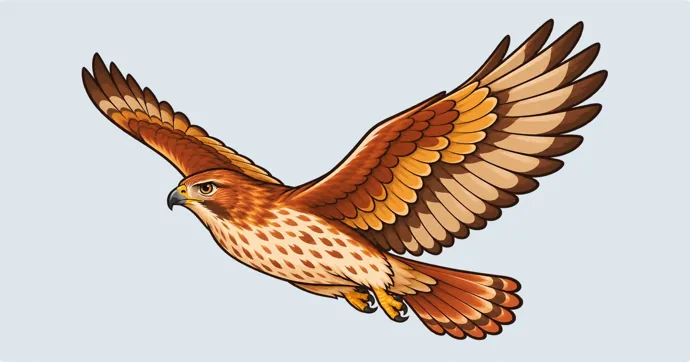
From the ground, the fastest way to tell a hawk from a falcon is the outline of the wings. A falcon’s wings are long and narrow and end in sharp points, and the bird beats them quickly and steadily. A hawk’s wings are broader with rounded tips, and the bird either rides the air in slow circles or flaps hard a few times and glides. Up close, the two kill differently: a falcon finishes prey with a notch in its beak, while a hawk uses the grip of its talons.
The two groups aren’t even close relatives. Falcons belong to their own family, and their nearest living relatives are parrots and songbirds. Eagles are a different question. An eagle is a hawk-family bird scaled up, with a heavier head, a bigger bill and longer, more evenly broad wings. The sections below cover the field marks, a chart, hunting styles, where you’re likely to see each bird in the U.S., and what to do if one is hurt.
Wings, wingbeats and tail: the sky test for hawks and falcons
Most raptor sightings are a shape against the sky, so the outline does most of the work. Audubon magazine’s guide to raptor ID sorts North American birds of prey into four working groups by size and shape before looking at any feather pattern. Two of those groups are hawks and one is falcons.
Falcon wings: long, slim and pointed
Wikipedia describes adult falcons’ wings as thin and tapered, built for high speed and fast changes of direction. Audubon calls falcons “slender- and pointy-winged speedsters with steadier wing flaps.” On a peregrine, the long outer flight feathers stretch the wing into a long, tapered shape, and Audubon describes its wingbeats as shallow and elastic, a ripple that runs down the wing.
Hawk wings: broad and rounded
North American hawks come in two builds. Buteos, such as the red-tailed hawk, have broad wings, a sturdy body and a short tail, and they spend long stretches soaring with few wingbeats. Audubon calls them “large, broad-winged, short-tailed” birds with “spare and labored wing beats.” Accipiters, such as the Cooper’s hawk and the sharp-shinned hawk, are woodland birds with short, rounded wings and a long tail. Their flight is a burst of quick flaps and then a glide.
The accipiter trap
An accipiter is the hawk most often mistaken for a falcon, because both are fast and both chase birds. Look at the wingtips and the tail together. A Cooper’s hawk has rounded wingtips and a long, rounded tail, with wings that look short for the body. A falcon’s wings look long for its body and come to clear points. If a raptor flies flap-flap-flap-glide through the trees of a park, it’s most likely an accipiter.
Hawk vs falcon vs eagle chart
Each column below is a group, not a single species, and the sizes come from one or two common North American examples per group. Read every cell as “usually,” and confirm with at least two rows before you name a bird.
| Hawks: buteos | Hawks: accipiters | Falcons | Eagles | |
|---|---|---|---|---|
| Family | Accipitridae | Accipitridae | Falconidae | Accipitridae |
| Wing shape | Broad, rounded | Short, rounded | Long, narrow, pointed | Long and evenly broad |
| Tail | Short | Long | Long and narrow on a peregrine | Moderately long, wedge-shaped on a bald eagle |
| Flight | Soars and circles, slow wingbeats | Quick flaps, then a glide | Fast, steady wingbeats; steep dives | Big, slow soaring with few wingbeats |
| How it kills | Talons | Talons | Bite with a notched beak | Talons |
| Typical prey | Rodents, rabbits, snakes | Songbirds, doves | Birds, insects, small rodents | Fish, mammals, birds, carrion |
| Nest | Builds its own nest | Builds its own nest | A scrape on a ledge, or a cavity | Builds a huge nest in a tall tree or on a cliff |
| U.S. example | Red-tailed hawk | Cooper’s hawk, sharp-shinned hawk | Peregrine falcon, American kestrel | Bald eagle, golden eagle |
| Example length | Red-tail: 18 to 26 in | Sharp-shinned: about 11 in | Peregrine: 14 to 19 in; kestrel: 9 to 12 in | Bald eagle: 28 to 40 in |
| Example wingspan | Red-tail: about 4 ft | Sharp-shinned: about 23 in | Peregrine: 39 to 43 in; kestrel: 20 to 24 in | Bald eagle: about 6 to 7.5 ft |
Red-tail, sharp-shinned and peregrine sizes are from Bryce Canyon National Park’s raptor page; kestrel and bald eagle sizes are from Wikipedia’s species pages, rounded to the inch. In all four groups the female is usually the bigger bird, so a pair perched together can look like two different species.
Why size alone can fool you
Size overlaps more than most people expect. A large female peregrine, at up to about 19 inches, is as long as a small red-tailed hawk. Wikipedia gives the female peregrine as up to 30% larger than the male, and a female red-tail as about 25% heavier than a male. Bryce Canyon’s page says a male sharp-shinned hawk is 57% smaller than a female. Use size only to break a tie after the wings and flight have narrowed things down.
For a family walk, three of the chart’s rows turn into easy “spot it” prompts on a nature scavenger hunt list: a bird on a tall perch, a bird hovering over grass, and a bird with pointed wings. Kids only look; nothing gets picked up.
How hawks and falcons hunt and kill
Hunting style is the second-best clue after shape, because it’s often what you actually see: a bird hanging over a field, a dive at a feeder, a blur over a city block.
Falcons: speed, dives and a notched beak
Falcons catch prey in the air or drop on it from above. The peregrine’s hunting dive is called a stoop. Bryce Canyon’s park page gives its cruising speed as 24 to 33 mph, about 67 mph when chasing prey, and a calculated 238 mph in a stoop with the wings closed. Wikipedia reports dives recorded at 200 mph and a fastest measured vertical speed of 240 mph.
The kill itself is the clearest anatomical difference between the two groups. Wikipedia explains that falcons kill with their beaks, using a tooth-like point on the side of the beak called a tomial tooth, whereas hawks and eagles kill with the talons on their feet. Falcons still grab prey with their feet; the finishing bite is what’s different.
Small falcons hunt more quietly. The American kestrel usually sits on a perch and scans the ground, and it sometimes hovers on rapid wingbeats over a field. Its diet runs to grasshoppers and other insects, plus mice, lizards and small birds. Before it strikes, Wikipedia notes, a kestrel typically bobs its head and tail.
Hawks: perch-and-pounce and the surprise attack
A red-tailed hawk mostly waits on a high perch or soars, then drops onto prey on the ground. Rodents make up as much as 85% of its diet, according to Wikipedia, with rabbits, birds and snakes taken when they’re available. In a strong wind a red-tail can hang almost still on beating wings, which is the one time it briefly looks like a hovering kestrel; the broad, rounded wings still give it away.
Accipiters hunt by ambush. Wikipedia describes them dashing suddenly from a hidden perch, and the Cooper’s hawk in towns and suburbs takes a lot of doves, especially the mourning dove. A sudden burst of birds away from a feeder, with a long-tailed hawk chasing through the branches, is the classic accipiter scene.
Two separate families, not two sizes of one bird
Hawks and falcons look alike because they do similar jobs, not because they’re related. Hawks, eagles, kites and harriers all belong to the family Accipitridae. Falcons, kestrels and caracaras make up a separate family, Falconidae, and Wikipedia’s falcon article places them nearest to parrots and songbirds rather than to the hawks. The falcon genus, Falco, has about 40 species, found on every continent except Antarctica.
The common names muddy this. The American kestrel was officially called the sparrow hawk until the American Ornithologists’ Union renamed it in 1983, and the peregrine was long known as the “duck hawk,” even though both are falcons. In the U.S., buteos are called hawks, but in Europe and other parts of the world the same group goes by “buzzards.” So a European bird book can use names that seem to contradict a U.S. field guide.
Nesting is a quieter difference. Hawks and eagles build their own nests, and Wikipedia says the bald eagle builds the largest nest of any North American bird, up to 13 feet deep. A peregrine lays its eggs in a scrape, a shallow hollow on a cliff edge or, in cities, on a tall building, and a kestrel uses a cavity in a tree, a cliff or a building.
Where you’ll see hawks and falcons in the U.S.
Context narrows the choice faster than any feather. These four everyday situations cover most of the hawk-or-falcon questions people ask.
A big bird on a highway light pole or a lone tree by a field. This is usually a red-tailed hawk, which Wikipedia calls probably the most common hawk in North America. It breeds from Alaska and northern Canada to Panama and uses deserts, grassland, farm fields, woodland and cities. A perched adult is whitish underneath with a dark band of streaks across the belly. The tail is brick-red on top and light buff-orange below.
A small bird on a wire or a fence post that bobs its tail. That’s likely an American kestrel, a falcon about 9 to 12 inches long and the smallest and most common falcon in the Americas. It needs open ground to hunt over, perches to watch from and a cavity to nest in, so it turns up in grassland, farm country, deserts and suburbs. Audubon notes that the kestrel’s double “mustache” of dark face stripes isn’t always easy to see, and that its overall pale look helps separate it from the slightly larger, darker merlin.
A hawk crashing into the bushes after birds at a feeder. Think accipiter, most often a Cooper’s hawk. Its short, rounded wings and long tail suit a bird that hunts by dashing through trees. The smaller sharp-shinned hawk looks very similar; Bryce Canyon’s page compares a “sharpie” to a blue jay in size.
A fast bird around skyscrapers or other tall buildings. Peregrine falcons nest in many cities, using tall buildings as nest sites and hunting pigeons and ducks. An adult peregrine is blue-gray above with fine bars underneath and a dark head with a thick black “sideburn” below each eye. Wikipedia’s peregrine page calls that patch the malar stripe and cites a 2021 study suggesting it cuts glare, since the stripe is larger where sunlight is stronger.
Peregrines became endangered in many areas because of pesticides, especially DDT, and their numbers recovered after DDT was banned in the early 1970s, according to Wikipedia. A city pair on a building ledge is part of that comeback.
Hawk vs eagle: size, head and how the wings are held
The hawk vs eagle question is one of scale and build rather than family. Eagles are in the same family as hawks, and Wikipedia notes that the word “eagle” carries no real taxonomic weight. In practice an eagle is a large, powerfully built hawk-family bird with a heavy head and beak.
The numbers make the gap obvious. A bald eagle is 28 to 40 inches long with a wingspan of about 6 to 7.5 feet and weighs roughly 6.6 to 13.9 pounds, per Wikipedia. A red-tailed hawk is 18 to 26 inches with a wingspan of about 4 feet and weighs around 1.5 to 3.5 pounds. Bryce Canyon’s page puts the golden eagle at 30 to 40 inches with an 80- to 88-inch wingspan. Seen together, a red-tail looks like a small bird beside either eagle.
Shape helps when nothing nearby gives you scale. Audubon groups eagles with vultures as the “super-size, darker-plumed titans that make spare use of their wings,” so a huge, dark bird that barely flaps belongs in that group. Even the smallest eagles in the world have relatively longer, more evenly broad wings than a red-tailed hawk of the same size, according to Wikipedia. An adult bald eagle is easy, with its white head and tail. A young bald eagle stays dark brown with messy white streaks until about its fifth year, and Wikipedia separates it from a golden eagle by its bigger, more protruding head and beak and wings held flat rather than slightly raised.
If you find a hurt hawk, falcon or eagle
A hawk on the ground isn’t always injured. Washington State University’s College of Veterinary Medicine points out that young raptors leaving the nest are often found on the ground while they learn to fly, and the parents usually keep caring for them there. Watch from a distance first, and keep children and dogs back, since a frightened raptor defends itself with its talons.
If something is clearly wrong, such as a bird that can’t stand or can’t fly, call a licensed wildlife rehabilitator and follow their instructions. If you can’t find one, WSU says to contact your local fish and wildlife department. Virginia’s Department of Wildlife Resources gives the same order of steps and adds two plain rules: handle an injured animal as little as possible, and do not feed it. WSU warns that trying to feed a dehydrated bird may kill it.
Hawks, falcons and eagles are protected under federal law. WSU’s page states that it is illegal for private individuals to rehabilitate wild animals without a license, and that harassing, catching or keeping a raptor without special permits is illegal too. The same law reaches feathers, so a hawk feather found on a walk should stay where it is. Take a photo of it for a nature journal instead.
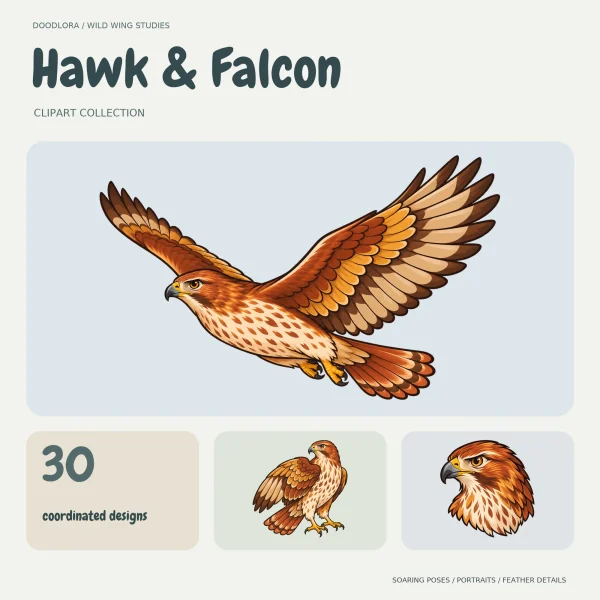
A raptor poster or report: which of our 30 bird drawings fit
A school report or a “hawk vs falcon” poster needs real photographs for the identification part, because only a photo shows true wing shape and markings. Our hawk clipart set is for everything around that: the title, section headers, borders and a cover. Its own guide says the birds are decorative cartoons, not a scientific identification chart, and that’s how to use them.
Most of the 30 designs share one look: a rust back, a cream breast with teardrop spots, yellow feet and a banded tail. None of them is drawn to match a real species, which is why none belongs in your “how to tell” panel.
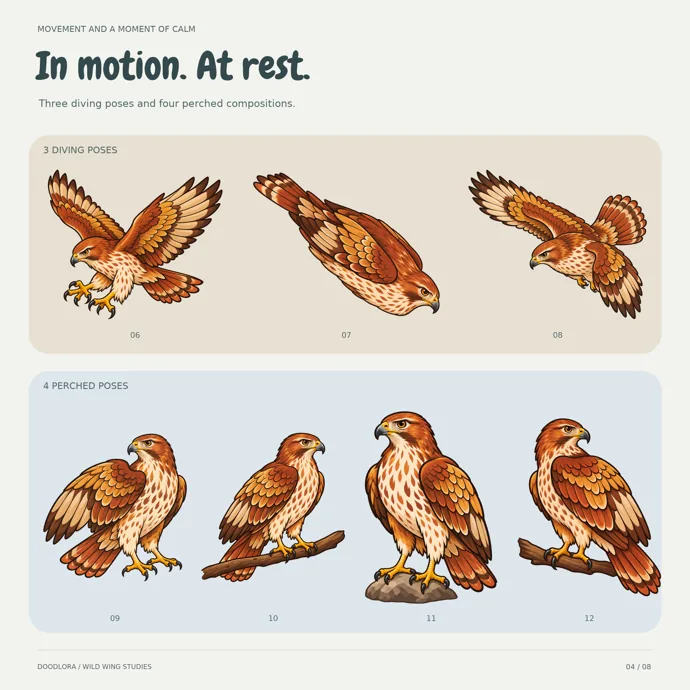
The design index names three of the 30 as falcons: 16, a rust falcon portrait; 19, a diving falcon silhouette; and 24, a perched falcon in line art. Design 16 is drawn with a darker cap and a dark patch below the eye, the nearest thing in the set to a falcon’s face. It’s still colored rust and cream, not a peregrine’s blue-gray, so caption it as an illustration.
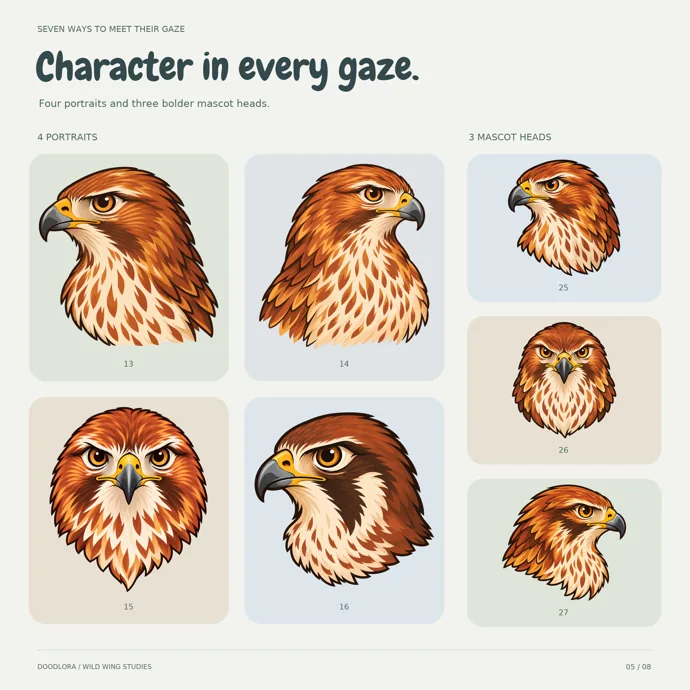
Design 24 has the same broad-winged build as the hawk drawing in 22, so don’t set the two side by side as a hawk-and-falcon pair; a student would learn the wrong outline. For the identification panel itself, pair a red-tail photo with a peregrine or kestrel photo and label the wings.
For a hawk vs falcon board on a classroom wall or at a science fair, build it from the center out:
- Start with the comparison chart as the centerpiece. Print “Wing shape,” “Flight” and “How it kills” larger than every other row label, since those three settle most sightings.
- Above the chart, mount the two photos side by side, hawk on the left and falcon on the right. Arrows from the labels should land on each bird’s wingtips and beak.
- Use one of the soaring hawks as the title art across the top, and an eagle photo in a smaller box for the hawk vs eagle comparison.
- Add a strip along the bottom with one line per bird: “light pole by the highway,” “wire, bobbing tail,” “feeder ambush” and “city tower.”
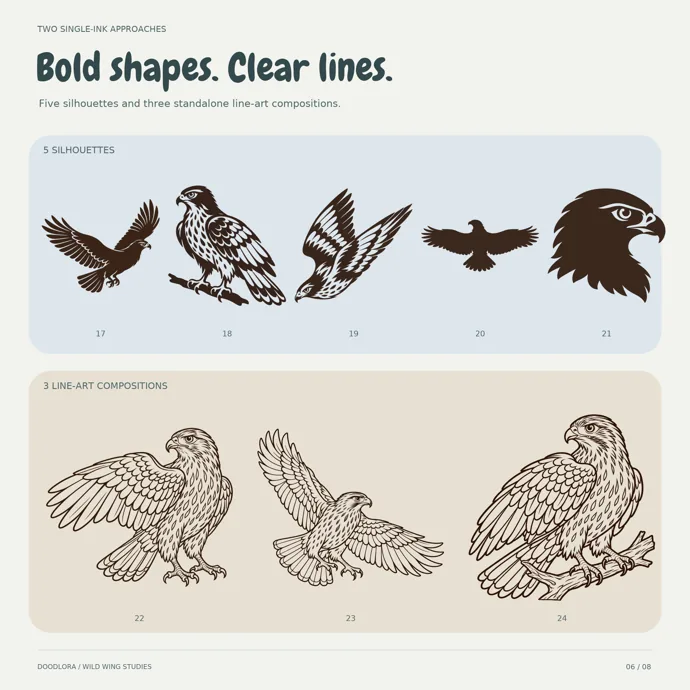
Every design comes in a color version and a single-ink mono version, as SVG, transparent PNG and DXF files. The PNGs are 3,600 pixels square, so a bird drops onto a colored poster board or a slide with no white box around it. The guide suggests starting detailed birds, portraits and talons at 6 inches wide or more. Our guide to clipart file types explains which format suits printing and which suits cutting, and how to use clipart covers resizing a PNG without blurring it.
For a cutting machine, start with the silhouettes, since feather tips, toe gaps and thin outlines on the detailed birds need a test cut on scrap at the final size. The files haven’t been tested on any particular machine or material. Besides the personal license, the hawk set has a commercial license, with the terms on its product page. Kids who’d rather make a bird than label one can pick a project from our bird crafts for kids and adults.
Still unsure? Five common hawk and falcon mix-ups
Is a kestrel a hawk or a falcon?
A falcon. The American kestrel is the smallest and most common falcon in the Americas, according to Wikipedia. It was called the sparrow hawk until 1983, and older field guides and some local names still use that label.
Is a falcon faster than a hawk?
In a dive, yes. A stooping peregrine is often called the fastest animal on Earth. A red-tailed hawk usually travels at 20 to 40 mph when soaring or flapping and can pass 120 mph in a dive, Wikipedia says, which is still roughly half a peregrine’s stoop.
Which is bigger, a hawk or a falcon?
It depends on the species. A red-tailed hawk is bigger and much heavier than an American kestrel, but a female peregrine can match a small red-tail in length. Hawks are generally stockier for their size, while falcons look longer-winged and slimmer.
Is an eagle a hawk?
Eagles and hawks share one family, Accipitridae, but “eagle” is kept for the big ones. Wikipedia’s eagle article says most eagles are larger than any other raptors apart from some vultures, and only two eagle species live in North America: the bald eagle and the golden eagle.
How do their calls sound?
A red-tailed hawk gives a hoarse, two- to three-second scream that Wikipedia writes as kree-eee-ar, starting high and sliding down, often compared to a steam whistle. An American kestrel calls in a rapid klee, klee, klee when it’s excited or upset. If you hear a raspy, falling scream above a field, look for a broad-winged bird circling high up.
Printables from this article
Related articles
Clipart & SVG Cut Files
How to Draw a Truck: Easy Pickup, Big Rig and Cartoon
Split a pickup into three parts before you draw a single wheel: a bed, a cab and a hood. Keep the roof about 2.2 wheels tall and the bed rail level with the hood, and the truck looks right even before the details go on.
Clipart & SVG Cut Files
How to Draw a Train: Steam Engine, Cars and Tracks
Split the page into a 10-square grid, lay a long boiler tube across the middle, set a box cab at the back and a tall stack at the front, hang two big driving wheels under the cab end, then couple cars behind and run the rails to a vanishing point.
Clipart & SVG Cut Files
Monarch Butterfly Migration: Routes, Life Cycle and Facts
Monarchs from east of the Rockies winter in about a dozen mountain areas in central Mexico, and monarchs from the West winter along the California coast. A long-lived fall generation flies south, and several shorter-lived generations carry the species back north.