Farm Activities for Preschool: Games, Songs, Crafts, Trips
Farm activities for preschool work best when one set of farm pictures does several jobs. A deck of animal cards can call a bingo game, sort into piles, pick the next verse of Old MacDonald and go along on a trip to a pumpkin patch. Pick by setting first: a whole class at circle time needs a different game from one child at the kitchen table.
Below are 13 activities in four groups, each with the group size, prep, how to start and how to finish. The times are our planning estimates for three- to five-year-olds, so stretch or cut them to fit your group. Each one also names the snag most likely to stall it.
Farm activities for kids at home or in class: pick by setting
Use this table to choose before you print anything. “Noise” is a rough guide to how much the activity stirs up a room.
| Activity | Best for | Group | Prep | Time | Noise |
|---|---|---|---|---|---|
| Farm animal bingo | Class or family | 2 to a whole class | Print cards, cut calling cards | 10–15 min | Medium |
| Memory match | Home or a center | 2–4 | Print on cardstock, cut 24 cards | 10 min | Quiet |
| Sort the farm | Small group | 1–6 | Calling cards from bingo | 5–10 min | Quiet |
| Pig shadow match | Home or a center | 1–2 | Print two pages, cut 8 cards | 5–10 min | Quiet |
| Trace a pig | Table time | 1 per page | Print 1–4 pages | 10–15 min | Quiet |
| Farm helper chart | Home | 1 child | Print 1–2 pages | A week | Quiet |
| Old MacDonald draw | Circle time | Any | Calling cards, a bag | 5–10 min | Loud |
| Who’s in the barn? | Circle time | 3 or more | Calling cards | 5–10 min | Medium |
| Farm animal moves | Open floor | Any | Calling cards, clear space | 5 min | Loud |
| Read-aloud card hunt | Circle time | Up to a class | A farm picture book, cards | 15 min | Medium |
| Farm scavenger hunt | Farm visit | 2–6 per adult | Print checklists, clipboards | The visit | Outdoors |
| Orchard bonus hunt | Orchard or patch | 2–6 per adult | Print the bonus page | 20 min | Outdoors |
| After-trip count-up | Back in class | Any | Used checklists | 10 min | Medium |
For a short block, take one quiet game and one loud one. Bingo plus animal moves fills about 20 minutes and gives the room a break between sitting and moving.
Farm games and matching for circle time or a table
These four use pictures kids can name without reading. Everything except the shadow match runs off the same set of farm animal pictures, so one print job covers several days.
Farm animal bingo with picture cards
Bingo is the easiest way to get a whole class saying farm words out loud. Plan on 2 players up to a full class, about 10 to 15 minutes a round, and one adult calling.
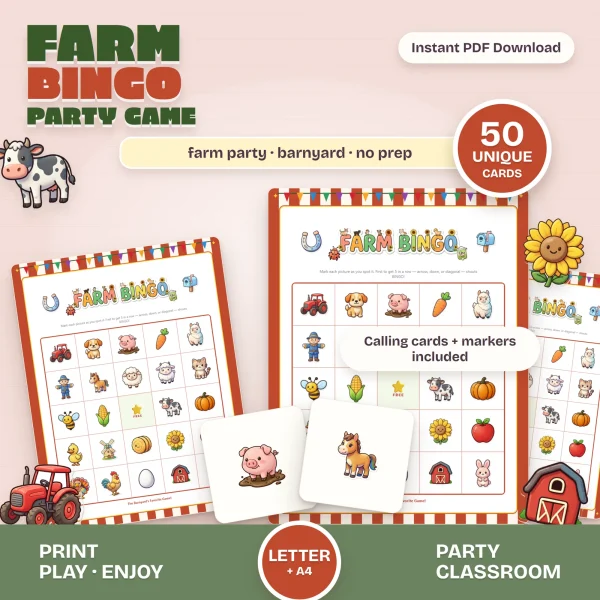
Our Farm Animal Bingo has 25 pictures: 13 animals, a bee, five farm sights such as a barn and a tractor, and six things that grow or get gathered, such as an apple, a pumpkin and an egg. The calling cards print six to a page, five pages in all, with a page of round markers after them. Choose the picture-only cards for children who can’t read yet. The labeled cards print the name under each picture.
To play, give each child a card and markers, put the cut calling cards in a bag, and draw one at a time. Hold the card up as you say the name, so pre-readers can match by sight. Finish when someone covers a line, or keep going to a full card.
The snag: every card shows 24 of the 25 pictures, so nearly every call covers a square on every card. Several children can reach a line on the same call. Decide before you start that everyone who gets a line on that call wins, so you don’t end with tears over a tie. A shared win heads off frustration before it starts.
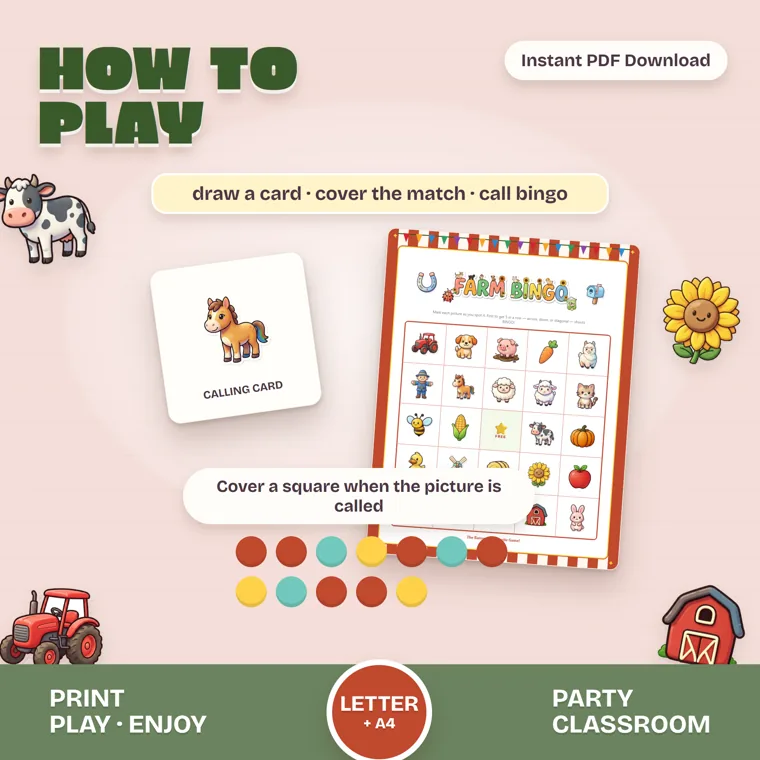
For callers who want more on patterns and checking a win, our printable bingo rules cover both.
Farm memory match with 12 pairs
Memory is the quiet partner game for a center or a rainy afternoon at home. It suits 2 to 4 players and takes about 10 minutes. It asks for real concentration, and turn-taking practice comes along with it.
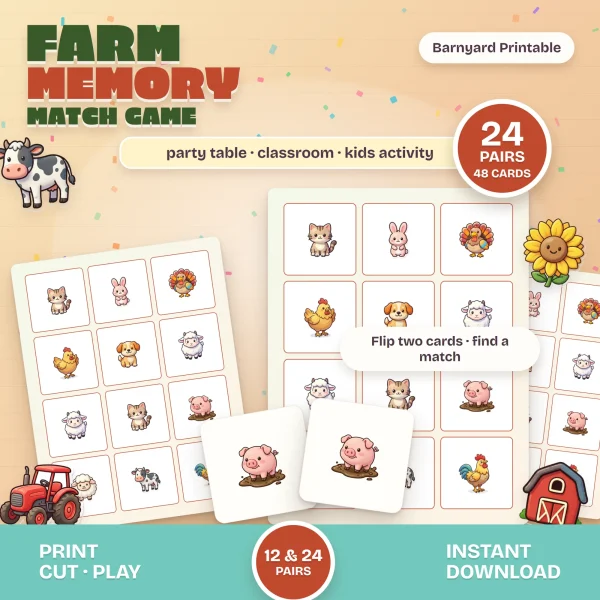
The Farm Memory Match comes in a 12-pair set and a 24-pair set. For preschool, use the 12-pair set: two pages of 12 animal cards, 24 cards in total, with no buildings or crops. Print on cardstock so the pictures don’t show through when the cards are face down.
Shuffle and lay the cards face down in rows. On a turn, a child flips two cards; a pair is kept, and two different pictures go back face down. The game ends when the last pair is picked up, and the child holding the most pairs wins. For a three-year-old, start with six pairs and add more once they’re finding them easily.
The snag: two pairs look almost alike. The hen and the rooster are separate pairs, and the goat is drawn as a fluffy white animal that differs from the sheep only by two small horns. Show those four cards side by side before the first game, so nobody claims a hen and a rooster as a match.
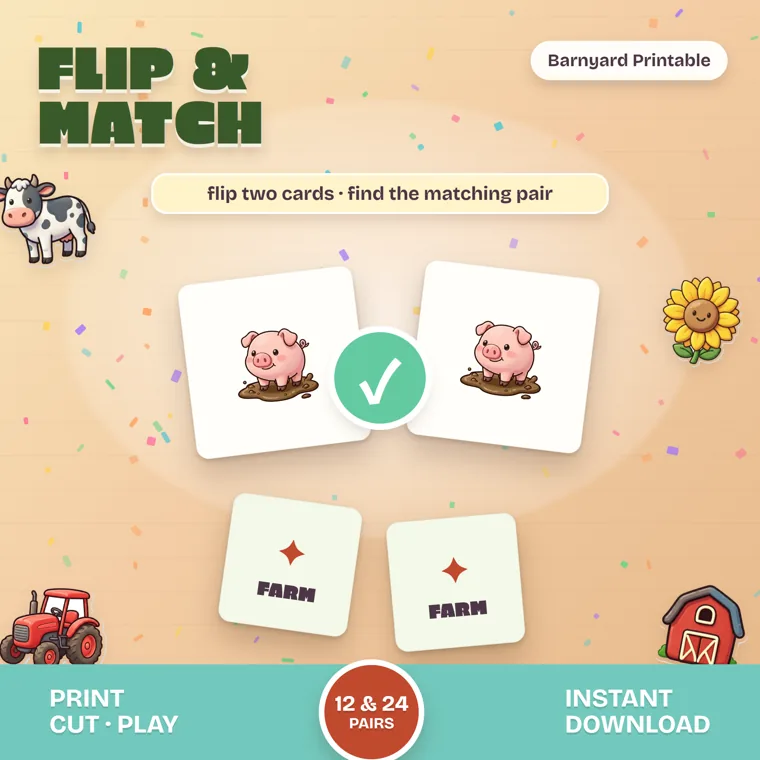
Our memory game rules go through scoring, teams and what to do with the last two cards.
Sort the farm into piles
Sorting needs no new printing if you already cut the bingo calling cards. One child can sort alone, or up to six can take turns placing cards. Allow 5 to 10 minutes.
Lay out three paper plates: animals, things that grow, and buildings and machines. Hand a child a card, ask what it is, and let them place it. When the plates are full, count each pile together, and that’s the finish.
The snag: the egg and the bee start arguments. An egg isn’t an animal yet and doesn’t grow in a garden, and plenty of children won’t count a bee as a farm animal. Add a fourth plate for “not sure,” or decide together where they go before you start. That conversation is half the point. It’s vocabulary practice too.
Pig shadow match
A shadow match asks a child to find a solid black shape that fits a drawing. It’s a quiet one-child or two-child game for about 5 to 10 minutes.
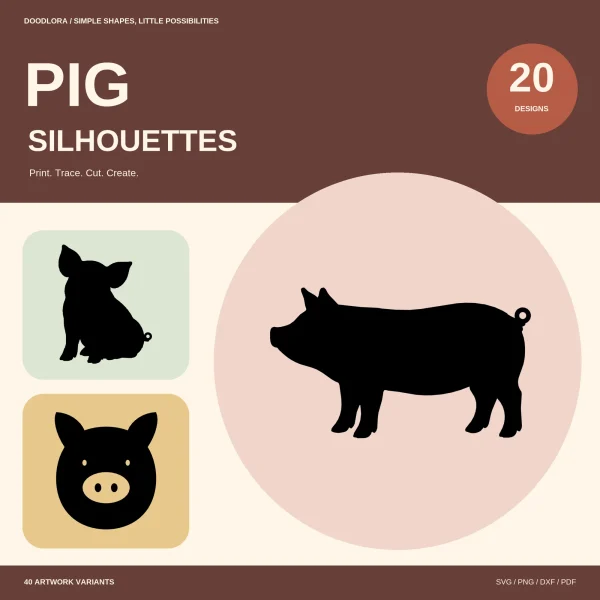
Our Pig Outlines PDF holds the same 20 pigs twice, once as line drawings with faces and once as solid black silhouettes. Print page 21, four line drawings, and page 50, the same four as silhouettes: a standing pig, a sitting piglet, a trotting pig and a pig face. Cut them apart into eight cards, mix them, and ask the child to pair each drawing with its shadow. The game is done when all four pairs are matched. Pairing a drawing with its shadow takes careful observation, since the child has to compare outlines rather than faces.
The snag: some pages aren’t for preschool. Page 25 includes a pork cuts diagram, a butcher’s chart that most parents won’t want in a preschool game. Its silhouette twin is on page 54. Print by page number rather than sending the whole file.
Hands-on farm crafts and fine-motor practice
These two keep hands busy at a table. Tracing works in a single session, while the helper chart runs for a whole week at home.
Trace a pig
Tracing builds pencil control without asking a child to draw from nothing. It’s quiet coordination work. One child per page, about 10 to 15 minutes, with crayons or a thick pencil.
The last four pages of the Pig Outlines PDF, pages 59 to 62, are full-page tracing templates. Three are line templates, a standing pig, a sitting piglet and a running pig. The fourth is a sleeping pig drawn in dots. Start younger children on the dotted page, since following dots is easier than staying on a line. Children who manage the dots can trace over the line pigs, then color them in.
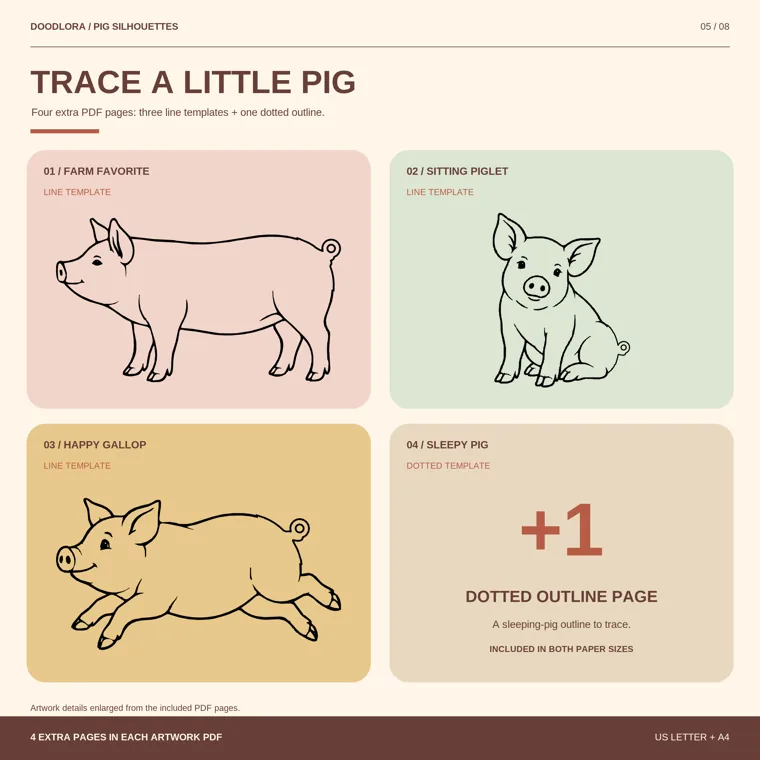
The snag: the PDF runs to 62 pages, and most of them are cutting templates for adults. Type 59-62 into the page range on your print screen, or you’ll empty the paper tray.
A farm helper chart for one week
On a farm, animals get fed and plants get watered every day. A helper chart turns that idea into a job your child does at home. This one is for one child over a week, and each day takes only a couple of minutes. A job that belongs to them every day builds independence.
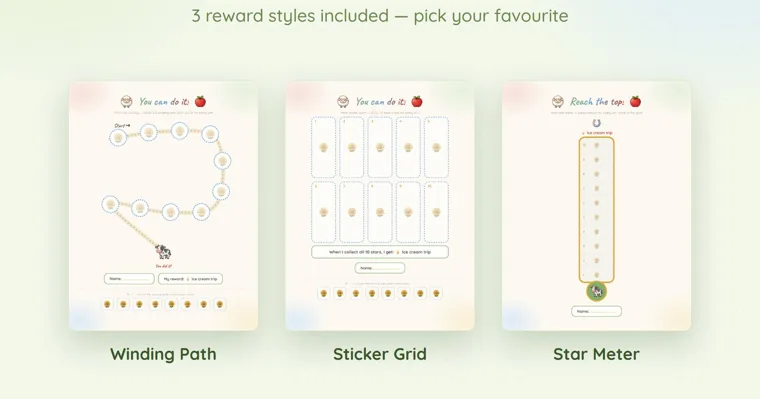
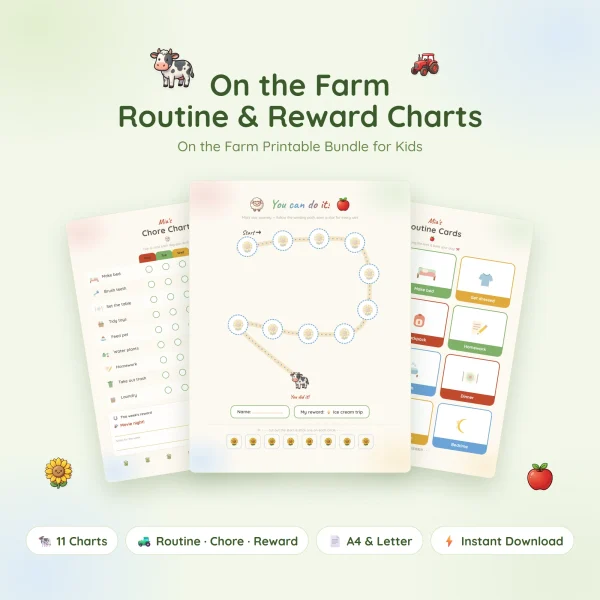
The Farm Reward Chart has a weekly chore chart and a star path. The star path winds through 10 circles to a cow at the finish, with a strip of sunflowers to cut out and stick on as each job gets done. Pick two jobs a preschooler can do with help, such as feeding a pet or watering plants. Add a sticker each time and let the child stick it on. The week ends when the path reaches the cow and the child gets the reward you wrote on the line.
The snag: the printed chore list also includes homework, laundry and taking out the trash. Cross out the jobs that don’t fit a four-year-old before the chart goes on the fridge. The cut-out strip under the path also has only eight sunflowers for the 10 circles, so print that page twice or keep two stickers of your own ready. Our guide on how to use a behavior chart covers picking goals and rewards.
Farm songs, stories and movement
These four are for circle time, and the loud ones are meant to be loud. Most of them use the same calling cards from the bingo game.
Old MacDonald, drawn from a bag
Old MacDonald turns a stack of picture cards into a song with no fixed end. Any number of children can join, and 5 to 10 minutes is plenty. Everybody knows the tune.
Put the animal calling cards in a bag. A child draws one, shows it, and the group sings the verse for that animal and its sound. Pass the bag on and keep singing until the bag is empty or you see wiggles start.
The snag: a tractor or a barn card has no sound to sing. Take those cards out first, or let children make one up. A tractor going “putt-putt” usually gets a laugh.
Who’s in the barn?
This guessing game works with three or more children and about 5 to 10 minutes. You need only the animal calling cards.
Hold one card behind your back and make that animal’s sound. The first child to name it takes the card and gives the next sound. That’s the whole game. Finish when every card has had a turn.
The snag: some animals don’t have a sound children know. Rabbits, llamas and goats can stall a round. Act those out instead, with hopping ears for a rabbit, or pull them before you begin.
Farm animal moves
Moving like animals burns off energy between two sitting activities. Any group size works, and five minutes is enough.
Draw a calling card and call the move. Waddle like a duck, hop like a rabbit, gallop like a horse, or roll in the mud like a pig. Say “freeze” between cards so children stop and listen for the next one. End with a slow one, a sleeping cat curled on the floor, to settle the room. A child who feels uncomfortable performing can copy a friend.
The snag: galloping in a crowded room ends in bumps. Clear a space and set a boundary, such as staying on the rug, before the first card.
Read-aloud card hunt
Any farm picture book from your shelf or the library works for this. Plan about 15 minutes for up to a whole class.
Hand each child one calling card before you start. Read the book, and whenever an animal on the page matches a child’s card, that child holds it up. After the last page, ask each child to say one thing their animal did in the story.
The snag: the book may skip animals on the cards, so a child can sit through the whole story with nothing to hold up. Flip through the book first and hand out only the animals in it.
Going to a farm, pumpkin patch or apple orchard
Fall is the season for farm trips, pumpkin patches and orchards, and a checklist gives a preschooler something to do while walking around. Plan two to six children per adult, so each group can stop and check boxes together.
Farm scavenger hunt on the visit
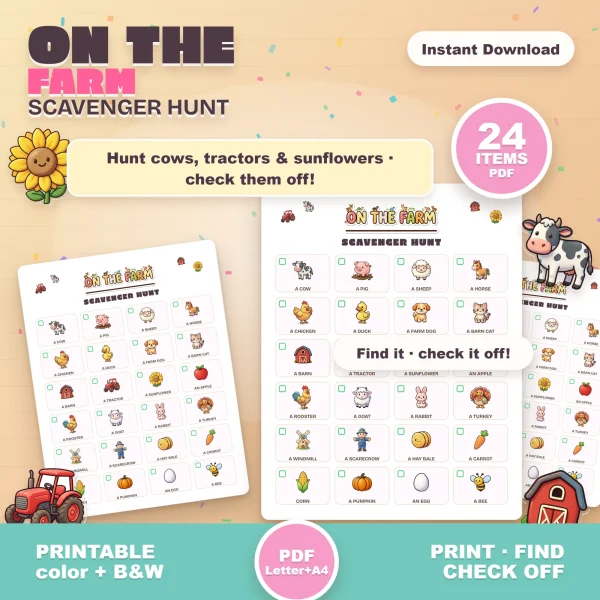
The Farm Scavenger Hunt lists 24 things to find, from a cow and a tractor to a sunflower and an egg, each with a picture beside a checkbox. The instruction page gives it as ages 3 and up, for 2 to 6 players. Print the picture grid, clip it to a clipboard, and give one crayon per group.
Check off each find as the group spots it. Preschoolers usually want to hold the crayon themselves, so pass it around. Finish when you’re back at the car or bus, then count the checks together. The last page is an “I did it!” certificate with a line for the child’s name and the date.
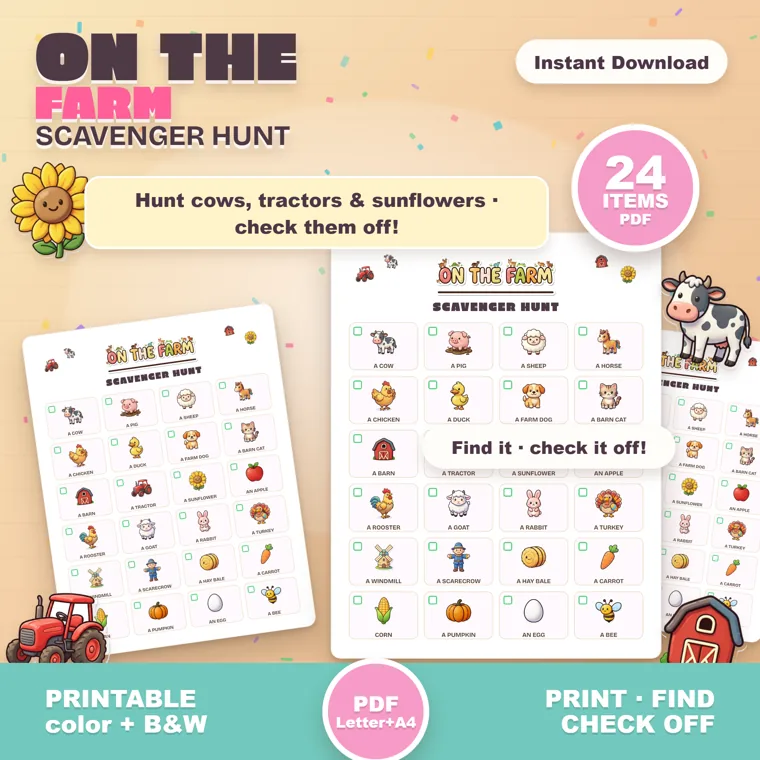
The snag: the score page counts a pumpkin, corn, a hay bale and a scarecrow as rare 5-point finds. At a pumpkin patch you’ll see dozens of each, so use the plain checklist there instead of the score page. Our nature scavenger hunt ideas cover hunts for a park or a backyard.
Bonus hunt at an orchard or pumpkin patch
An apple orchard won’t have most of the farm animals on a full checklist. Page 4 of the hunt adds four bonus challenges: something soft, something that grows, three different animals and something red. Those four fit an orchard or a patch better than a list of livestock.
Give each group the page and let children call out each find. An apple covers something red, and a pumpkin vine covers something that grows. Finish when all four are done; plan on about 20 minutes of walking. The same page has a line to fill in how many of the 24 items the child found.
Before you touch any animals: the handwashing plan
Farm visits with preschoolers come with one firm rule. The CDC says to “wash your hands right after touching animals or anything in the areas where they live, roam, or eat,” and again when you leave animal areas, even if you didn’t touch the animals. Soap and running water come first. When there’s no sink, the CDC says to use a hand sanitizer containing at least 60% alcohol, then wash with soap and water as soon as you can.
Two more CDC points matter for this age group. Adults should supervise handwashing for children under 5. And children under 5 shouldn’t handle or touch chicks, ducklings or live poultry, which many farms keep in a petting pen. Leave strollers, cups and toys outside the animal area, and keep snacks for after the handwashing stop.
Find the handwashing station when you arrive, before anyone heads to the animals. Point it out to the children so the last stop of the visit is already planned. Supervising every child at the sink is easier when the adults have split the group beforehand.
After-trip count-up
Back in class the next day, the used checklists become a counting lesson. Any group size works, for about 10 minutes.
Ask each child to count their checks and say one animal they saw. Tally the whole class on chart paper, with one row per animal, and see which was spotted most. Finish by sending each certificate home with its child.
The snag: groups that went different ways will have different counts, and one child may decide they “lost.” Count as a class total rather than ranking groups.
Printables from this article
Related articles
Printable Bingo Cards
Space Activities for Preschoolers: Games, Hunts & Moon Watch
Eleven hands-on space activities for three- to five-year-olds, sorted by situation, with group size, prep, how to start and finish, plus a five-day plan.
Printable Bingo Cards
Space Facts for Kids: Our Solar System, Moon and Stars
The Sun, Mercury to Neptune, the Moon, the stars and life on the space station, with NASA's numbers and simpler lines for preschoolers and early readers.
Printable Bingo Cards
Dinosaur Activities for Preschool: Games, Crafts & Fossils
Thirteen dinosaur activities for three- to five-year-olds, from ice eggs and sand digs to circle-time games, plus dinosaur facts that hold up and fixes for the usual snags.