Types of Transportation for Kids: Land, Water and Air
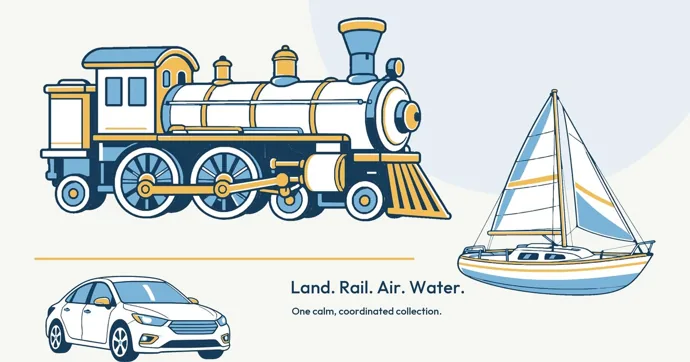
There are three main types of transportation: land, water and air. Land transportation splits again into road (cars, buses, trucks, bikes) and rail (trains, subways, trams), so many teachers present it as four groups. Wikipedia’s overview of transport adds a few smaller modes on top of those: cable, pipeline and space. That gives kids a simple rule to start with. Ask where the vehicle moves, on a road, on a track, on water or through the air, and you have its group.
Below, each type comes with what it is, what it’s used for and where a child is likely to see it. After that come the vehicles that confuse kids, how to pitch the topic by age, and six classroom activities with ages, times and materials.
The main types of transportation at a glance
Use this table as the one-page answer before going into each group.
| Type | Moves on or through | Examples | Where kids see it |
|---|---|---|---|
| Road | Paved roads and streets | car, taxi, bus, truck, motorcycle, bicycle | Outside the house, on the way to school |
| Rail | Steel tracks | steam train, high-speed train, subway, tram | Train stations, city centers, crossings |
| Water | Seas, rivers, lakes, canals | ship, sailboat, ferry, tugboat, submarine | Harbors, lakes, ferry docks |
| Air | The air above the ground | airplane, helicopter, hot air balloon | The sky, airports |
| Cable | A moving cable | ski lift, aerial tram, elevator | Ski hills, tall buildings |
| Pipeline | Inside a pipe | water and natural gas pipes | Mostly underground, so almost never |
| Space | Beyond the atmosphere | rocket, spacecraft | Launches on TV or online |
Wikipedia also notes that walking, cycling and riding animals are sometimes counted as separate modes, human-powered and animal-powered transport. For young kids they fit easily into the land or water group, which keeps the sorting simple.
Land transportation: road vehicles and trains
Land transportation is any way of moving people or goods across the ground, and it comes in two kinds: road and rail. Most kids ride in land vehicles every day, so this is the group to teach first.
Road vehicles: cars, buses, trucks and bikes
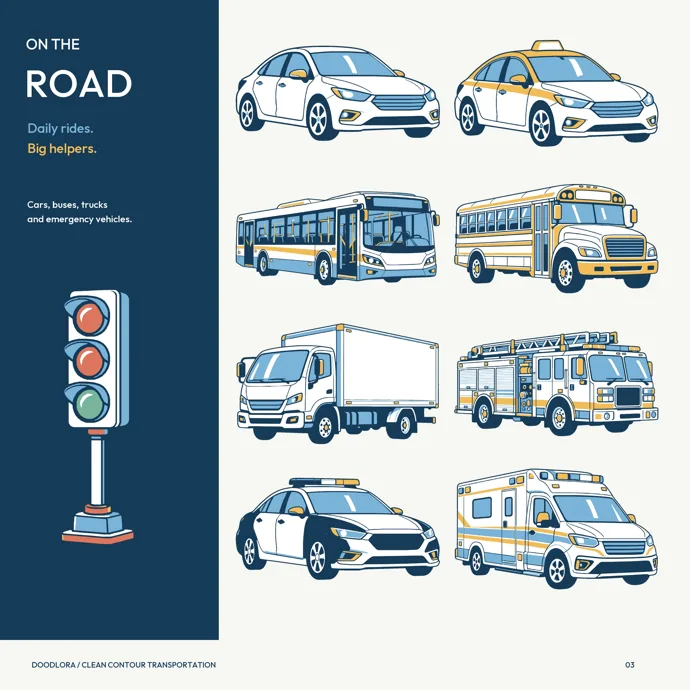
A road is a prepared route between places, and the most common vehicle on it is the car. Cars carry a few people door to door. Buses carry many people on a set route, city buses between stops downtown and school buses between kids’ homes and school. Trucks mostly carry goods, from a box truck delivering parcels to a big rig pulling a trailer down the highway.
Motorcycles, bicycles and kick scooters are road vehicles too. A bicycle and a kick scooter have no motor, so they also count as human-powered transportation, which is a good second fact for kids who already know the groups. Wikipedia points out that only road transport can take you right from one door to another inside a city. That is why delivery vans and taxis use it.
Rail: trains, subways and trams
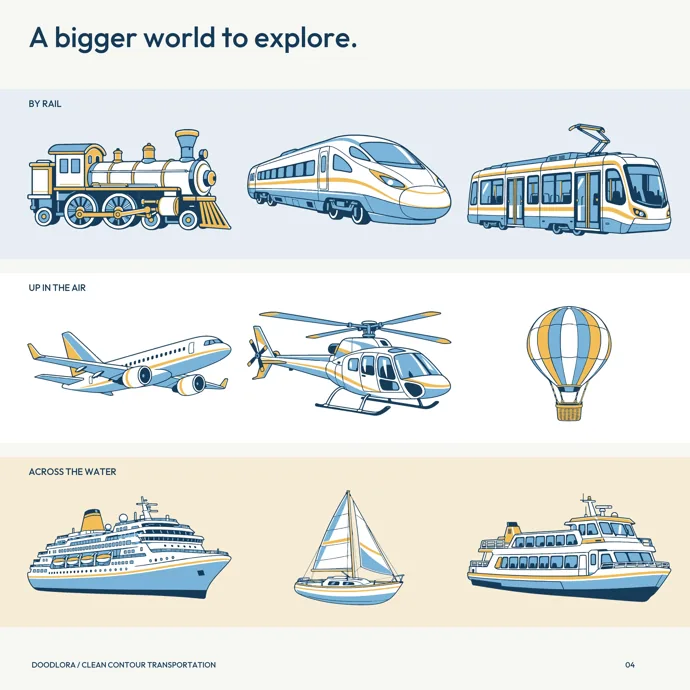
Rail vehicles run on tracks, usually two parallel steel rails. A train is one or more connected cars on those rails, often pulled by a locomotive. The locomotive can be powered by steam, diesel or electricity. Steam locomotives are the old kind kids know from picture books, with a tall chimney puffing smoke.
A subway is a train that runs mostly in tunnels under a city. A tram is similar to a train but smaller, travels shorter distances and runs on rails set into the street, and it is usually electric. A good point for older kids: trains roll with much less friction than rubber tires on a road, which makes them more energy efficient than cars and trucks.
Vehicles with a job: fire trucks, garbage trucks and tractors
Some land vehicles exist to do a job rather than to take you somewhere. Fire trucks, ambulances and police cars carry helpers and their equipment, and garbage trucks collect trash from the curb. If your class is also learning about people in the neighborhood, our community helpers guide for kids pairs each job with what that person does.
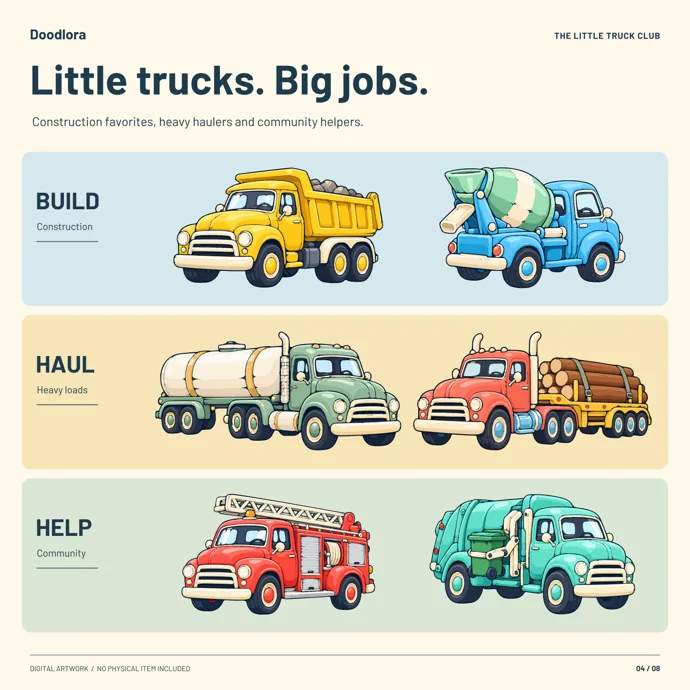
Tractors, dump trucks, cement mixers and excavators are work machines. They do move along the ground, so they belong in the land group, but kids often ask whether they “count.” A useful answer is that they move materials, dirt or crops, so they are transportation for goods, even when the trip is only across a field or a building site.
Water transportation: ships, boats and submarines
Water transportation moves people and goods across seas, oceans, lakes, rivers and canals in boats and ships. Every watercraft needs to float, so the hull, the body of the boat that sits in the water, matters more than anything else on it.
Boats move in three ways kids can remember: wind, steam and engines. Sailboats use wind in their sails. In the 19th century the first steamships appeared, using a steam engine to turn a paddle wheel or a propeller. Most big ships now run on engines that burn fuel, while small boats may still use sails, oars or a motor.
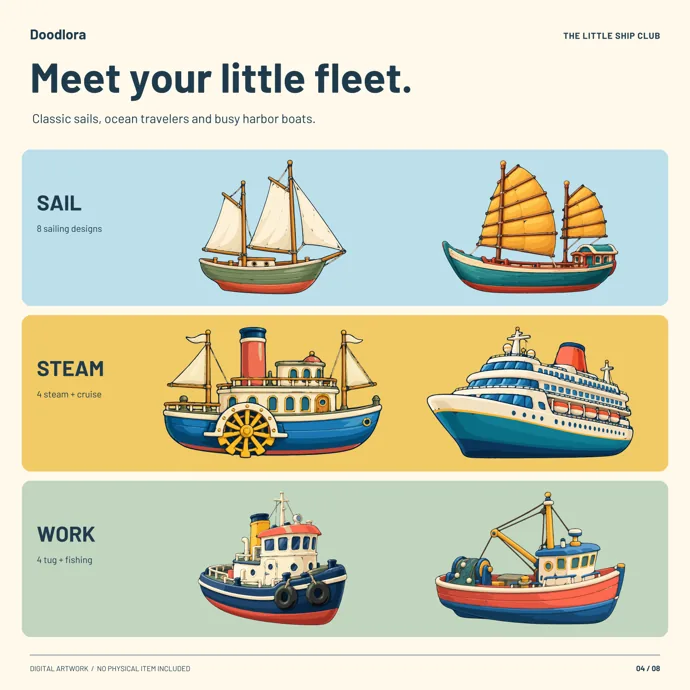
Here is what the common water vehicles do:
- Cargo ships carry huge loads of goods. Water transport is slow, but it costs much less than flying goods across an ocean.
- Ferries carry passengers, and often cars, back and forth on a short regular route across a lake, river or bay.
- Cruise ships are floating hotels for vacations.
- Tugboats are small, strong boats that push and pull bigger ships in a harbor.
- Fishing boats go out to catch fish and bring it back to port.
- Submarines can travel underwater on their own. Wikipedia notes they are called boats, not ships, whatever their size, which is a fun fact kids like.
Air transportation: airplanes, helicopters and balloons
Air transportation is the fastest way to cover long distances, and kids usually know it from airports and vacations. The three air vehicles they meet first each stay up in a different way.
Airplanes fly because air flowing over their wings creates lift. Most need an airport with a runway to take off and land, plus space for fuel, passengers and cargo. Helicopters have spinning blades on top instead of fixed wings. They are useful for short trips and can land in places that have no runway, such as a small pad on a rooftop or a field.
Hot air balloons are lighter-than-air aircraft. A burner heats the air inside the big bag, called the envelope, and the warm air is lighter than the cooler air around it, so the balloon rises. Passengers ride in a basket underneath. Kids are often surprised that a balloon counts as an aircraft, which makes it a good card to hold up during a sorting game.
Drones are a newer member of the air group. Wikipedia’s transport overview notes they are used to carry medicine in some places and are being tested for delivering small parcels.
Other modes of transportation: cable, pipeline, human-powered and space
The smaller modes of transportation are worth a short lesson for kids aged 7 and up, because each one stretches the idea of what a “vehicle” is.
- Human-powered: walking, running, swimming, cycling, rowing and using a wheelchair all move people by muscle power. Many kids walk or bike to school, so this one is personal.
- Animal-powered: horses, camels, donkeys and sled dogs carry riders, carry packs or pull sleds and carts. They are still useful on rough ground that cars can’t reach.
- Cable: vehicles pulled by a moving cable instead of their own engine, such as ski lifts, aerial trams, funiculars on steep hills and elevators. Elevators are the cable transport most kids ride without realizing it.
- Pipeline: liquids and gases travel through pipes. Water, petroleum and natural gas all move this way, and no one rides along.
- Space: spacecraft travel beyond Earth’s atmosphere, mostly to put satellites in orbit and to carry crews to space stations. Kids who love rockets can follow up with how to draw a rocket ship.
Vehicles that confuse kids, and how to settle them
A few vehicles start arguments in any sorting game, so decide your answer before the lesson.
- Hovercraft: Wikipedia describes it as an amphibious craft that travels over land, water, mud and ice on a cushion of air. Give it its own “both” spot rather than forcing it into one group.
- Submarine: it goes under the water, not on it, but it is still water transportation.
- Hot air balloon: air, even though it has no engine and no wings.
- Excavator and tractor: land, and they count, because they move dirt, crops or materials.
- Traffic lights, stop signs and crosswalk signs: not vehicles at all. They help road transportation run, which is a good “not a vehicle” pile for kids aged 5 and up.
- Elevator and escalator: cable or moving-stair transport, a fun stretch question for older kids.
One more trap is the pictures themselves. Clipart vehicles are simplified drawings, not exact models of a real train or airplane. Use them to name the type of vehicle, and use photos or a trip outside if kids want to identify a particular make or model.
Explaining modes of transportation by age
How deep you go depends on the age group. These levels are a planning guide, not a fixed curriculum.
| Age | What to teach | How long |
|---|---|---|
| 3–5 (preschool) | Names of 10–15 vehicles, and the three groups land, water and air | 10–15 minutes at a time |
| 5–6 (kindergarten) | Add road vs. rail, and vehicles that carry people vs. goods | 15–20 minutes |
| 6–8 (1st and 2nd grade) | Add helper vehicles, human-powered travel and why people choose one mode over another | 20–30 minutes |
| 8 and up | Cable, pipeline and space, plus stations, airports and ports as places where modes meet | 30–45 minutes, or a short project |
For the 6–8 group, Wikipedia’s overview gives a simple reason people pick one mode over another: cost, what it can carry and the route. A ship is cheap for heavy goods, a plane is fast across an ocean and a car goes right to the door. Kids can test that by planning how a box of apples would travel from a farm to their lunchbox.
How to teach types of transportation: six classroom activities
Each activity below works at home with one or two kids and in a classroom of 20 or more. All of them run on a set of picture cards, so print those first.
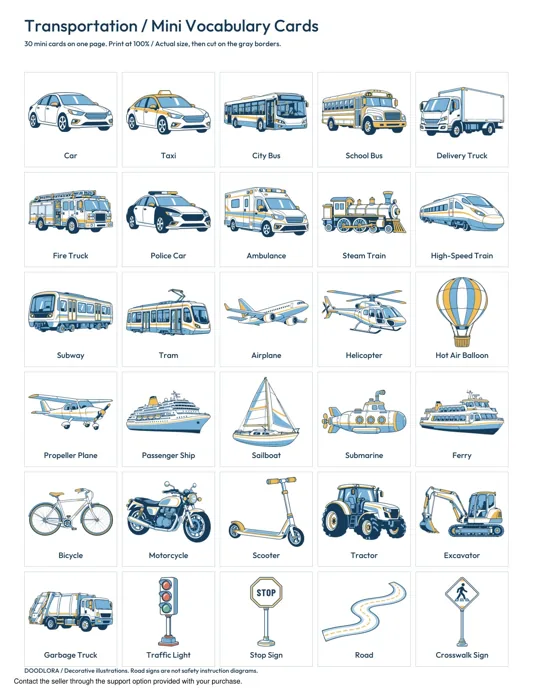
Printing the picture cards
Our transportation clipart includes a one-page sheet of 30 mini vocabulary cards in US Letter and A4. The cards cover 26 vehicles and four road pieces: a traffic light, a stop sign, a road and a crosswalk sign. Print the sheet at 100% or Actual size, then cut along the gray borders. Each card comes out about 1½ inches square.
- Print on cardstock so the cards don’t bend or show through when they’re face down.
- Print two copies for the memory game, and one copy per small group for sorting.
- The sheet notes that its road signs are decorative, not safety instruction diagrams, so don’t use them to teach street-crossing rules.
1. Land, water or air sorting game
- Ages: 3–6
- Group: 1–6 kids per set of cards
- Time: 10–15 minutes
- Materials: one card sheet, three paper plates or sheets labeled Land, Water and Air (draw a road, a wave and a cloud for non-readers)
Hand out the cards and let kids place each one on a plate, saying the vehicle’s name out loud. Finish by checking each plate together and asking one child to explain a tricky card. Pull out the traffic light, stop sign, road and crosswalk cards first for under-5s, or add a fourth “not a vehicle” plate for older kids. For 5s and 6s, split Land into Road and Rail.
2. Guess the vehicle sound
- Ages: 3–6
- Group: 2 to a whole class
- Time: 10 minutes
- Materials: the vehicle cards laid out face up, your own voice (or recorded vehicle sounds you have on hand)
Make a vehicle’s sound, such as a train’s “choo choo,” a siren, a helicopter’s “whup whup” or a boat horn, and kids point to or hold up the matching card. Let a child take a turn making the sound once they’ve got the idea. Pick sounds that are clearly different, because a car, a taxi and a police car without its siren all sound alike and the game stalls.
3. Transportation memory match
- Ages: 4–7
- Group: 2–4 players
- Time: 15 minutes
- Materials: two copies of the card sheet, cut out
Start with 8–10 pairs for 4-year-olds and work up to all 30 for 6- and 7-year-olds. Lay the cards face down, take turns flipping two and keep any matching pair. The player with the most pairs at the end wins. Ask kids to say the vehicle’s group (land, water or air) before keeping a pair, which turns the game into review.
4. How did you get here? Class graph
- Ages: 4–8
- Group: whole class
- Time: 10 minutes to set up, then 2 minutes a day for a week
- Materials: a large sheet of paper or a bulletin board, cards or drawings for car, bus, bike, walking and any other way your kids arrive, sticky notes or clothespins
Each morning, every child adds a sticky note under the way they came to school. At the end of the week, count the columns together and talk about which way was most common. Some kids ride two ways in one trip, such as walking to the bus. Let them pick the longest part of the trip, or give them two notes, and decide that rule before day one.
5. People or goods?
- Ages: 6–9
- Group: pairs or small groups
- Time: 15 minutes
- Materials: one card sheet per group, a T-chart labeled People and Goods
Groups sort each vehicle by what it mainly carries. Then they argue the hard ones: a ferry carries both, and a garbage truck carries trash, which counts as goods. Finish with each group explaining one card they disagreed on. This game is a natural lead-in to talking about why we choose different modes.
6. Build a transportation wall
- Ages: 4–9
- Group: whole class
- Time: 30–45 minutes over two sessions
- Materials: blue and green butcher paper for sky, land and water, printed vehicle pictures or kids’ own drawings, glue sticks, crayons
Divide the wall into a sky band, a land band with a road and a railway, and a water band at the bottom. Kids color, cut and glue each vehicle into the right band, then add labels. Hang the cable, pipeline or space extras off to one side for older kids. A wall vehicle needs to be several inches long to read from across the room, and working out clipart print size is just pixels divided by pixels per inch. Kids who would rather draw can start with how to draw a fire truck.
Transportation clipart for lessons, crafts and printables
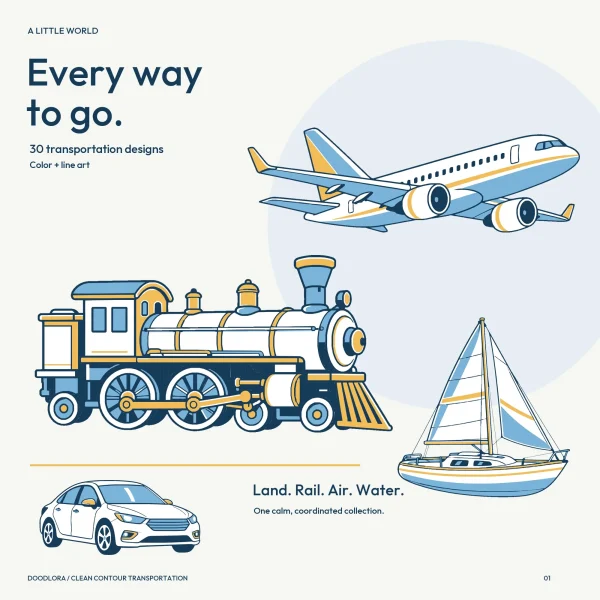
The activities above need only the vocabulary card sheet, but bigger pictures help with walls, worksheets and bulletin boards. The transportation clipart set behind those cards has 30 designs in color and line art, so the same vehicles work for a color poster and a coloring page. It’s a personal-use download, which covers a teacher printing for their own class.
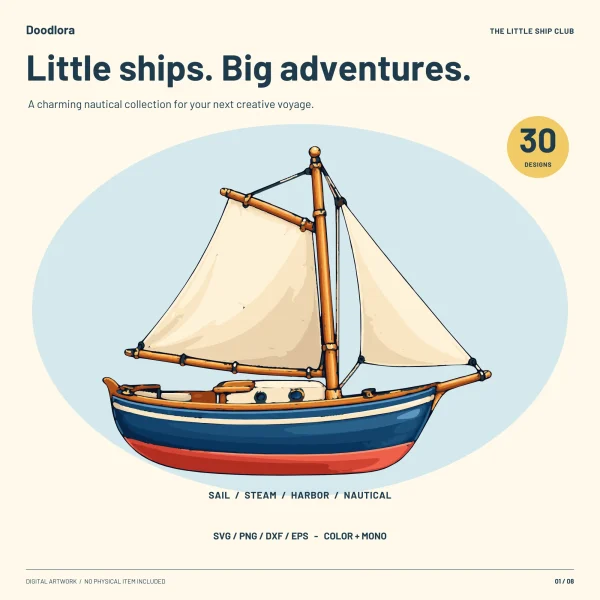
For a unit that zooms in on one group, the ship clipart adds sailing ships, steamers, tugboats and fishing boats, and the truck clipart adds dump trucks, mixers, big rigs and fire trucks. If you’re new to clipart files, what clipart is and which file types to use explains the PNG and SVG files in each download.
Printables from this article
Related articles
Clipart & SVG Cut Files
How to Draw a Truck: Easy Pickup, Big Rig and Cartoon
Split a pickup into three parts before you draw a single wheel: a bed, a cab and a hood. Keep the roof about 2.2 wheels tall and the bed rail level with the hood, and the truck looks right even before the details go on.
Clipart & SVG Cut Files
How to Draw a Train: Steam Engine, Cars and Tracks
Split the page into a 10-square grid, lay a long boiler tube across the middle, set a box cab at the back and a tall stack at the front, hang two big driving wheels under the cab end, then couple cars behind and run the rails to a vanishing point.
Clipart & SVG Cut Files
Hawk vs Falcon: Wings, Size, Hunting Style and Eagles
A falcon has long, narrow wings that taper to sharp points and flies on steady, quick wingbeats; a hawk has broader wings with rounded tips and either soars in slow circles or flaps hard and glides. Falcons kill with a notched beak and hawks with their talons, and eagles are the largest, heaviest-billed members of the hawk family.