SMART Goal Examples: Fitness, Students, Money & Daily Life

A SMART goal is a goal that is specific, measurable, achievable, relevant and time-bound. “Get in shape” becomes “walk for 30 minutes after dinner on Monday, Wednesday and Friday for the next six weeks.” The 25 SMART goal examples below cover fitness, school and language learning, everyday money habits, home life and work. Each one shows the vague wish it replaces, what to tick off and the snag most likely to stall it.
Copy the sentence that’s closest to your situation, then change the numbers to fit your week. The numbers here are examples, not targets anyone has set for you.
| If you want to… | Start with | What you’ll tick off |
|---|---|---|
| Move more after a long break | Walk after dinner | 18 walks in six weeks |
| Get stronger | Two strength sessions a week | 16 logged sessions in eight weeks |
| Bring up a grade | 20 minutes of practice problems | Four practice days a week, plus quiz scores |
| Start speaking a new language | A 5-minute conversation | Study days, then one test call |
| Stop wondering where money went | Write down every purchase | 30 days of entries |
| Save for something specific | $75 every Friday | Eight transfers |
| Keep the house under control | 15-minute tidy before bed | Five nights a week for three weeks |
| Get noticed at work | One presentation a month | Three talks in three months |
What SMART stands for, with one goal rewritten
Each letter in SMART is a test a goal has to pass before you start. Run “exercise more” through all five and you get a goal you can check on any given day.
| Letter | What it asks | “Exercise more,” rewritten |
|---|---|---|
| S, specific | What exactly will I do? | Walk after dinner |
| M, measurable | How will I know it’s done? | 30 minutes, three evenings a week |
| A, achievable | Is it realistic for my week? | The three evenings without late meetings |
| R, relevant | Why does it matter to me? | I want to keep up on weekend hikes |
| T, time-bound | By when? | For the next six weeks, then review |
The questions in the middle column are the ones printed on page 7 of our language learning planner. That page works for any goal, not only languages.
The term goes back to George T. Doran, who proposed it in the November 1981 issue of Management Review as a way for managers to write objectives. His original letters were specific, measurable, assignable, realistic and time-related. Most people now read A and R as achievable and relevant, and some writers stretch the acronym to SMARTER. The version you use matters less than answering all five questions in writing.
SMART goals for fitness and exercise
The measurable part of a fitness goal works best when it’s something you do: sessions, minutes, sets. Body weight moves for reasons you don’t control week to week. Page 26 of our workout journal makes the same point. It lists eleven body measurements to take at the start, in week 4 and in week 8, and notes that the scale is only one of them.
If you’re new to exercise or have a health condition, ask your doctor what’s safe before you pick the numbers.
1. Walk after dinner. Vague goal: “exercise more.” SMART goal: “Walk for 30 minutes after dinner on Monday, Wednesday and Friday for the next six weeks.” That makes 18 walks to tick off. The snag is weather. Decide your indoor backup before week one, such as a walking video or laps at a mall, so a rainy evening doesn’t cost you the session.
2. Two strength sessions a week. Vague goal: “get stronger.” SMART goal: “Do a full-body strength workout every Tuesday and Saturday for eight weeks, and log every set, rep and weight.” Success here is 16 logged sessions, not a number on the bar. The welcome page of the workout journal has a rule for missed days: “One skipped session is life. Two in a row is the start of a pattern.”
3. Run a 5K without walk breaks. Vague goal: “start running.” SMART goal: “Run 5K without stopping by the end of 10 weeks, following a beginner run-walk plan three days a week.” Choose a plan written for beginners before you start. Repeat a week if it felt too hard rather than skipping ahead to stay on schedule.
4. Stretch after every workout. Vague goal: “be less stiff.” SMART goal: “Stretch for 10 minutes after every workout for the next four weeks.” Tie it to the workout you already do, and the habit has a trigger. Each daily log in the workout journal has a cool-down and mobility line, so the tick goes right under the session.
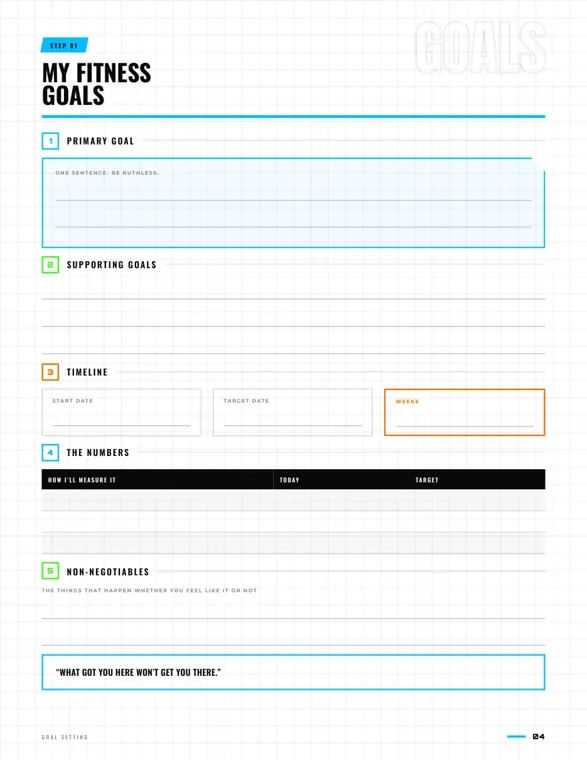
That goal page asks for one primary goal in a single sentence, then supporting goals, start and target dates, the number of weeks, and a table with “how I’ll measure it,” today’s number and the target. Fill in today’s number before the first workout, because that’s the figure you’ll compare against in week 8.
SMART goals aren’t the only way to set an exercise goal. The Wikipedia article on SMART criteria describes the evidence for physical activity as mixed. It cites a 2020 walking study by Christian Swann and colleagues that reported preliminary evidence for open goals over specific ones. If a fixed target makes you dread the workout, try an open goal for a few weeks and compare.
SMART goals for students and learners
Students usually can’t control the grade, but they can control the hours and the practice. The best SMART goals for students name both: the result you’re aiming for and the routine that gets you there.
5. Raise a quiz average. Vague goal: “do better in chemistry.” SMART goal: “Bring my chemistry quiz average from 72 to 80 by the end of the semester by doing 20 minutes of practice problems Monday to Thursday.” The snag is that one hard quiz can drag the average down. Track the practice days too, so a bad score doesn’t hide the fact that the routine is working.
6. Finish a paper early. Vague goal: “stop leaving papers to the last minute.” SMART goal: “Finish a full draft of my research paper three days before it’s due by writing 300 words every weekday.” Book the research days first. Writing 300 words a day stalls quickly if the sources aren’t found yet.
7. Read a book a month. Vague goal: “read more.” SMART goal: “Read 12 books this year, one a month, by reading 20 pages every night before bed.” Keep a list of the next two books ready. Choosing the next one is where a reading goal usually loses a week.
8. Hold a short conversation in a new language. Vague goal: “learn Spanish.” SMART goal: “Have a 5-minute conversation in Spanish with a tutor by March 31, studying 20 minutes a day, five days a week.” Our guide on how to learn a new language splits a goal like this into three monthly targets for a 90-day plan.

9. Finish an online course. Vague goal: “learn Excel.” SMART goal: “Finish all eight modules of an online spreadsheet course in eight weeks by doing one module every Sunday morning.” Put the Sunday slot on your calendar like an appointment. The module you skip for a busy weekend is the one that turns eight weeks into twelve.
10. Help a young reader build a habit. Vague goal: “get my second grader reading.” SMART goal: “My child reads aloud to me for 15 minutes, five nights a week, until winter break.” A parent or teacher sets this one with the child. Let the child tick the box, and pick books the child chooses some of the time.
Financial SMART goals for everyday money habits
The financial SMART goals here are habit goals: knowing where the money goes, saving for something with a name and paying bills on time. They aren’t investment advice. The dollar amounts are placeholders, so take your own numbers from a monthly budget. Our guide on how to make a budget walks through one.
11. Write down every purchase. Vague goal: “spend less.” SMART goal: “Write down every purchase, including card and app payments, on the day I make it for the next 30 days.” Small payments are the ones that slip through. Check your bank app each Sunday and add anything you missed.
12. Save for a named expense. Vague goal: “save more.” SMART goal: “Save $600 for holiday gifts in eight weeks by moving $75 into a separate savings account every Friday.” Page 8 of our printable budget planner puts it this way: “Money without a name gets spent.” Each of its three savings boxes asks for a goal, a target date, a target amount and what you’ve saved so far.
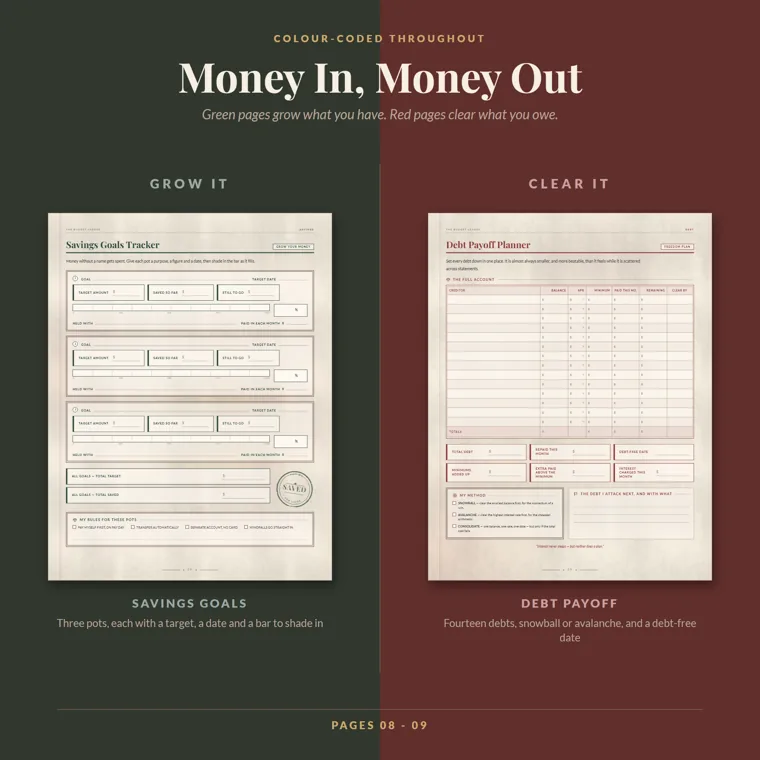
13. Add no-spend days. Vague goal: “stop impulse buying.” SMART goal: “Have two no-spend days every week for the next four weeks.” Pick the days in advance, and shop for groceries on a different day. The weekly review on page 12 of the budget planner has a row for counting no-spend days.
14. Pay every bill on time. Vague goal: “get organized with bills.” SMART goal: “Pay every bill on or before its due date for the next three months by listing all due dates in one place on the first of the month.” Bills that arrive once or twice a year are the ones people forget. The bill tracker on page 7 of the budget planner keeps a separate box for those.
15. Review your subscriptions. Vague goal: “cut back on subscriptions.” SMART goal: “By the end of this month, list every subscription and cancel any I haven’t used in the last 30 days.” Check card statements for free trials that turned into paid plans. Our list of budget categories shows where subscriptions fit next to your other spending.
Personal SMART goals for home and daily life
Personal SMART goals at home tend to fail for one reason: they don’t have a set time of day. Each example below gives the habit a slot, so the habit doesn’t depend on remembering it.
16. Tidy before bed. Vague goal: “keep the house clean.” SMART goal: “Tidy the kitchen and living room for 15 minutes before bed, five nights a week, for three weeks.” Set a timer and stop when it rings. A goal that ends on time is easier to repeat the next night.
17. Plan dinners on Sunday. Vague goal: “eat out less.” SMART goal: “Plan five dinners and write the grocery list every Sunday for the next four weeks.” Our guide on how to meal plan covers picking dinners and writing the list from the plan.
18. Keep in touch. Vague goal: “be better about calling people.” SMART goal: “Call or message one friend or family member every Thursday for eight weeks.” Write the person’s name on Monday so Thursday doesn’t start with deciding who.
19. Put the phone away at night. Vague goal: “use my phone less.” SMART goal: “Leave my phone charging outside the bedroom on weeknights for the next three weeks.” Buy a cheap alarm clock first if your phone is your alarm. Otherwise, the goal fails on the first morning.
20. Journal for five minutes. Vague goal: “start journaling.” SMART goal: “Write in a journal for five minutes after brushing my teeth every night for two weeks.” If you don’t know what to write, our journal prompts for beginners give you a first line.
SMART goals for work and career
Work goals are where SMART started, and most work goals need a deadline someone else can see. Agree on the numbers with your manager before you count them as yours.
21. Reply to customers faster. Vague goal: “improve customer service.” SMART goal: “Reply to every customer email within one business day for the rest of the quarter by checking the inbox at 9 a.m. and 3 p.m.”
22. Pass a certification exam. Vague goal: “get certified.” SMART goal: “Pass a professional certification exam in my field by June 30 by studying four hours a week and taking a practice test every two weeks.” The practice tests are your checkpoints. A low score in week 4 still leaves time to change the plan.
23. Speak up in meetings. Vague goal: “be more visible at work.” SMART goal: “Present one short update at a team meeting each month for the next three months.”
24. Search for a new job. Vague goal: “find a better job.” SMART goal: “Apply for two jobs a week for the next six weeks, changing my résumé to match each listing.” You can’t control the offers, so count the applications you send.
25. Clear a backlog. Vague goal: “get on top of my inbox.” SMART goal: “Get my unread email under 50 by Friday, then spend the first 20 minutes of each workday sorting new mail.”
How to check a SMART goal each week
A SMART goal still drifts if you only look at it on the deadline. A short weekly check-in catches a stalled goal while there’s time to fix it.
- Monday: write the goal’s weekly part. “Walk three times” or “save $75” is easier to act on than the six-week version.
- Midweek: check what’s done. If you’re behind on Wednesday, two days are left to catch up.
- Friday: list what worked. Write down the wins, and carry unfinished tasks to next week.
- Weekend: decide what changes. Keep the goal, change the time slot, or change the number.

Our printable daily planner follows this order. Monday has three lines for this week’s goals. Wednesday has a midweek check-in with a row for each of three goals and a “what needs adjusting” box. Friday lists wins of the week and what carries over, and the weekend page ends with what went well, what to let go and next week’s focus. For the rest of the daily routine, see our guide on how to use a planner.
Where SMART goals go wrong
Most SMART goals that fail were written correctly. They stall because of something the five letters don’t catch.
- Too many goals at once. Five new habits in the same week compete for the same evenings. Start with up to three, which is also how many lines the Monday planner page gives you.
- Measuring a result you don’t control. Weight, grades and job offers depend partly on things outside your routine. Pair each one with a number you do control, like sessions, practice minutes or applications sent.
- Judging “achievable” on your best week. Check the goal against a normal week with a late meeting and a sick day in it. If it only works on a perfect week, cut the number.
- No checkpoint before the deadline. A goal with only an end date gives no warning. Add a halfway check, such as week 4 of 8.
- Treating a missed date as failure. If you reach the deadline at 80%, set a new date for the last 20%. You still have the progress you made.
Frequently asked questions
What are the five parts of a SMART goal?
The five parts are specific, measurable, achievable, relevant and time-bound. A goal like “walk for 30 minutes on Monday, Wednesday and Friday for six weeks” covers all five: what you’ll do, how much, on which days, and for how long.
Who came up with SMART goals?
George T. Doran introduced the SMART acronym in the November 1981 issue of Management Review. His A and R stood for assignable and realistic. Achievable and relevant are the more common readings today.
How many SMART goals should I set at once?
Start with one to three. Each goal needs its own time slot in your week, and fewer goals make that easier to protect. Add a new one when the first has become routine.
Find more printable planners and trackers on the Doodlora Studio home page.
Printables from this article




Related articles
Printable Planners
How to Build a Workout Plan: Weekly Schedule & Template
A step-by-step way to turn a fitness goal into a weekly workout schedule, with 3-, 4- and 5-day sample weeks, a logging routine and simple rules for progressing, resting and restarting.
Printable Planners
How to Create a Home Maintenance Checklist: Monthly & Yearly
A step-by-step way to build a home maintenance checklist that fits your house, with monthly, quarterly, seasonal and yearly jobs and where the safety intervals come from.
Printable Planners
Self Care Ideas for Mental Health: Relaxing Habits & Tracker
Sixteen small, non-clinical self-care habits sorted by what you need, from sleep and walks to boundaries and a joy list, plus a low-pressure weekly check-in.