Fun Friday Activities for the Classroom: Games and Rewards
Fun Friday activities work best as a 20 to 45-minute block at the end of the week that the class has earned, with one loud game for everyone, one quiet option at desks, and a clear signal that ends it. For a 30-minute slot, a one-minute challenge tournament played in teams fills the time and keeps all 25 kids watching. For the last ten minutes before the bell, an emoji puzzle on the board or a round of heads up, seven up is enough.
Below are 13 options sorted by how loud they are and how long they take, with group size, prep and the catch in each one. The setup section comes first, because a fun Friday falls apart over who earned it long before it falls apart over the game.
| Activity | Group | Time | Prep | Noise |
|---|---|---|---|---|
| One-minute challenge tournament | 4 to 5 teams | 20–30 min | Cards, cups, balloons | Loud |
| Autumn charades | Two teams | About 20 min | Cut 12 cards | Loud |
| Ten-minute openers | Whole class | 5–10 min | None | Loud |
| Emoji guessing rounds | Teams or solo | 10–20 min | Projector or copies | Medium |
| Harvest trivia | Teams | About 20 min | One question page, score sheet | Medium |
| Heads up, seven up | 20 to 30 kids | 10–15 min | None | Quiet |
| Silent ball | Whole class | 10 min | One soft ball | Silent |
| Puzzle pages | Solo | 10–20 min | Copies, pencils | Silent |
| Roll and draw a scarecrow | Solo, all at once | 10 min | Copies, dice | Quiet |
| Silly fill-in stories | Pairs | 10–15 min | Copies | Loud laughing |
| Comic strip about me | Solo | 20 min | Paper, pencils | Quiet |
| Cup tower building | Teams of 3 or 4 | 15 min | 20 cups per team | Medium |
| Classroom escape room | Teams of 4 to 6 | 30 min | Four envelopes, made ahead | Medium |
How to set up fun Friday as a classroom reward
A fun Friday reward needs three things decided on Monday: what earns it, how long it lasts, and what happens to a student who didn’t earn it. Write all three on the board where the class can see them all week. Kids argue far less about a rule they could read on Tuesday.
What earns fun Friday, and how long it lasts
Tie the reward to something the whole class controls, like homework turned in or transitions done on time. A class goal works better than individual points here, because the activity itself is a group game. Put the time on it too: 20 minutes earned, up to 45 if the class hits a bonus goal. A fixed slot, such as the last half hour on Friday afternoon, keeps it from eating into a lesson.
Start with a signal everyone knows, and end with the same one. A timer projected on the board does both jobs. When it hits zero, the game stops mid-round, scores are read out, and desks go back. Stopping on time this week is what makes next week’s reward believable.
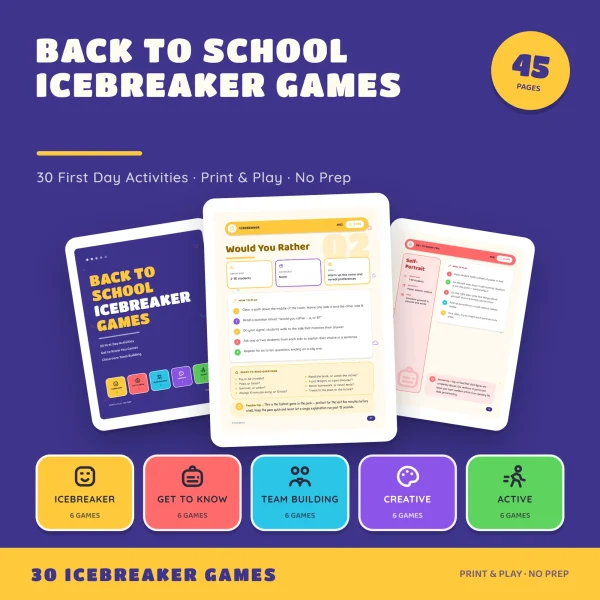
Prizes are optional. The checklist page in our first day of school icebreaker pack says stickers work better than candy, and that holds on Fridays too. Check your school’s food and allergy policy before you plan anything edible, including the challenge cards below that put food in a mouth.
When a few students didn’t earn fun Friday
Sitting with nothing to do while everyone else plays tends to make the next week worse, not better. Give those students a quiet desk option from the list below, such as a puzzle page or a scarecrow drawing, at the side of the room. They still get something calm, and the line between “earned” and “didn’t” stays clear.
Loud whole-class fun Friday games for 30 minutes
These three games get every student out of their seat or shouting an answer. Clear a stretch of floor first and push the desks to the walls if you can. Pick one main game for the block, not all three.
One-minute challenge tournament
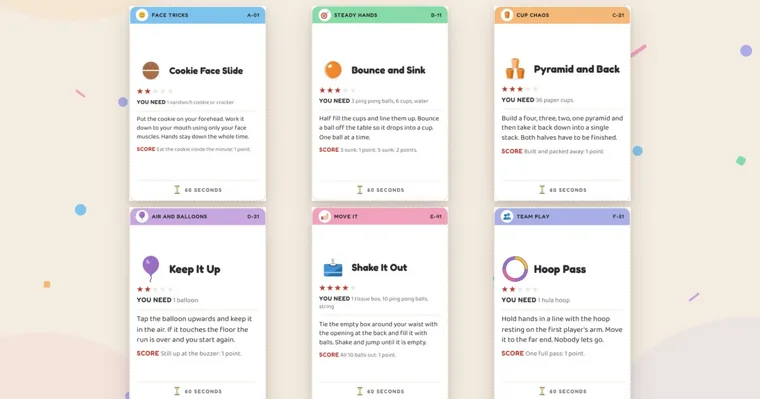
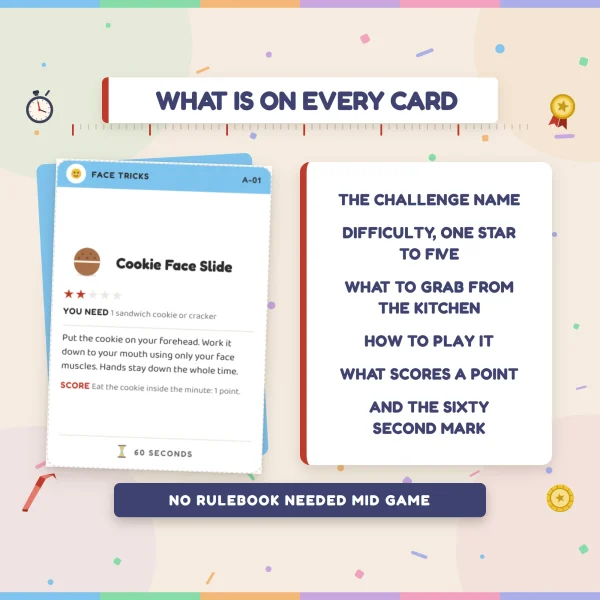
Each turn is one challenge, done in 60 seconds while the rest of the class counts down the last ten. Our one-minute challenge cards give you 60 challenges in six groups of ten, each card with a “You need” line, the rules and a score line. Most cards are worth one point, or two for beating the harder target.
For a class of 25, play the pack’s team battle, where teams take turns sending one player per card. The how-to page calls six players the sweet spot and says twenty still works, so a full class sits past the top of its range. That’s why teams matter. The pack suggests teams of three or four, but with 25 kids that makes seven teams and a long wait between turns. Five teams of five keep it moving: one turn each is roughly five minutes a round with setup, so a 30-minute block gives you five or six rounds.
Watch the score sheet. The team sheet holds four teams with four player columns, so a class of 25 won’t fit on it. Keep team totals on the board instead and skip the per-player columns.
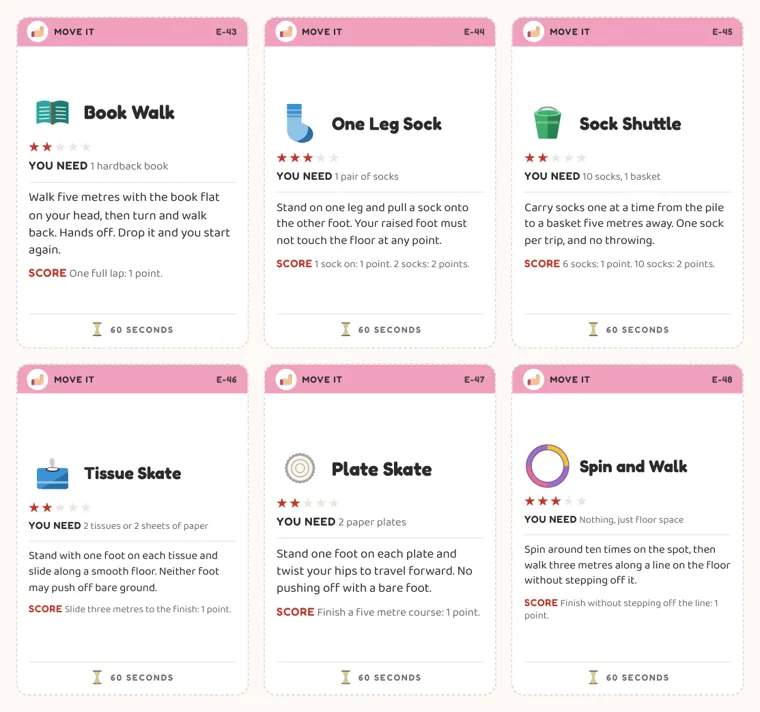
Pull some cards before the deck goes near the kids. In a classroom, take out:
- The cards that put food in a mouth: Cookie Face Slide (A-01), Straw Transfer (A-03), Catch It (A-05), Marshmallow Launch (A-09), Straw and Beans (B-12) and Launch and Catch (F-59).
- The water cards: Bounce and Sink (B-11), Cup to Cup (C-26), Water Stack (C-30) and Pass the Water (E-50).
- The balloon-popping cards, Sit and Pop (D-34) and Pop Relay (D-38). Twenty balloons going off in a classroom is a lot of noise next door. Ask about latex allergies before using any balloon card.
That still leaves plenty. Book Walk, Sock Shuttle and Plate Skate need floor space, while Coin Tower, Dice Tower, Pyramid and Back and Cup Bounce work at a desk. Two of the pack’s house rules suit a class well: a failed challenge goes back into the deck, and if a card needs something you don’t have, put it back and draw another. For under-eights, the pack says to let them stand closer, use bigger targets and count a near miss as a hit.
For more ways to play with cups and balloons, including rounds with no supplies, see our one-minute party game ideas.
Autumn charades with twelve cards
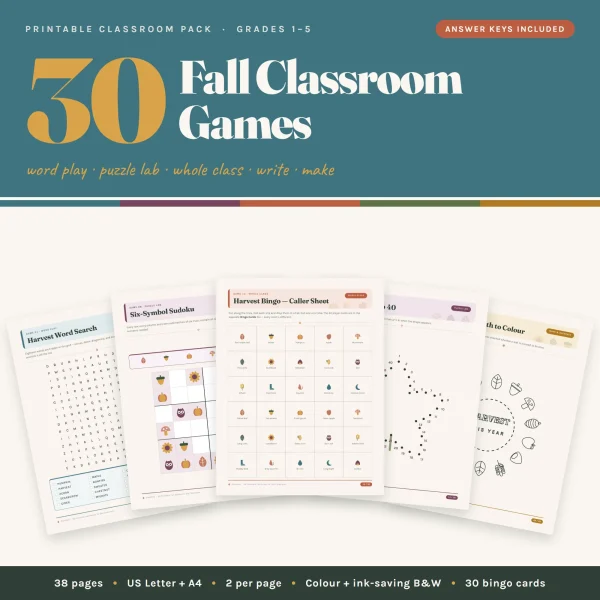
Charades suits a fall Friday through November because the prompts are seasonal and the rules need no explaining. Game 14 in our fall classroom games pack has twelve cards, such as raking a huge pile of leaves and jumping in, or a goose flying south in a V. Split the class into two teams. A player draws a card and acts it out, and the card’s rules are no talking, no sounds and no pointing at objects in the room.
Each card gets 90 seconds, so twelve cards take up to 18 minutes of acting, close to 20 with handovers. That’s about right for a short block. The catch is the shy student called up alone. Let nervous kids act in pairs, as the icebreaker pack’s charades page suggests, and nothing is lost from the game. For prompts by age and turn lengths for younger groups, our guide to charades for kids covers both.
Ten-minute openers before the main game
A short, loud opener burns off energy before you ask a class to wait for turns. Would you rather, where students walk to one side of the room for each answer, takes five minutes. Four corners and freeze dance take about ten. The icebreaker pack files its active games as transitions rather than rewards, and that fits here: use one to open the block, then move to the main game. Our list of icebreaker games for kids has full rules for all three, and our would you rather questions for kids give you enough pairs for months of Fridays.
Fun Friday games you run from the board
A projector or a document camera turns one printed page into a game for the whole room. These two need very little floor space, so they work after lunch when the floor is a mess or the class is tired.
Emoji guessing rounds
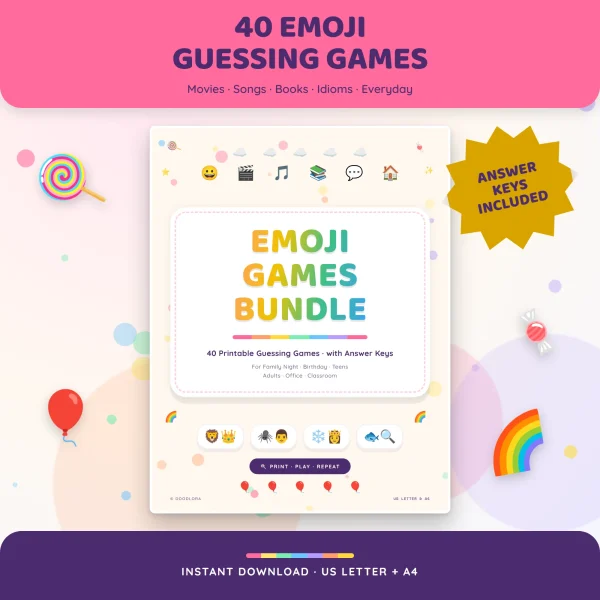
Each puzzle is two to four large emoji that stand for a title or a saying. Our emoji guessing game has 40 of them, one per page, in five rounds: ten movies, ten songs, ten books, five idioms and five everyday moments. Put a page on the board, give teams 30 seconds to write a guess, and score one point per correct answer, as the how-to page does.
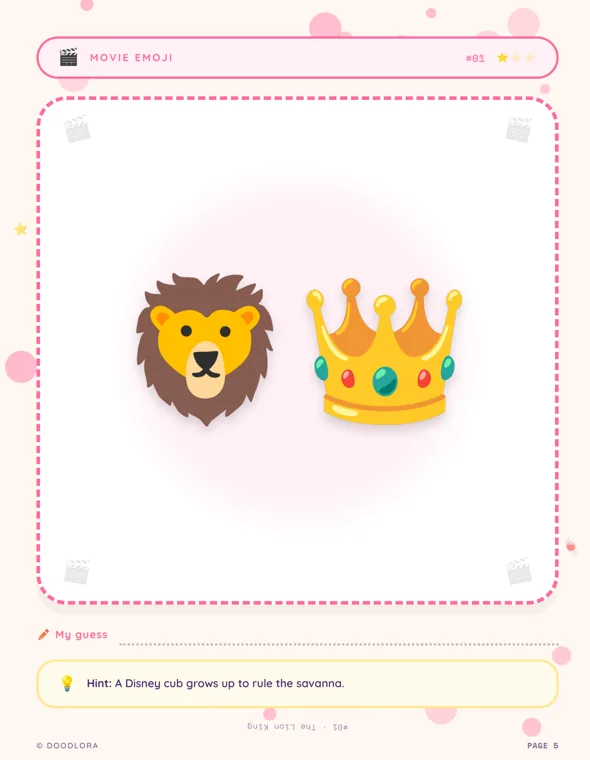
Two things on that page will catch you out. The answer is printed upside down at the foot, so cover the bottom strip or zoom in before you project it. The hint is on the page as well. Show it only after the first 30 seconds and make a hinted answer worth half a point, so a fast team still gains something.
Pick rounds by age. The books round suits a classroom best, from The Very Hungry Caterpillar to Charlotte’s Web. The idioms round, with “raining cats and dogs” and “break the ice,” fits a language arts lesson as well. The songs round mixes Twinkle Twinkle Little Star with Dancing Queen, Purple Rain and Ring of Fire, which most kids won’t know. The movie round includes Titanic and Jurassic Park, which some families haven’t watched yet. In the everyday round, the answer to puzzle 40 is “going on holiday,” so accept “vacation.” The full answer key is on pages 49 and 50 if you’d rather read answers aloud than flip pages.
Harvest trivia by teams
Game 18 in the fall pack is 20 questions in four rounds of five: leaves and trees, animals, harvest, and the calendar. Split the class into teams, read one round at a time, and give one point per correct answer. A one-page score sheet tracks all four rounds, and its tie-break is “how many seeds in a pumpkin?” with the closest guess winning.
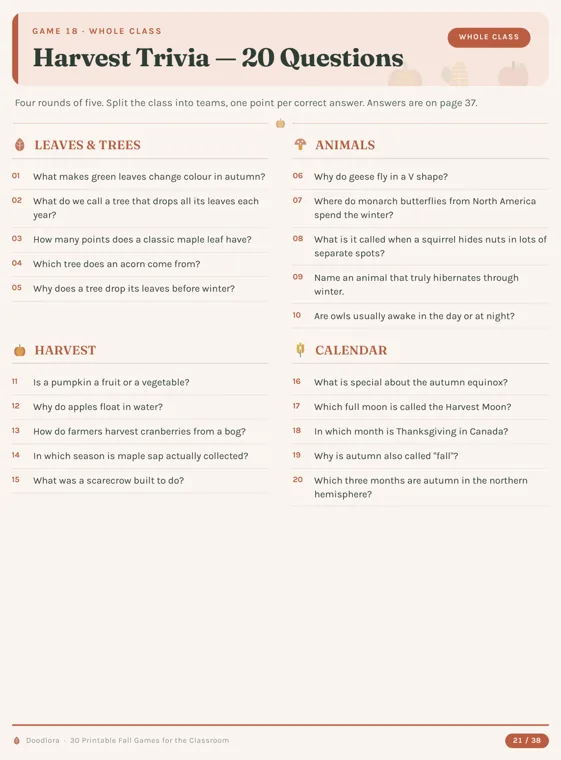
The answers are on page 37, and the pack suggests printing the keys separately if you’d rather the class didn’t find them. A few answers surprise kids, which makes good arguing material: a pumpkin is botanically a fruit, and maple sap is collected in late winter into early spring, not in fall. Allow about 20 minutes with reading time. If you want more questions for later in the month, our thanksgiving trivia list picks up where this one stops.
Quiet fun Friday activities when the room needs to calm down
Not every Friday class can handle a loud game, and not every student wants one. These four run with the lights low and the volume down. They also make good choices for the students who didn’t earn the main reward.
Heads up, seven up
Seven students (or another number) come to the front. One of them calls “Heads down, thumbs up,” and everyone else puts their head on the desk, eyes closed, one thumb raised. The seven walk around and each presses down one thumb, then go back to the front. On “Heads up, seven up,” the students whose thumbs were pressed stand and each guesses who pressed it. A right guess swaps that student to the front; a wrong one sits down, and the round starts again.
The pressing part takes about a minute, so you’ll get several rounds into 10 to 15 minutes. The catch is order. Students who guess later have an advantage, especially once a picker’s name has already come up. Change the order you call on guessers each round, front to back one time and left to right the next.
Silent ball
Silent ball is a classroom game in which students toss a soft ball to each other while everyone tries to stay silent. You act as referee, and players who are out sit down. Rules vary from room to room. One common version says a throw that is inaccurate or aggressive puts the thrower out, and seated players can come back in by catching the ball.
Settle the outs before the first toss. Making a sound is the obvious one. Hard throws, known as “whipping,” and looking at one player while throwing to another are the habits that cause arguments, so ban the ones you don’t want. Use a foam ball, never anything hard, and have students sit on their desks or stand in a circle on the carpet. Ten minutes is plenty.
Puzzle pages and the logic grid catch
Games 1 to 12 in the fall pack are silent work: a word search with 18 hidden words, a word scramble, word ladders, a cipher that spells out a joke, a symbol sudoku, a maze and a dot to dot. For grades 1 and 2, the pack points to games 1, 2, 7, 9, 10 and 11 among others. Grades 3 to 5 can do everything, and the cipher and word ladders stretch them.
One catch in this section. Game 12, Who Picked What?, has clues that allow two answers. Nora clearly takes the pumpkin in the wagon, but Theo and Wren can swap: Theo with corn in the basket and Wren with apples in the backpack, or the other way round. The answer key gives only the first. Accept either, or let a student who found the second one explain it to the class.
Make-and-take fun Friday activities at desks
Drawing and writing games give a Friday something kids can take home. They also suit a split room, with one group making while another plays.
Roll and draw a scarecrow
Everyone rolls a die once for each row and draws whatever they land on: a hat, eyes, nose, mouth, arms and a friend for the scarecrow. Game 30 in the fall pack lays out six choices per row, from a straw hat to a pumpkin on the head, and a box to draw in. The pack lists it among its five-minute fillers. With a whole class and a few dice to share, plan on ten minutes.
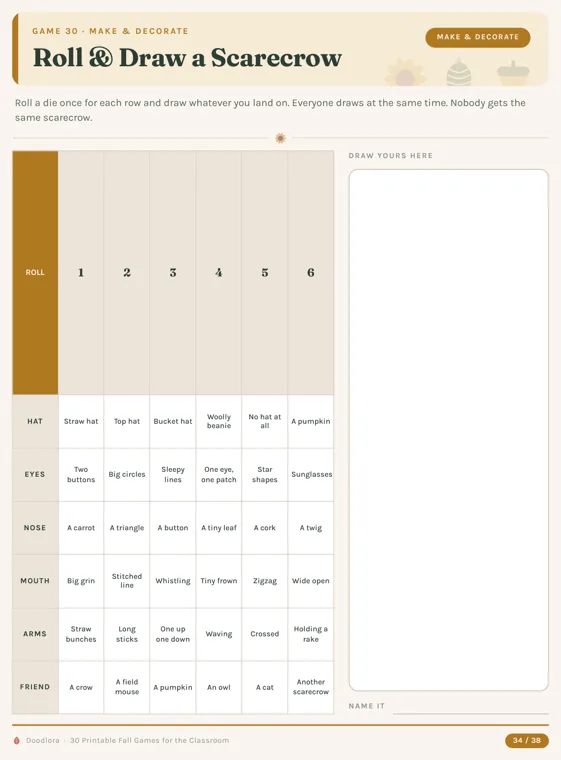
Short on dice? Roll one large die at the front and call the result for each row, so the whole class draws the same row at once. Everyone still ends up with different-looking scarecrows, and nobody waits for a die.
Silly fill-in stories
Games 19 and 20 in the fall pack are fill-in stories about a giant pumpkin and a field trip to an apple orchard, each with 12 blanks. One partner asks for the words first, such as an adjective, an animal or a silly noise, without showing the story. Then they copy the words in and read the result aloud. Pairs finish one story in 10 to 15 minutes.
The pumpkin story asks for a classmate’s name, and the field trip story asks for a teacher’s name. Decide ahead whether real names are allowed. If a student is likely to be the joke, use “a classmate” for every story that day.
Comic strip about me
Students fold a sheet into four panels and draw one true, small story about themselves: the setup, what happened in two panels, then the ending. The icebreaker pack gives it 20 minutes, and stick figures and speech bubbles are encouraged. The pack’s tip is to draw a quick example on the board badly on purpose, because students copy your confidence more than your technique. Hang them as a class comic wall before the bell.
Team challenges for a full-period fun Friday
When the class has earned a long block, give them one problem to solve together. Both of these come from our first day of school activities pack, and both work better once students know each other well, which makes them a natural fit for later in the year.
Cup tower building
Split into teams of three or four, and give each team an identical stack of 20 paper cups. Teams get two minutes to plan with no touching, then ten minutes to build. The tallest free-standing tower wins, and it has to stand alone for ten seconds to count. Finish with a short talk about whether planning helped.
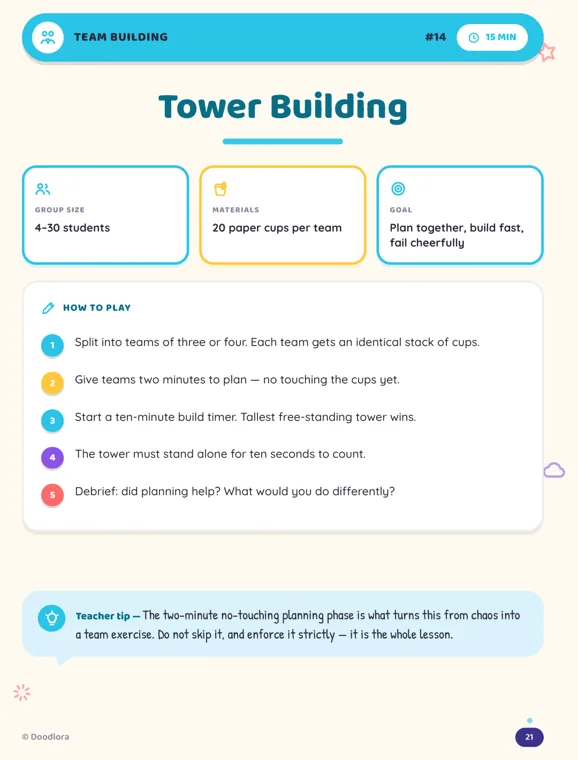
The whole game is about 15 minutes, and the planning rule is the part teams try to skip. Enforce it strictly. You’ll need about 140 cups for seven teams, and the same cups can go straight into the one-minute deck’s cup cards next week.
Classroom escape room
Before class, hide four envelopes around the room. Each holds a puzzle whose answer points to the next, and the last answer is a code that “unlocks” the classroom. Split into teams of four to six, give every team the same first clue, and start a 25-minute timer. The whole game runs about 30 minutes.
The pack lists puzzle ideas that need no prep, such as a math answer that is a page number, a riddle answered by an object on your desk, or coordinates on the seating chart. The catch is prep time: this one has to be built on Thursday, not Friday morning. Laminate the clue cards and store them in a labeled envelope, and the second time costs you nothing. For more hiding-spot ideas and clue rules, see our indoor scavenger hunt guide.
Printing and prep for fun Friday on Thursday
Most fun Friday problems start at the printer. A few minutes on Thursday saves the first ten minutes of the reward.
- Print at actual size. Both the challenge cards and the fall pack say to print at 100 percent with “fit to page” off. Otherwise the cards come out small and cut lines get cropped.
- Use the black and white editions for class sets. The fall pack’s ink-saving edition is redrawn in three grays, so the puzzles stay readable. The challenge cards print category names on every card, so the groups still read in black and white.
- Print the card deck once on card stock. The challenge cards suggest 250 gsm or heavier, though plain paper works. Six cards come to a page with three straight cuts, plus six blank cards for challenges your class invents.
- Keep answer keys out of the stack. Print the fall pack’s keys on pages 35 to 37 separately, and keep the emoji answer key, pages 49 and 50, with you.
- Gather supplies in one bin. Paper cups, a bag of balloons, ping pong balls, a foam ball, a few dice and a timer cover nearly everything here.
Running a fun Friday for staff instead of students? The same ideas scale up, and our list of icebreaker games for adults has options for a work meeting. More printable games for home and school are on the Doodlora Studio shop.
Printables from this article
Related articles
Kids Activity Books
Letter M Craft Ideas: Monkey, Mouse & Mushroom for Preschool
Twelve letter M crafts grouped by who is at the table, from a foil-print moon for one toddler to monkeys swinging on a paper-chain vine for a whole class, with ages, minutes, supplies, steps and where each one tends to go wrong.
Kids Activity Books
Letter R Crafts for Preschool: Raccoon, Rabbit & Rainbow
Eleven letter R crafts grouped by what the child is into, from a sticky tissue rainbow for 2-year-olds to a raccoon shadow puppet, with ages, minutes, supplies, steps and the usual slip.
Kids Activity Books
Letter D Crafts: Dinosaur, Dog & Donut Ideas for Preschool
Eleven letter D crafts sorted by age, from a play dough D for 2-year-olds to a fuse bead dinosaur footprint, with supplies, times, steps and the snag in each one.