Icebreaker Games for Kids: Group and Get to Know You Games
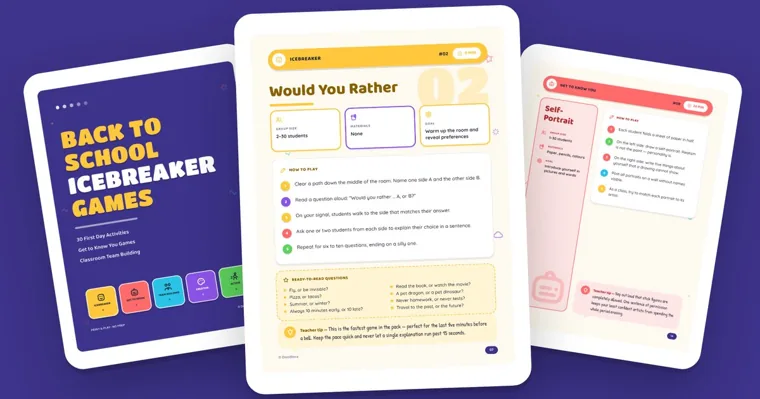
The icebreaker games that work best for kids are short, need almost nothing and let every child say something easy before anything personal. Start a new group with a name game, mix the room with a game like Find Someone Who, and save team challenges such as Human Knot for after the names have stuck. The 20 games below are sorted by the situation you’re in, whether that’s a class after winter break, a club’s first meeting or a birthday party of cousins and classmates.
How to pick an icebreaker game for a group of kids
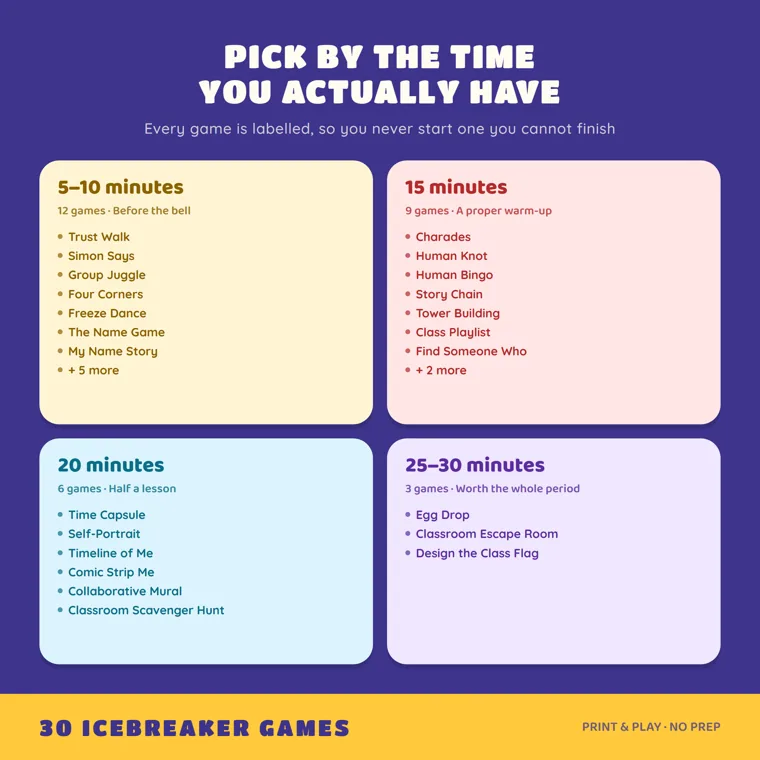
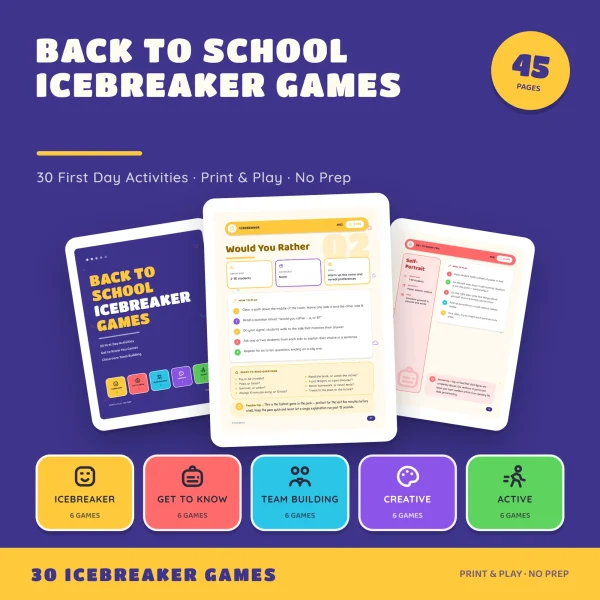
Four things decide the game: how many kids, how much time, whether they can all write, and how well they know each other yet. A circle game that’s lovely with 12 drags with 28, and a game that starts “write three facts about yourself” leaves out a child who can’t write a sentence. The order matters too. Our First Day of School Icebreaker Games pack sorts its 30 games into five sections and puts names and easy questions first, sharing next, and team problems after names are known.
| Your situation | Try these | Players | Time | You need |
|---|---|---|---|---|
| First 10 minutes, nobody knows names | The Name Game, My Name Story | 2–30 (Name Game up to 20) | 10 min | Nothing |
| Whole class of 20 to 30 | Find Someone Who, Human Bingo, Would You Rather | 2–30 | 5–15 min | A list or grid and pencils |
| Small club, cabin or table group | Two Truths and a Lie, Interview a Classmate | 2–30 | 10–15 min | Paper and pencils |
| Kids who can’t write yet | Simon Says, Freeze Dance, Story Chain | 3–30 | 10–15 min | Music for Freeze Dance |
| A room that needs to move | Four Corners, Snowball Fight, Group Juggle | 5–30 | 10 min | Paper or soft balls |
| End of the first week | Human Knot, Tower Building | 4–30 | 15 min | 20 paper cups per team |
| Party with mixed ages | Musical Chairs with nobody out, Charades in pairs | 4–30 | 10–15 min | Chairs, music, prompt slips |
The player ranges and times in this guide come from the game pages in our pack, which are written for a teacher with up to 30 students. Treat them as a starting point. A camp counselor with eight kids in a cabin can run most of them in half the time. If the group is grown-ups, like a parent night or a staff meeting, our icebreaker games for adults are sorted for work, parties and large groups instead.
Name games for the first ten minutes with a new group
Names come first because every other game goes faster once kids can call each other something. These three need no paper, so you can start while bags are still being hung up.
1. The Name Game
3 to 20 kids · 10 minutes · nothing to prepare. Stand in a circle and go first: say your name and add one movement, like a clap, a spin or a wave. The next child repeats your name and movement, then adds their own, and each child after that repeats everyone before them in order. The round ends when the last child gets through the whole circle, with the group helping anyone who gets stuck.
The snag is size. Past about 20 names, the memory load stops being fun for shy kids, so split a big class into two circles.
2. My Name Story
2 to 30 kids · 10 minutes · nothing to prepare. Tell your own name story first: who chose it, what it means, and what people get wrong about it. Then each child says their full name, how to pronounce it and anything they know about it. A child who doesn’t know their name story can tell how they got a nickname instead. After each speaker, the whole group says the name aloud once, correctly.
Write down any pronunciation you’re unsure of on the spot. Getting a name right the next day is the part kids remember.
3. Group Juggle
5 to 30 kids · 10 minutes · 3 to 5 soft balls. In a circle, toss one ball to a child across from you and say their name. That child tosses to someone new, and so on, until everyone has caught it once and it comes back to you. Run the same order twice more, then add a second ball and a third. The round ends when the circle drops too many to keep going, and you can count how many balls it held.
Use soft balls or rolled-up socks, never anything hard. Insist on saying the catcher’s name on every throw, because that’s what turns the juggling into name practice.
Icebreaker games for a whole class of 20 to 30 kids
A big group needs games where everyone plays at once instead of waiting through 29 turns. These five keep the whole room moving and talking at the same time.
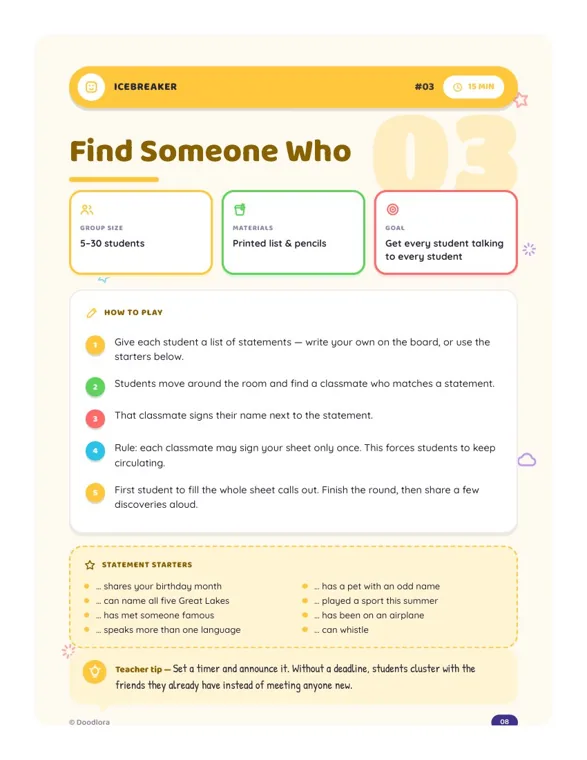
4. Find Someone Who
5 to 30 kids · 15 minutes · a printed list and pencils. Give each child a list of statements, such as “shares your birthday month,” “has been on an airplane” or “can whistle.” Kids walk around and find a classmate who matches a line, and that classmate signs next to it. Each classmate may sign a sheet only once, which keeps everyone circulating. The first child to fill the sheet calls out, then finish the round and share a few discoveries aloud.
Set a timer and announce it. Without a deadline, kids cluster with the friends they already have.
5. Human Bingo
5 to 30 kids · 15 minutes · bingo grids and pencils. Hand out a 4×4 or 5×5 grid with a different description in each square. Kids find a classmate who matches a square and get a signature, one per classmate per sheet. The first to complete a row, a column or a diagonal calls “Bingo!”, and if you have time, play on to a full card.
Draw the grid on the board and let kids copy it. You save the photocopies, you can fit the squares to your own group, and a free space in the middle gives everyone one square for free.
6. Would You Rather, the walk-to-a-side version
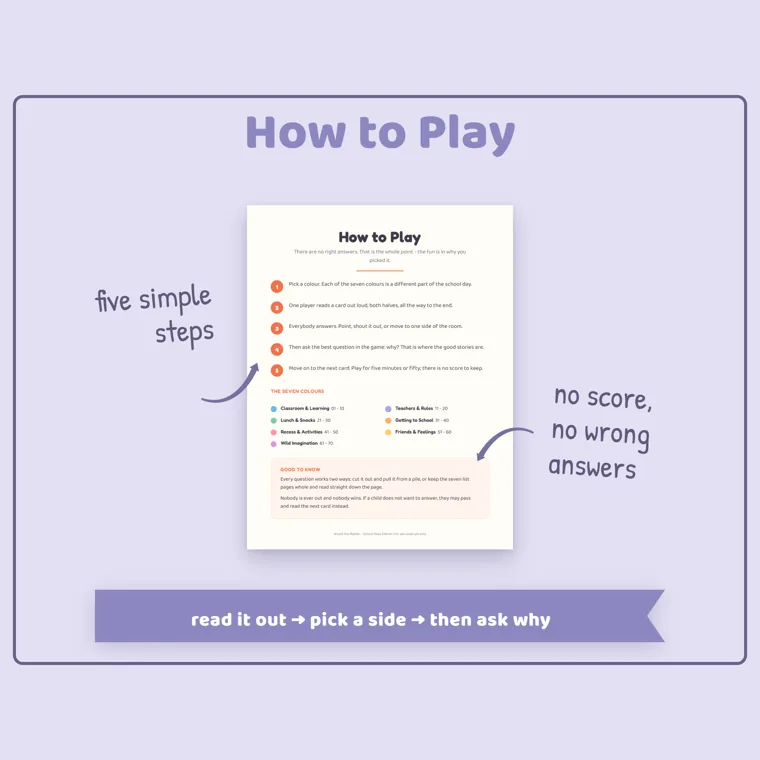
2 to 30 kids · 5 minutes · nothing to prepare. Clear a path down the middle of the room and call one side A and the other side B. Read a question aloud, like “Pizza or tacos?” or “A pet dragon or a pet dinosaur?”, and on your signal kids walk to their side. Ask one or two kids from each side to explain their choice in a sentence. Stop after six to ten questions, ending on a silly one.
Keep it fast and cut any explanation that runs past 15 seconds. This is the quickest game in our pack, which makes it the one to use in the five minutes before a bell.
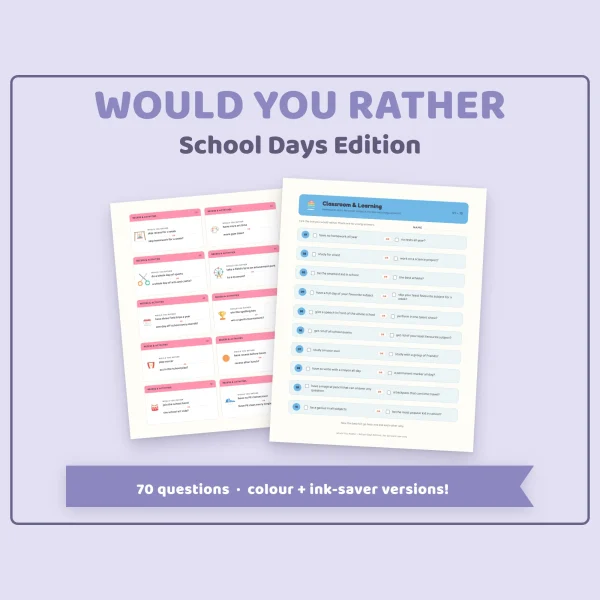
Our School Days cards give you 70 more questions in seven topics of 10, from Lunch & Snacks to Wild Imagination. Each question comes as a cut-apart card and again on a list page with checkboxes and a name line. Watch the Friends & Feelings topic on a first day. Questions like “be the new kid at a new school, or stay when your best friend moves away” can land hard on a child who has just moved, so save that topic for a later week. For more questions sorted by age, see our would you rather questions for kids.
7. Four Corners
5 to 30 kids · 10 minutes · corner labels if you want them. Number the four corners of the room 1 to 4. Close your eyes and count down from ten while kids walk to a corner. With your eyes still closed, call out one number, and everyone in that corner is out and sits in the middle. Play on until one child is left.
Kids who are out early sit for most of the game, so bring them back for a fresh round after a couple of minutes. In a classroom you can also make the corners four answers to a review question.
8. Snowball Fight
5 to 30 kids · 10 minutes · one sheet of paper each. Each child writes three facts about themselves on a sheet, with no name, and crumples it into a “snowball.” On your signal, everyone throws snowballs across the room for 20 seconds. Each child then picks one up and reads it aloud while the group guesses whose it is. The game ends when every snowball has been read.
Set the throwing boundaries before the first toss and show an underhand throw. Say once, at the start, that anyone who throws hard sits out the round.
Get-to-know-you games for a small group, club or camp cabin
Once names are out of the way, these go one layer deeper. Each one ends with kids knowing something true about someone they didn’t know that morning, and they work just as well around one table as across a classroom.
9. Two Truths and a Lie
3 to 30 kids · 10 minutes · paper and pencils. Each child writes three statements about themselves, two true and one false. Read your own three first and let the group guess. Then kids take turns reading theirs aloud with no hints, the group votes on the lie, and the reader reveals it. Give a point for each correct guess if you want a winner.
Give kids 60 seconds to think before anyone writes. A child who rushes tends to write an obvious lie and the round ends too fast, so ask for “small and believable” rather than “wild and funny.”
10. Interview a Classmate
2 to 30 kids · 15 minutes · a question sheet and pencils. Pair each child with someone they haven’t talked to. One partner interviews the other for three minutes and takes notes, then they swap for three more. Each child introduces their partner to the group in 30 seconds, and may only say things the partner actually said. Questions that work: “What are you proud of?”, “Who do you go to for help?”, “What’s a food you refuse to eat?”
This is the game for kids who freeze when asked to introduce themselves, because talking about someone else is much less scary. After winter break, swap “best part of your summer” for the best part of the break.
11. All About Me Bag
2 to 30 kids · 15 minutes · one paper bag per child. Send a paper bag home the day before with one instruction: bring three small things that say something about you. Kids sit in a circle with their closed bags and take turns pulling out one item and explaining why it matters. Classmates may ask one follow-up question per item. Keep going around until everyone has shared all three.
Keep a spare bag with three of your own things in it. A child who forgot theirs can borrow it and talk about what they’d have brought. With a full class, three items each is a lot of turns for one sitting, so circles of five or six keep it moving.
12. Favorite Things
2 to 30 kids · 10 minutes · paper if you want it. Call out a category, such as food, movie, color, season, song, place or animal. Kids write or say their favorite. Ask everyone who gave the same answer to raise a hand and look around, then each child finds one person who matched and learns their name. Run six to eight categories and stop.
Tally the answers on a poster and hang it up. It turns into something you can point to all year when you need quick teams.
Icebreaker games for kids who can’t write yet
Every game in this section runs on listening, moving or drawing, so a group of preschoolers or kids still learning to read can play the same round as everyone else. The Name Game, My Name Story and the walk-to-a-side Would You Rather above work the same way.
13. Simon Says
3 to 30 kids · 10 minutes · nothing to prepare. Kids stand where they can move their arms. Call out actions, and kids do the action only if it starts with “Simon says.” Anyone who moves without “Simon says” sits down. Speed up as you go and do the actions yourself to trick the room. The last child standing becomes the next Simon.
Bring the kids who are out back in after two minutes. Elimination games lose exactly the kids who most need to move.
14. Freeze Dance
3 to 30 kids · 10 minutes · music. Clear a space and play music while kids dance however they like. Stop it without warning, and everyone freezes. Anyone who moves after the music stops is out for that round only. Restart, cut the music sooner each time, and stop after three or four short rounds.
Use it between two stretches of sitting, not as a lesson of its own. Two rounds is usually enough to get a group ready to sit again.
15. Story Chain
3 to 30 kids · 15 minutes · nothing to prepare. Sit in a circle and open with one sentence, like “On the first day of school, the door would not open…” Each child adds exactly one sentence that follows the last. Nobody restarts the story, and the last child in the circle has to end it. If you write it down as you go, you can read the whole thing back.
Ban “and then they woke up” and the alien invasion before you start. Both are escape hatches for kids who weren’t listening to the sentence before theirs.
16. Self-Portrait
1 to 30 kids · 20 minutes · paper, pencils and crayons. Each child folds a sheet in half, draws a self-portrait on the left and writes five things a drawing can’t show on the right. Kids who can’t write yet can tell an adult the five things to write down. Post the portraits on a wall with no names showing and let the group match each one to its artist.
Say out loud that stick figures are fine. That one sentence keeps the least confident artists from spending the whole time erasing.
Team-building games once kids know each other’s names
Team games work far better once nobody is a stranger, so save these for the second half of the first week, or for the second meeting of a club. Each one is a problem a child can’t solve alone.
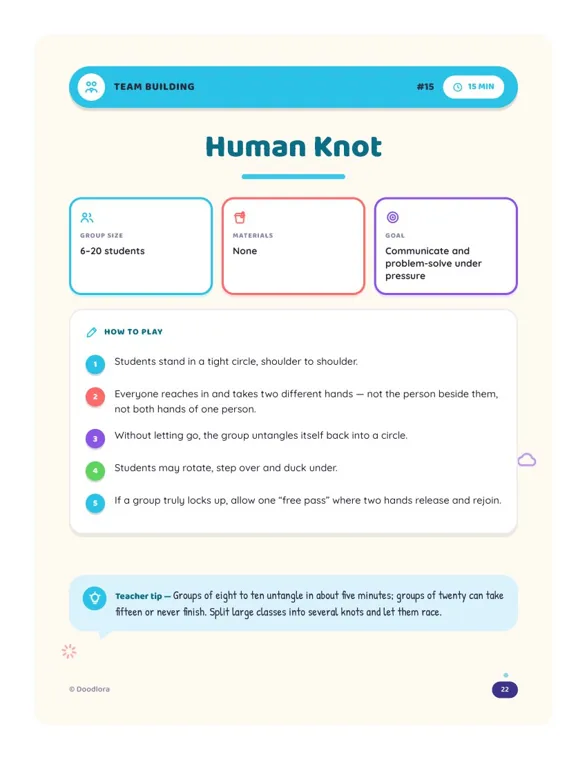
17. Human Knot
6 to 20 kids · 15 minutes · nothing to prepare. Kids stand in a tight circle, shoulder to shoulder. Everyone reaches in and takes two different hands, not from the person beside them and not both hands of one person. Without letting go, the group untangles itself back into a circle by turning, stepping over and ducking under. If a group truly locks up, allow one free pass where two hands let go and rejoin.
A knot of eight to ten kids comes undone in about five minutes, while 20 can take 15 or never finish. Split a big class into several knots and let them race. The game means holding hands with near strangers, so ask first, and give a child who’d rather not join a job as the untangling coach.
18. Tower Building
4 to 30 kids · 15 minutes · 20 paper cups per team. Split into teams of three or four, each with an identical stack of cups. Teams get two minutes to plan with nobody touching the cups. Then start a ten-minute build. The tallest tower that stands on its own for ten seconds wins, and afterward ask each team whether the planning helped.
Don’t skip the two-minute planning time, and enforce the no-touching rule. Without it, the game is just a scramble for cups.
For a team game that takes the whole room, a classroom scavenger hunt fits the same end-of-week slot, and our guide to running an indoor scavenger hunt has a classroom version.
Icebreakers for a birthday party or a mixed group of kids
At a party, kids of different ages who don’t know each other end up in one room, and the games need to be loud and easy to explain. These two work for both a five-year-old and a ten-year-old, and nobody spends the party sitting out.
19. Musical Chairs where nobody is out
5 to 30 kids · 10 minutes · chairs and music. Set chairs in a circle facing outward, one fewer than the number of players. Play music while kids walk around, and when it stops, everyone sits. In this version, nobody is out when they miss a chair. You take a chair away each round, and kids have to share the ones that are left until the whole group is piled onto a couple of chairs.
Stop the game at the number of chairs that still lets everyone sit safely, which with small kids comes earlier than you’d think. The classic version, where the child without a chair is out, works better once kids know each other.
20. Charades in pairs
4 to 30 kids · 15 minutes · prompt slips. Write prompts on slips and drop them in a bowl. Split into two teams. One player draws a slip and acts it out with no words, no sounds and no pointing at objects, and their team gets 60 seconds to guess for a point. Teams take turns until everyone has acted once. Good starter prompts: “a cat in a thunderstorm,” “trying to open a jammed locker,” “waiting for the bell.”
Let nervous kids act in pairs. Two on stage is far less scary than one, and the game loses nothing. Our charades for kids guide has more prompts and a version for kids who can’t read the slip yet. For a whole party plan by age and space, see our birthday party games.
How to run icebreakers so shy kids join in
The games above go better with a few habits that hold for every one of them. Most come from the guide pages in our two sets, and they matter more than which game you pick.
Spread the games out. The teacher checklist in our pack suggests one or two games a day for the first five days rather than six on Monday, because kids need the gap to remember the names they just learned. Go first in any game that asks for a personal answer. The grown-ups page in our School Days cards says children copy the length of the answer they hear, so a two-sentence answer from you gets two-sentence answers back.
Let anyone pass. A child who doesn’t want to answer can read the next card or hand the turn on, and nothing about the game breaks. Afterward, spend two minutes asking what kids noticed about each other, since that short talk is where the group starts to feel like a group. Our pack ends with a reflection page for that, with four sentence starters such as “Someone new I met today is …”.
More party and classroom printables are on the Doodlora Studio home page.
Printables from this article
Related articles
Printable Party Games
How to Plan a Baby Shower: Timeline, Food & 2-Hour Schedule
A baby shower plan from the first talk with the parents-to-be to the last gift: timing, guest list, budget, venue, a two-hour schedule, safe food and backup plans.
Printable Party Games
How to Plan a Bridal Shower: Timeline, Budget and Schedule
A host's plan for a bridal shower, from the first talk with the bride and co-hosts to the guest list, invitations, a timed party schedule, the gift opening and what to do when something slips.
Printable Party Games
35th Birthday Ideas: Party, Trip, Theme and Gift Ideas
Ways to celebrate turning 35, sorted by how many people the birthday star wants around, with group size, time, prep and the snag to plan for in each.