Charades for Kids: Easy Ideas, Simple Rules and Team Play
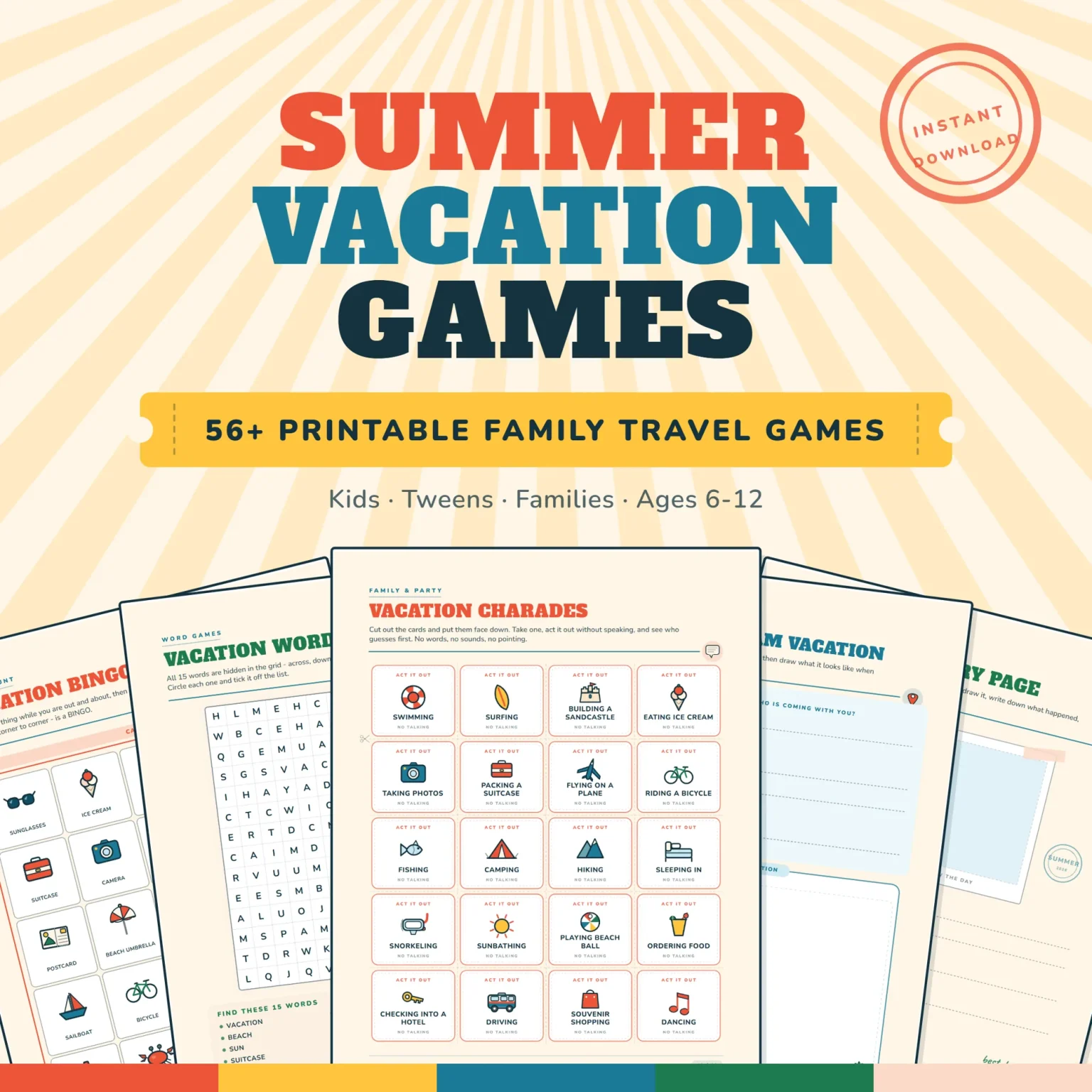
In charades for kids, one child silently acts out a card while everyone else guesses, and one-action cards like swimming or eating ice cream make the easiest start.
Before the first card, settle three things out loud: who reads the card to a child who can’t read yet, whether sound effects count, and whether turns are timed.
Our own printable decks don’t agree on that last one, and the difference between them turns out to be the most practical guide to setting it.
How to play charades with kids: the rules to say before the first card
Most of the rules fit in one breath, and kids remember instructions better before the cards come out than halfway through somebody’s turn.
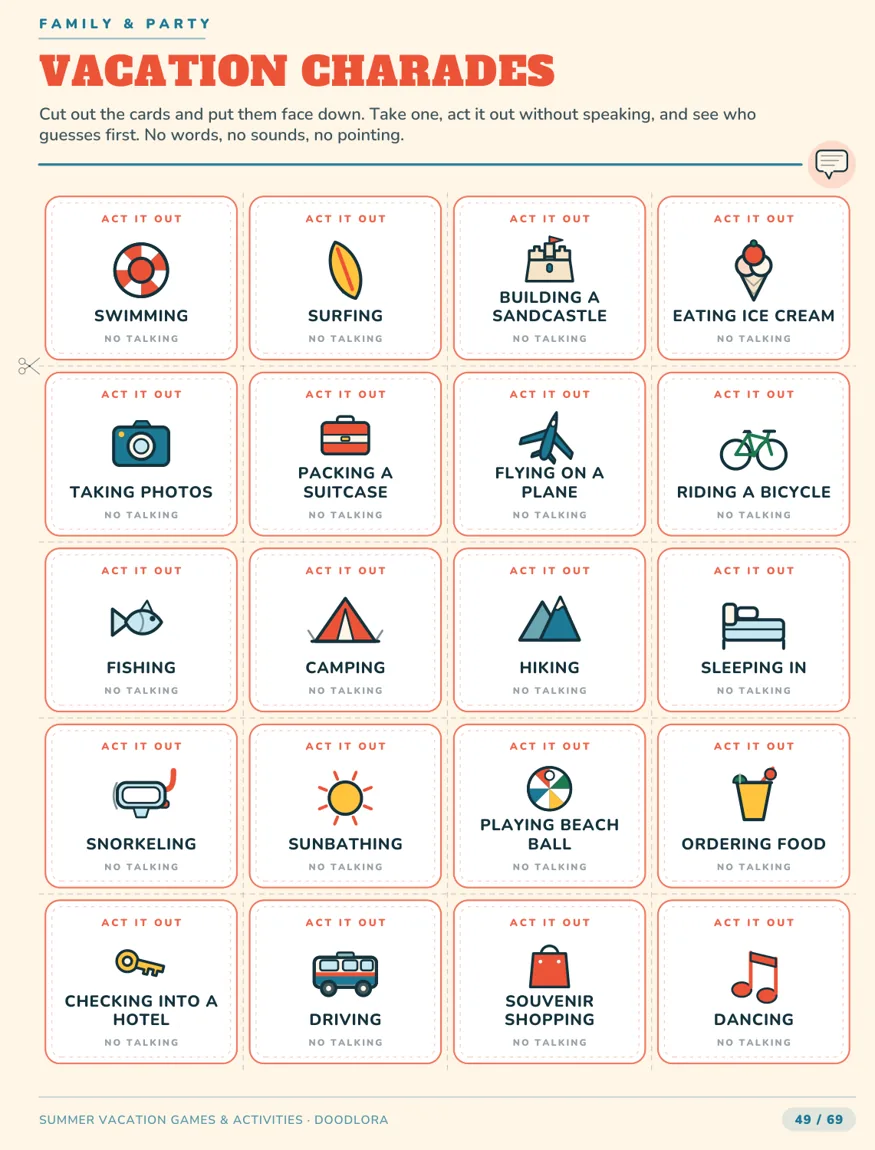
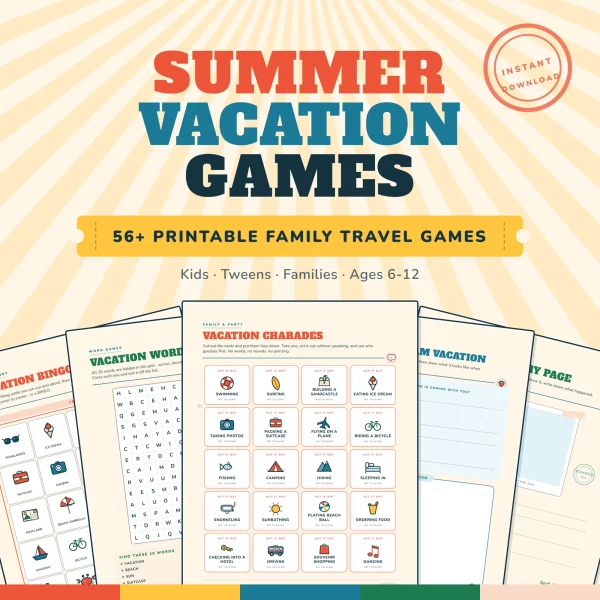
The card sheet in our vacation book prints the whole round in two short lines: cut out the cards and put them face down, take one, act it out without speaking, and see who guesses first.
Those two lines are the whole game. Everything else is a house rule, and house rules are where most of the frustration starts.
The same sheet spells out the silence as “No words, no sounds, no pointing.”
The harder deck, on the very next page, only asks for no words and no pointing at things in the room.
That second sheet never mentions sounds.
So decide before you start whether a bark, a splash or a whoosh is allowed, because a five-year-old acting out a dog will bark without thinking.
We’d allow sound effects in the first round with young kids and take them away once everyone understands the idea.
Pointing is the other gray area. Pointing at a real cup on the table gives the answer away, but pointing at your own feet to show you’re walking on hot sand is just acting.
Mouthing the word and drawing letters in the air both count as talking, and it’s easier to say so now than to take back a point later.
Then give a demonstration with one card yourself, something easy like taking photos, and let that practice turn end when someone guesses rather than when a timer goes off.
Easy and hard charades prompts for kids
Once the rules are clear, the card decides whether a turn is fun or a long, frozen minute.
An easy card names one action the guessers can see, while a hard card adds a problem, a second character or something that isn’t there.
Easy charades: one action the guessers can see
Every card in the easier vacation deck is a single action with a movement most kids can picture: swimming, surfing, fishing, riding a bicycle, eating ice cream, sleeping in.
There are 20 of them, four across and five down, with a small picture on each card.
The four cards marked easy on our Summer Charades sheet work the same way: blowing up an airbed, eating corn on the cob, putting up a tent, swatting a mosquito.
You can tell an easy card by the first move it gives the actor. With “fishing,” the arms come up to cast immediately, before the actor has had a second to think.
If you’re writing your own cards, start with something your kids do every week and add the thing they do it to, like pouring milk or zipping a backpack.
Harder charades: a problem, a second character or something missing
The second vacation deck is labeled “the harder deck,” and its 20 cards show how a prompt gets harder.
Put the two decks side by side and a pattern appears: many harder cards are an easy card with one complication added.
Packing a suitcase becomes packing at the last minute. Taking photos becomes taking a group photo. Ordering food becomes ordering food in another language, and flying on a plane becomes falling asleep on one.
Some harder cards bring in a second character the actor has to play too, like a crab pinching your toe, or the “seagull stealing chips” on our beach sheet.
Others ask the actor to show something that isn’t physically there: a very long line of people, or the sunglasses you’ve just lost.
Our fall set does the same thing with a second line printed under each action, so raking up leaves comes with “then jumping in”; you can see that page in our fall party games roundup.
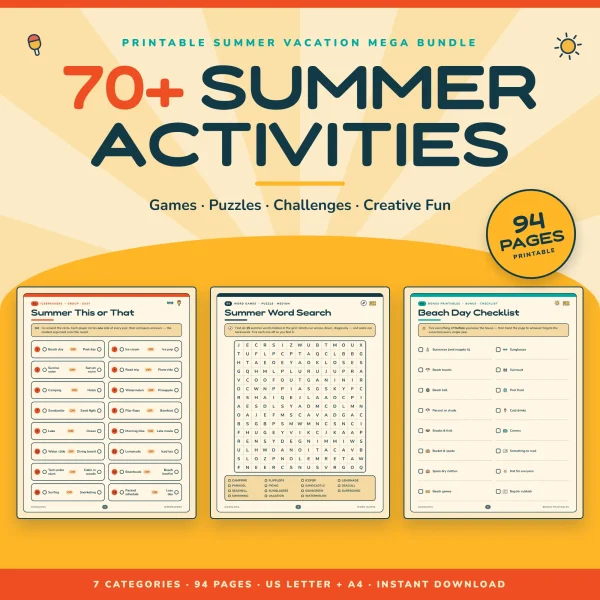
The labels on our Summer Activities & Games Bundle don’t always agree with the vacation decks, and that’s useful to know.
Putting up a tent is marked easy on Summer Charades and sits in the harder vacation deck. Blowing up an airbed is easy there, but blowing up a pool float is hard on the beach sheet.
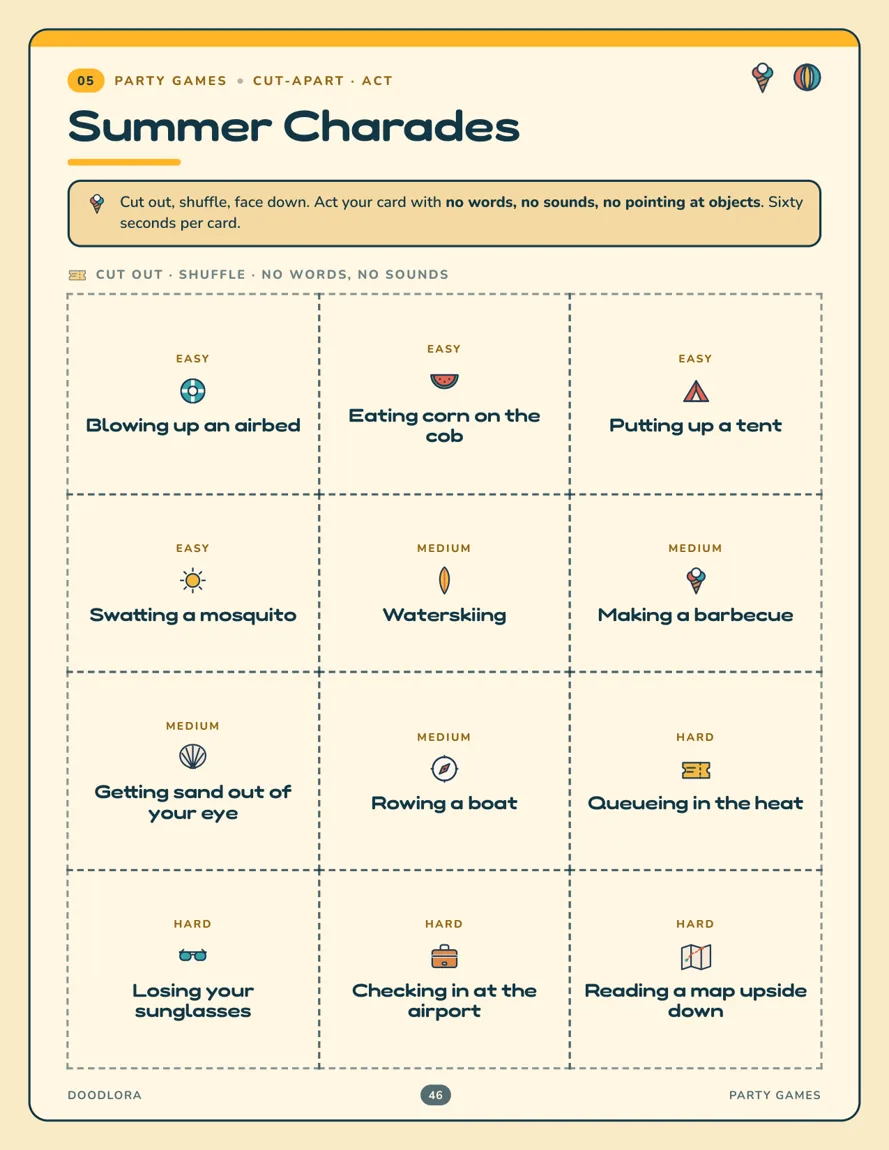
We read that as a sign the labels are a first estimate, not a measurement. The same card is easy for a kid with camping experience and hard for one who’s never held a tent pole.
To make any hard card easier on the spot, cut it back to its action: “packing at the last minute” becomes “packing a suitcase,” and the turn is playable again.
Charades for kids who can’t read the card yet
A hard card is hard to act, but for a child who can’t read yet, every card is hard to read first.
On the easier vacation deck, the picture on each card is the answer: an ice cream cone for eating ice cream, a fish for fishing, a bed for sleeping in.
A kindergartner can take one of those cards, look at the picture and start acting without anyone reading it to them.
The harder deck uses its pictures as hints, not answers. Riding a camel shows two mountains, a very long queue shows a ticket, and missing the train shows a clock.
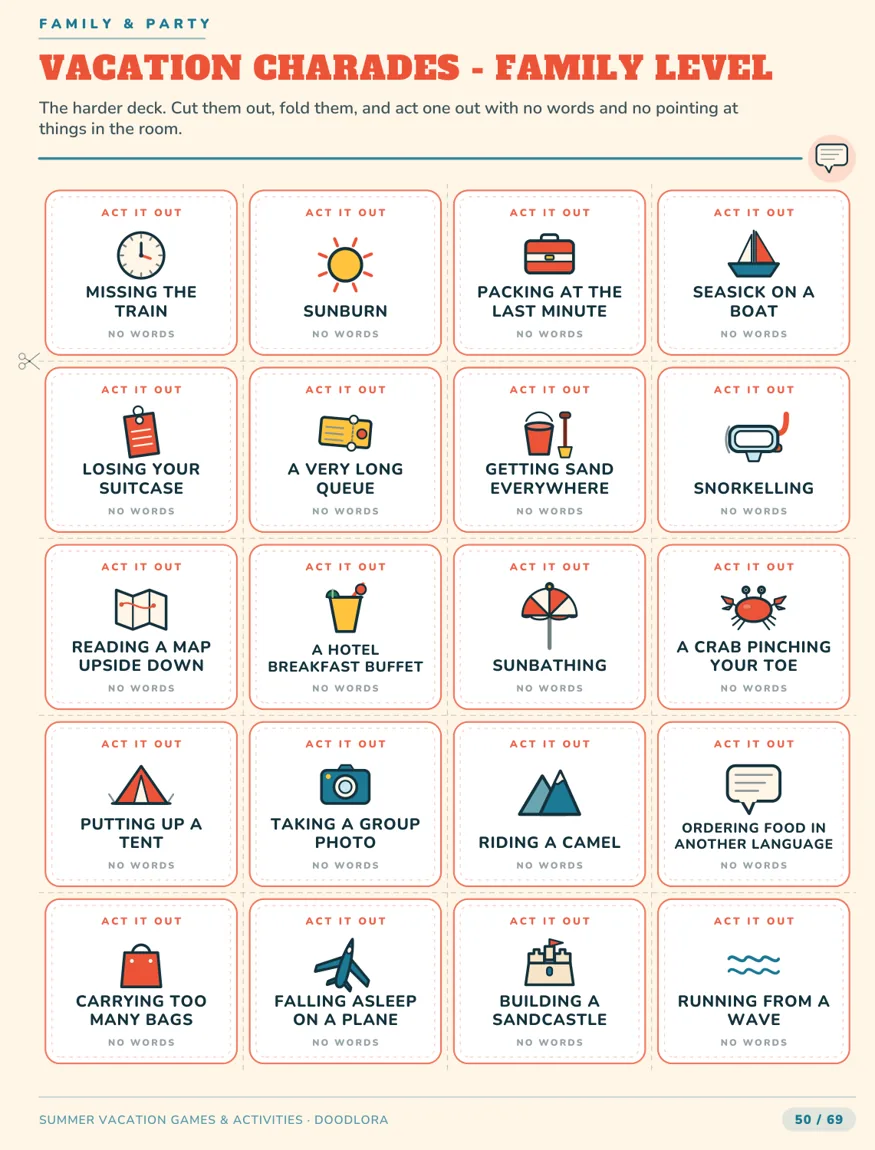
For those cards, whisper the words into the actor’s ear, away from the guessers, and give them a moment to plan the first move before the turn starts.
Whoever reads the card sits out the guessing for that turn, since they already know the answer.
Some of our cards use British words, so swap them as you whisper. “Queue” means a line, and “chips” on the beach sheet means French fries.
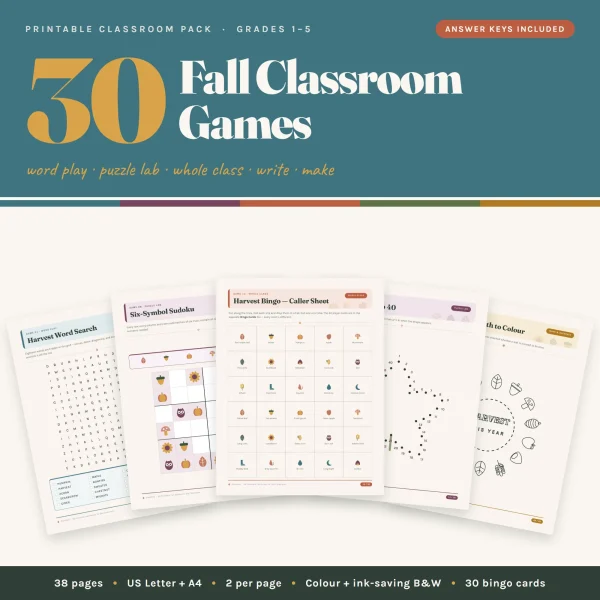
Our Fall Classroom Games book leaves its charades page off the list of games for grades 1 and 2. Its 12 cards are full sentences, like “Pull on rain boots that are two sizes too big.”
For first and second graders, we’d use the picture deck or whisper a simplified version of the card instead.
With preschoolers, skip the sheet and whisper one-action prompts yourself, the kind with a picture you could draw.
If acting from a whisper is still too much, picture bingo, with pictures on both the player cards and the calling cards, needs no reading at all.
Making a charades deck from a printable sheet
Once you know which cards your kids can handle, the sheet has to become a pile of cards.
Print the card pages at actual size, with “Fit to Page” turned off. The read-me in our vacation book warns that fitting the page shrinks the grids and the card sheets stop lining up.
Use light cardstock if you have it. The book asks for 160 to 200 gsm, and 65 lb cover cardstock (176 gsm) falls inside that range; our guide to which paper to print on explains the US weights.
If the cards still don’t line up when you cut, the book’s quick-start fix is to print one sheet at a time rather than two-sided and cut along the dashed lines, not the card borders.
If you shuffle both vacation decks together, pull out the repeats first.
Building a sandcastle and sunbathing appear in both decks, and snorkeling turns up twice with two spellings, snorkeling and snorkelling.
Leave them in and somebody will act out a card the room guessed ten minutes ago.
Keep unused cards face down in one pile and played cards in a second pile, so a card can’t come back in the same game.
If an actor may swap a card they don’t recognize, give everybody the same single swap, so the permission feels fair.
In Family Vacation Games & Activities, the two vacation decks and the draw-and-guess deck sit back to back on pages 49 to 51, so printing three pages covers an evening of acting and drawing for kids 6 to 12.
How long should a charades turn be for kids?
Give a short, one-action card about 60 seconds and a card that’s a whole sentence about 90, and don’t time a child’s first few turns at all.
Across five Doodlora Studio books and bundles, the charades pages give three different answers, and the turn length tracks how long the card is.
| Our deck | Turn length printed on it | What the cards look like |
|---|---|---|
| First day of school, game 28 | 60 seconds for the team | Prompts you write on slips |
| Summer Charades and Beach Charades | 60 seconds a card | Short actions marked easy to hard |
| Fall Classroom Games, Autumn Charades | 90 seconds each | Full sentences, often in two parts |
| Fall party set, Fall Charades | 90 seconds per turn | An action plus a second line |
| Vacation decks, both | No timer; first to guess | One action, or one situation |
The 90-second sets are the ones with the longest cards.
A card like “A squirrel who forgot where the nuts are buried” has two parts to act, and nobody can guess the second until they’ve seen the first.
So time the card, not the child. Short card, short clock; sentence card, longer clock; first turn, no clock.
We haven’t run real rounds with a stopwatch, so treat 60 and 90 as the decks’ starting points rather than something we measured.
Team charades, first-to-guess or the whole group together
With the clock settled, the last thing to decide is who guesses, and our decks use three formats.
Two teams take turns on the classroom card. The vacation decks let anyone guess first. Our summer Act It Out page has the whole group working through one list together.
Charades at home with brothers, sisters and cousins
For four to six players at home, first-to-guess is the simplest format and needs no scorekeeping.
The vacation charades sheet just says to see who guesses first. Its draw-and-guess deck on the next page adds that the first to guess takes the next card, and that rule works for charades too.
If one child shouts out every answer first and the competition stops being fun, switch to taking turns at guessing. Each guesser gets one try, in order around the circle, while the actor repeats the move.
A child can pass on a card they don’t want to act without losing the turn.
With mixed ages, or a child who finds losing especially hard, try the cooperative version on our summer Act It Out page.
The whole group works down a list of 12 situations, ticking each one off once somebody has acted it and someone else has guessed it, and the goal is the whole page rather than a winner.
For a child who goes quiet with everyone watching, our would-you-rather questions for kids leave room to answer with a point or a quick gesture instead.
Charades in a classroom of 4 to 30 students
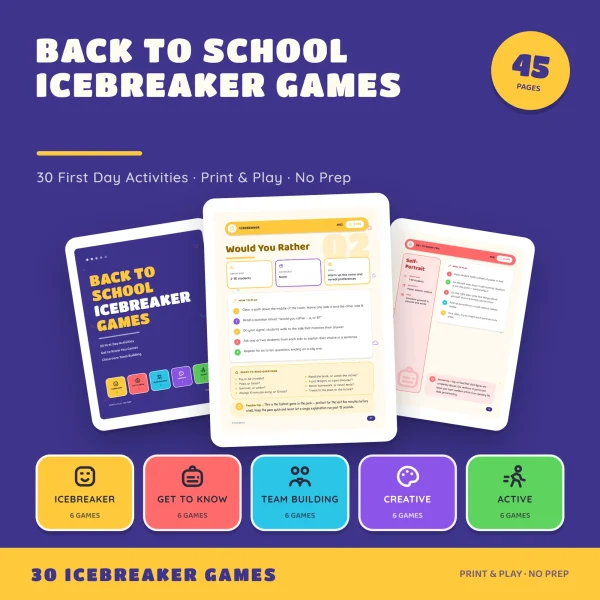
Charades is game 28 in our First Day of School Icebreaker Games, a 15-minute card for 4 to 30 students that needs nothing but prompt slips.
The card runs it in five steps: write prompts on slips of paper and drop them in a container, split into two teams, have one student draw a slip and act it out silently, give their team 60 seconds to guess for a point, and alternate teams until everyone has performed once.
The card’s six first-day prompts are built for a new class, like trying to open a jammed locker, waiting for the bell and a teacher who lost their glasses.
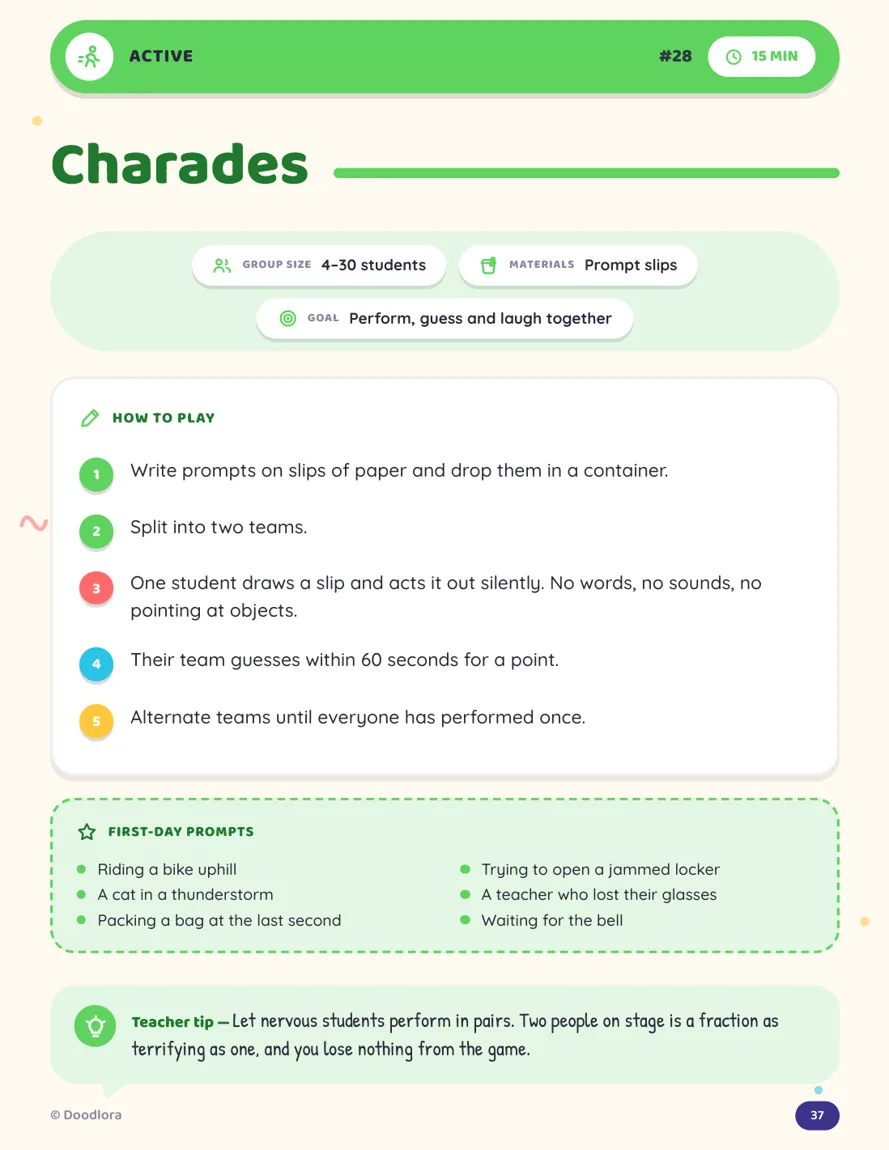
The teacher tip at the bottom is the part we’d keep for any class: let nervous students perform in pairs.
Two kids up front feel far less embarrassment than one, and the game loses nothing.
Charades sits in the pack’s Active section, alongside a classroom scavenger hunt. If you want a second game that gets a room moving, our indoor scavenger hunt has a 20-item list.
When a charades guess is almost right
Once points are on the line, the question you’ll hear most is whether a guess that’s nearly right counts.
Set the rule before the first card. On an easy card, naming the action is enough, so “packing” counts for packing a suitcase.
On a hard card, the problem is the point. “Packing” isn’t enough for packing at the last minute; somebody has to say the rushing part.
Use one rule for both teams consistently, and keep the card next to you so you can read it again before you decide.
When a guess fits what the actor did but isn’t the card, give a short explanation out loud of why you’re counting it or not, so the next actor knows how close is close enough.
If a turn turns into an argument, don’t replay that card, since everyone has now heard the answer. Draw a new one and give the turn back.
The answer key in our vacation book leaves charades out on purpose, calling those pages “opinions and dares, not questions,” which makes the grown-up holding the card the only answer key the game has.
Printables from this article
Related articles
Printable Party Games
How to Plan a Baby Shower: Timeline, Food & 2-Hour Schedule
A baby shower plan from the first talk with the parents-to-be to the last gift: timing, guest list, budget, venue, a two-hour schedule, safe food and backup plans.
Printable Party Games
How to Plan a Bridal Shower: Timeline, Budget and Schedule
A host's plan for a bridal shower, from the first talk with the bride and co-hosts to the guest list, invitations, a timed party schedule, the gift opening and what to do when something slips.
Printable Party Games
35th Birthday Ideas: Party, Trip, Theme and Gift Ideas
Ways to celebrate turning 35, sorted by how many people the birthday star wants around, with group size, time, prep and the snag to plan for in each.