Would You Rather Questions for Kids, Students & Family
Good would you rather questions for kids match the child’s age: two silly pictures at four, a choice with a catch at seven or eight, and a question about people from about ten. Every one should leave room for the best part, which is asking why.
Would you rather have spaghetti for hair or maple syrup for sweat? That one’s fine at four. Would you rather be told the truth even when it stings, or be told what you want to hear? That one’s better saved for ten.
The lists below are sorted by age, from 4 to 12. After them come sets for the classroom and the car, the follow-up questions that keep a conversation going, a few ways to keep score, and a checklist for writing your own.
Would you rather questions for kids by age
The sorting here isn’t by difficulty. It’s by how much a question asks a child to hold in their imagination while they decide.
A young child needs two pictures.
An older child can weigh a cost that lasts a whole year, or a question about the kind of person they’d like to be.
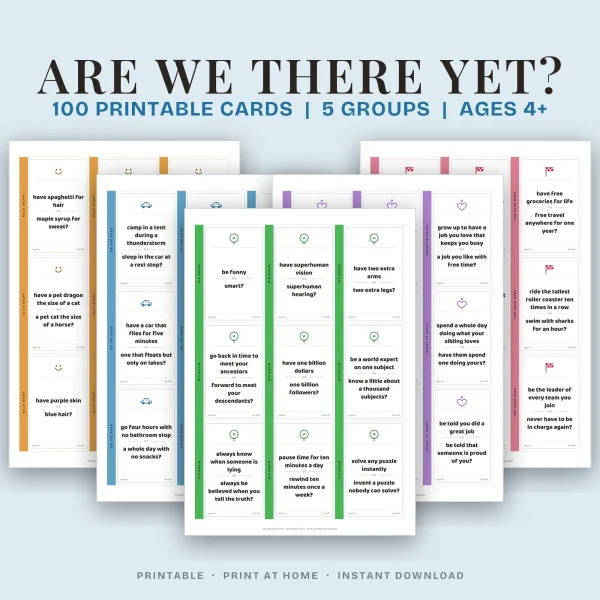
Our road trip deck, Are We There Yet?, sorts its 100 cards the same way. Every card carries a minimum age, from 4+ on the orange Silly Stuff cards to 10+ on the purple Heart to Heart ones.
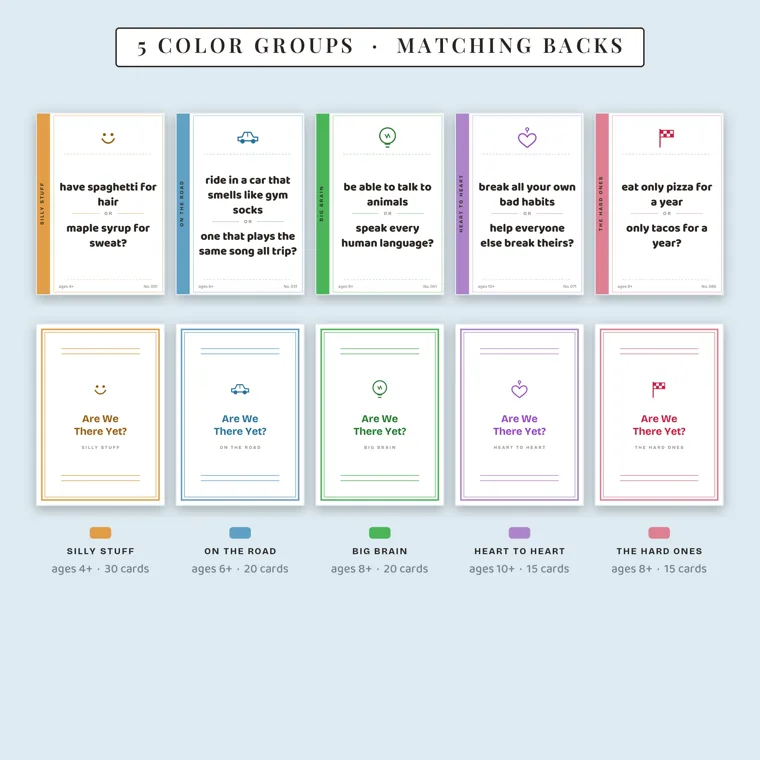
Treat the ages as starting points, not boundaries. A six-year-old who loves hypothetical questions will cope a group up, and nothing stops a twelve-year-old from voting on the spaghetti one.
Ages 4 to 6
For the youngest players, both sides should be something they can see right away: a body that does something funny, an animal, a food, a place. Keep it to one change to the world per option, and nothing that adds up over weeks or years.
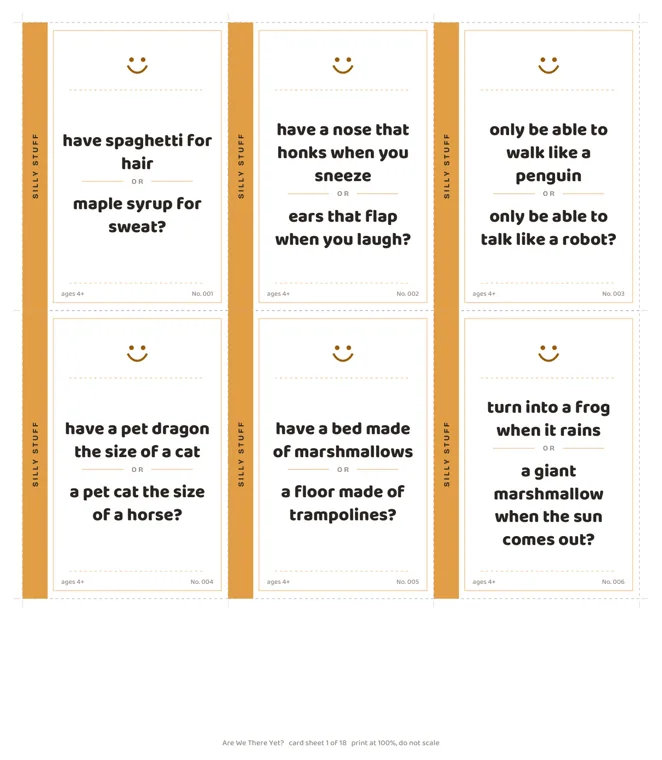
- Would you rather have spaghetti for hair or maple syrup for sweat? (road trip deck, ages 4+)
- Would you rather sleep upside down like a bat or standing up like a horse? (road trip deck, ages 4+)
- Would you rather have socks that squeak with every step or a hat that sings when it rains?
- Would you rather fit inside a teacup for a day or be too tall to fit through your front door?
- Would you rather roar like a lion every time you laugh or quack every time you say hello?
- Would you rather eat cereal with chopsticks or pancakes with a spoon?
- Would you rather have a giraffe as your babysitter or a penguin?
- Would you rather wear mittens all day, even while you eat, or a raincoat all day, even in the bath?
A four-year-old might answer by pointing, or by acting the whole thing out, and that counts as an answer.
If “why?” only gets a shrug, go smaller. Ask something that doesn’t need an explanation: what song would the hat sing, and what would the giraffe make you for lunch?
It’s the same conversation, one step easier.
Ages 7 to 9
Around seven, a question can start carrying a catch: a rule, a number, a cost that runs “every day for a year.” The fun moves from picturing the choice to working out the consequences of living with it.
In the road trip deck, the blue On the Road cards start at 6+ and the green Big Brain cards at 8+, and both groups lean on trade-offs like these.
- Would you rather pick every song on the trip or pick every snack on the trip? (road trip deck, ages 6+)
- Would you rather pause time for ten minutes a day or rewind ten minutes once a week? (road trip deck, ages 8+)
- Would you rather get $20 today or $5 a week for the next eight weeks?
- Would you rather talk to dogs for one hour a day or read your teacher’s mind for one minute a day?
- Would you rather have an extra hour of recess every day or two extra weeks of summer vacation?
- Would you rather read a whole book in one minute or learn any song on the piano in one hour?
- Would you rather always know what’s for dinner before you get home or always know what you’re getting for your birthday?
- Would you rather have a slide from your bedroom to the kitchen or a zip line from your house to your best friend’s?
The money question has a math answer: eight weeks of $5 is $40, twice the $20 on offer today. If a child takes the $20 anyway, don’t correct the arithmetic. Ask why instead, and you’ll hear how they feel about waiting, which is the more interesting conversation.
Ages 10 to 12
Older kids can take questions about people: friendships, brothers and sisters, fairness, and what they’d stand up for. These don’t have a silly side, so they’re better suited to a quiet drive or the end of dinner than to a loud birthday party.
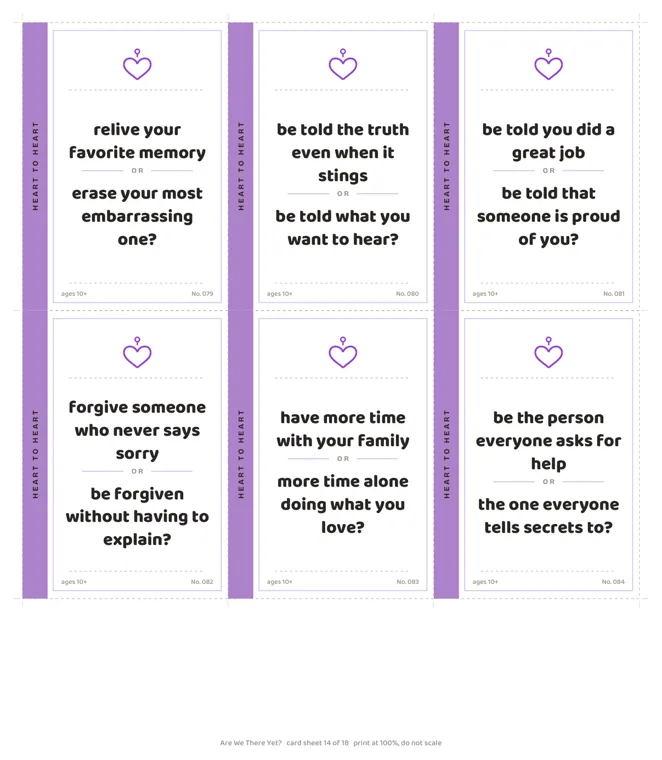
The road trip deck keeps its purple Heart to Heart cards, the ones about family and feelings, for ages 10 and up.
- Would you rather be the oldest kid in a family or the youngest? (road trip deck, ages 10+)
- Would you rather be told the truth even when it stings, or be told what you want to hear? (road trip deck, ages 10+)
- Would you rather have one friend who knows everything about you or ten friends who each know a little?
- Would you rather be the kid who has the idea or the kid who makes it happen?
- Would you rather redo one day from last year or skip one day from next year?
- Would you rather stand up for someone and get in trouble for it, or stay quiet and feel bad about it later?
- Would you rather win a big trip for yourself or a smaller trip for your whole family?
- Would you rather have a sibling who’s your best friend or a best friend who feels like a sibling?
Answer these yourself as well, because a ten-year-old asked about standing up for someone will want to know what you’d do. “It depends” is a fair answer, as long as you say what it depends on.
Would you rather questions for elementary students
In a classroom, the same game has a different job.
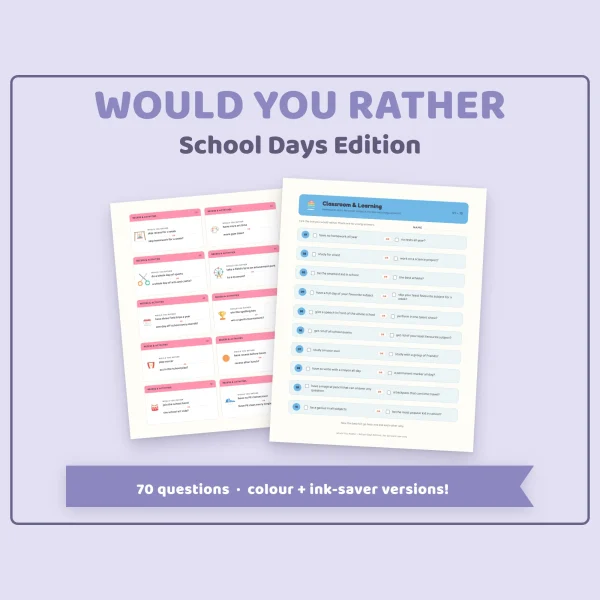
It warms up a group, fills the five minutes before the bell, and gives a quiet student one easy sentence to say out loud. The Ways to Play page in our School Days set lists those jobs: a first-day icebreaker, a morning circle warm-up, speaking and listening practice, something a substitute teacher can run, and indoor recess on a rainy day.
Questions about the school day itself work well with a class, because everyone in the room has lived through lunch, the bus and homework. These five come from School Days, which has 70 questions in seven topics:
- Would you rather have no homework all year or no tests all year?
- Would you rather eat school cafeteria meals or bring lunch from home?
- Would you rather walk to school or take the bus?
- Would you rather have three field trips a year or one day off school every month?
- Would you rather have a pet T-Rex or a shape-shifting alien as the class pet?
And three of our own for the same room:
- Would you rather have class outside once a week or take the class pet home every weekend?
- Would you rather eat lunch in the library or have recess in the gym every day?
- Would you rather be line leader for a month or pick the read-aloud book for a month?
With a whole class, a list you read from is quicker than a deck of cards. School Days prints every question both ways: seven card pages with ten cards to cut apart, and seven list pages with the same ten questions per topic, a checkbox beside each choice and a line for a name.
A list page lets every child mark an answer before anyone speaks, so the students who never call out still get a say. Our Halloween deck’s classroom tips suggest the game as speaking practice for English learners, too: two options, one reason.
If you print the cards, print at 100% rather than Fit, or the cards won’t come out the size they were drawn at. How to print at actual size shows where that setting lives. The School Days guide also suggests punching a hole in one corner of each card and keeping each topic on its own ring.
Family would you rather questions for dinner and car rides
At home, the questions can be about the family itself, and the grown-ups and grandparents take a turn too. For open questions the whole table can answer, try our family conversation starters, 64 questions in seven groups sorted by the kind of night you’re having and who’s at the table.
- Would you rather cook dinner with a grown-up tonight or pick dessert for the whole week?
- Would you rather go camping in the backyard or have a sleepover in the living room?
- Would you rather have your grandparents live next door or visit them somewhere far away every summer?
- Would you rather have a family game night every Friday or a pancake breakfast every Sunday?
- Would you rather visit every state once or visit your favorite state ten times? (road trip deck, ages 6+)
- Would you rather stop for a two-hour hike or a two-hour museum? (road trip deck, ages 6+)
In the car, the deck’s own house rules keep the conversation moving.
Are We There Yet? is written for 2 to 6 players, with no winners and no timer, and whoever answered last reads the next card.
That way the reading passes around the car without anyone arguing over whose turn it is.
The deck adds three variations on a card of their own. Beat the Clock gives ten seconds to answer. In Guess the Driver, everyone predicts what the driver will pick. All Agree means the whole car has to land on the same side.
All Agree is the one to try with siblings who argue. It turns a disagreement into a negotiation, since they’ve got to talk each other into it instead of scoring points.
The cards are 2.5 x 3.5 in (6.4 x 8.9 cm), the size of a regular playing card, so a stack fits in a glove box. For other games to print for the same trip or party, browse our printable party games.
How to ask would you rather questions so kids really talk
The pick takes a second, but the reason is where the conversation is, so ask “why?” after every choice, the silly ones included.
The For Grown-Ups page in School Days gives four rules for this: ask why every single time, answer it yourself first, let the strange answers stand, and watch the quiet ones, because a two-option question is much easier to answer than an open one.
Answering first matters more than it sounds. The same page says children copy the length of the answer they hear, so if your own explanation is one word long, don’t expect more than one word back.
When “why?” stalls, change the question instead of repeating it. The page lists six follow-ups, and these four fit almost any card:
- What would make you switch?
- What is the worst part of the other one?
- Who else would pick what you picked?
- Would you still pick it tomorrow?
Decide on skipping before you start, because our own decks don’t agree.
School Days lets a child who doesn’t want to answer pass and read the next card instead, and that still counts as a turn.
Are We There Yet? says everybody answers, with no skipping and no picking “both.”
Each rule fits its setting. In front of a class, a pass keeps a nervous child in the game without any embarrassment. In the family car, “no both” closes the easy way out, and “both” is the one answer nobody learns anything from.
Ways to turn would you rather into a game
A plain round has no score, and for most families that’s enough. When a group wants a winner, our decks score the guessing rather than the answers, so nobody wins for holding the “right” opinion.
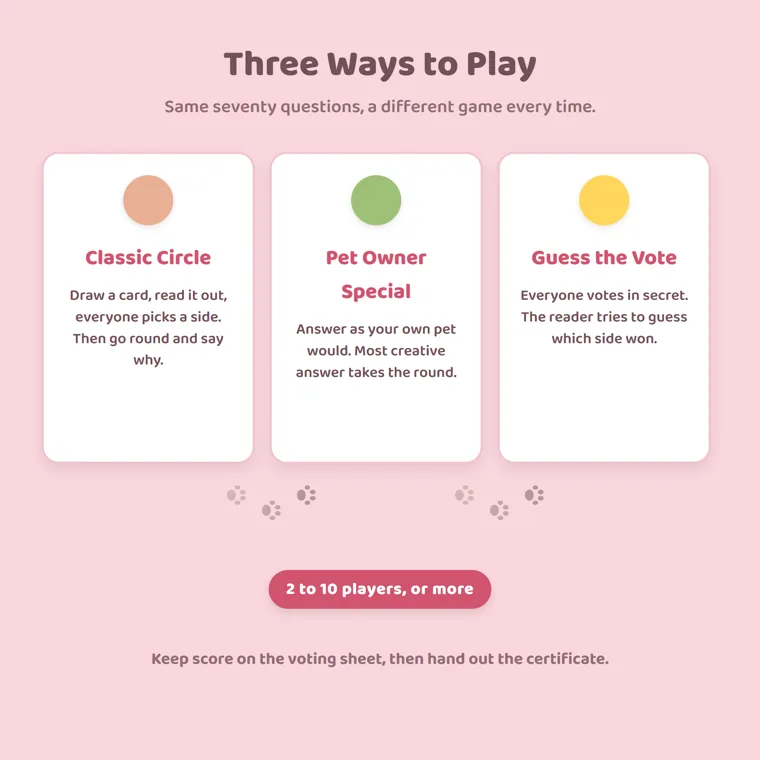
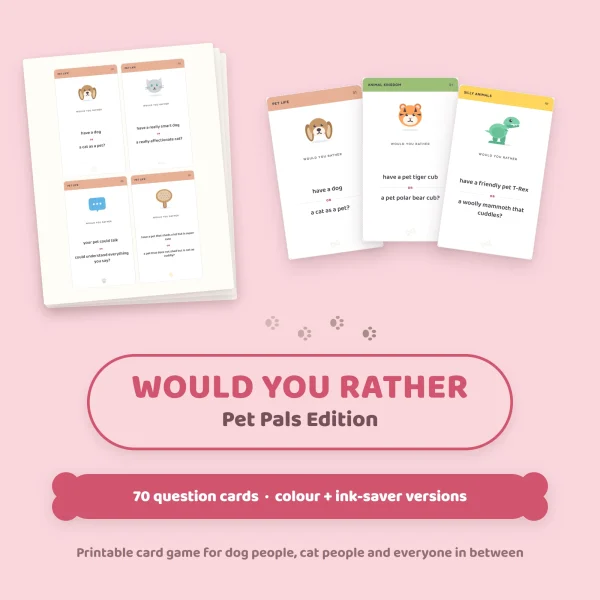
- Guess the vote. One player reads, everyone points at A or B on the count of three, and the reader guesses which side got more votes. Our Pet Would You Rather Cards call it Guess the Vote and include a voting sheet for the score.
- Answer as your pet. In the same deck’s Pet Owner Special, players answer the way their own pet would, or their dream pet, and the table votes for the most creative answer.
- Guess your partner. Before a card is read, one player predicts what a friend will choose. School Days lets a right guess keep the card.
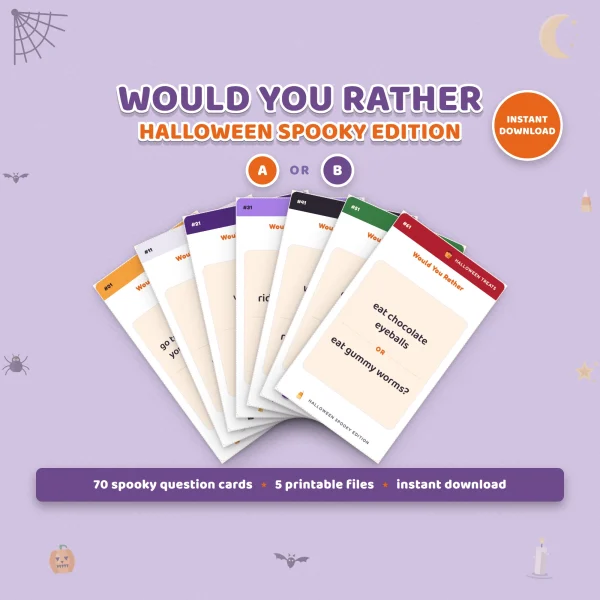
- Trick or treat. In our Halloween Would You Rather Cards, the player who draws can do a trick instead, like a silly dance or a monster face. Its tips page suggests letting kids 6 to 10 act the answer out instead of explaining it.
- Pick a side of the room. With space to move, read the question and have everyone walk to one wall or the other. School Days lists it among its party ideas.
The acting options are worth keeping for the kid who goes silent in front of a group. Doing a monster face still counts as taking a turn.
If the acting turns are the part your kids like best, our guide to playing charades with kids covers which cards a young actor can manage and how to help one who can’t read the card yet.
If they’d rather race a clock than argue, our guide to timed one-minute games hands each child one card and 60 seconds, with the target moved closer for players under eight.
How to write your own would you rather questions
Kids run through a deck fast, and they’re often proudest of the questions they write themselves. Most of our decks leave room for that: School Days, the Pet deck and the Halloween deck each include 10 blank cards, and Are We There Yet? has four.
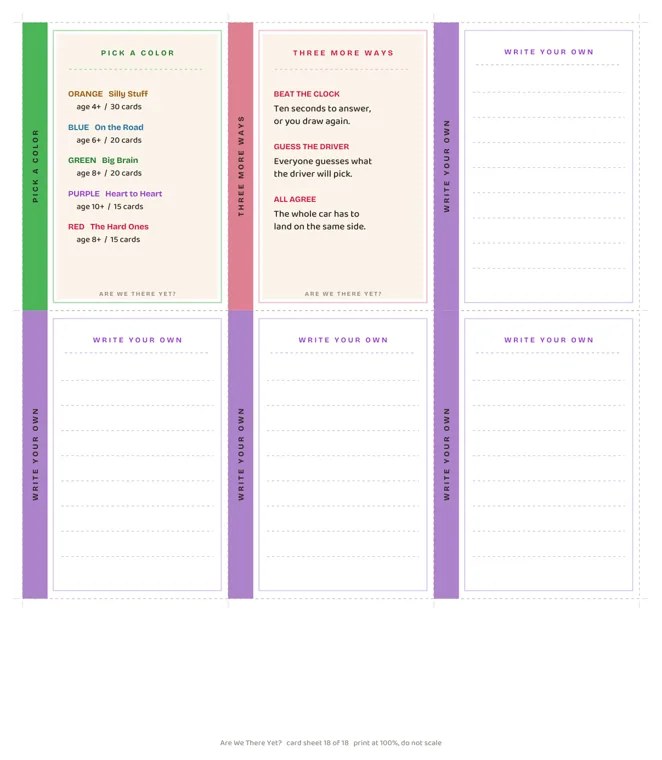
Before a new question goes on a card, check it four ways.
Both sides pull. If one side is plainly better, the answer takes a second and there’s nothing to discuss. “Ice cream or a stomachache” isn’t a question.
Both sides can be pictured. This matters most for younger kids, especially under six. A side they can’t imagine is a side they won’t choose.
There’s a catch. The good ones make you give something up. A pet T-Rex sounds unbeatable until you remember it has to live in your classroom.
It fits in one breath. If the reader has to start the card over, cut words until they don’t. Long, complicated sides lose the listener halfway through.
In a group, add one more: keep the question about the player, not about someone in the room. “Would you rather sit next to Sam or Maya?” puts two real kids on the spot.
Writing questions is also an assignment in itself: the Pet and Halloween guides both suggest turning a card into a writing prompt, where kids defend their choice in one paragraph.
For blanks that get written on and passed around, cardstock holds up better than copy paper. Our paper guide lists which weight to buy for game cards.
Printables from this article
Related articles
Printable Party Games
How to Plan a Baby Shower: Timeline, Food & 2-Hour Schedule
A baby shower plan from the first talk with the parents-to-be to the last gift: timing, guest list, budget, venue, a two-hour schedule, safe food and backup plans.
Printable Party Games
How to Plan a Bridal Shower: Timeline, Budget and Schedule
A host's plan for a bridal shower, from the first talk with the bride and co-hosts to the guest list, invitations, a timed party schedule, the gift opening and what to do when something slips.
Printable Party Games
35th Birthday Ideas: Party, Trip, Theme and Gift Ideas
Ways to celebrate turning 35, sorted by how many people the birthday star wants around, with group size, time, prep and the snag to plan for in each.