 1 / 8
First Day of School Icebreaker Games
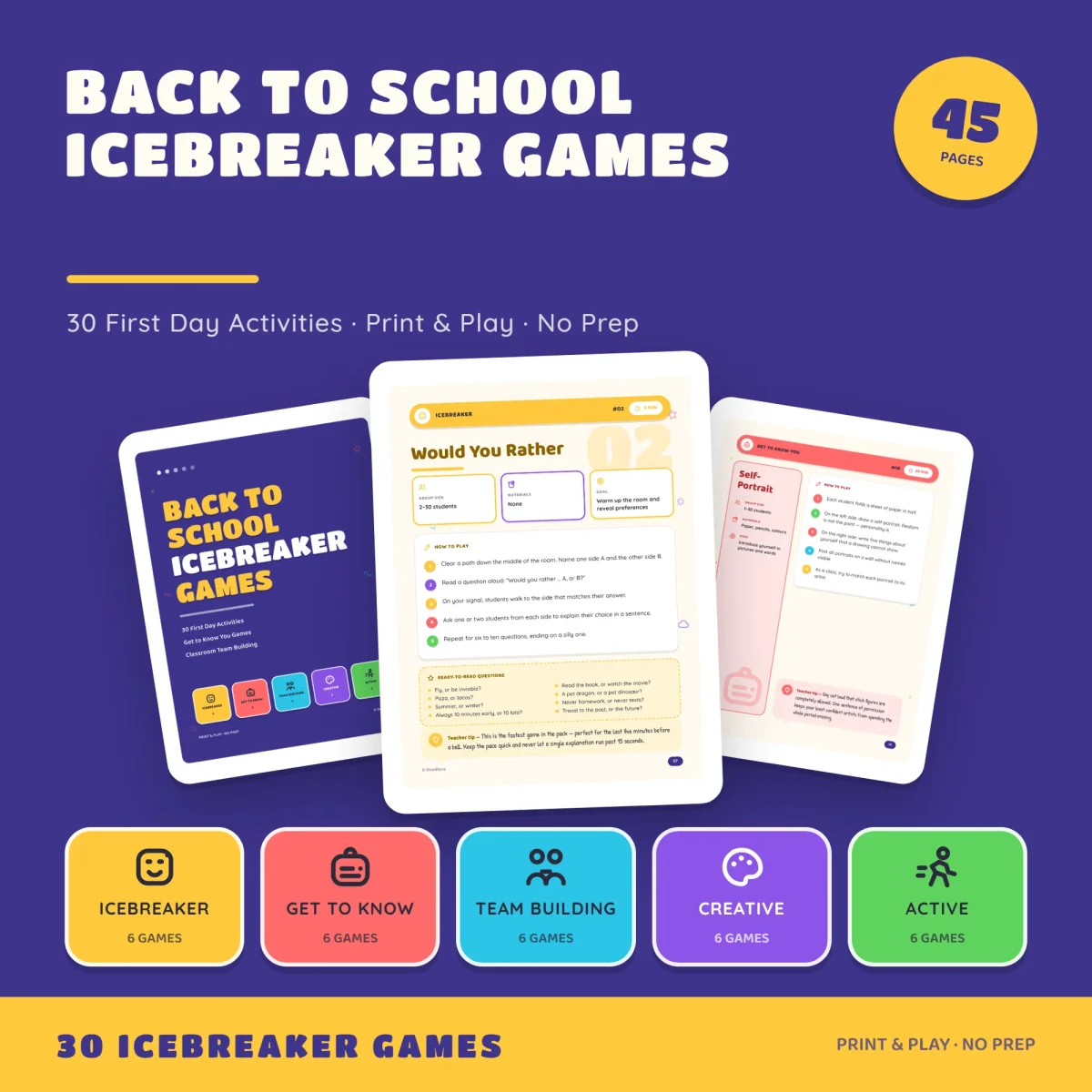
Thirty classroom icebreakers written as one-page teacher cards, each giving the minutes it takes, how many students it suits, what to gather and steps you can read out loud. A game selector at the back matches games to the time you have, from a spare five minutes to a full period.
$6.99
Buy any 3 or more printables and save 20% at checkout.
- Download right after payment — link works for 30 days, up to 5 downloads
- Files arrive as a ZIP with your license PDF inside
- Secure checkout by Stripe · Refund policy
First Day of School Icebreaker Games is a 45-page teacher’s pack of 30 games for a new class, written so you can run each one straight off the page. It covers the first morning, when nobody knows anyone yet, through to the end of the first week, when the class is ready to solve something together.
What each game page tells you
Every game gets one page with the same layout: its section, number and running time at the top, then boxes for group size, materials and goal, the numbered steps, and a teacher tip at the bottom. Times run from 5 minutes (Would You Rather) to 30 minutes (the classroom escape room and the egg drop). Some pages carry a ready-made list, so you don’t need to invent prompts on the spot: eight would-you-rather questions, eight find-someone-who statements, six interview questions, six first-day charades prompts, six escape-room puzzle ideas and eight things for the classroom scavenger hunt.
The five sections
- Icebreaker. Low-risk openers for day one, such as Two Truths and a Lie, The Name Game and a paper Snowball Fight.
- Get to Know You. One step deeper: an All About Me Bag, partner interviews, My Name Story and a Timeline of Me.
- Team Building. Tower Building with paper cups, Human Knot, Trust Walk and Group Juggle, meant for later in the week once names are learned.
- Creative. Things the class makes and keeps, like a shared mural, a class playlist, a time capsule to open in June and a class flag.
- Active. Simon Says, Musical Chairs, Four Corners, Freeze Dance and more, for when the room stops listening.
Planning the week
The game selector near the back sorts all 30 by time (5 minutes, 10 minutes, 15–20 minutes, a full period) and lists the ones that need no materials at all. The pack’s own advice is one or two games a day across the first five days rather than six on Monday. Most games need nothing or just paper and pencils. A few take gathering or setup: 20 paper cups per team for Tower Building, soft balls for Group Juggle, blindfolds for Trust Walk, one egg per team for the Egg Drop, a paper bag sent home the day before for All About Me Bag, and four envelopes hidden around the room before the escape room starts. Group sizes are listed up to 30 students, and Human Knot works best with 20 or fewer.
Printing
Print single-sided so the pages can be handed around as separate game cards. Plain copy paper is enough for one use; for cards that last the year, the pack suggests card stock of 120 gsm (32 lb) or heavier.
Questions
- Are there worksheets for the students?
- Mostly not. The game pages are instructions for the teacher. The reflection page is the one sheet made for students to fill in. For Human Bingo and Find Someone Who, the page gives you starter statements and you draw the grid or list on the board.
- Will it print well in black and white?
- Yes. Color helps because the five sections are color-coded, but each page also prints its section name in words, so nothing depends on color.