Gratitude Journal Prompts: 60 Ideas for Hard Days and Kids
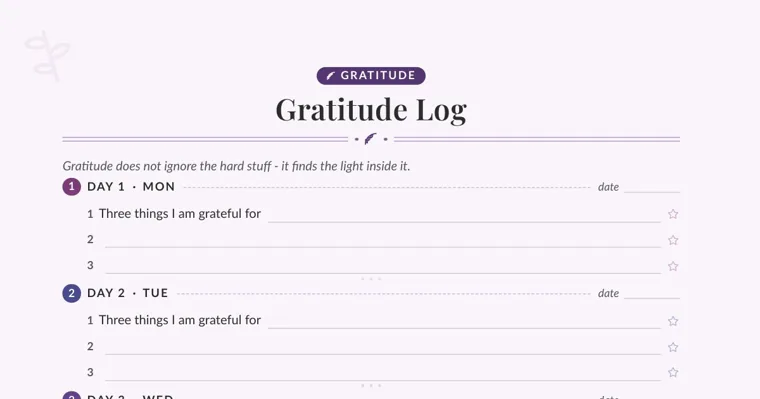
Gratitude journal prompts work best when they ask about one specific moment, person or object instead of the broad “What are you grateful for?” A question like “Who made today easier, and what did they do?” gets a real answer in under a minute. The 60 prompts below are our own, grouped by the situation you’re writing in.
Most entries take two to five minutes: three short answers, written at the same point in your day. You’ll also find what to do when the page stays blank, how to keep going through a rough week, and a version for kids that works at the dinner table.
Pick a set of gratitude prompts by situation
Start with the row that sounds like your week, not the first list on the page. The times are our suggestions for a comfortable entry, and you can stop sooner.
| Your situation | Time per entry | What to have ready | Start with |
|---|---|---|---|
| New to gratitude journaling | About 5 minutes | Any notebook or one printed page, and a pen | First-week prompts |
| Busy weekdays | About 2 minutes | A notebook left where you’ll see it, like the nightstand | Two-minute prompts |
| A hard week | 2 to 5 minutes, stop any time | Permission to write one line and close the book | Hard-day prompts |
| Dinner or bedtime with kids | About 10 minutes for 2 to 6 people | One question, paper slips, crayons for kids who don’t write yet | Kids and family prompts |
| Thanksgiving through New Year’s | 5 to 10 minutes, a few times a week | A page per week and a calendar | Holiday and year-end prompts |
How to start a gratitude journal this week
Starting a gratitude journal needs a pen, a page and a time of day you already keep. Tie it to something that happens anyway: the first cup of coffee, brushing your teeth, the minute after you turn off the bedroom light. Leave the notebook open at that spot so you don’t have to go looking for it.
Write three things per entry, and give each one a detail or a “because.” “My sister” is a start. “My sister drove 40 minutes to drop off soup” is a memory you’ll be glad to reread. Date every entry, then close the book. That’s the whole routine.
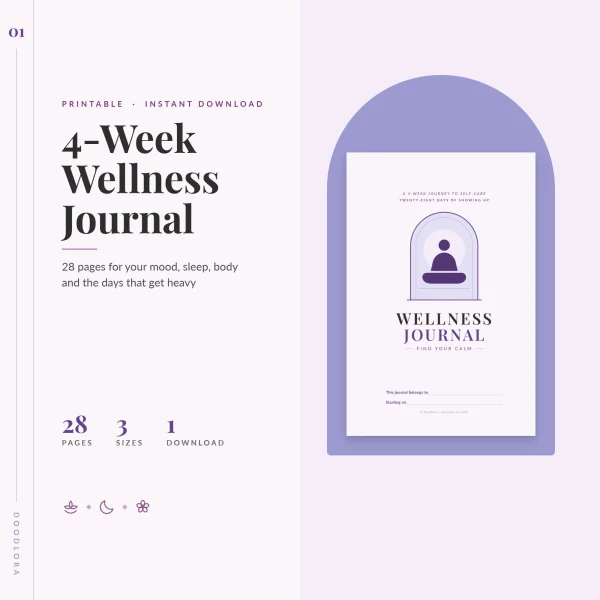
A plain notebook works fine, but a printed page with numbered lines removes one decision. The Gratitude Log in our 4-Week Self-Care Journal puts Monday through Sunday on one page, with three lines for each day.
Daily isn’t required. If every night feels like a chore by Thursday, switch to three evenings a week and keep those three. A short entry you keep writing beats a long one you dread.
First-week gratitude prompts
Use one of these each day for the first week, or answer two on a slow evening:
- What’s one thing from today you’d like to remember a year from now?
- Who made your day a little easier, and what exactly did they do?
- What’s something in your home you use every day and rarely notice?
- Which meal or snack this week tasted better than you expected it to?
- What’s a skill you have now that took you a long time to learn?
- Where were you when you laughed hardest this week, and who was there?
- What’s one small problem this week that turned out fine in the end?
- Which message, call or text this week are you glad you received?
- What did you get to do today that you’d have missed if you’d stayed home?
- What’s something you’re looking forward to, even if it’s very small?
Reading back at the end of the week
Set aside five minutes on Sunday to read the week’s entries in one sitting. Look for a name or a place that keeps showing up. Then write one line under the last entry: what you’d like more of next week. Reading back is where a pile of short notes turns into something you can act on, like calling the friend who appears three times.
Two-minute gratitude prompts for busy days
Two-minute gratitude prompts suit mornings before work and nights when you’re already half asleep. Pick one question, answer it in a sentence or two, and stop. Keep the same prompt for a whole week if choosing a new one each day slows you down.
Morning prompts
- What’s one thing about this morning that has already gone right?
- Who are you likely to see today that you’re glad to have around?
- What will you use today that someone else made, grew or fixed?
- Which part of today are you looking forward to, even slightly?
- What’s one comfort you have this morning that you didn’t have a few years ago?
Evening prompts
- What were the best ten minutes of your day, and what made them good?
- Who said something today that stayed with you in a good way?
- What went more smoothly today than you expected it to?
- What did you do today that next week’s you will be thankful for?
- What did you see on the way home, or out the window, that deserved a second look?
- What happened today that wouldn’t have happened without someone else?
- What made you smile today that nobody else noticed?
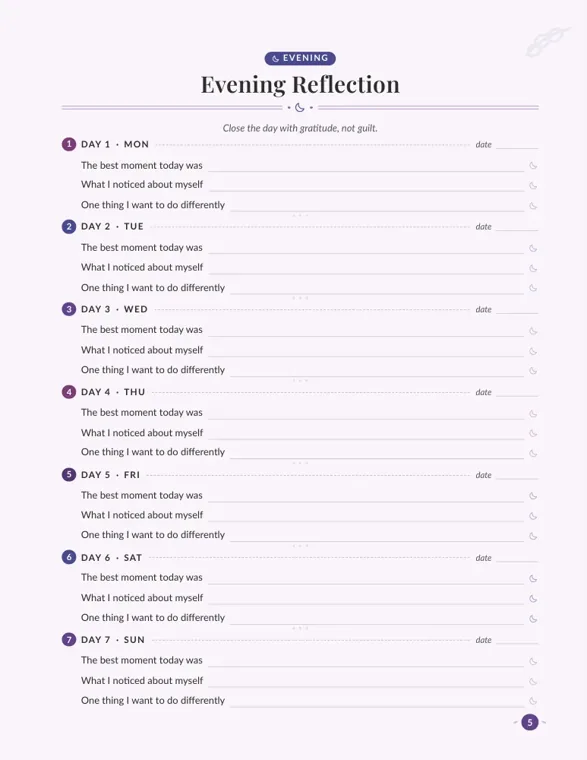
The 4-Week Self-Care Journal has this Evening Reflection page on page 5, with seven days of three fixed lines. Its Gratitude Log on page 8 uses the same weekly layout, with three numbered lines per day under “Three things I am grateful for.”
Here’s the catch: each of those pages covers one week, and the 28-page journal has one of each. For a full month of gratitude entries, print page 8 four times.
Gratitude prompts for hard days
Hard days are when “list three things you’re grateful for” can feel like being told to cheer up. The fix is to lower the bar instead of skipping the entry. Name the hard thing honestly, in one line, and then look for one small thing that sits next to it. A warm drink counts. A text from a friend counts.
- What’s one thing that worked today, even if everything around it didn’t?
- Who checked on you this week, or who would you call if you needed to?
- What was the smallest comfort you had today, like a quiet minute or dry socks?
- What did you get through this week that you weren’t sure you could?
- What’s one thing you don’t have to deal with today?
- Write the hard thing in one sentence, then write one thing that helped you carry it.
- What will still be there for you tomorrow, no matter how today went?
- What would you thank yourself for today, if a friend had done it?
- What did you do today only because you care about someone?
- What’s one thing you’re not grateful for right now, and one thing beside it that you are?
Watch out for sentences that start with “at least.” “At least it wasn’t worse” compares your day to an imagined disaster, and it tends to make a hard entry feel like a scolding. Prompt 28 avoids that by letting the hard part stay on the page.
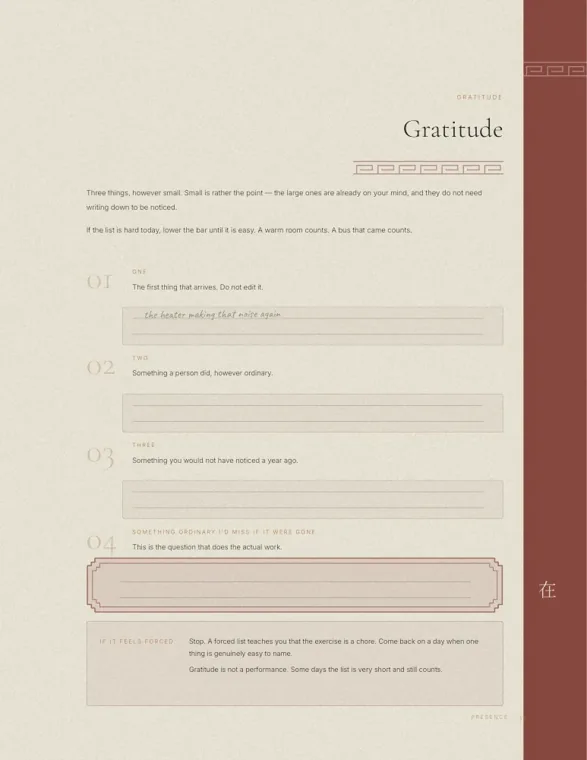
The Gratitude page in our Chinese-Inspired Wellness Journal is page 35, the first prompt page of its Presence volume. It asks for three things, then a fourth: something ordinary you’d miss if it were gone.
Its advice for a forced list is to stop and come back on a day when one thing is easy to name. If a rough stretch keeps pulling your entries somewhere heavier, closing the notebook and talking to someone you trust is a fine choice too.
Gratitude prompts for kids and families
Gratitude prompts for kids work best spoken aloud, at a set time, with the whole family answering. Dinner and bedtime are the easiest slots. Two to six people can go around a table in about ten minutes if each person gives one answer. Children who can’t write yet can draw their answer or tell an adult what to write on a slip.
Start by reading one question and answering it yourself first, so kids hear what a specific answer sounds like. Go around once. To finish, drop the slips in a jar, or have one person read the answers back. Let anyone pass. A forced “thank you” at the table teaches the opposite of what you’re after.
Prompts for young children
- What was the funniest thing that happened today?
- Who was kind to you today, and what did they do?
- What’s your favorite thing in your room, and why do you like it?
- What food did you really love eating this week?
- What’s something you can do now that you couldn’t do last year?
- Who would you like to say thank you to, and what would you say?
Prompts for older kids and teens
- Which friend made this week better, and how did they do it?
- What’s a song, show or game you’re glad exists right now?
- What did a teacher, coach or family member do that you never said thanks for?
- What’s something about where you live that you’d miss if you moved?
- What’s a mistake from this month that taught you something useful?
- What’s one thing you’re glad to have that you didn’t have to earn?
If a child answers “my tablet,” take it. Ask one follow-up, like “What do you like doing on it most?” Correcting the answer is the quickest way to get “I don’t know” next time.
Our family conversation starters has more on follow-up questions and on letting family members pass. For a craft version, the thankful tree and gratitude jar in our Thanksgiving activities for kids give younger children something to make and keep.
Gratitude prompts from Thanksgiving to New Year’s
The weeks from Thanksgiving to New Year’s give a gratitude journal natural checkpoints. Use the Thanksgiving prompts the week of the holiday, the December ones on busy weekends, and the year-end list in the quiet days after Christmas. A few entries a week is plenty in this season.
Thanksgiving week prompts
- Which person at this year’s table, or missing from it, are you most thankful for, and why?
- What dish or tradition would feel wrong to skip, and who started it?
- What went right this fall that you haven’t told anyone about yet?
- Who helped get this holiday ready and might not get thanked for it?
- What’s different about this Thanksgiving compared with last year, in a good way?
At the table itself, a spoken game is easier than a journal. The thankful alphabet in our Thanksgiving games gets everyone naming something, one letter at a time.
December prompts
- Which December plan are you most looking forward to, and who’s in it?
- What gift from a past year do you still use, and who gave it to you?
- Who did something kind for you this month without being asked?
- What holiday sight, sound or smell would you miss if it disappeared?
- What’s one thing you’re glad you said no to this month?
A note on December: holiday entries can drift into lists of presents. If yours do, switch the question from things to people for a week.
Looking back on the year
- What was the best ordinary day of this year, with nothing special planned?
- Who showed up for you this year in a way you didn’t expect?
- What did you learn this year that you’ll keep using?
- Which worry from January looks smaller now?
- What improved this year in your home, work or routine?
- What do you want to carry from this year into the next one?
These six make a good single long entry for December 31. For a group version on the night itself, the time capsule cards and “Whose resolution is it?” in our New Year’s Eve games turn the look-back into something guests do together.
When your gratitude journal stalls
A blank page usually means the question is too broad, not that there’s nothing there. Three problems come up most often, and each has a quick fix.
The page stays blank
Swap the question for a category. Instead of “What am I grateful for?”, try “a sound I like” or “a food I love.” A narrow category points you at one real thing.
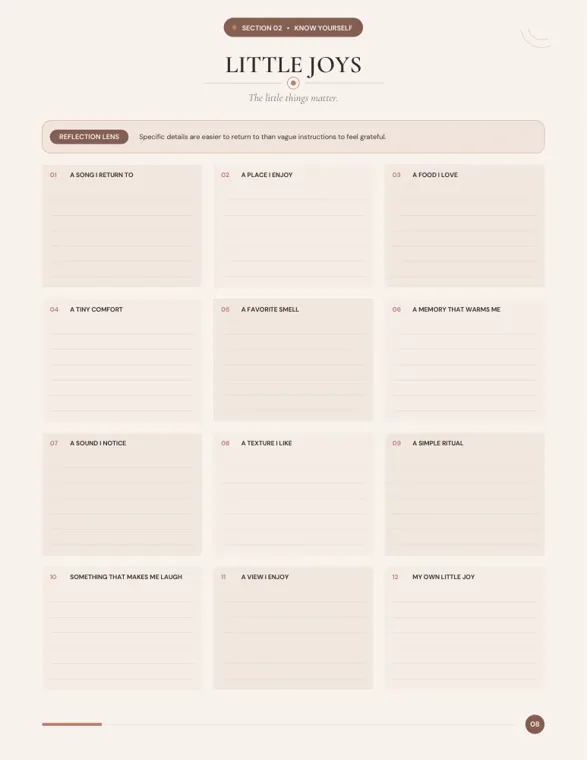
The Little Joys page in our A Little Space for Me guided journal is page 8 and works this way. It has twelve boxes, from a song you return to and a favorite smell to a simple ritual and something that makes you laugh.
Its note says specific details are easier to return to than a vague instruction to feel grateful. Fill one box a day and you have nearly two weeks of entries.
You keep writing the same three things
Family, health and coffee are real answers, but writing them every day turns the entry into a habit you skim. Keep the person and change the question: what did your partner do today, specifically? Or rotate themes: people on Monday, places on Tuesday, objects on Wednesday.
You missed a week
Don’t backfill the empty days. Write today’s date and answer one prompt, the shortest one you can find. Skipped days don’t need to be made up, and trying to catch up is how a two-minute habit starts to feel like homework.
Printables from this article


Related articles
Printable Journals
Journal Prompts for Beginners: 40 Ideas to Start Journaling
Forty beginner journal prompts sorted by what you want from the page, with how long each kind of entry takes and what to do when you get stuck.
Printable Party Games
How to Plan a Baby Shower: Timeline, Food & 2-Hour Schedule
A baby shower plan from the first talk with the parents-to-be to the last gift: timing, guest list, budget, venue, a two-hour schedule, safe food and backup plans.
Printable Party Games
How to Plan a Bridal Shower: Timeline, Budget and Schedule
A host's plan for a bridal shower, from the first talk with the bride and co-hosts to the guest list, invitations, a timed party schedule, the gift opening and what to do when something slips.