Stoic Journal Example: Morning & Evening Prompts to Copy

A Stoic journal example usually has three parts. In the morning you preview the day’s likely trouble and decide how you’ll meet it, an idea taken from the opening of Book II of Marcus Aurelius’s Meditations. At night you review the day with three questions that Seneca records in On Anger. When something keeps nagging at you in between, you split it into what is and isn’t in your control, the first lesson of Epictetus’s Enchiridion.
The morning page takes three to five minutes and the evening page five to ten. Those times are our suggestions, not rules from the old texts, and the sample pages below show what a finished entry looks like so you can copy the shape on the first day.
| Practice | When to write it | Time we suggest | Where it comes from | Use it when |
|---|---|---|---|---|
| Morning preview | Before you open your phone | 3–5 minutes | Meditations, Book II, section 1 | You know the day holds a hard call, a difficult person, or a long wait |
| Evening review | In bed, before lights out | 5–10 minutes | On Anger, Book III, chapter 36 | You want to see whether you’re actually changing a habit |
| Control sort | Whenever a worry keeps circling | About 5 minutes | Enchiridion, chapters 1 and 5 | One problem is taking up the whole day |
| Weekly read-back | Sunday | About 15 minutes | Our addition | You’ve written six or seven days and want to see the pattern |
If you’ve never kept a journal at all, start with our journaling basics and come back once writing a few lines a day feels normal.
Which Stoic translations the quotes come from
Every quote on this page comes from an old translation that is free to read on Project Gutenberg. Meditations is quoted from George Long’s translation, On Anger from Aubrey Stewart’s, and the Enchiridion from Thomas Wentworth Higginson’s. Modern translations word these lines differently, so a quote you’ve seen on a poster may not match these word for word. The ideas are the same.
The older English (“thyself,” “thou risest”) reads stiffly at six in the morning. You don’t need to copy it. Read the line once, then write your entry in plain words.
Morning: Marcus Aurelius’s preview of the day
The morning entry is a short rehearsal. You name the people and problems you’ll probably run into, then decide ahead of time how you want to act when they show up. It isn’t a forecast of disaster. The point is to meet the predictable irritations without being surprised by them.
The original lines
Book II of the Meditations opens this way in Long’s translation:
“Begin the morning by saying to thyself, I shall meet with the busybody, the ungrateful, arrogant, deceitful, envious, unsocial. All these things happen to them by reason of their ignorance of what is good and evil.”
The passage then turns away from the list and toward how to treat those people, with the line “we are made for co-operation.” That turn is the part a journal can use. The list of difficult people takes one line, and the rest of the entry is about your own response.
A second morning line comes from Book V, for days when getting out of bed is the hard part: “I am rising to the work of a human being.”
How to write the morning preview
- Write the date and one line on what’s ahead. Three items is enough: a person, a situation, and one of your own habits that tends to get in the way.
- Next to each item, write how you want to respond. Keep it to an action you could see yourself doing, such as “answer once, plainly” or “let the line be ten free minutes.”
- Circle the part that’s yours. Usually it’s your tone, your timing, or one decision. Everything else on the page stays as information.
- Close with one sentence, either your own or the Book V line above, and shut the notebook.
A full example of a morning page
Tuesday, 6:40 a.m. (about 4 minutes)
- What I’ll probably meet today: a client who’ll ask to move the deadline again; the 4:30 traffic on the way to pick up my son; my own habit of checking email before breakfast.
- How I’ll meet it: Give the client one date I can actually hit, and say it once. Treat the traffic as twenty minutes of the podcast I’ve been saving. Leave the email until 8:00.
- The part that’s mine: my tone on the call, and when I open my inbox.
- One line: “I am rising to the work of a human being.”
Four lines, and the notebook goes back on the shelf. If a morning page runs longer than a third of a sheet, it has usually turned into a planning page; the section on where Stoic journaling goes wrong covers that.
How long, and how to keep a week of it
Three to five minutes is enough for this entry, and it fits best right after you get up, before the phone. If you already have a morning routine, slot it into the quiet part. Our morning routine ideas include a ten-minute version that leaves room for one written line.
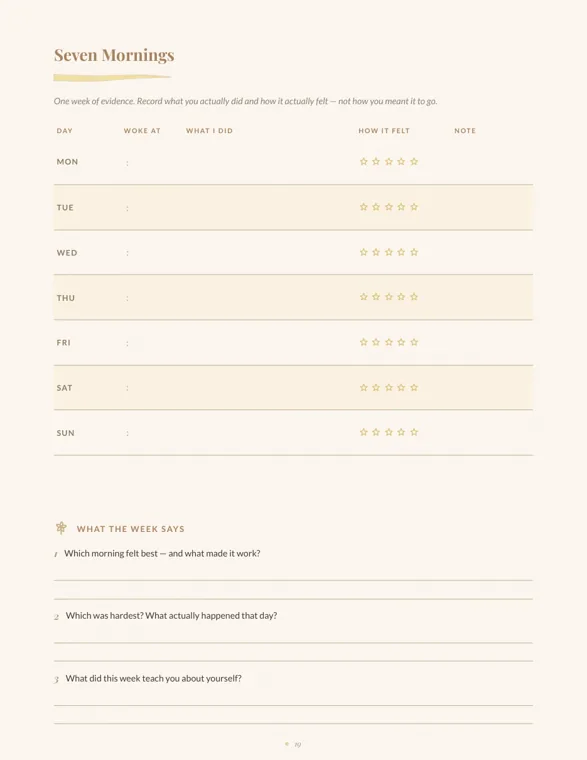
To see whether the habit is sticking, log it for a week. The Seven Mornings page in our Morning Routine Planner (page 19 of 28) has a row for each day with “woke at,” “what I did,” five stars for “how it felt,” and a note column. Underneath, three questions ask which morning felt best, which was hardest, and what the week taught you.
Evening: Seneca’s three questions
The evening entry looks back over the day. You answer three questions about your habits, note one moment you’d handle differently, and then let the day go. Of the three practices, this one most often slides into self-criticism, which is why the last step matters as much as the first.
The original lines
In Book III of On Anger, Seneca describes a nightly habit of the philosopher Sextius. In Stewart’s translation, Sextius would ask his own spirit:
“What bad habit of yours have you cured to-day? what vice have you checked? in what respect are you better?”
Seneca then says he does the same: “I pass the whole day in review before myself, and repeat all that I have said and done.” His examples are ordinary ones, like arguing too hard in a dispute and correcting someone so bluntly that it offended them. He also gives himself the words “I pardon you this time” before he moves on. That small sentence is the key to keeping the review useful instead of punishing.
How to write the evening review
- Answer the three questions in a line each. “Cured” and “checked” can be small. Holding off on your phone until 8:00 counts.
- Pick one moment from the day you’d replay. Write what happened in one sentence, then what you’d do next time in one sentence.
- Write a line of pardon. Use Seneca’s words or your own. The day is over; the note is for tomorrow.
- Close the notebook and stop. If a worry is still circling, write it on a separate list instead of in the review (more on that below).
A full example of an evening page
Tuesday, 10:15 p.m. (about 7 minutes)
- What bad habit did I cure today? Didn’t open email until 8:10. First time this week.
- What did I check? Started to snap at my partner about the dishes, stopped halfway, and said it again more quietly.
- In what respect am I better? Gave the client one clear date instead of two maybes.
- The moment I’d replay: In the 3:00 meeting I argued for ten minutes about a slide nobody else cared about. Next time I’ll say my point once and let it go if the room isn’t with me.
- Pardon: “I pardon you this time.” Lights out.
How long, and where it fits in the night
Five to ten minutes covers it. Write it in bed or right before, after the phone is away and the kitchen is done. Keep it close to sleep so it stays a review and doesn’t turn into a work session. Our guide to building a night routine has a 15-minute version with three written lines that this entry can slot into.
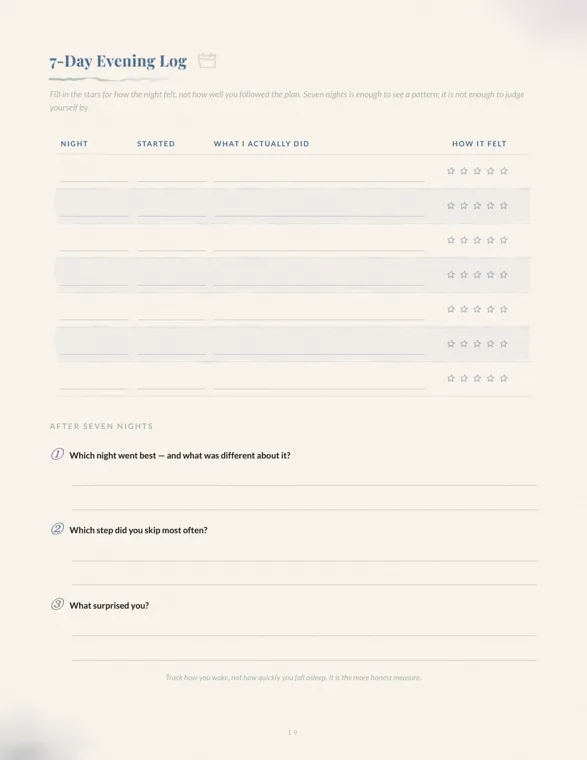
If you’d like to track the evening habit for a week, the 7-Day Evening Log in our Evening Routine Planner (page 19 of 28) works the same way as the morning one. It has columns for “started,” “what I actually did,” and five stars for how the night felt. The note at the top says to fill in the stars “for how the night felt, not how well you followed the plan,” which is the same spirit as Seneca’s pardon.
During the day: Epictetus’s two columns
The control sort is a short entry you write only when you need it. You take one problem that keeps pulling your attention, split it into two columns, and end with one action. It’s useful on days when a single worry eats the morning’s good intentions.
The original lines
The Enchiridion opens with the distinction, here in Higginson’s translation:
“There are things which are within our power, and there are things which are beyond our power. Within our power are opinion, aim, desire, aversion, and, in one word, whatever affairs are our own. Beyond our power are body, property, reputation, office, and, in one word, whatever are not properly our own affairs.”
Chapter 5 adds the line people quote most: “Men are disturbed not by things, but by the views which they take of things.” For a journal, that means the “can control” column is usually smaller than you’d expect. It holds your effort, your preparation and how you respond. Outcomes and other people’s choices go in the other column.
How to write the control sort
- Write the problem as one sentence. If it takes three, you’ve got more than one problem; pick the loudest.
- Fill the “can’t control” column first. It’s usually the longer list, and getting it on paper is what quiets it.
- Fill the “can control” column with things you could do or decide. Test each item by asking whether it could still go wrong even if you did your part perfectly. If it could, it belongs in the other column.
- Finish with one next step you could start within the day.
A full example of a control sort
Wednesday, 12:30 p.m. (about 5 minutes). The problem: my performance review is Thursday and I can’t stop thinking about it. Writing it as one sentence already makes it smaller than it felt at 9:00.
| Can’t control | Can control |
|---|---|
| The rating I get | Bringing three examples of work I’m proud of |
| The team’s budget for raises | Asking one clear question about next year’s goals |
| My manager’s mood that day | Getting to bed by 11 on Wednesday |
| Whether the meeting gets moved | How I respond if the feedback stings |
Next step: Write the three examples tonight, 20 minutes, before dinner.
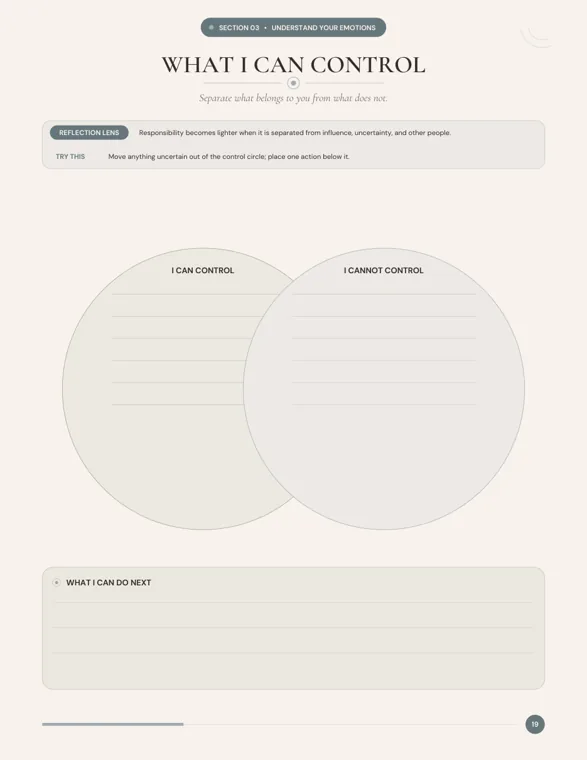
Our A Little Space for Me guided journal has a printed version of this page. Page 19 of the 64-page US Letter edition, “What I Can Control,” has two overlapping circles marked “I can control” and “I cannot control,” with a “What I can do next” box underneath. Its prompt says to move anything uncertain out of the control circle, which is the same test as step 3.
A sample week of Stoic journal entries
The week below shows how the three practices fit together without turning into a second job. Most days have a morning line and an evening review; the control sort shows up only when something calls for it. The entries are examples to adapt, not a schedule to follow.
| Day | Morning preview | Evening review (one answer shown) | Control sort |
|---|---|---|---|
| Monday | A full inbox after the weekend; answer the oldest first, not the loudest | Checked: didn’t reply to the group chat during the meeting | — |
| Tuesday | Client wants the deadline moved; give one date, once | Cured: no email before 8:00 | — |
| Wednesday | Long wait at the DMV; bring a book and expect an hour | Better: stayed polite at the counter when the form was wrong | Thursday’s review: rating vs. preparation |
| Thursday | The review; say my three examples and listen to the rest | Replay: I interrupted twice; next time let the full point finish | — |
| Friday | Tired by afternoon; keep the 3:00 slot for easy work | Checked: skipped the second coffee | — |
| Saturday | Family visiting; my brother will bring up politics, so change the subject once and then let it go | Pardon: lost my temper about the parking, and wrote the pardon line | Brother’s opinions vs. my reply |
| Sunday | No preview; read back the week instead | — | — |
The Sunday read-back takes about 15 minutes. Read the six evening entries in a row and look for anything that shows up twice, such as the same person, the same hour of the day, or the same habit. Write one sentence on what you’ll try differently this week. That sentence becomes Monday’s morning preview.
If you’d like the weekly look-back to include gratitude, our gratitude journal prompts have a set for reading back at the end of the week. For a fixed three-morning, three-evening question format instead of the open Stoic entries, see how to set up a five-minute journal.
Where Stoic journaling goes wrong
Two problems account for most Stoic journals that stop being useful: the evening review becomes a list of personal failings, and the morning preview becomes a to-do list. Both are easy to spot once you know what they look like, and each has a simple fix.
The evening review turns into self-blame
Signs: the review has more “always” and “never” in it than facts, question three (“in what respect are you better?”) is blank most nights, and you start dreading the notebook. Seneca’s review ended with a pardon and one correction for next time. It didn’t end with a verdict on his character.
The fix is to require an answer to question three every night, even a small one, and to end every review with the pardon line. Our Morning Routine Planner makes the same point in its “When You Miss a Day” page (page 22): “Skip the guilt. Being hard on yourself will not get you up earlier tomorrow.” Its next step is to ask “What happened this morning, and what does it tell me?” That question works as an evening replay line too.

The morning preview turns into a to-do list
Signs: the morning page reads “email Sam, buy milk, finish the report.” That’s a fine list, but it isn’t the practice. The Meditations passage is about the people and frictions you’ll meet and how you’ll treat them, not what you need to get done.
The fix is to keep two pieces of paper. Tasks go on their own list, ideally the night before, and the morning page holds only what you’ll meet and how you’ll respond. Our Evening Routine Planner suggests the same split on page 20: when your mind won’t stop, write a worry list and tomorrow’s three tasks “before you brush your teeth.” Keep that list separate from Seneca’s review.
Everything ends up in the “can control” column
When the control column fills with outcomes like “get the promotion” or “make sure the kids are happy,” the entry makes the worry bigger. Use the test from step 3: if it could still go wrong after you did your part, move it across. What stays is usually short, and that’s the point.
The page fills up with quotes instead of entries
Copying a passage you like is reading, not journaling. Keep it to one quoted line a day at most, and write the rest in your own words about your own day. If a quote doesn’t connect to anything that happened, leave it out.
An entry gets heavy
Some reviews will land on things that are hard to think about. A Stoic journal is a daily habit, not a treatment, and it doesn’t replace talking to a doctor, counselor or therapist. Our guided journal puts it plainly on its second page: “For personal reflection and everyday wellbeing; not a substitute for professional care.” If you’re in the US and in crisis or thinking about suicide, you can call, text or chat 988. The 988 Suicide & Crisis Lifeline offers free, confidential support 24/7.
Printable pages for a Stoic journal
A plain notebook works for all three practices. Printed pages help if you’d rather track the habit than rule lines every morning, and each of the three files below has one page that matches a practice.
| Practice | Printed page | What’s on it |
|---|---|---|
| Morning preview | Morning Routine Planner, page 19 (of 28) | Seven Mornings log: woke at, what I did, five stars, note |
| Evening review | Evening Routine Planner, page 19 (of 28) | 7-Day Evening Log: started, what I actually did, five stars |
| Control sort | A Little Space for Me, page 19 (of 64, US Letter) | Two circles for can and can’t control, plus “what I can do next” |
Both routine planners also split a routine into five elements on page 10. The morning one lists journaling under “Connect,” and the evening one lists it under “Release,” so the Stoic entries fit in as one element of a longer routine. The guided journal also has a 30-day self-reflection challenge in its 8-page bonus pack if you want a different question to think about on days when the review feels flat.
Printables from this article



Related articles
Printable Journals
DIY Five-Minute Journal: Format, Template & How to Start
Build your own five-minute journal: pick three morning and three evening questions, lay out a week per spread, print and bind it, and keep going after missed days.
Printable Journals
Scrapbook Ideas: 19 Page Ideas for Baby, Travel and Layouts
Nineteen scrapbook page ideas grouped by what you're saving, from a baby's first year to a page with no photos at all, with photo-safe materials and simple layouts.
Printable Journals
Journal Prompts for Beginners: 40 Ideas to Start Journaling
Forty beginner journal prompts sorted by what you want from the page, with how long each kind of entry takes and what to do when you get stuck.