DIY Five-Minute Journal: Format, Template & How to Start

A DIY five-minute journal is a short page you fill in twice a day: about three lines in the morning and three in the evening, the same questions every day, with roughly two or three minutes for each half. To make one, choose your six questions, lay out a week on two facing pages, print enough weeks for a month, and bind them so the pages lie flat. All you need is a pen, paper, and a place to keep the journal where you’ll see it at both ends of the day.
The setup takes one evening. The rest of this guide covers the format, the paper and binding, what to write each morning and night, and what to do on the days you skip.
What a five-minute journal page looks like
The format has two halves. The morning half looks ahead: something you’re grateful for, what you want from the day, and one thing you’ll do for yourself. The evening half looks back: the best moment, what you noticed, and what you’d change. Each answer is a single line, which is what keeps the whole thing to five minutes.
Here is a set of six questions to start with. Swap any of them, but keep the count at three and three.
| When | Question | What a line might look like |
|---|---|---|
| Morning | Three things I’m grateful for | coffee before anyone else is up · my sister’s text · a dry day |
| Morning | Today my intention is | finish the report draft before lunch |
| Morning | One thing I’ll do for myself | a 15-minute walk after work |
| Evening | The best moment today was | the walk, the light on the trees |
| Evening | What I noticed about myself | I rush when I’m hungry |
| Evening | One thing I’d do differently | eat before the 3 p.m. meeting |
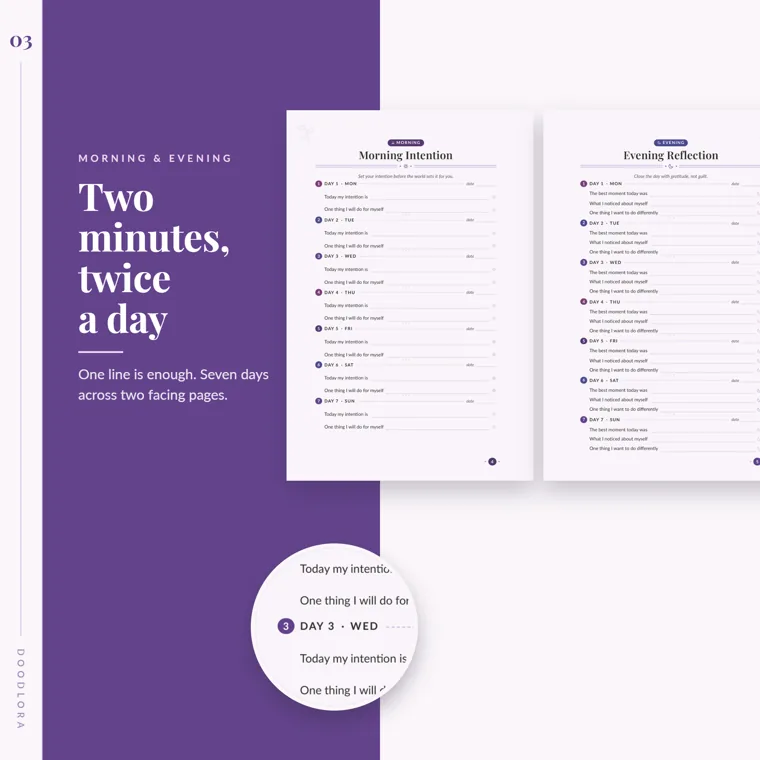
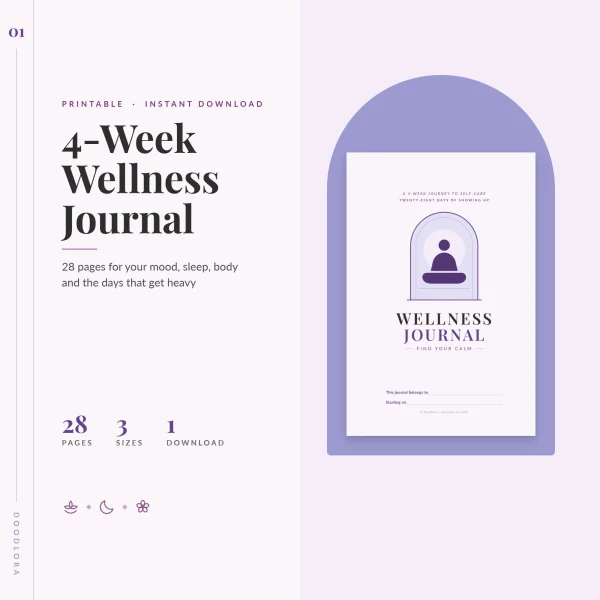
Our 4-week self-care journal uses almost exactly this split. Page 4 is a Morning Intention page with two prompts per day, “Today my intention is” and “One thing I will do for myself.” Page 5 is the Evening Reflection page, with “The best moment today was,” “What I noticed about myself” and “One thing I want to do differently.” Gratitude has its own page, covered in the morning section below.
What you need to make one
You need very little, and nothing has to be bought new for a first try.
- Paper. Plain printer paper works for a test week. For a journal you’ll keep, the printing notes in our self-care journal suggest 120 to 150 gsm (32 to 40 lb) paper, heavy enough that ink doesn’t show through to the other side.
- A pen you like writing with. Heavier paper also takes fountain pen ink without feathering.
- A way to hold the pages together. A spiral or coil binding from a copy shop, a three-hole binder, or a binder clip for the first week.
- Your six questions, written down before you design anything.
- Optional: a ruler and fine pen if you’re drawing the layout by hand in a notebook instead of printing it.
Step 1: Pick three morning and three evening questions
Choose the six questions before you think about layout. A good question can be answered in one line, without looking anything up, on a bad day as well as a good one.
Three per half is the ceiling, not the floor. A fourth question pushes the morning past five minutes, and that’s usually where the habit cracks. If you can’t decide between two questions, keep one for the first month and try the other next month.
Avoid questions that ask for a plan. “What are my priorities this week?” belongs in a planner. The journal works best when it’s about how the day feels rather than everything that needs doing.
Step 2: Lay out a week on two facing pages
Put all seven mornings on the left page and all seven evenings on the right, so an open spread holds one full week. Each day needs a date line and one writing line per question, and that fits on a US Letter page with room to spare.
This layout has two advantages over a page per day. You can see the whole week at a glance, which makes patterns easier to spot by Sunday. It also uses a quarter of the paper, so printing a month costs little.
If you prefer a notebook, rule the lines by hand: a header across the top, then seven blocks down each page, each with a date and three short lines. A half-letter or A5 notebook fits the same layout with smaller handwriting.
Step 3: Print and bind the pages
Set the printer to Actual size or 100%. “Fit to page” shrinks everything and eats the margins, which matters once you punch holes or bind the edge.
Print double-sided and flip on the long edge, so the backs come out the right way up. Then check that your morning and evening pages really face each other. A spread is the back of one sheet plus the front of the next. If you print only the morning page and the evening page as one double-sided sheet, they end up back to back instead of side by side.
In our self-care journal, the printing notes handle this by suggesting you reprint pages 3 to 6 together: the weekly tracker, morning page, evening page and mood palette. Printed as one run, pages 4 and 5 land as a facing pair. Print that set four times for four weeks.
For binding, a spiral or coil lets the journal lie flat while you write, and copy shops will often do it on the spot. For a binder, our pages leave a 0.9-inch inside margin so the holes stay clear of the writing.
Step 4: Fill in the morning half
Write the morning half before you open your phone. Once the inbox is open, the questions start answering themselves in terms of other people’s demands.
Start with gratitude, because it’s the easiest question to answer half awake. Three specific things are better than three big ones. “My sister’s text about the dog” will mean more when you reread it than “my family.”
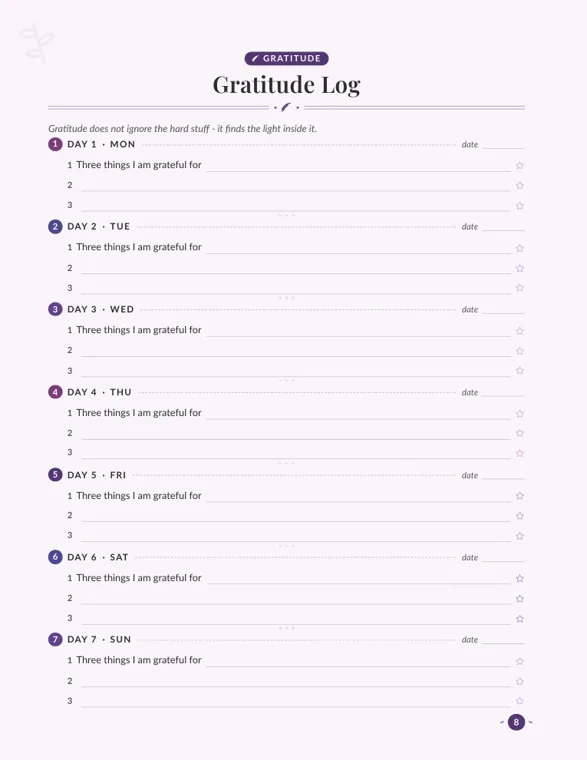
Then write your intention and one thing you’ll do for yourself. Keep the intention to a single outcome you’ll know you hit, such as “call the dentist” or “leave work by six.” “Be more productive” gives you nothing to check off in the evening.
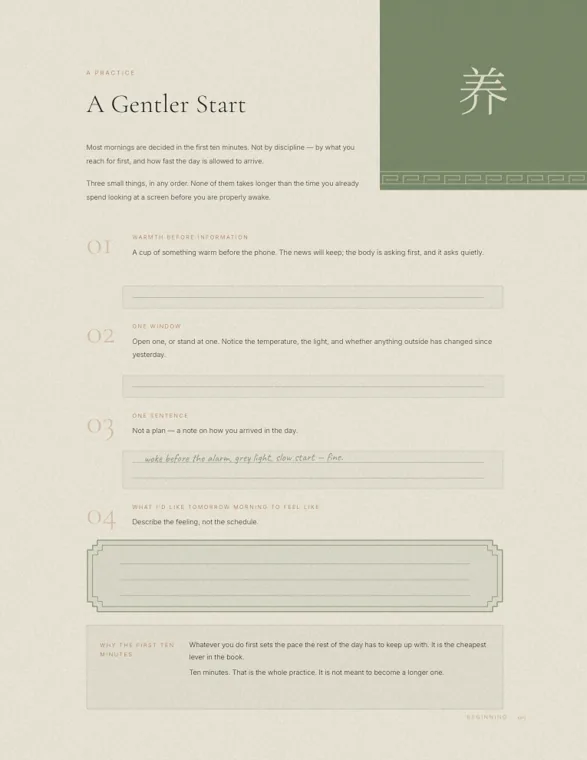
If writing three lines first thing feels like too much, start with one. Page 9 of our wellness journal is a short morning practice called A Gentler Start. Its third prompt asks for a single sentence, “a note on how you arrived in the day,” and the page itself caps the practice at ten minutes.
For more ideas on what to do around the journal, our morning routine ideas cover ten-minute routines for busy weekdays.
Step 5: Fill in the evening half
Keep the journal and a pen on your nightstand, open to the current week. If you have to fetch it from another room, the evening half is the first thing you’ll drop.
Write the best moment first. Even on a long day, there’s usually one small thing, and starting there sets the tone for the other two lines.
“What I noticed about myself” is the line that pays off later. After two or three weeks, the same notes start to repeat, like “I rush when I’m hungry” or “I’m calmer after a walk,” and that repetition is the useful part.
Keep “one thing I’d do differently” small and concrete. Link it to the next morning if you can. If tonight’s line is “eat before the 3 p.m. meeting,” tomorrow’s “one thing I’ll do for myself” can be packing a snack. Our night routine guide has more on fitting a short wind-down into weeknights.
When you can’t keep it up
Missing days is normal, and how you come back matters more than the streak. Here is what to do in the situations that most often stop a five-minute journal.
You missed a few days. Leave the blanks and start on today’s line. Filling in old days from memory turns the journal into a chore. The closing page of our wellness journal puts it plainly: “Pages left blank are not failures.”
Mornings keep getting skipped. Move the morning half to whenever you sit down first, like the bus, your desk or the first coffee. Or shrink it to the gratitude line until the habit sticks.
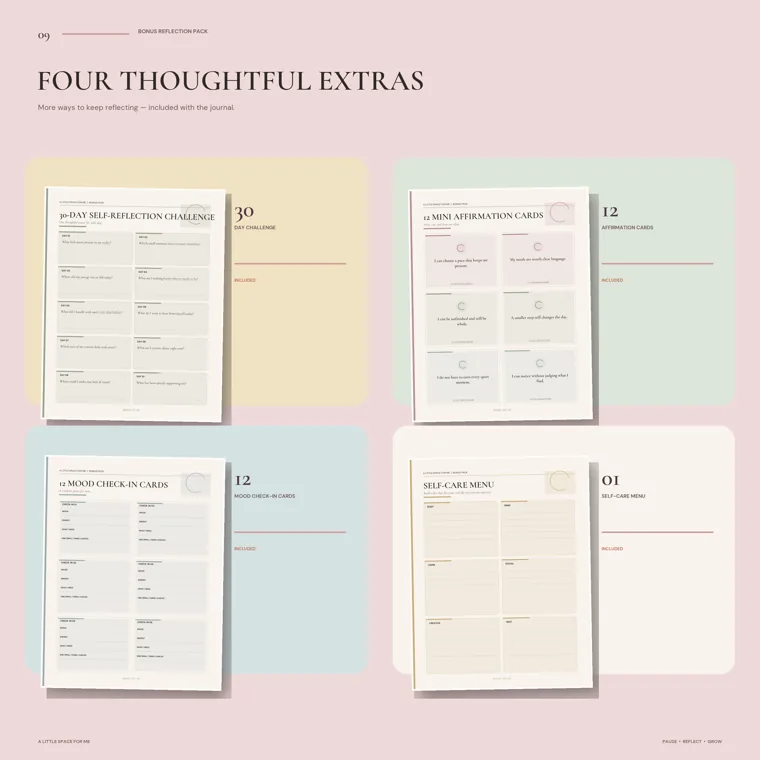
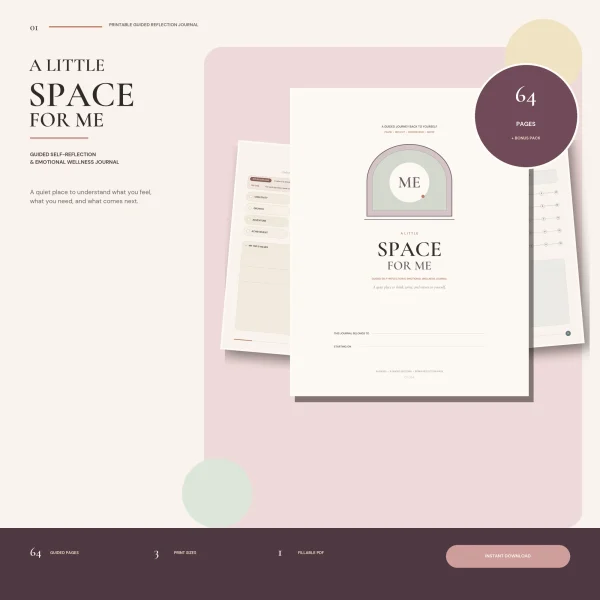
The answers feel repetitive. Keep the format and change one question for a month. A list of rotating prompts helps here. The bonus pack with our guided journal has a 30-day self-reflection challenge, one question a day, such as “What can be good enough for today?” Use it as your third evening line for a month.
Every day feels like too much. Try once a week instead. Research on gratitude journals hasn’t settled how often to write, and some of it favors once a week over every day. A Sunday entry listing three to ten things from the week is still a journal.
It’s turning into a to-do list. Cross out the intention question for a week and keep only gratitude and the evening lines.
A journal is a place to notice how your days go. It isn’t a substitute for professional care. If what you’re writing down keeps getting heavier, talk to someone you trust or a health professional.
Make it your own
Once the first month is done, look back at all four weeks in one sitting. Note which question you skipped most and which you were glad you wrote, then adjust the next month’s six questions.
For more questions to rotate in, see our gratitude journal prompts, including two-minute prompts for busy days. If the five-minute format feels too tight and you’d like longer entries, journal prompts for beginners covers starting a regular journal from scratch.
Printables from this article
Related articles
Printable Journals
Stoic Journal Example: Morning & Evening Prompts to Copy
Three Stoic journaling practices with the original lines, a filled-in page for each, how many minutes they take, a sample week, and the two ways entries usually go wrong.
Printable Journals
Scrapbook Ideas: 19 Page Ideas for Baby, Travel and Layouts
Nineteen scrapbook page ideas grouped by what you're saving, from a baby's first year to a page with no photos at all, with photo-safe materials and simple layouts.
Printable Journals
Journal Prompts for Beginners: 40 Ideas to Start Journaling
Forty beginner journal prompts sorted by what you want from the page, with how long each kind of entry takes and what to do when you get stuck.