What Is a Ten Frame? How to Fill One and 8 Activities
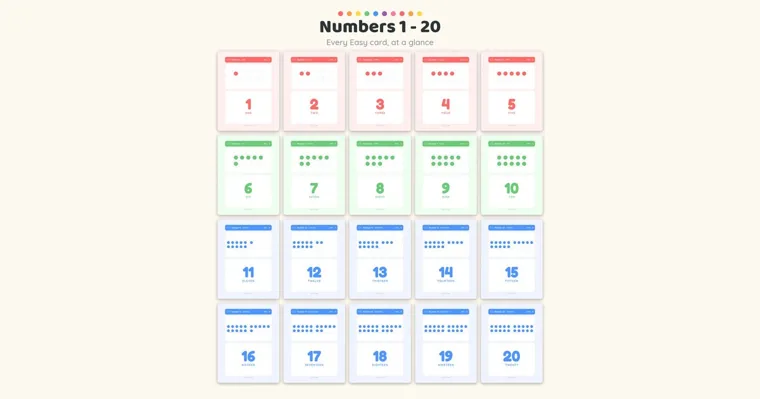
A ten frame is a rectangle split into ten boxes, arranged in two rows of five. You put one dot or counter in a box for each thing you’re counting, so the frame shows any number from zero to ten as a picture.
A child who knows that picture can read seven as a full row of five and two more, without touching each dot.
The frame does two jobs at once. It shows how many are there, and the empty boxes show how many more you’d need to reach ten. That second job is what keeps it useful long after a child can count to ten out loud.
What a ten frame looks like
The grid is always five boxes across and two boxes down.
Classroom versions get printed on cardstock, drawn on a whiteboard, or made from an egg carton with two cups cut off. The material doesn’t matter; the arrangement does.
For numbers past ten, you place two frames side by side. The first one’s completely full, and the second holds the extra ones, so fourteen looks like a full frame and four more. A long row of full frames counts by tens.
How to fill a ten frame
Start in the top left box and fill the top row from left to right. When the top row has five, start the bottom row at the left.
On our ten frame set, every number is filled this way. Three is three dots in a row, five is a complete top row, and eight is a complete top row with three underneath.
Pick one filling order and keep it.
If dots land in random boxes, the child has to count them individually, and the frame stops doing its job. When children fill a frame with counters, the first thing to watch for is a counter dropped into the middle of the bottom row.
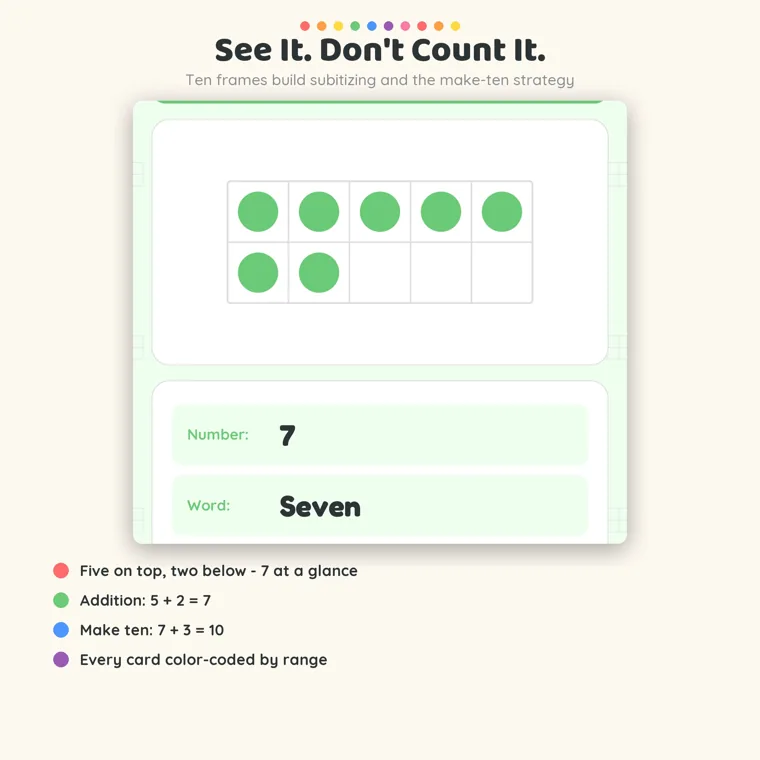
Read the frame in two steps. First say what the top row shows: five, or fewer than five. Then add the bottom row.
A child who answers “five and two, seven” has stopped counting by ones, and that’s the whole point.
Why ten frames help kids count
Five and ten are the anchors.
Once a child knows that a full row means five, any number from six to ten becomes “five and some more,” and anything below five is “not a full row yet.” Recognizing a small amount without counting is called subitizing, and the ten frame gives that skill a predictable arrangement to lean on.
The empty boxes turn into make-ten facts. A frame with seven dots has three empty boxes, so seven and three make ten.
The Common Core kindergarten standard K.OA.A.4 asks children, for any number from 1 to 9, to “find the number that makes 10 when added to the given number.” A ten frame shows that answer before any calculation happens.
Two frames handle the teen numbers. Kindergarten standard K.NBT.A.1 asks kids to break numbers from 11 to 19 into ten ones and some further ones, with the example “18 = 10 + 8.” A full frame next to a frame of eight is that equation as a picture.
The same idea carries into first grade. Standard 1.OA.C.6 lists “making ten” as an addition strategy and gives the example 8 + 6 = 8 + 2 + 4 = 10 + 4 = 14.
On two frames, a child slides two of the six dots across to complete the first frame, and the answer’s sitting right there: ten and four.
The standards don’t mention the ten frame by name. They ask for objects or drawings, and the frame happens to be one of the tidiest drawings for these particular jobs.
What age to start with ten frames
Our set is labeled for ages three to seven. Still, it’s better to decide by what the child can already do than by their birthday:
| Stage | Numbers | What to ask |
|---|---|---|
| Just learning to count | 1 to 5, one row only | “How many dots?” Counting each one is fine here. |
| Counts to ten reliably | 6 to 10 | “Is the top row full? How many below?” |
| Knows frames to ten on sight | 1 to 10 again | “How many empty boxes? What makes ten?” |
| Ready for teen numbers | 11 to 20 | “One full frame is ten. Ten and how many more?” |
| Counting to one hundred | 10 to 100 in full frames | “Count the frames by tens.” |
A preschooler can comfortably stay on one to five for weeks. Moving on before the first row feels automatic only gives them more dots to count one at a time.
Two ten frames for numbers 11 to 20
From eleven onward, our cards put two frames side by side. The left one’s always full, and the right one holds the ones, so fourteen shows ten on the left and four on the right.
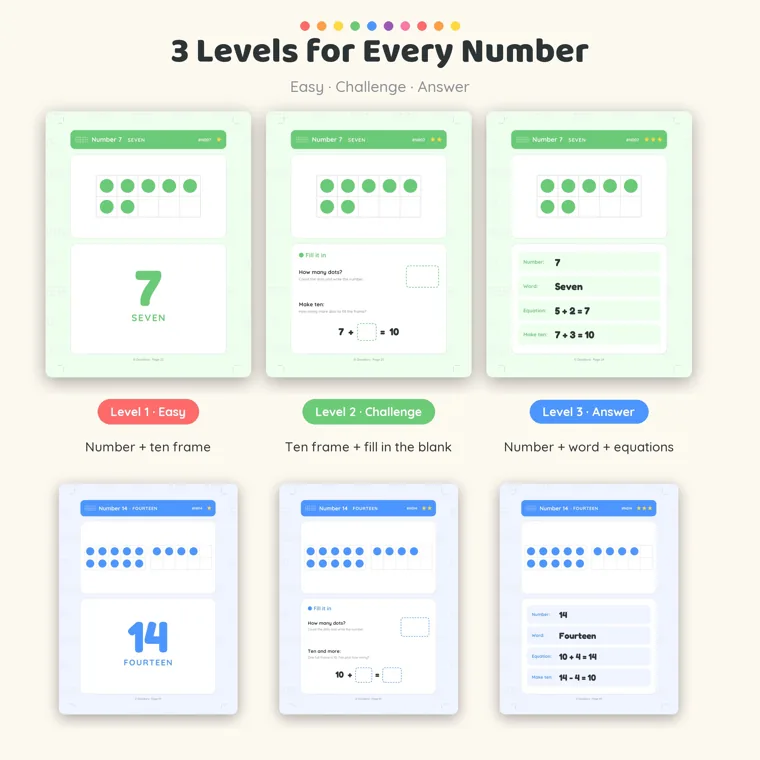
The question changes at eleven. Up to ten, our Challenge card asks how many more dots would fill the frame. From eleven to twenty, it asks “Ten plus how many?” and leaves the equation 10 + ? = ? for the child to complete.
Don’t ask a make-ten question on a teen card. The left frame’s already full, and the child won’t know which frame you mean.
8 ten frame activities
Each of these needs one adult and a short block of time. The player counts and times are our planning suggestions, so stretch or shorten them to fit the child.
| Activity | Players | Time | You need |
|---|---|---|---|
| Flash and say | 1 adult, 1 to 6 kids | 5 minutes | Number cards with frames |
| Build it with counters | 1 to 2 kids | 10 minutes | A drawn frame and ten small objects |
| How many more to make ten | 1 kid at a time | 5 to 10 minutes | Frames for 1 to 9, a dry-erase marker |
| Make-ten partners | 1 to 3 kids | 10 minutes | Frames for 1 to 9, plus a second 5 |
| Draw the dots | 1 kid or a whole table | 10 minutes | A page of empty frames, a pencil |
| Roll and cover | 2 players | 10 minutes | A page of frames, dice, counters |
| Ten and some more | 1 to 4 kids | 10 minutes | Frames for 11 to 20 |
| Count by tens | 1 kid or a group | 5 minutes | Ten full frames |
Flash and say
It’s the quickest game here and the one to start with. Hold up a frame card for about two seconds, hide it, and ask how many. Kids call out the number, then you show the card again so everyone can check.
Use only the range the child already recognizes, such as one to five for a young preschooler.
If the card stays up too long, kids switch back to counting each dot, which is exactly the habit you’re trying to replace. Stop after ten cards or whenever concentration drops.
Build it with counters
Draw a two-by-five grid on paper, with boxes big enough to hold a button or a piece of cereal. Say a number and have the child build it on the frame, top row first. Then ask them to read it back: “five and three, eight.”
The snag is the filling order, since children often drop counters into whichever box is closest.
Ask them to complete the top row from the left before they touch the bottom row, and their frame will match the cards. Finish by clearing everything and building ten, which fills every box.
How many more to make ten
Use frames for one to nine. Show a frame, have the child count the dots, then ask how many boxes are empty. That number is the partner that makes ten.
Our Challenge cards print this underneath the frame as “Make ten,” followed by an equation like 7 + ? = 10.
Laminate the cards or slip them into sheet protectors, so a child can write answers with a dry-erase marker and wipe them off. Our Answer cards repeat the frame with the finished fact, such as 7 + 3 = 10, so children can check their own work independently. The game’s over when every card from one to nine has been answered.
Make-ten partners
Lay frames for one to nine face up on the table. The child looks for two frames whose dots would fill one frame exactly, such as three and seven or four and six. Each pair goes into a pile, and the game ends when there aren’t any pairs left.
There’s one catch: five needs another five, and a single set has only one.
Print the card for five twice before you start (in our set, it’s page 16), or that five will sit alone at the end and a careful child will think they’ve made a mistake. With three kids, take turns finding pairs instead of racing, so the fastest counter doesn’t collect every match.
Draw the dots
Give the child a page of empty frames with a number underneath each one, and they draw that many dots. It’s the reverse of reading a frame: they start from the number and build the picture.
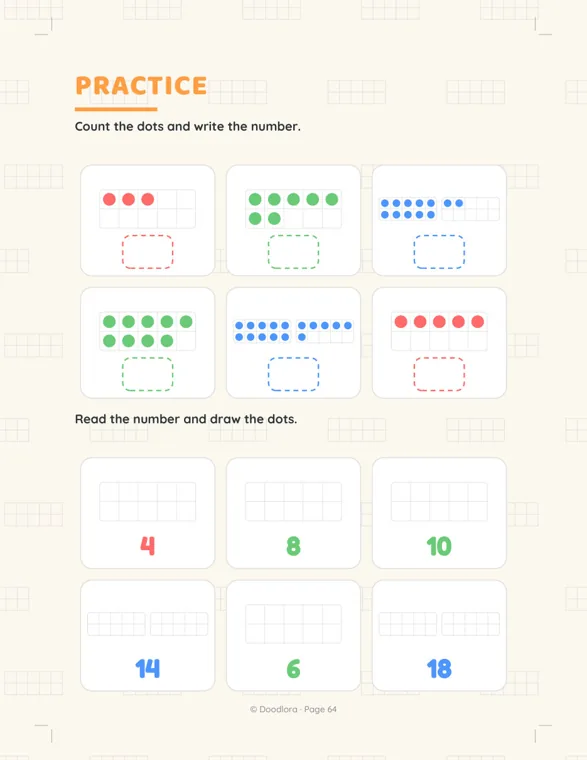
Our practice page has six frames to count and six to fill: 4, 8, 10, 14, 6 and 18.
Check the bottom row of each drawing. A child who draws eight as four on top and four below has the right count, but it won’t match the cards. Point to the top row and ask whether it’s full.
Roll and cover
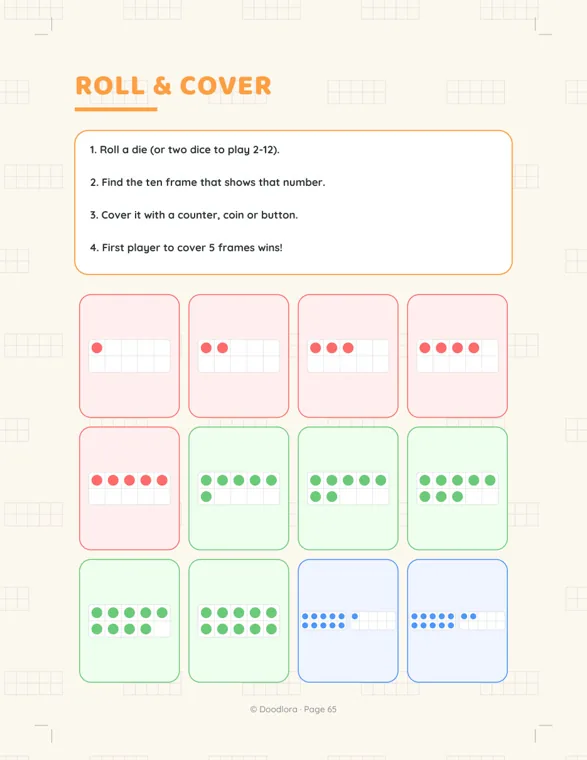
Each player gets their own copy of a page of frames showing one to twelve. On a turn, roll a die, find the frame that shows that number, and cover it with a counter, coin or button. Our page says the first player to cover five frames wins.
Decide two things before anyone rolls.
With one die, only one to six can come up. Use two dice and add them to reach seven through twelve, though then nobody can ever roll a one.
The page also doesn’t say what happens when you roll a number you’ve already covered. Agree on “lose the turn” or “roll again” before the first roll, or that’s where the arguing starts.
Coins and buttons are small, so keep them away from younger siblings who still put things in their mouths.
Ten and some more
Use frames for eleven to twenty. Show a card, and before the child counts anything, cover the full left frame with your hand and say “that’s ten.” Then they count only the right frame and put the two parts together: ten and six, sixteen.
This is K.NBT.A.1 in practice, so have the child say the equation out loud, 10 + 6 = 16.
Watch for twenty, where both frames are full and the answer is ten and ten, not “ten and zero.” Stop after five teen numbers in one sitting, because the left frame starts to blur together after that.
Count by tens
Lay out full frames one at a time and count them together: ten, twenty, thirty, all the way to one hundred. Each frame is a ten, so the child counts frames instead of dots. Kindergarten standard K.CC.A.1 asks children to “count to 100 by ones and by tens.”
Our tens page has one row per ten, with the number, the word and that many full frames, so the thirty row has three frames and the hundred row has ten.
Point to each frame as you count along a row, and stop at the first one where the child hesitates. Next time, start one frame earlier and go one frame further.
Printing ten frames at home
A ten frame works at any size, as long as the boxes are big enough for a dot or a counter. Our cards fill a full Letter page, which is large enough to hold up in front of a small group. For handheld cards, set your printer to four pages per sheet and cut along the corner marks.
Laminating pays off for the fill-in pages, because a dry-erase marker wipes clean and the same Challenge cards can go back in the box for the next session.
If you’re making your own, drawing one frame per index card gives you a set you can shuffle for Flash and say.
For very young children, the card games in our list of activities for 3-year-olds sit comfortably alongside the first-row frames. And if you’d like a matching game with turn-taking rules, our memory game rules cover that.
Printables from this article
Related articles
Printable Flashcards
Pattern Activities for Preschool: AB to Growing Patterns
Fourteen pattern activities for preschoolers, ordered from first AB rhythms to growing number patterns, with what to prepare, how long each takes and where kids get stuck.
Printable Flashcards
Telling Time Activities: How to Teach Time to Kids by Stage
Fifteen clock activities sorted by stage, from an hour-hand-only clock to elapsed time on a number line, each with ages, players, time, supplies and the mistake to watch for.
Printable Flashcards
Weather Activities for Preschool: Snow & Seasons for Kids
Sixteen weather activities for a preschool class or a child at home, from a five-minute window check to snow measuring, weather bingo and a seasons diary.