Dinosaur Activities for Preschool: Games, Crafts & Fossils
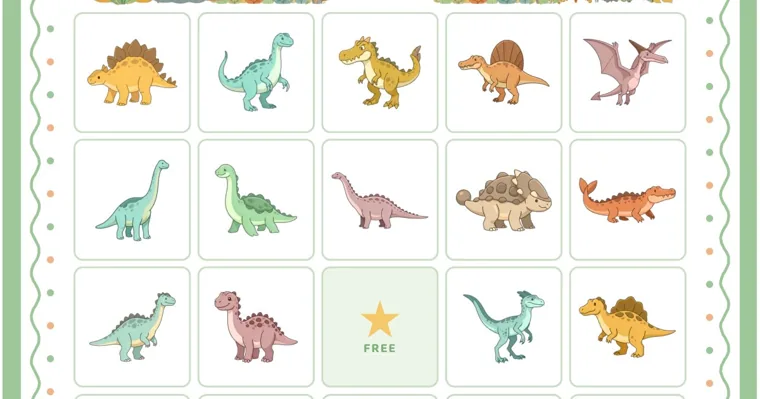
The best dinosaur activities for preschool let a three- to five-year-old do what a paleontologist does: dig something up, look at its shape, count it and give it a name. Add one game where they get to stomp, and a dinosaur morning is done. The 13 ideas below are grouped by the situation you are in, a quiet table, a messy floor or a whole class, and each one lists how many children it suits, how long it runs, what to set out and how it ends.
The times are planning estimates for this age group, not measurements, so stretch or cut them. Where an activity has a snag that tends to stop it, the snag is written into that activity.
Pick a dinosaur activity by the time and space you have
| Activity | Ages | Kids at once | Time | You’ll need |
|---|---|---|---|---|
| Trace and color a big outline | 3–5 | 1–4 | 10–15 min | Outline pages, crayons |
| Color a fossil camp scene | 4–5 | 1–4 | 15 min | One printed coloring page |
| Count the dig tools | 4–5 | 1–2 | 5–10 min | One counting page, a pencil |
| Match the fossil shapes | 4–5 | 1–2 | 5 min | One matching page |
| Big, middle, small stegosaurus | 3–5 | 1–3 | 10 min | Three outline pages, safety scissors |
| Frozen dinosaur eggs | 3–5 | 1–3 | 20–30 min | Toy dinosaurs, a muffin tin, a freezer overnight |
| Fossil prints in play dough | 3–5 | 1–4 | 15 min | Play dough, toy dinosaurs, shells |
| Sand-bin fossil dig | 3–5 | 2–4 per bin | 15–20 min | A bin of play sand, cardstock shapes, brushes |
| Picture bingo | 3–5 | 2 to a class | 10–15 min | Bingo cards, calling cards, markers |
| Is it a dinosaur? | 4–5 | 2–8 | 5–10 min | The 25 bingo calling cards |
| Dinosaur, dinosaur, what time is it? | 4–5 | 4 or more | 10 min | A yard or a gym |
| Dino says | 3–5 | 3 to a class | 5 min | Open floor |
| Footprint hop | 3–5 | 1–6 | 10 min | Ten paper footprints, tape |
If you only have ten minutes and one child, start with the outline page. For a class, start with picture bingo, then go outside for the chasing game. If the class is moving on to another theme next week, the farm activities for preschool and weather activities for preschool collections are laid out by setting in the same way.
Quiet dinosaur activities at a table
These work for one child after lunch, or for a learning center that two to four children rotate through. Everything here is paper and crayons, so setup is printing and nothing else.
Trace and color a big outline
Kids: 1–4, ages 3–5. Time: 10–15 minutes. Prep: print one outline page per child.
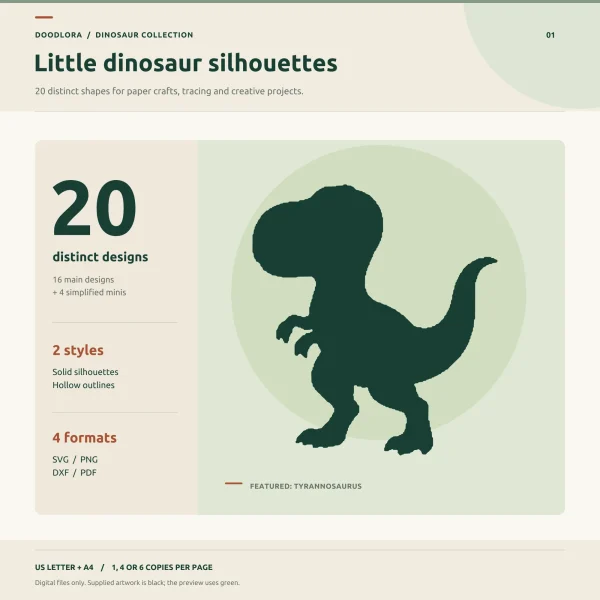
Our dinosaur outline set has 20 designs, and its 1-per-page PDF puts a single dinosaur across the page with a thick black edge. Page 3 is the stegosaurus with its back plates and spiked tail. A three-year-old can run a finger around the edge first, then a crayon. A four- or five-year-old can color inside and draw the missing parts, because the shapes come with no eye, mouth or scales drawn in.
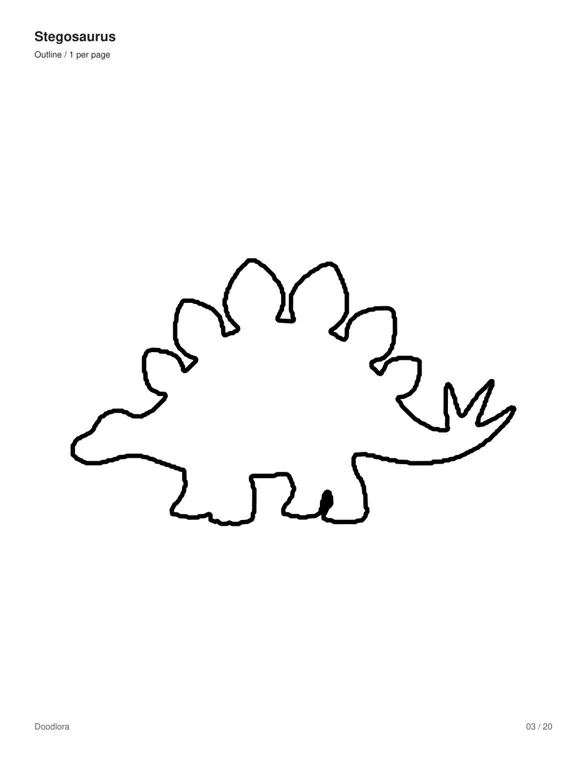
Finish by asking the child to name their dinosaur and write the name for them at the top. The snag is page 8: it is a pteranodon, and the file’s own notes say it is a flying reptile, not a dinosaur. Keep it for the sorting game further down instead of mixing it in here.
Color a fossil camp scene
Kids: 1–4, ages 4–5. Time: about 15 minutes. Prep: print one page per child.
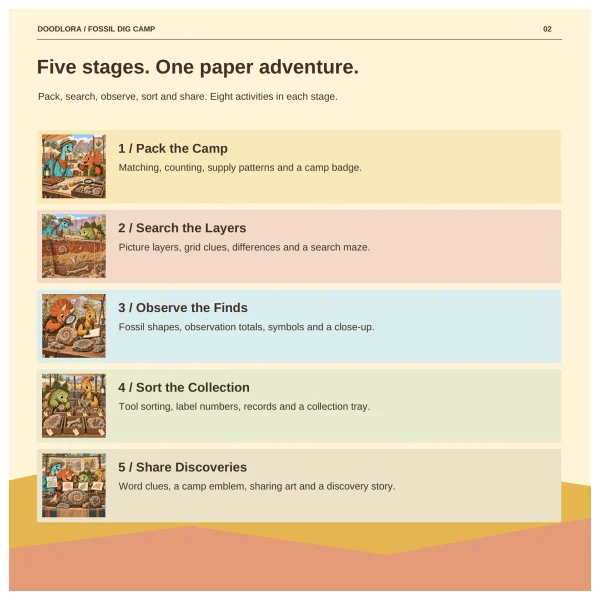
Our Fossil Dig Camp activity book is written for ages 6 to 9, so most of its 48 pages are too wordy for preschool. Five of its tasks are coloring scenes, though, and those suit a four- or five-year-old. Page 11 shows two cartoon dinosaurs, one in a hat and one with a triceratops frill, at a camp table with a brush, a magnifying glass and a tray of rocks and a spiral shell. The other scenes are on pages 19, 27, 35 and 43.
The page asks the child to add a flag with their own symbol, which makes a natural ending: when the flag is drawn, the page is done. The book comes in color and low-ink versions; low-ink prints the art as black lines on white and saves toner if you are printing for a class.
Count the dig tools
Kids: 1–2, ages 4–5. Time: 5–10 minutes. Prep: print page 6 of the same book.
Page 6 is a counting page with four rows: three brushes, six magnifying glasses, four notebooks and seven green trays. Each row ends in an empty circle for the number. That range, three to seven, is about right for a child who is starting to count past five.
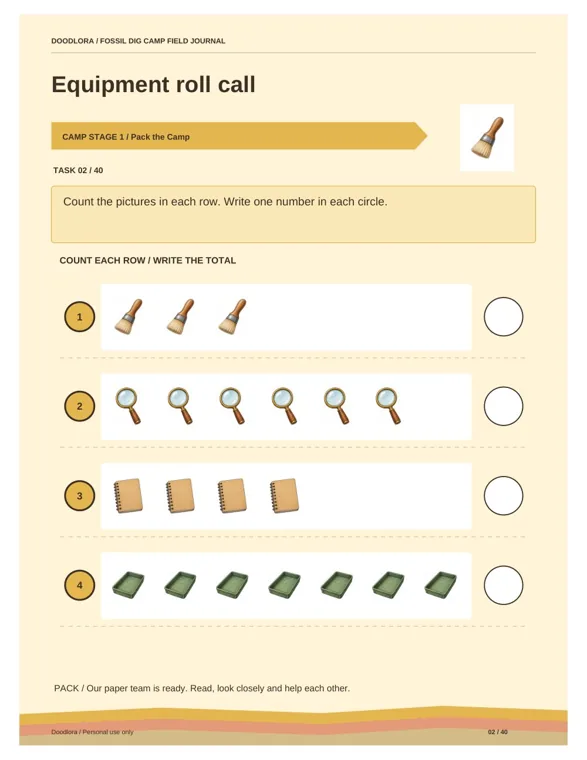
The snag at this age is counting the same picture twice. Have the child put a crayon dot on each picture as they say the number. If they cannot write numbers yet, they can say the number and you write it in the circle.
Match the fossil shapes
Kids: 1–2, ages 4–5. Time: about 5 minutes. Prep: print page 22.
On page 22, three fossil pictures sit on the left: a coiled shell, a pointed tooth and a three-toed footprint. On the right are three plain shapes, a footprint outline, a spiral and a triangle. The child draws a line from each fossil to its shape.
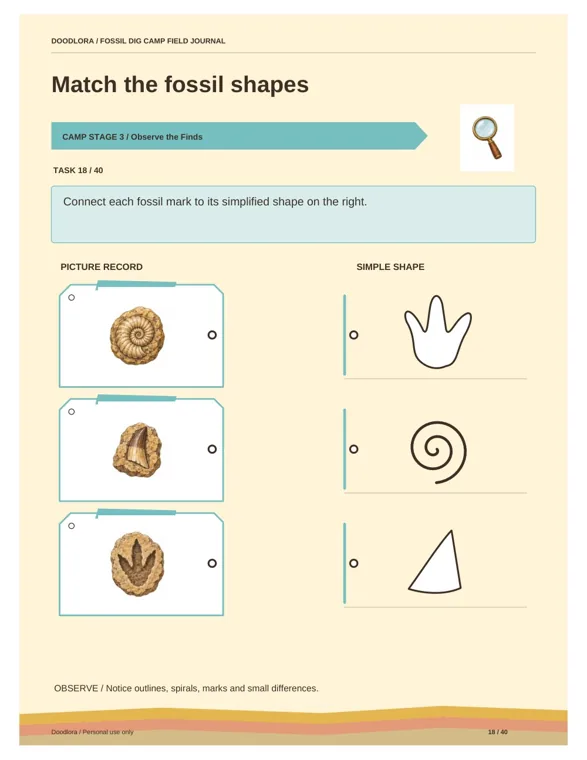
Use it to make one true point: not every fossil is a dinosaur. The book’s guide says the same, that shells, leaf prints and footprints are not all dinosaur remains. A coiled shell like the one on this page belongs to the ammonites, sea animals more closely related to octopuses and squid.
Big, middle, small stegosaurus
Kids: 1–3, ages 3–5. Time: about 10 minutes. Prep: print page 3 from the 1-per-page, 4-per-page and 6-per-page outline files.
The outline set comes in three layouts, and each file keeps the same dinosaur on the same page number. So page 3 of each gives you one big stegosaurus, four medium ones and six small ones. Cut them out (you cut for three-year-olds; four- and five-year-olds can cut the big one with safety scissors) and ask the child to line them up from smallest to biggest.
It ends when the line is in order. Then mix them up and let the child hide one while you guess which size is missing.
Messy dinosaur play: ice, dough and sand
These need a towel, a floor you don’t mind wiping, or a sensory table. They are the activities preschoolers ask to repeat.
Before you start, check your toy dinosaurs. Federal rules ban toys with small parts that are meant for children under 3, because of the choking risk. Small plastic dinosaurs are fine for most four- and five-year-olds, but if a toddler sibling is in the room, use the larger toys or keep the bin up high when you are done.
Frozen dinosaur eggs
Kids: 1–3, ages 3–5. Time: 20–30 minutes of play, plus a night in the freezer. Prep: one small toy dinosaur in each cup of a muffin tin, topped with water and frozen overnight.
Pop the ice “eggs” into a large tray. Give each child a cup of warm tap water, a spoon or a squeeze bottle, and let them melt the dinosaur free. The game ends when every dinosaur has hatched. Line them up and count them.
The snag is impatience. A full egg can take longer than a three-year-old wants to wait, so fill the cups only halfway, with the dinosaur’s head poking out of the top.
Fossil prints in play dough
Kids: 1–4, ages 3–5. Time: about 15 minutes. Prep: one ball of play dough per child, a few toy dinosaurs and a shell or two.
Flatten the dough into a pancake. Each child presses a dinosaur’s feet, or a shell, into it and lifts it off. That mark is the idea behind a trace fossil: a fossil is any preserved remains, impression or trace of something that once lived, and a footprint pressed into mud counts.
To finish, everyone covers their eyes while one child makes a print, and the rest guess which toy made it.
Sand-bin fossil dig
Kids: 2–4 per bin, ages 3–5. Time: 15–20 minutes. Prep: a shallow bin of play sand, a few dinosaur shapes cut from cardstock, paintbrushes and spoons.
A scientist who studies fossils is a paleontologist, and children like having the job title. Print the solid black version of the outline set on cardstock, cut out four to six shapes and bury them. Children dig with spoons and brush the sand away with paintbrushes. Every shape they find gets matched to the same dinosaur on a printed outline page.
It ends when every shape is matched. The snag is sand in the eyes: paleontologists brush gently, so set that as the rule before the brushes come out, and keep the sand low in the bin.
Dinosaur games for a class, a playdate or a party
These run with anywhere from three children to a full class. The first two need little space; the second two need a yard, a gym or a cleared classroom.
Picture bingo
Kids: 2 to a class, ages 3–5. Time: 10–15 minutes. Prep: print one card per child, cut out the calling cards, and print the marker page.
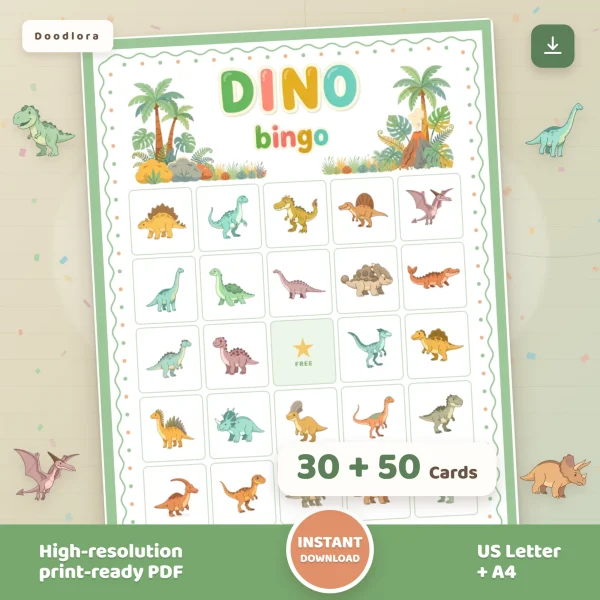
Our dinosaur bingo set has 25 calling cards and comes as a 30-card or a 50-card set, each in two styles. The picture-only cards are the ones for preschool; the cards with names under each dinosaur are for children who are starting to read. Each card is a five-by-five grid with a free star in the middle.
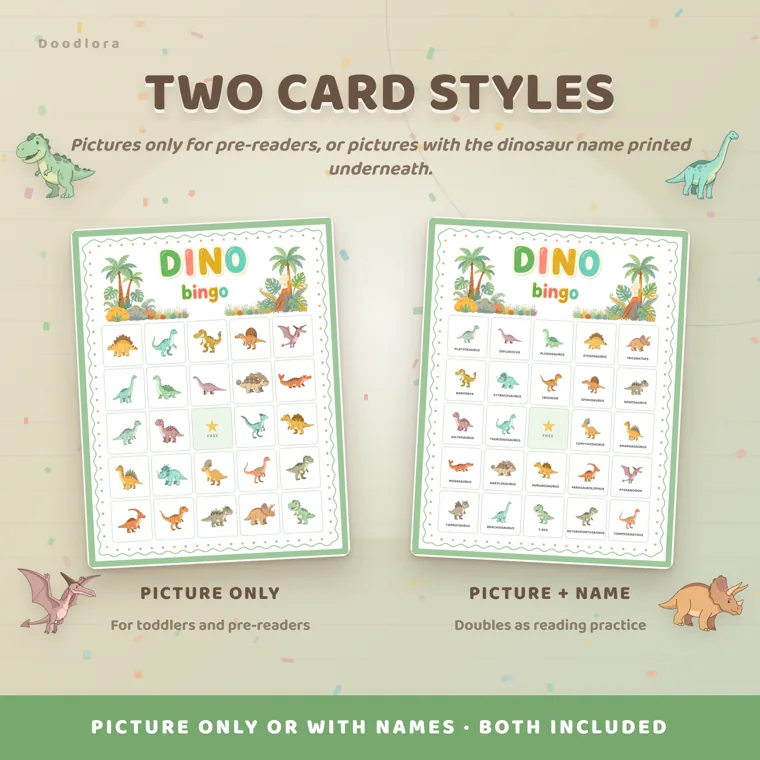
Our printable bingo rules cover the calling and checking. For this age, change three things. Hold up each calling card so children can match the picture, because few three-year-olds know a Corythosaurus by name. Play for one line, not a full card: every card shows 24 of the 25 dinosaurs, so a full-card game ends with half the room calling bingo at once. And since the how-to-play page suggests candy, buttons or coins as markers, use the printed paper markers if anyone under 3 is at the table.
Is it a dinosaur?
Kids: 2–8, ages 4–5. Time: 5–10 minutes. Prep: the 25 calling cards from the bingo set and two hoops or two pieces of paper marked Yes and No.
Twenty-two of the calling cards are dinosaurs. Three are not: the pteranodon, the plesiosaurus and the mosasaurus. Pterosaurs were flying reptiles, plesiosaurs were sea reptiles with four flippers, and mosasaurs were sea reptiles related to lizards and snakes. None of them is classed as a dinosaur. Children draw a card, decide Yes or No and put it in a pile.
The ending is the twist. Ask whether any dinosaurs are alive today, then point out a window. Birds are dinosaurs, the only line of them that survived the extinction about 66 million years ago.
Dinosaur, dinosaur, what time is it?
Kids: 4 or more, ages 4–5. Time: about 10 minutes. Prep: a start line and a space at least as long as a classroom.
This is the old tag game “What’s the time, Mr. Wolf?” with a dinosaur in the wolf’s place. The dinosaur stands at the far end with its back to the group. The children call, “Dinosaur, dinosaur, what time is it?” The dinosaur answers with a time, such as “Four o’clock,” and the children take that many steps forward. Agree on the chase word before you start, for example “Dinner time!” When the dinosaur says it, it turns and chases everyone back to the start line, and whoever is tagged is the next dinosaur.
For the first few rounds, an adult should be the dinosaur so the chasing stays slow. If a child cries at being caught, let tagged children become a second dinosaur instead of going out.
Dino says
Kids: 3 to a class, ages 3–5. Time: about 5 minutes. Prep: open floor.
This is Simon Says with dinosaur moves. “Dino says” goes in front of each move, and children only move when they hear it. Use moves from real dinosaur bodies:
- T. rex: stomp on two legs and tuck your arms in close. Tyrannosaurus walked on two legs, and its arms were short, with two clawed fingers each, so hold up two fingers.
- Triceratops: walk on hands and feet and make three horns with your fingers. The name means “three-horned face.”
- Brachiosaurus: stretch up as tall as you can. It had a very long neck and front legs longer than its back legs.
- Stegosaurus: crawl and swish your tail. Its spiked tail was most likely used to fight off predators.
In the standard game, players who move without “Dino says” are out. For preschoolers, skip the outs. Everyone keeps playing, and the game ends after about ten moves.
Footprint hop
Kids: 1–6, ages 3–5. Time: about 10 minutes. Prep: ten large three-toed footprints cut from paper, numbered 1 to 10 and taped to the floor in a winding trail.
Children hop from print to print, saying each number as they land. Four- and five-year-olds can try counting backward on the way back. It ends at footprint 10, where a toy dinosaur, or the coloring page from the table, is waiting. The snag is slippery paper on a smooth floor, so tape all the edges down.
Dinosaur facts that hold up when a four-year-old asks
Preschoolers ask the same few questions. These answers come from Wikipedia’s articles on each animal and are safe to say out loud.
- What does “dinosaur” mean? “Terrible lizard.” Sir Richard Owen made up the name in 1842.
- Are dinosaurs still alive? Birds are. The fossil record shows birds are feathered dinosaurs, and they are the only dinosaurs that survived the extinction about 66 million years ago.
- Did T. rex fight Stegosaurus? No. Stegosaurus lived about 155 to 145 million years ago and T. rex about 69 to 66 million years ago, so they missed each other by tens of millions of years. T. rex lived closer in time to us than to Stegosaurus.
- Who did T. rex live with? Triceratops. Both lived in what is now western North America, and T. rex most likely hunted it.
- Is a pterodactyl a dinosaur? No. Pterosaurs, mosasaurs and plesiosaurs are often called dinosaurs but are not.
- How do we know about dinosaurs? Paleontologists study fossils: bones, shells, footprints and other traces left in rock.
“Millions of years” means nothing to a four-year-old. “A very, very long time ago, long before there were any people” is accurate and enough.
When dinosaur time goes wrong
A child is scared of T. rex. Roaring games can tip a three-year-old into tears. Let that child be the dinosaur instead of being chased by it, or switch to a plant-eater like Triceratops for the round.
Everyone wants to be T. rex. Draw roles from the bingo calling cards. Whatever dinosaur you draw is the one you are, and the rule applies to adults too.
The names are too long. Nobody needs to say Heterodontosaurus at four. Say the name once, then let children use their own words: the spiky one, the long neck, the one with the sail.
The printouts come out the wrong size. The bingo and outline files come in both US Letter and A4. Choose the Letter files and print at 100% or Actual Size rather than fit to page. The bingo set recommends cardstock, which also stands up better to small hands.
Printables from this article
Related articles
Printable Bingo Cards
Space Activities for Preschoolers: Games, Hunts & Moon Watch
Eleven hands-on space activities for three- to five-year-olds, sorted by situation, with group size, prep, how to start and finish, plus a five-day plan.
Printable Bingo Cards
Space Facts for Kids: Our Solar System, Moon and Stars
The Sun, Mercury to Neptune, the Moon, the stars and life on the space station, with NASA's numbers and simpler lines for preschoolers and early readers.
Printable Bingo Cards
Farm Activities for Preschool: Games, Songs, Crafts, Trips
Thirteen farm activities for preschoolers, grouped by setting, with group sizes, preparation, how to start and finish, and the snag to plan around in each.