Pattern Activities for Preschool: AB to Growing Patterns
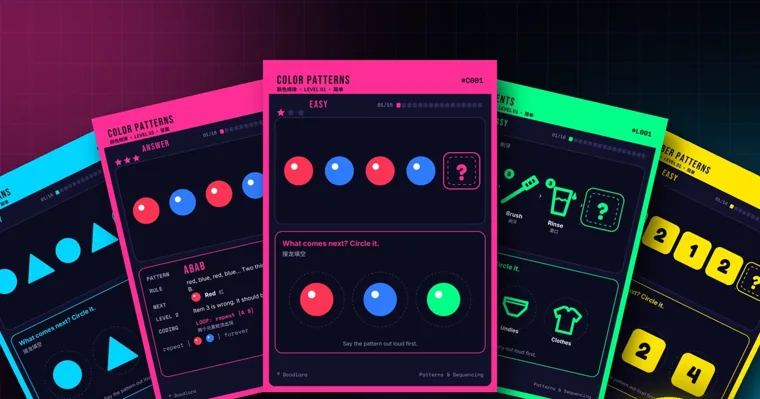
The best pattern activities for preschool start with the body and the voice, not with paper. Clap, pat, clap, pat is an AB pattern a three-year-old can do before they can hold a crayon well. From there the order that works is AB, then AAB and AABB, then ABC, then growing patterns like 2, 4, 6, 8. Each step below says what age it suits, how many kids, how long it takes, what to set out and where children usually get stuck.
Pick a pattern activity by age and time
| Activity | Pattern type | Best age | Group | Time | Prep |
|---|---|---|---|---|---|
| Clap and pat | AB | 3+ | 1 to whole class | 3–5 min | None |
| Stand, sit | AB | 3+ | 2 to whole class | 3–5 min | None |
| Big block train | AB | 3+ | 1–3 | 10 min | Large blocks or toy cars |
| Clap, clap, stomp | AAB | 3½+ | 1 to whole class | 5 min | None |
| Color the row | AB, AABB, ABC | 4+ | 1–4 at a table | 10–15 min | One printed page, crayons |
| Fix the broken pattern | Any | 4+ | 1–6 | 10 min | Pattern cards |
| Bead or button strings | AB, AABB, ABC | 4+, never under 3 | 1–4, adult at the table | 15 min | Large beads, lace |
| Pattern walk | Any | 3+ | Small group | 15–20 min | None |
| Guess my rule | AB, AABB, ABC | 4+ | 3–10 | 5–10 min | Kids themselves |
| Staircase towers | Growing | 4½+ | 1–3 | 10–15 min | Blocks or snap cubes |
| Hop by twos | Growing | 5+ | 1–6 | 5–10 min | Tape or chalk numbers |
| Number detective | Growing | 5+ | 1–2 | 10 min | One printed page |
| Story order | Sequence | 4+ | 1–4 | 10 min | Picture steps |
| Pattern Path board game | Mixed | 4+ | 2–4 | 15–20 min | Board, die, tokens |
If you only have five minutes and no supplies, start with clap and pat. If you have a table, crayons and four kids, color the row. Planning a themed week instead? Our farm activities for preschool use the same kind of table.
How to teach patterns to preschoolers in four steps
Every activity below fits into one of four jobs, and kids should meet them in this order.
- Copy it. You clap, pat, clap, pat. The child does the same thing back.
- Keep it going. You start the row and stop. The child adds the next one, then the next.
- Fix it. You make a row with one wrong piece. The child finds it and says what belongs there.
- Make one up. The child builds a pattern and you try to continue it.
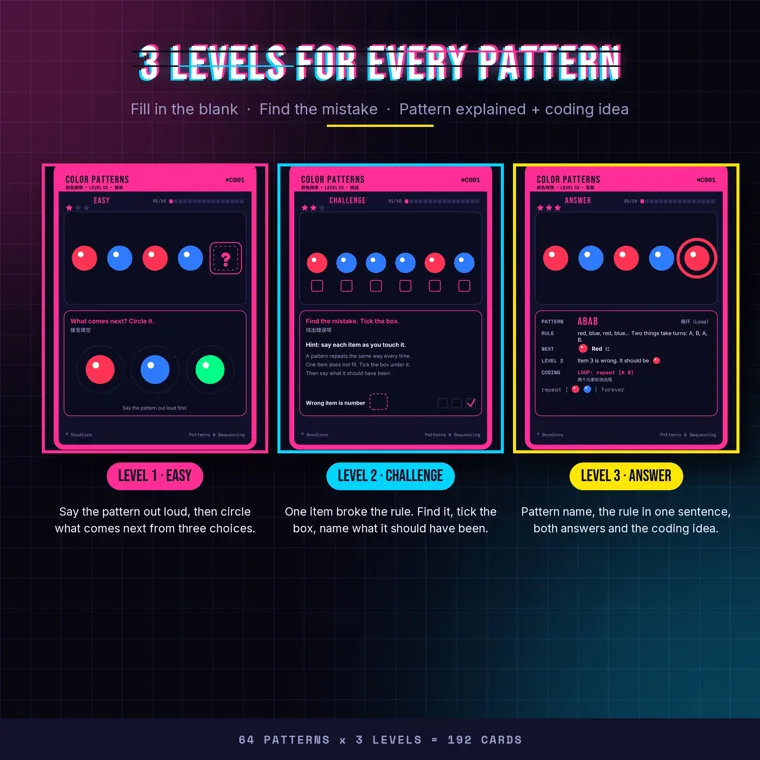
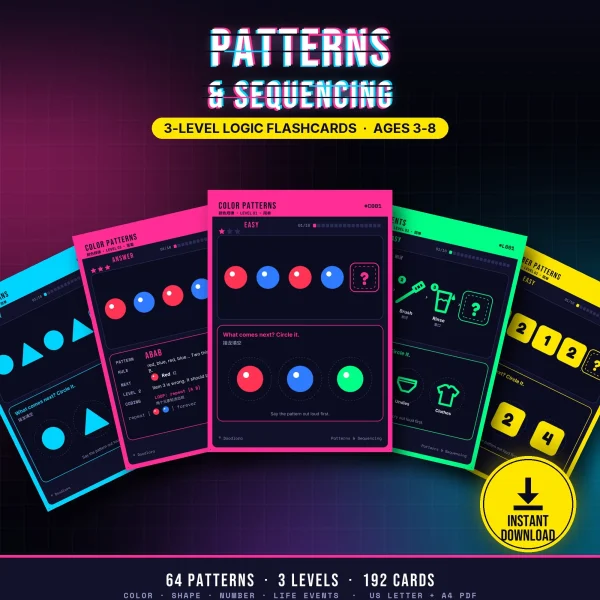
Say the pattern out loud at every step: “red, blue, red, blue.” Hearing the rhythm makes the next piece easier to guess than staring at a row. Our pattern and sequencing cards print that instruction on every easy card for the same reason: “Say the pattern out loud first.”
First patterns for 3-year-olds: AB with the whole body
Start here whatever the age. Even five-year-olds who have never named a pattern should spend a few minutes on AB before they see a worksheet.
Clap and pat
- Who: ages 3 and up, one child or a whole circle
- Time: 3–5 minutes
- Prep: none
Clap your hands, then pat your knees. Say “clap, pat, clap, pat” as you go. After four or five rounds, stop after a clap and wait. The child should pat without being told. Then swap leaders and let a child start the rhythm. End when every child has led once, or after a set number of rounds in a big group.
Snag: kids speed up until it turns into random clapping. Keep a slow, even beat and say the words louder than the claps.
Stand, sit
- Who: ages 3 and up, two kids to a whole class
- Time: 3–5 minutes
- Prep: chairs or a carpet
Go around the circle: the first child stands, the next sits, the next stands. Ask the next child in line, “Stand or sit?” before they move. When the whole circle is done, everybody looks around and reads the pattern back together. It works well as a transition right before snack.
Big block train
- Who: ages 3 and up, 1–3 kids
- Time: 10 minutes
- Prep: large blocks or toy cars in two colors
Lay out red, blue, red, blue in a long line and hand the child the next block. Once they keep it going, let them make the train and you add a car. Finish by “driving” a finger along the train and saying each color.
Use pieces that are too big to fit in a mouth for this age. The safety section below explains why.
AAB, AABB and ABC for 4-year-olds
These are the next step once AB feels easy. The jump that trips kids up is AABB, because it looks like AB with mistakes in it.
Clap, clap, stomp
- Who: ages 3½ and up, any group size
- Time: about 5 minutes
- Prep: none
This is the first AAB pattern. Clap, clap, stomp. Clap, clap, stomp. Have the group say the words with the actions, and stop after the second clap so they supply the stomp. When it’s solid, try AABB (clap, clap, stomp, stomp) and ABC (clap, pat, stomp).
Snag: in AABB, children often stomp once and go back to clapping. Count the doubles on your fingers, “one, two,” for each part.
Color the row
- Who: ages 4 and up, 1–4 kids at a table
- Time: 10–15 minutes
- Prep: one printed page and crayons in six colors
Page 59 of our pattern cards set is a “Make your own pattern” sheet. Each row has the first two or three circles already colored and blank circles after them, ten circles in all. There are two rows each of ABAB, AABB and ABCABC, then one blank row labeled “your own.” The child colors each row to the end, saying the colors out loud.
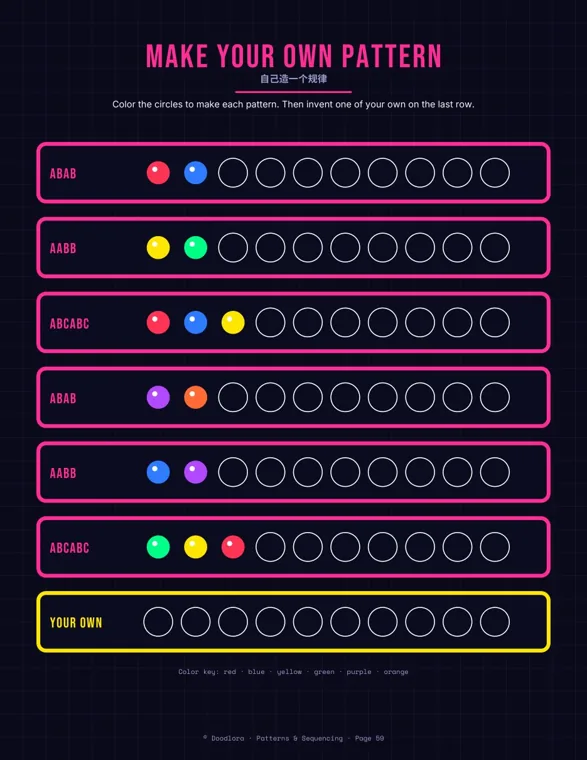
Snag: the AABB rows show only one dot of each color at the start (yellow, green). Before the child colors, point to the label and say “two yellow, two green” so the first two dots aren’t read as a finished AB. The last row is the real test. If a child colors it in random colors, go back to clap, clap, stomp for a day.
Fix the broken pattern
- Who: ages 4 and up, 1–6 kids
- Time: 10 minutes
- Prep: pattern cards, or any row of objects with one wrong piece
Lay out red, blue, red, red, red, blue. Ask, “Which one broke the rule?” The child touches each piece while saying the colors and should hear the mistake. Next, the child names what it should have been and swaps it.
The challenge cards in our set do the same thing on paper. Each one shows six items with a check box under each, and the hint on the card is “say each item as you touch it.” Finish when the row reads correctly out loud.
Bead or button strings
- Who: ages 4 and up, 1–4 kids, with an adult sitting at the table. Not for children under 3.
- Time: about 15 minutes
- Prep: large beads or buttons in two or three colors, a lace with a stiff tip
Start a string with two repeats of the pattern (red, red, blue, blue, red, red, blue, blue) and let the child continue. The string is done when it reaches the end of the lace or the child has finished five repeats. Tie it off and read it back together.
Count the pieces into a bowl before you start and count them back at the end, so nothing ends up on the floor where a younger sibling can find it.
Pattern games for a small group
Games keep the same skills going once worksheets get old. They also show you which kids can make a pattern and which can only continue one.
Guess my rule
- Who: ages 4 and up, 3–10 kids
- Time: 5–10 minutes
- Prep: none; kids are the pattern
Line up children by something they can see: shirt color, hat or no hat, standing or kneeling. Line them up in an AB order without saying the rule. Ask the group who should come next and why. Whoever says the rule correctly gets to set up the next line. End after three or four rounds.
Snag: “shirt color” fails when two kids wear similar shades. Pick a rule that’s yes or no, like “arms up, arms down.”
Pattern walk
- Who: ages 3 and up, a small group
- Time: 15–20 minutes
- Prep: none
Walk the classroom, hallway or yard and hunt for patterns already there: floor tiles, fence posts, a striped shirt, brick rows, window panes. When someone finds one, everybody says it out loud. Back inside, each child draws one pattern they saw.
Pattern Path board game
- Who: ages 4 and up, 2–4 players
- Time: 15–20 minutes
- Prep: page 63 of our pattern cards set, one die, a small token for each player
The board has 28 squares between START and FINISH. Roll, move, and say what comes next on the square you land on. A wrong answer sends you back one square, and the first to reach FINISH wins. The squares run through dot colors, shapes, counting by 2s and counting by 5s, so a single game covers most pattern types.
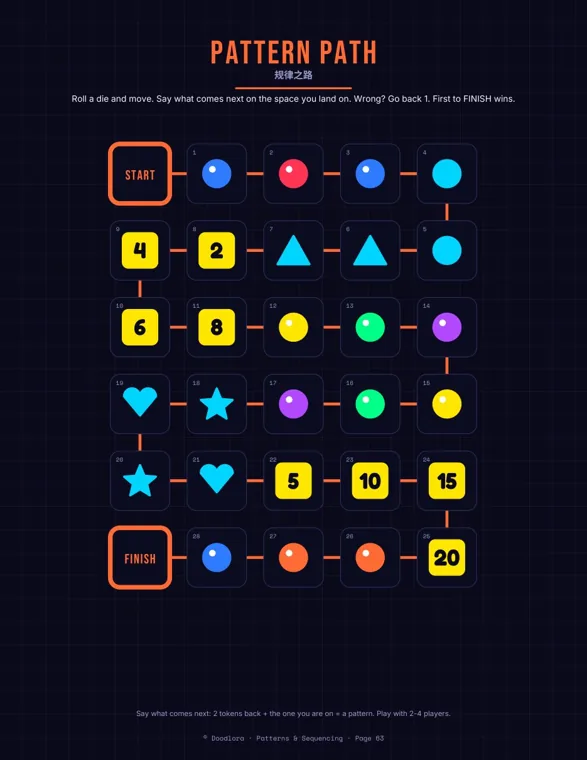
Snag: the rule for reading a square, written at the bottom of the board, is “2 tokens back + the one you are on = a pattern.” That is hard for a four-year-old to follow alone. An adult should point to the two squares behind the token and the one under it, say them out loud, and let the child name the next one. Decide before you start whether a player needs an exact roll to land on FINISH; the board doesn’t say.
Growing patterns for 4- and 5-year-olds
A growing pattern changes by the same amount each time instead of repeating: 1, 2, 3, 4 or 2, 4, 6, 8. Wait until a child can do AABB and ABC with ease, and don’t rush it if that takes most of the year.
Staircase towers
- Who: ages 4½ and up, 1–3 kids
- Time: 10–15 minutes
- Prep: blocks or snap cubes of one size
Build a tower of one block, then two, then three. Ask the child to build the next tower. Count each tower out loud. Once they get it, try towers that grow by two: two, four, six. Stop when the staircase is as tall as the child can count.
Snag: kids add one block when the rule is “add two.” Have them lay the new tower next to the last one and count only the extra blocks.
Hop by twos
- Who: ages 5 and up, 1–6 kids
- Time: 5–10 minutes
- Prep: numbers 1–20 in chalk outside or tape on the floor
Children hop only on even numbers: 2, 4, 6, 8. Then try fives on a longer line. Say each number as you land. One child hops while the rest call out the next number.
Number detective
- Who: ages 5 and up, 1–2 kids
- Time: about 10 minutes
- Prep: page 61 of our pattern cards set, a pencil
Each of eight rows has missing numbers and a “Rule:” blank. The rows mix repeats with counting up, counting down, counting by 5s and 10s, and doubling. For preschoolers, read each row aloud and fill only the numbers; skip writing the rule. Leave the doubling row (1, 2, 4, _, 16) for later. It’s a big jump from counting on.
Sequencing: putting steps in order
Sequencing is a cousin of patterns. Instead of “what repeats,” the question is “what comes next in a story.” The life events cards in our set cover 16 everyday routines. Brush teeth goes paste, brush, rinse, wipe. Wash hands goes tap on, wet, soap, rinse, dry. Others include getting dressed, planting a flower, baking a cake and bedtime.
Story order
- Who: ages 4 and up, 1–4 kids
- Time: about 10 minutes
- Prep: picture steps for a routine the child already does every day
Show the steps out of order and ask, “What do you do first?” The child lays the steps left to right and tells the story with “first, then, next, last.” Start with three or four steps. Page 62 of our pattern cards set is a cut-and-sort page for this. Cut the tiles before kids arrive to save a lot of time.
Snag: pick routines the child really does at home. A child who has never mailed a letter can’t tell you whether the stamp comes before the writing.
For another ordering activity, our weather activities for preschool have kids number four season pictures from 1 to 4 and then fill in a seasons wheel.
Keeping small parts safe
Patterns are easy to build with small things like beads, buttons, marbles and coins, and those are the pieces to watch. The American Academy of Pediatrics lists toys with small parts, marbles and small balls among household items to keep away from infants and children. It also says “Balloons, balls, marbles, pieces of toys and foods (small round objects) cause the most choking deaths.”
U.S. federal rules draw the line at age 3. Under 16 CFR 1501, CPSC treats “any toy or other article intended for use by children under 3 years of age that presents a choking, aspiration, or ingestion hazard because of small parts” as a banned hazardous substance.
In practice:
- For children under 3, and for any classroom with a younger sibling around, use big blocks, toy cars, body movements and paper.
- With older preschoolers, use small pieces only at a table with an adult sitting there, and count them in and out.
- Never use button batteries or magnets as pattern pieces. AAP warns that button batteries “can also cause internal burns if swallowed.”
When a child gets stuck
- They copy but can’t continue. Go back to body patterns and say the words with them. Stop in the same spot every time so they learn where their turn is.
- They make a “pattern” that never repeats. Ask them to say it out loud. Saying it twice often shows them it doesn’t repeat.
- They read AABB as ABAB. Group the doubles with your hands or space them on the table: (red red) (blue blue).
- They get the answer but can’t say the rule. That’s normal at this age. The rule can wait; continuing the row is the skill.
- They lose interest. Five minutes a day beats one long worksheet session. A pattern walk counts.
Printing the pattern cards for a preschool group
Our patterns and sequencing cards hold 64 patterns in four groups of 16: color, shape, number and life events. Each pattern comes as an easy card, a find-the-mistake card and an answer card, which makes 192 cards in all. They print four to a page at 3.5 x 5 inches, and the file comes in US Letter and A4, 68 pages each. A few things to know before you print:
- Ink. Every card has a dark navy background. Print only the group you need this week.
- Circle time. Pages 4–6 print the first color pattern as full-page easy, challenge and answer cards for showing to a group.
- Answer cards are for adults. They name the pattern type and also explain it as a “loop” in coding terms. Use the one-sentence rule and skip the coding line with three-year-olds.
- Labels. English comes first on every card, with smaller simplified Chinese labels.
- Extras. The set also has the four practice pages above, the Pattern Path board, a progress tracker, a two-page answer key and a certificate.
Printables from this article
Related articles
Printable Flashcards
What Is a Ten Frame? How to Fill One and 8 Activities
How a ten frame works, why five on top and two below reads as seven, what age to start, and eight short activities with players, time and setup.
Printable Flashcards
Telling Time Activities: How to Teach Time to Kids by Stage
Fifteen clock activities sorted by stage, from an hour-hand-only clock to elapsed time on a number line, each with ages, players, time, supplies and the mistake to watch for.
Printable Flashcards
Weather Activities for Preschool: Snow & Seasons for Kids
Sixteen weather activities for a preschool class or a child at home, from a five-minute window check to snow measuring, weather bingo and a seasons diary.