Memory Game Rules: How to Play, 2-Player Rules and Scoring
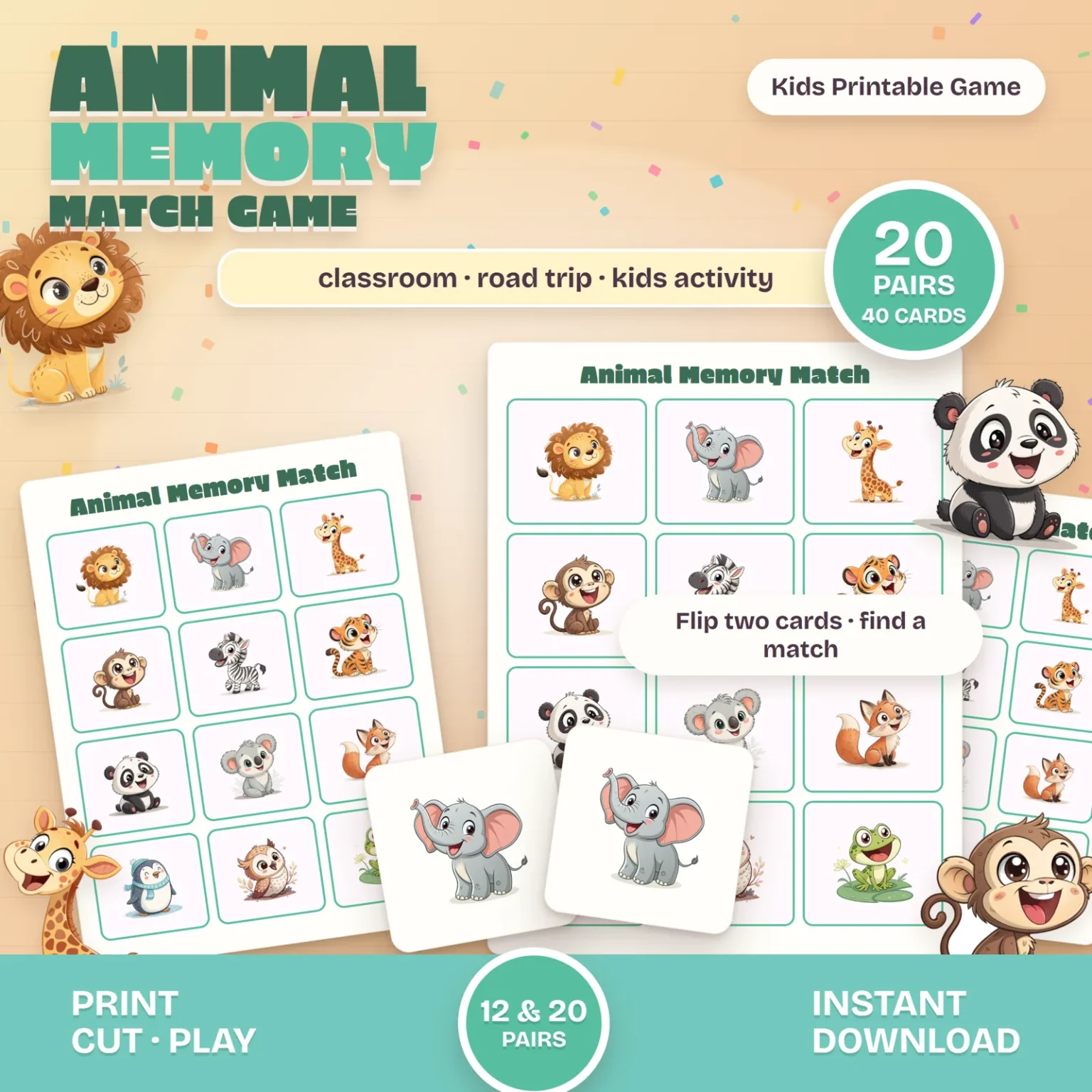
Memory is played with every card face down and every picture printed twice. On your turn you flip two cards, keep them if they match and go again, and put a miss back exactly where it was.
When the table’s empty, the player holding the most pairs wins, and you may know the same game as Concentration or Pairs.
The part that really changes from one table to the next is the size of the grid.
The instructions in our Memory Match Cards start a three-year-old on six pairs and hand all 24 to anyone 11 or older. That single decision is what makes the game feel like a hunt or like a test.
How to play memory: one turn, start to finish
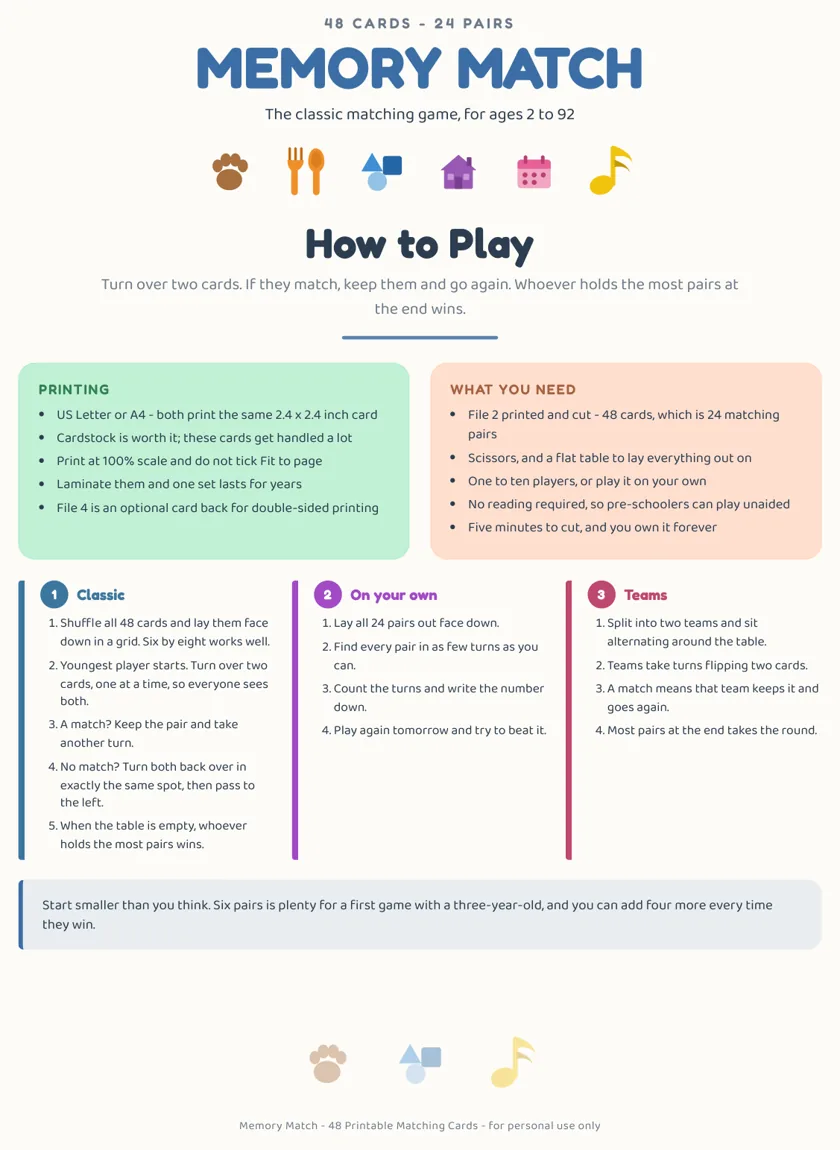
Every turn follows the same five steps. Here they are the way our Memory Match Cards instructions give them, and the How to Play page in our animal set says the same thing in fewer words:
- Shuffle all the cards and lay them face down in a grid.
- The youngest player starts by turning over one card, then a second, one at a time, so everyone at the table sees both.
- If the two pictures match, that player keeps the pair and takes another turn.
- If they don’t match, both cards go back face down in exactly the same spots, and play passes to the left.
- When the table is empty, everyone counts their pairs, and whoever holds the most wins.
Leave enough space in the grid to lift one card without nudging its neighbor, because a card that’s been bumped is a card nobody can place with confidence anymore.
Turning the cards one at a time matters more than it looks. Your first card tells you what you’re hunting for, so the second flip becomes either a guess or a memory.
“Exactly the same spot” is the rule players bend most, usually by sliding a card into a gap or dropping it a little to one side.
Don’t let that slide. Every location the table has been tracking stops meaning anything once the cards start drifting.
Looking during somebody else’s turn isn’t cheating. It’s the whole game, because every miss shows two pictures to everyone watching.
The only thing a waiting player can’t do is touch a card, so tip each one toward anybody sitting on the far side before it goes back down.
Here’s how that plays out with our animal cards. Say Maya turns over a koala in the top row, then a frog near the bottom, and both go back face down.
On Leo’s turn, his first card is the other koala, so he turns up the spot where Maya’s koala went back, keeps the pair, and goes again.
Leo didn’t find that koala by luck, and he didn’t find it on his own turn either. He found it by watching Maya’s, which is exactly the skill the game rewards.
How many pairs should you lay out for a memory game?
Put out four to six pairs for ages 2 to 4, ten to twelve pairs for ages 5 to 10, and all 24 for players 11 and up.
Those counts come from the instruction sheet in our Memory Match Cards deck. The tip printed in our animal set makes the same point more briefly: fewer pairs for younger kids, more for a bigger challenge.
| Players | Pairs to put out | Cards on the table | How to start |
|---|---|---|---|
| Ages 2 to 4 | 4 to 6 | 8 to 12 | Face up first, so it’s a hunt, then face down once that’s easy |
| Ages 5 to 10 | 10 to 12 | 20 to 24 | Classic rules, plus a timer once they start beating the grown-ups |
| Ages 11 and up | All 24 | 48 | Face down from the first flip, in teams if you want it loud |
| Older adults | 6 to 8 | 12 to 16 | Familiar pictures, printed at 120% for larger cards |
Start with fewer pairs than you think a child needs.
Six pairs is plenty for a first game with a three-year-old. After that, the instructions suggest adding four more every time they win, which keeps the challenge a step ahead without ever jumping straight to the full deck.
The grid shape follows from the count: twelve cards lay out three by four, 24 cards four by six, and the full 48-card deck six by eight, the layout the instructions recommend.
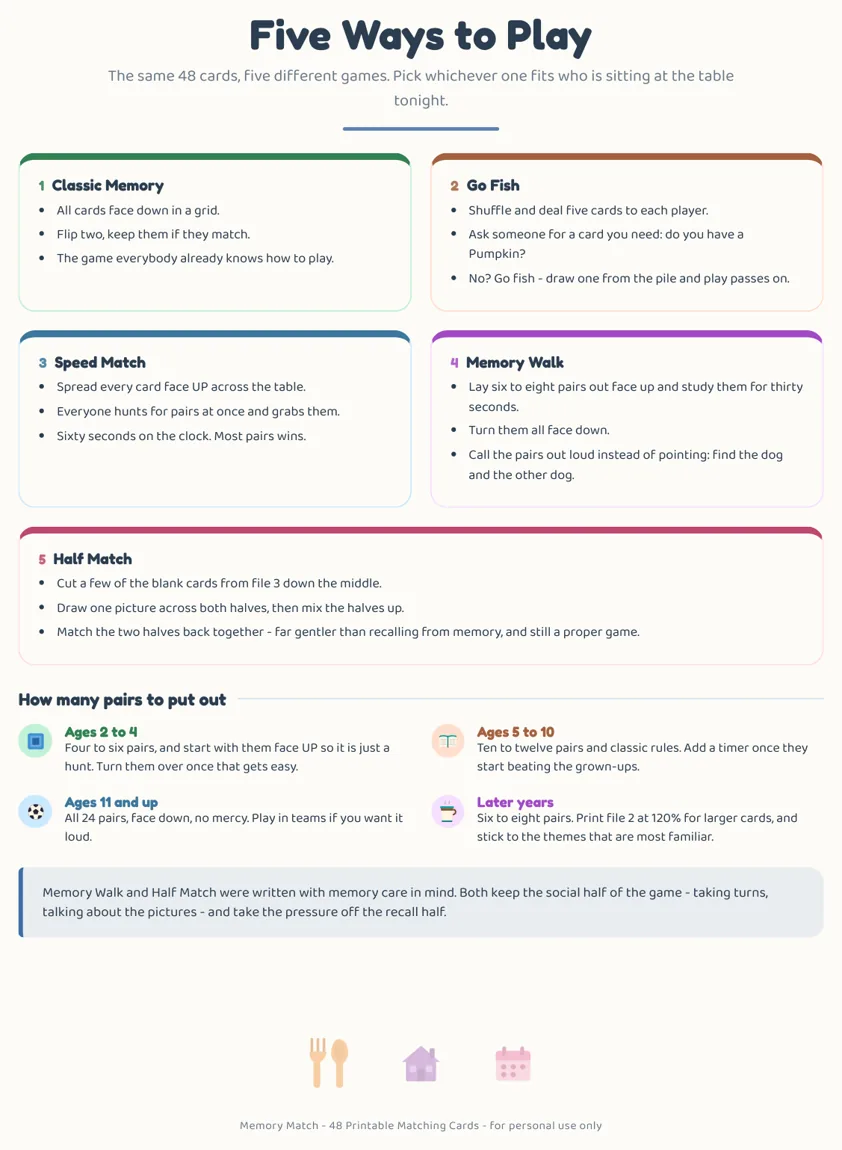
For an older relative, the instructions also suggest printing the card file at 120% for bigger cards.
Type 120 into the Custom Scale setting of your print dialog. Expect the edge cards to run off a US Letter sheet, though, because the enlarged page measures about 10.2 by 13.2 inches (26 by 34 cm). Printing on 11-by-17-inch paper (28 by 43 cm) keeps every card whole.
Picture cards keep the game open to preschoolers and other children who can’t read yet, and neither of our decks needs any reading to play.
Our animal set comes two ways, with each animal’s name in capitals under the picture or with the picture alone. The named cards give an early reader something to sound out whenever a pair turns up.
If a child calls the koala a bear, let the match stand and sort out the name afterward, because a memory game that turns into a vocabulary quiz stops rewarding memory.
The Memory Match Cards instructions put the game at one to ten players. Beyond that, the waits between turns get long, and a round of printable bingo suits a whole classroom better.
Memory game scoring: one point a pair, rounds and the last two cards
Each pair you collect is worth one point, and a wrong guess costs nothing, since remembering is hard enough already.
Count pairs, not cards.
A child who counts 12 cards as 12 points has doubled their score. The quickest check is that everyone’s totals together should equal the number of pairs you laid out, so with all 20 pairs of our animal deck on the table, the scores add up to 20.
For a game night, the score sheet in our Memory Match Cards gives each player a row, with four round columns and a total, and there’s room for ten players.
Write the pairs down after every round rather than at the end, and a few short games turn into one evening’s competition.
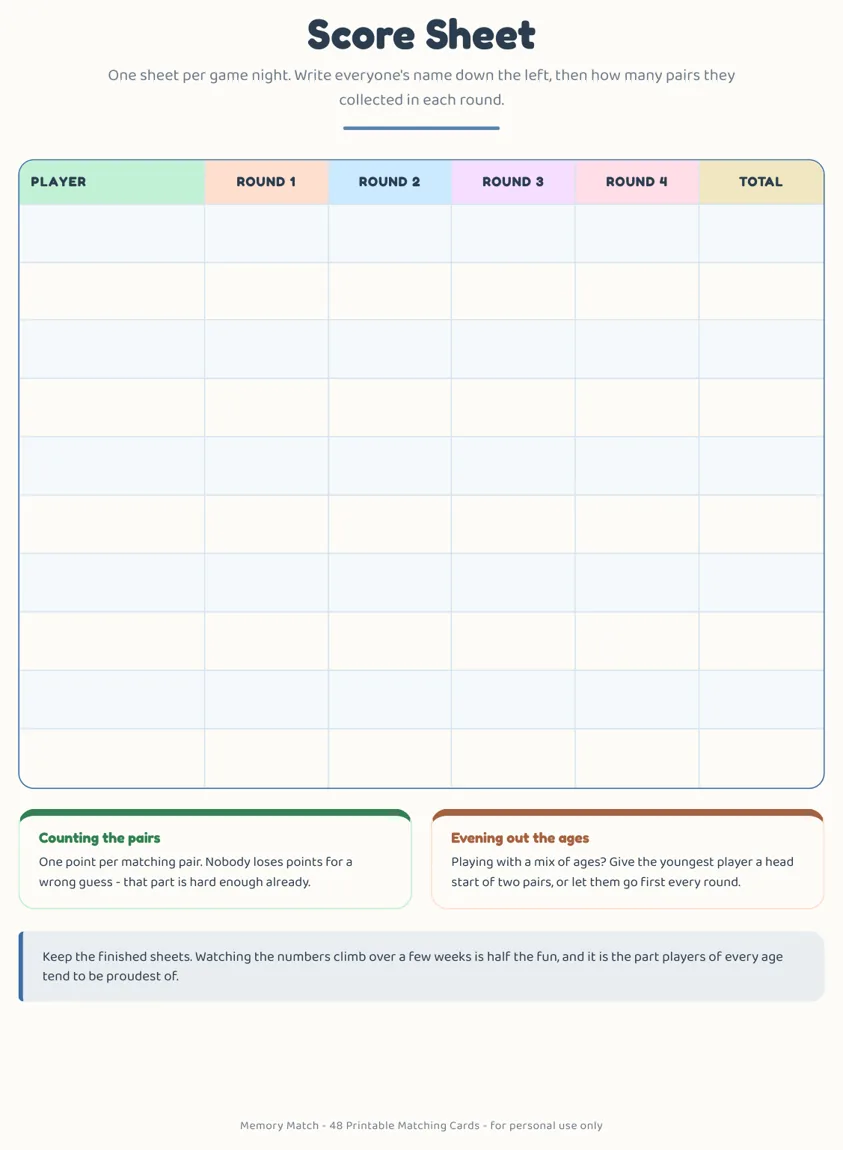
When ages are mixed, the same sheet suggests giving the youngest player a head start of two pairs, or letting them go first every round.
We’d choose the head start for a preschooler, because two pairs already written in their row is something a four-year-old can actually see.
Neither of our decks settles a tie, so we’d let a tie stand and reshuffle the whole deck for a rematch rather than play off a few leftover pairs.
When only two cards are left face down, they have to be a pair.
If they aren’t, the game isn’t over and the deck isn’t complete, which usually means a card was missed during cutting or packed away with the wrong set.
Memory game rules for 2 players, one player or teams
The classic rules work for any number from two up to ten. Two players, a single player and two teams each change something, though, either in how a turn ends or in how the score is kept.
Playing memory with 2 players
With two players, turns simply alternate, and every card your opponent flips is information for you, so you end up watching the other player’s flips as closely as your own.
The match-means-go-again rule can let one experienced player clear several pairs in a single turn.
That’s fine between two adults, but against a five-year-old it can end the game before the child has had much of a turn.
If that happens at your table, agree beforehand that a match keeps the pair but ends the turn. Apply the change to both players for the whole game.
The head start works with two players as well, so the younger one can begin with two pairs already on the score sheet.
Playing memory on your own
Solo memory turns the scoring around. Lay out all 24 pairs face down, find every pair in as few turns as you can, count the turns, and write the number down.
Count each two-card flip as one turn, whether it matches or not.
You can’t finish in fewer turns than there are pairs, so 24 is a perfect game for the full deck, and every miss adds one to that number.
The instructions’ last step is to play again tomorrow and try to beat it. We’d use the round columns on the score sheet for those numbers, one day per column, so the improvement sits on a single page.
Playing memory in teams
Split into two teams and sit with the teams alternating around the table, so neither side has all its players on one edge of the grid.
Teams take turns flipping two cards. A match goes to that team’s pile and that team goes again, and the team with the most pairs at the end takes the round.
For players 11 and up, the age guide puts all 24 pairs on the table and suggests teams whenever you want the game loud.
Decide before you start whether teammates can call out a location, because that one choice decides whether a team plays as one memory or as several.
Other games to play with a memory card deck
Teams are still the same game. One step further out, the same deck plays four more games, and they’re set out on the second page of our Memory Match Cards instructions.
Go Fish turns the pairs into a hand of cards. Deal five to each player and ask someone for a card you need (“Do you have a pumpkin?”). If they don’t have it, draw one from the pile while play passes on.
Speed Match lays every card face up, everyone hunts for pairs at the same time and grabs them, and after sixty seconds the most pairs wins.
Memory Walk puts out six to eight pairs face up for players to study for thirty seconds.
Then everything goes face down, and players call each pair out loud instead of pointing at it (“the dog and the other dog”).
Half Match uses the blank cards. Cut a few down the middle, draw one picture across both halves, mix up the halves, and match them back together, which is far gentler than recalling positions from memory.
The same 12 blank cards are also how you make a matching game of your own. Draw the same thing on two of them, like a family pet or a favorite food, and you’ve added a pair to the deck.
For a party, the Memory Match card in our one-minute party games turns this into a race: 12 pairs face down, 60 seconds, four pairs for a point and eight for two.
With a group that doesn’t like losing, try a cooperative round instead, where every pair goes into one shared pile and the table wins together once the grid is cleared.
Printing a memory card deck that doesn’t give the pairs away
All of those games assume a full deck with backs that hide the pictures, and a printed deck can fail at either one before the first turn.
Partners don’t print on the same sheet.
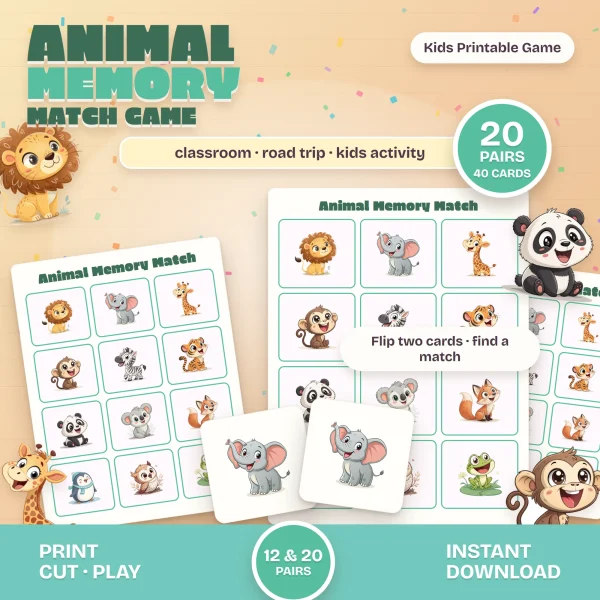
Our 20-pair animal deck fills three pages with 12 cards each. The last four, a lion, monkey, bear and sloth, sit alone on page 4, while their partners are on the pages before it.
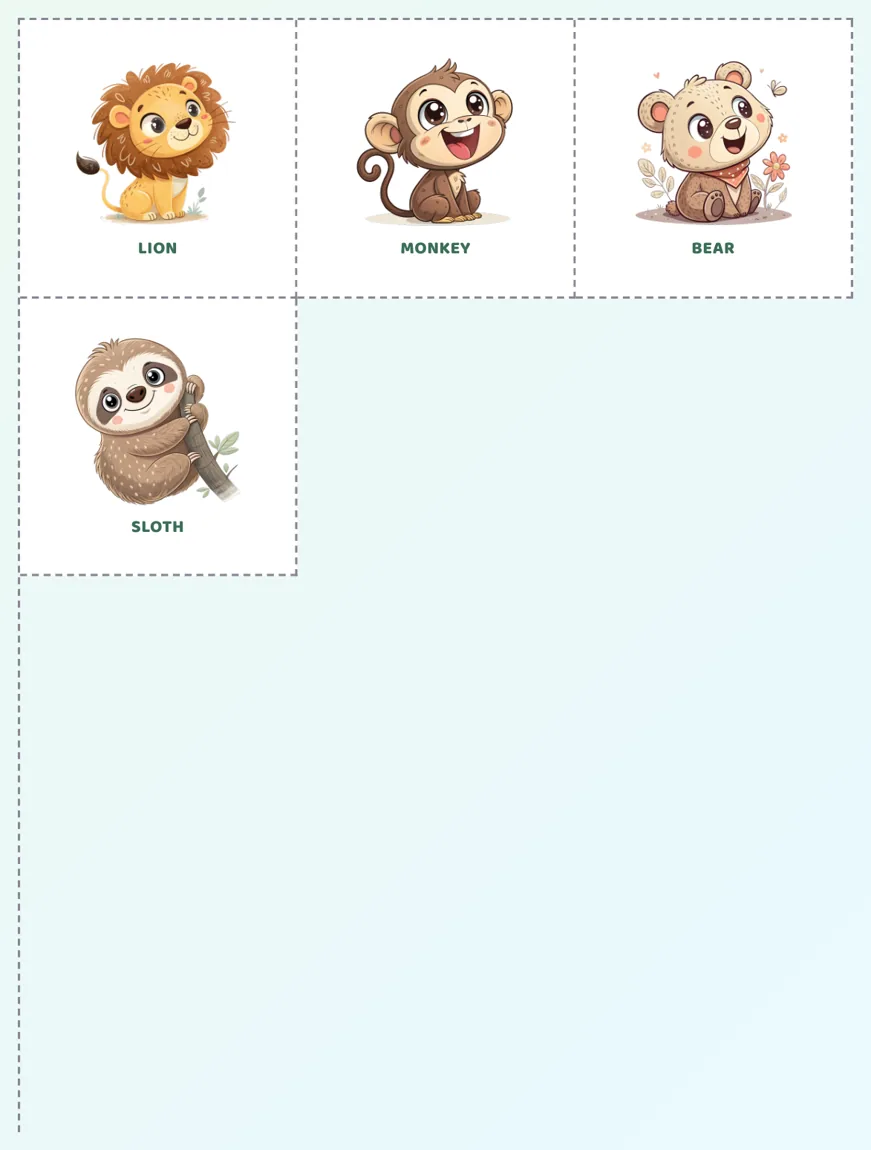
Skip that mostly blank page and four animals end up with no partner at all.
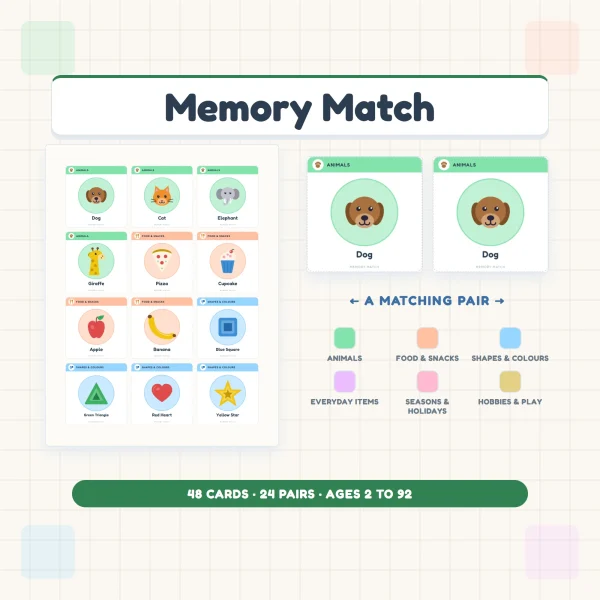
The Memory Match Cards deck works the same way. Pages 1 and 3 carry the same 12 pictures, and pages 2 and 4 carry the other 12.
Print every card page, then count everything before the first game: 40 cards for 20 pairs, 24 for 12, and 48 for the full Memory Match Cards deck.
Use one version per game. The 12-pair animal set is 12 of the same 20 animals, and the named and picture-only versions show the same animals, so combining any two of them puts four elephants on the table.
Print the whole deck on one paper size, too.
Our animal grid cards, the layout where cards touch edge to edge, come out 2.5 inches (6.4 cm) square from the US Letter file but 2.42 by 2.67 inches (6.1 by 6.8 cm) from the A4 file.
A taller card in the grid is easy to remember face down, so one stray A4 sheet in a Letter deck marks every card printed on it.
The Memory Match Cards print at the same size on both papers. Either way, set the scale to 100% and leave Fit to page unticked, and our page on US Letter or A4 explains the difference in more detail.
The optional card-back page in our animal set lines up with its bordered cards, the layout where every card has its own frame, square for square.
Behind the grid sheets, the same backs don’t line up. Each back lands inside its card with a white strip of up to about 0.17 inches (4 mm), and the strip changes from row to row.
A sharp-eyed player can learn those strips, so print the backs only behind the bordered pages, or leave the backs blank, which the animal instructions allow.
Thin paper gives the pictures away from behind. Try a single sheet on cardstock first, cut one card, and hold it up to a lamp, looking for the dark stripes of a tiger or a zebra before you print the rest.
Our paper guide for printables puts game cards on 65 to 80 lb cover stock (176 to 216 gsm).
Cut consistently along the same edge of every line, because a card that comes out a little narrower than the rest, or with a bent corner, gets remembered face down. If one card is damaged beyond saving, take its partner out too.
If you get down to two face-down cards that don’t match, stop and count the cards in every player’s pile. The missing card is usually still on the cutting table or in the wrong envelope, and the game can finish once it’s back.
Printables from this article
Related articles
Printable Party Games
How to Plan a Baby Shower: Timeline, Food & 2-Hour Schedule
A baby shower plan from the first talk with the parents-to-be to the last gift: timing, guest list, budget, venue, a two-hour schedule, safe food and backup plans.
Printable Party Games
How to Plan a Bridal Shower: Timeline, Budget and Schedule
A host's plan for a bridal shower, from the first talk with the bride and co-hosts to the guest list, invitations, a timed party schedule, the gift opening and what to do when something slips.
Printable Flashcards
Pattern Activities for Preschool: AB to Growing Patterns
Fourteen pattern activities for preschoolers, ordered from first AB rhythms to growing number patterns, with what to prepare, how long each takes and where kids get stuck.