Telling Time Activities: How to Teach Time to Kids by Stage
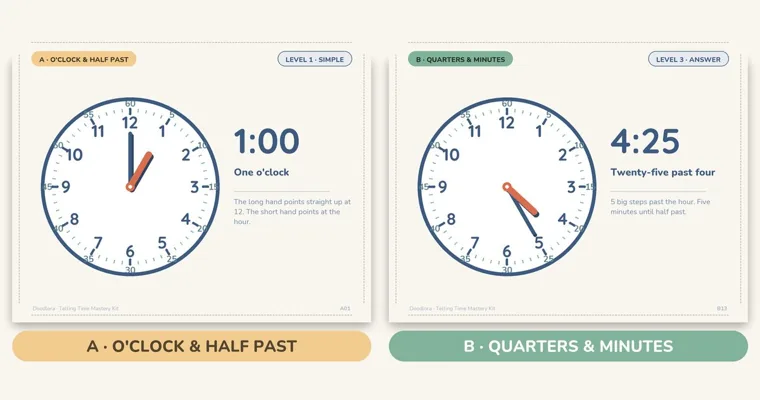
Telling time activities work best in the order children learn the clock: o’clock first, then half past, then quarter past and quarter to, then five-minute times, and finally the exact minute. Each stage below has two to four short games for a parent and child or a small classroom group, and most take 5 to 15 minutes. Move a child on when the current stage feels comfortable, not when the worksheet pile runs out.
We picked the ages, group sizes and minutes in this table as planning numbers, and your child’s attention span will adjust them quickly.
| Activity | Stage | Ages | Players | Time | You need |
|---|---|---|---|---|---|
| Hour-hand-only clock | O’clock | 5 to 7 | 1 child + adult | 5 min | Paper plate, paper fastener |
| Human clock on a chalk circle | O’clock | 5 to 8 | 2 to 6 | 10 to 15 min | Sidewalk chalk |
| Clock hunt at home | O’clock | 5 to 7 | 1 to 3 | 10 min | A notepad |
| Fold-the-plate half hour | Half past | 6 to 7 | 1 to 4 | 5 min | Paper plate, crayon |
| Clock card quiz | O’clock, half past | 6 to 7 | 1 or 2 | 5 min | Clock flashcards |
| Daily routine clock | O’clock, half past | 5 to 7 | 1 child | A minute at a time | Routine cards or sticky notes |
| Four-slice paper clock | Quarters | 6 to 8 | 1 to 4 | 10 min | Paper circle, two crayons |
| Clock Race board game | Quarters, hour jumps | 7 to 9 | 2 to 4 | 15 to 20 min | Board page, die, counters |
| Skip-count sticky notes | Five minutes | 7 to 8 | 1 to a class | 10 min | 12 sticky notes, wall clock |
| Past or to? | Five minutes | 7 to 8 | 1 to 3 | 10 min | Clock cards, two bowls |
| Morning or evening? | a.m. and p.m. | 7 to 8 | 1 to 4 | 5 to 10 min | Routine cards or slips |
| Count the little marks | Nearest minute | 8 to 9 | 1 or 2 | 5 to 10 min | Clock with minute marks |
| One-minute challenges | Feel for a minute | 6 to 10 | 2 or more | 10 min | A timer |
| Number-line hops | Elapsed time | 8 to 9 | 1 or 2 | 10 min | Paper strip, pencil |
| Later and earlier cards | Elapsed time | 7 to 9 | 1 or 2 | 5 to 10 min | Laminated cards, dry-erase marker |
How to teach time to kids: which grade learns each step
Teaching time to kids goes smoothest when each step rests on the one before, and the Common Core math standards lay out the same ladder by grade. Telling time first appears in first grade. Kindergarten’s measurement standards cover describing, comparing and sorting objects, not reading clocks.
| Grade | Common Core standard | What children are expected to read |
|---|---|---|
| 1st (about ages 6 to 7) | 1.MD.B.3 | Hours and half hours on analog and digital clocks |
| 2nd (about ages 7 to 8) | 2.MD.C.7 | Time to the nearest five minutes, using a.m. and p.m. |
| 3rd (about ages 8 to 9) | 3.MD.A.1 | Time to the nearest minute, plus time intervals in minutes and word problems that add or subtract them |
Quarter past and quarter to aren’t named in any of the three. They sit inside second grade’s five-minute step, since quarter past is three jumps of five. Many families teach them right after half past anyway, because the idea of a half leads naturally into quarters, and the sections below follow that order. If your state writes its own standards, check your school’s math curriculum for the exact grade.
Keep each session short. Around ten minutes on most days gives a child more repetition than one long sit-down on the weekend, and it’s easier on everyone’s concentration. Our morning routine for kids guide already keeps ten minutes spare on school mornings, and that’s enough for one round at the kitchen clock.
O’clock activities: start with the short hand
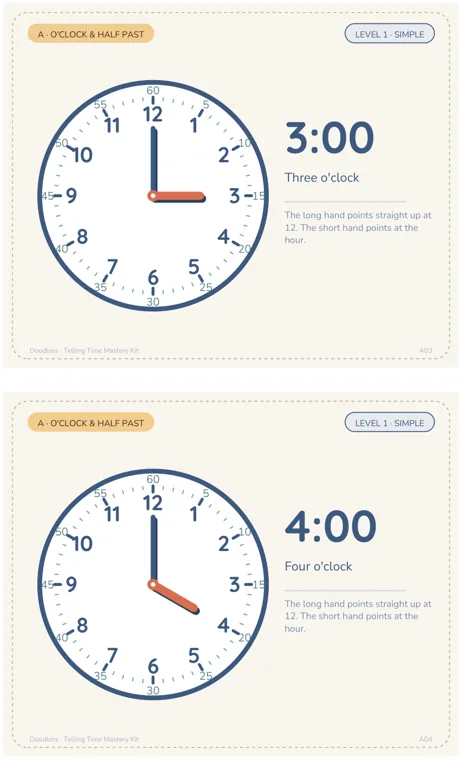
An o’clock time is the easiest one to recognize. The long hand points straight up at 12 and the short hand points right at the hour, so a child only has to read one number. That’s why every activity in this stage concentrates on the short hand.
Hour-hand-only clock
Ages 5 to 7 · Players one child and an adult · Time about 5 minutes · You need a paper plate, a marker, a strip of card for the hand and a paper fastener
Write 12, 3, 6 and 9 around the plate first, then fill in the other numbers between them so the spacing comes out even. Fasten only the short hand. Point it at a number and ask what time it is, then park it partway between two numbers and ask again. Stop after ten turns, or sooner if your child gets five right in a row.
The usual slip is naming whichever number the hand is closest to. Between 3 and 4 it’s still “3-something” until the hand actually reaches the 4, and that understanding is exactly what half past depends on later.
Human clock on a chalk circle
Ages 5 to 8 · Players 2 to 6 · Time 10 to 15 minutes · You need sidewalk chalk and a patch of driveway or playground
Draw a big circle on the ground and write the 12 numbers around it. One child stands in the middle as the clock, with one arm completely straight for the long hand and the other bent at the elbow for the short hand. Someone calls an o’clock time, the clock shows it, and everyone checks. Swap clocks after each correct answer, and finish when everyone has had two turns in the middle.
The child in the middle has to face the 12. Facing the rest of the group instead puts the 3 on their left, and every time comes out mirrored. Point out that difference once and it usually sticks.
Clock hunt at home
Ages 5 to 7 · Players 1 to 3 · Time about 10 minutes · You need a notepad and pencil
Walk through the house and find every clock: the oven, the microwave, the wall clock, the car dashboard, a watch. At each one, write down whether it has hands or only numbers, and read the hour together. The hunt ends back at the clock with hands, where your child shows the same hour with a finger.
Digital clocks will show times like 3:47 that a first grader can’t read on a dial yet. Don’t push it. Read the first number, call it “after 3” for now, and let the comparison between the two kinds of clock be the lesson.
Half past activities: when the short hand sits between two numbers
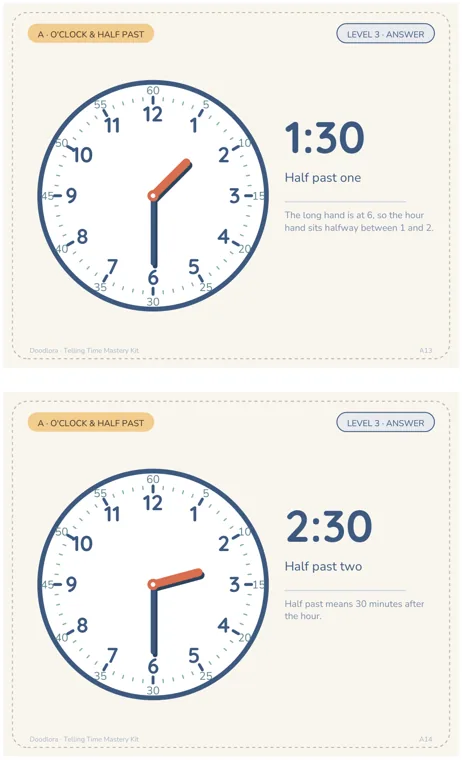
Half past is the first time the short hand stops pointing at a number. At 1:30 the long hand points at the 6 and the short hand sits halfway between 1 and 2, which is why children so often read it as 2:30. Expect some confusion here, and don’t rush past it.
Fold-the-plate half hour
Ages 6 to 7 · Players 1 to 4 · Time about 5 minutes · You need a paper plate or a paper circle and one crayon
Fold the plate in half from the 12 to the 6 and color the right-hand half. Explain that the long hand takes 30 minutes to travel down that colored side, and that’s what “half past” means. Call out half past times and have your child move both hands to show them. You’re done when your child can show half past any hour you name.
Watch the short hand. Children tend to move the long hand to the 6 and leave the short hand on the number, which makes 1:30 look like a broken 1:00. A quick reminder before each turn, “both hands move,” prevents most of it.
Clock card quiz
Ages 6 to 7 · Players 1 or 2 · Time about 5 minutes · You need a stack of o’clock and half past flashcards
Read the answer cards together first, then switch to cards that only ask the question. Flip a question card, your child says the time, and a right answer keeps the card. The quiz ends when the pile is gone, and the number of cards kept is the score.
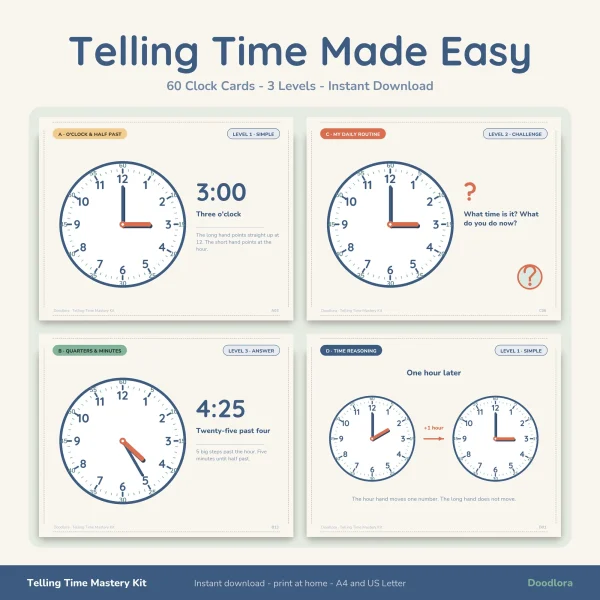
Our telling time flashcards open with 15 cards for this stage. Five print the answer (1:00 to 5:00), five ask “What time is it?” with no answer, and five add a line of everyday context, including the three half past cards at 1:30, 2:30 and 3:30.
The question cards have no answer key in the file. Work out each time and pencil it on the back before the quiz, so you aren’t squinting at a small clock in the middle of a game. To play memory instead, write the matching digital time on a blank card for each clock card. The turn order and how many pairs to lay out are in our memory game rules.
Daily routine clock
Ages 5 to 7 · Players one child · Time a minute at a time through the day · You need routine cards or sticky notes
Pick five moments your child already knows: waking up, breakfast, leaving for school, lunch and bedtime. At each one, stop at the clock together and read the time. Our routine cards print these as 7:00 wake up, 7:30 breakfast, 8:00 school, 12:00 lunch and 8:30 bedtime, all o’clock or half past. Tape each card next to the clock in the room where it happens, and end the day on the bedtime card.
Printed times rarely match a real household. A few later cards in our routine set read 11:30 home time and 2:00 nap time, which suit a half-day kindergarten more than a full school day. Write your family’s own times on sticky notes instead of teaching a schedule your child doesn’t live. If bedtime itself keeps shifting, our bedtime routine for kids guide sets lights-out by counting back from wake-up time.
Quarter past and quarter to: cutting the clock into four
Once half past is solid, quarters split each half again. Quarter past means the long hand is on the 3, 15 minutes after the hour. Quarter to means it’s on the 9, 15 minutes before the next hour. The vocabulary is half the battle, so say “a quarter is one of four equal parts” out loud before you start.
The answer cards in our set cover quarter past four through quarter past eight, but none of them show a quarter to time. Make two or three of those yourself on a blank clock before you begin.
Four-slice paper clock
Ages 6 to 8 · Players 1 to 4 · Time about 10 minutes · You need a paper circle and two crayons
Fold the circle in half and in half again, then open it. The folds cross at 12, 3, 6 and 9 and cut the clock into four slices. Color the slice from 12 to 3 in one color for quarter past, and the slice from 9 back to 12 in the other for quarter to. Call out times like “quarter past 2” or “quarter to 5” and have your child set both hands.
Quarter to 4 is 3:45, not 4:45. The short hand sits almost on the 4 but hasn’t reached it, so the hour is still 3.
Clock Race board game
Ages 7 to 9 · Players 2 to 4 · Time 15 to 20 minutes · You need the board page, one die, a counter for each player and a clock for each player
The Clock Race page in our flashcard set has a 15-square track from START to FINISH. Each square in between changes the time: plus 1 hour, minus 30 minutes, plus 2 hours, plus 15 minutes, plus 45 minutes and so on.
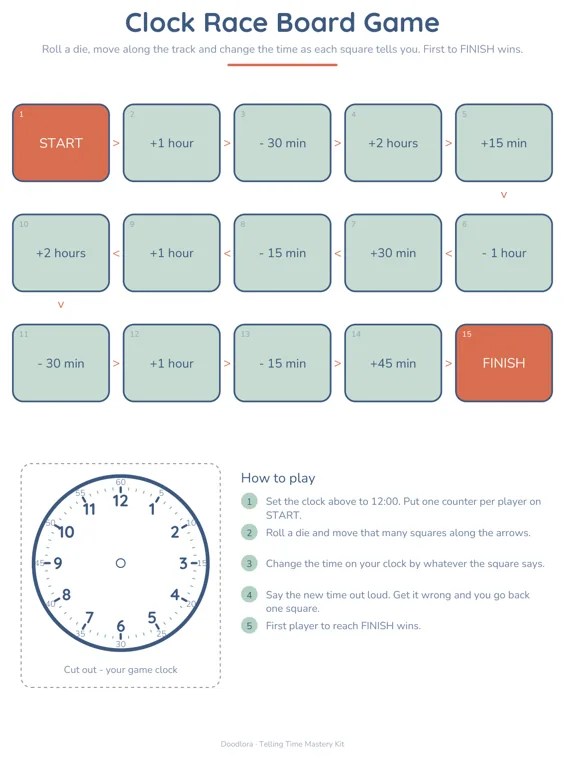
- Set every clock to 12:00 and put all the counters on START.
- Roll the die and move that many squares along the arrows.
- Change the time on your clock by whatever the square says.
- Say the new time out loud. A wrong answer sends you back one square.
- The first player to reach FINISH wins.
The page has only one cut-out clock, so print it once per player or give everyone a blank clock. Also show the second square before you start. A first roll of 2 means 12:00 minus 30 minutes, which goes backward past the 12 to 11:30, and that one trips up a lot of new players.
Five-minute activities for second graders
Five-minute times turn the clock into a counting game. Each number the long hand passes adds five more minutes, and second grade also brings a.m. and p.m. into it, so the activities here mix skip counting with everyday scheduling.
Skip-count sticky notes
Ages 7 to 8 · Players one child up to a whole class · Time about 10 minutes · You need 12 sticky notes and a wall clock, or a big clock drawn on paper
Write 5, 10, 15 and so on up to 55 on eleven notes, and “:00” on the twelfth. Stick each note beside its number on the clock and count around together. Then call a time like 3:20, and your child counts fives from the 12 to the 4 before saying it. Take one note away each round, and finish when the notes are all gone and the counting still holds up.
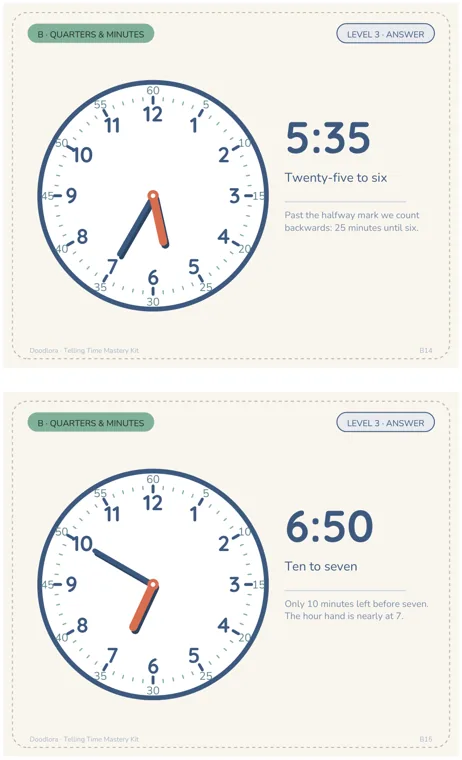
Our cards print 60 at the top of the minute ring, and some children copy that into answers like 3:60. When the long hand reaches the top, it’s a new hour and the minutes go back to :00.
Past or to?
Ages 7 to 8 · Players 1 to 3 · Time about 10 minutes · You need 10 clock cards or drawn clocks and two bowls labeled “past” and “to”
Sort the clocks into the two bowls. If the long hand is on the right side, between 12 and 6, it goes in “past.” If it’s on the left side, it goes in “to.” Then read each one both ways: “twenty-five to six” and “five thirty-five.” The round ends when both bowls are full and every clock has been read twice.
On a “to” time, the short hand is already near the next number. At ten to seven it’s almost on the 7, so children who read the short hand first say 7:50. Have them read the long hand side first, then name the hour the short hand hasn’t reached yet.
Morning or evening?
Ages 7 to 8 · Players 1 to 4 · Time 5 to 10 minutes · You need routine cards or paper slips with everyday events
Read out an event with a time, like breakfast at 7:30 or bedtime at 8:30, and your child answers a.m. or p.m. and says why. A.m. runs from midnight to noon, and p.m. from noon to midnight. Our bedtime card reads “Half past eight in the evening,” and its hands look exactly like 8:30 in the morning. That’s the point of this game, since the clock face alone doesn’t carry that information.
Leave 12:00 out of the a.m. and p.m. sort. Call it noon or midnight instead, because 12 a.m. and 12 p.m. mix up plenty of adults too.
Telling time to the minute and elapsed time in third grade
Third grade adds the last two pieces: reading the exact minute, and working out how long something takes, which the standard calls measuring time intervals.
Count the little marks
Ages 8 to 9 · Players 1 or 2 · Time 5 to 10 minutes · You need an analog clock with minute marks between the numbers
Count by fives up to the last number the long hand has passed, then count the small marks one at a time. If the long hand is three marks past the 5, that’s 25, then 26, 27, 28. Do ten times, set by you or by your child for you to read.
Children often count the mark the hand starts from as “one.” Start on the first small mark after the number.
One-minute challenges
Ages 6 to 10 · Players 2 or more · Time about 10 minutes · You need a timer
Estimation is the skill here: a feel for how long a minute really lasts. Before each challenge, everyone writes down a guess. How many cups can you stack, or how many times can you write your name, in one minute? Then run it with the timer and compare. Our one-minute party games page has plenty of 60-second challenges to borrow, from cup stacking to balloon games.
Make sure the guesses are written down before the timer starts. Otherwise they quietly drift to match the result.
Number-line hops
Ages 8 to 9 · Players 1 or 2 · Time about 10 minutes · You need a strip of paper and a pencil
Common Core’s third-grade standard suggests a number line diagram for word problems about elapsed time. Write the start time at the left end and the end time at the right. Hop from the start to the next o’clock, then on to the end, and add the hops. From 3:40 to 4:15 is a hop of 20 minutes, then 15, so 35 minutes in all. Use five times from your child’s own day, like a show, a practice or a car ride.
Subtracting the times like ordinary numbers gives 415 minus 340, or 75, which is wrong. An hour has 60 minutes, not 100, and that’s exactly why the hop to the o’clock comes first.
Later and earlier cards
Ages 7 to 9 · Players 1 or 2 · Time 5 to 10 minutes · You need laminated cards and a dry-erase marker
The last group in our flashcard set works on time moving forward and back. “One hour later” cards show two clocks where only the short hand moves on by one number. “Half an hour earlier” cards leave the second clock empty for your child to draw the hands. “What comes next?” cards show three clocks in a row that jump by two hours or half an hour, or count backward. Wipe the cards and go again until each one is quick.
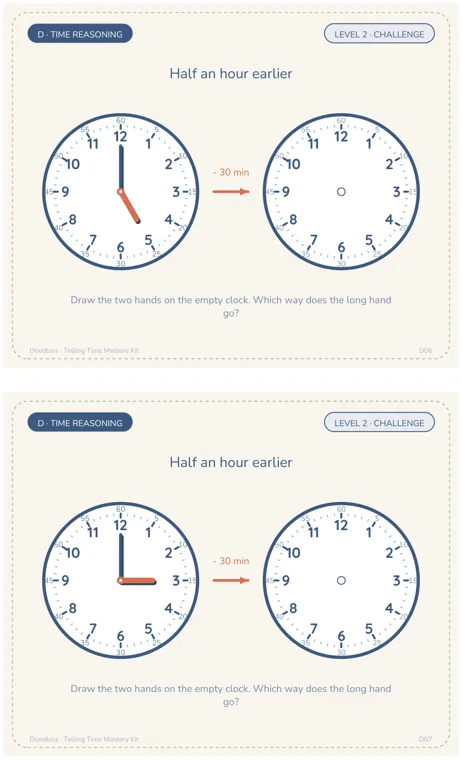
Earlier means the long hand goes backward, counterclockwise. Children move it forward automatically, so ask which direction it has to go before they draw. If the cards will see a lot of use, print them on cardstock at actual size, so the minute marks stay where they belong. Other printable card sets and games are on the Doodlora Studio home page.
Printables from this article
Related articles
Printable Flashcards
Pattern Activities for Preschool: AB to Growing Patterns
Fourteen pattern activities for preschoolers, ordered from first AB rhythms to growing number patterns, with what to prepare, how long each takes and where kids get stuck.
Printable Flashcards
What Is a Ten Frame? How to Fill One and 8 Activities
How a ten frame works, why five on top and two below reads as seven, what age to start, and eight short activities with players, time and setup.
Printable Flashcards
Weather Activities for Preschool: Snow & Seasons for Kids
Sixteen weather activities for a preschool class or a child at home, from a five-minute window check to snow measuring, weather bingo and a seasons diary.