Space Facts for Kids: Our Solar System, Moon and Stars
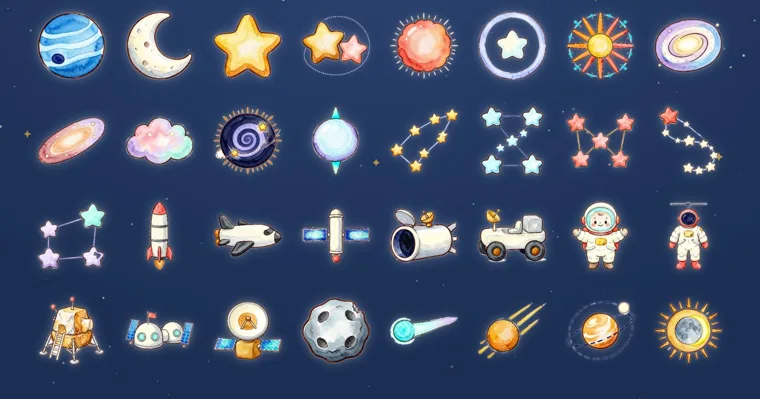
Space facts for kids stick best when each one is short, true and tied to something a child already knows. The Sun is a star 109 times wider than Earth, its light takes about eight minutes to reach us, and a single day on Venus lasts longer than a whole Venus year. Every number below comes from NASA’s planet and mission pages, and most facts come with a shorter line you can read aloud to a preschooler.
The facts run outward from the Sun: the four rocky planets, the four giant planets, our Moon, the stars beyond, and the astronauts living on the space station. Near the end there’s a list of facts that older books get wrong, and one way to turn the whole list into a picture bingo game.
Matching space facts to a child’s age
The same fact can be told three ways, and the right one depends on the child in front of you more than on the fact. Here’s how we’d pitch the Sun to three ages.
| Age | What works | The Sun, told for that age |
|---|---|---|
| 3 to 5 | One idea, compared with something they’ve seen | “The Sun is a star. It looks small because it’s very, very far away.” |
| 6 to 8 | Round numbers and “bigger than” or “faster than” | “About 109 Earths could line up across the middle of the Sun.” |
| 9 to 12 | Exact numbers, both units and the reason behind them | “The Sun is about 865,000 miles (1.4 million kilometers) across, and its core tops 27 million °F (15 million °C).” |
These age bands are our suggestions, not a rule. A curious five-year-old may beg for the huge numbers, and a tired ten-year-old at bedtime may only want one sentence. One or two facts a night fit neatly into the book part of a bedtime routine, and they give a child something to ask about the next morning.
The Sun is our closest star
The Sun is a star, the closest one to Earth, and it sits about 93 million miles (150 million kilometers) away. That distance is why its light needs about eight minutes to reach us. It’s the largest object in the solar system, and its gravity keeps every planet, asteroid and comet circling around it.
Its size is hard to picture, so pick the comparison that fits the child. NASA puts it at 109 times wider than Earth, and it would take 1.3 million Earths to fill the Sun’s volume. The surface is about 10,000 °F (5,500 °C), while the core reaches 27 million °F (15 million °C).
Even so, the Sun is only an average star. There are much bigger stars and much smaller ones. The next nearest star, Proxima Centauri, is 4.24 light-years away, and one light-year is about 6 trillion miles (9.5 trillion kilometers). In another 5 billion years, the Sun will swell into a red giant, then shrink into a small white dwarf about the size of Earth.
To read aloud: “The Sun is a star. More than a million Earths could fit inside it.”
The eight planets in order from the Sun
The planets, in order from the Sun, are Mercury, Venus, Earth, Mars, Jupiter, Saturn, Uranus and Neptune. A sentence like “My Very Educated Mother Just Served Us Nachos” helps kids remember the order, since each word starts with a planet’s first letter.
The table gives each planet’s distance from the Sun, how long it takes to spin once (its day) and how long it takes to go around the Sun once (its year).
| Planet | Average distance from the Sun | One spin | One trip around the Sun |
|---|---|---|---|
| Mercury | 36 million miles (58 million km) | 59 Earth days | 88 Earth days |
| Venus | 67 million miles (108 million km) | 243 Earth days | 225 Earth days |
| Earth | 93 million miles (150 million km) | 23.9 hours | 365.25 days |
| Mars | 142 million miles (228 million km) | 24.6 hours | 687 Earth days |
| Jupiter | 484 million miles (778 million km) | 9.9 hours | about 12 Earth years |
| Saturn | 886 million miles (1.4 billion km) | 10.7 hours | about 29.4 Earth years |
| Uranus | 1.8 billion miles (2.9 billion km) | about 17 hours | about 84 Earth years |
| Neptune | 2.8 billion miles (4.5 billion km) | about 16 hours | about 165 Earth years |
Older kids usually spot the odd one first. On Venus, one spin takes longer than one trip around the Sun, so a Venus day is longer than a Venus year.
The rocky planets: Mercury, Venus, Earth and Mars
The four planets closest to the Sun are small and rocky, and Earth is the biggest of them at 7,926 miles (12,756 kilometers) across. Each one has a single fact that children tend to remember.
Mercury is the closest planet to the Sun and the fastest, racing around it every 88 Earth days at nearly 29 miles (47 kilometers) per second. It has no real atmosphere to hold heat, so days reach 800 °F (430 °C) and nights drop to -290 °F (-180 °C). To read aloud: “Mercury is the speedy planet next to the Sun. Its days are hot and its nights are freezing.”
Venus is Earth’s closest planetary neighbor and the hottest planet, at about 872 °F (467 °C), which is hot enough to melt lead. Its thick atmosphere traps the heat, and it spins slowly in the opposite direction from most planets. To read aloud: “Venus is hotter than Mercury, even though Mercury is closer to the Sun.”
Earth spins once every 23.9 hours and takes 365.25 days to go around the Sun. That extra quarter day is why the calendar adds a day every four years. Earth’s axis is tilted 23.4 degrees, and the tilt gives us seasons. Preschoolers who are learning summer and winter can pair this fact with seasons activities for preschool. To read aloud: “Earth leans a little to one side. That lean is why we have summer and winter.”
Mars is about half the size of Earth. Its day lasts 24.6 hours, close to ours, but a Mars year takes 687 Earth days. Mars has two small moons, Phobos and Deimos, named after the horses that pulled the chariot of the Greek war god Ares. To read aloud: “A day on Mars is almost as long as a day on Earth, but a year there is almost two of ours.”
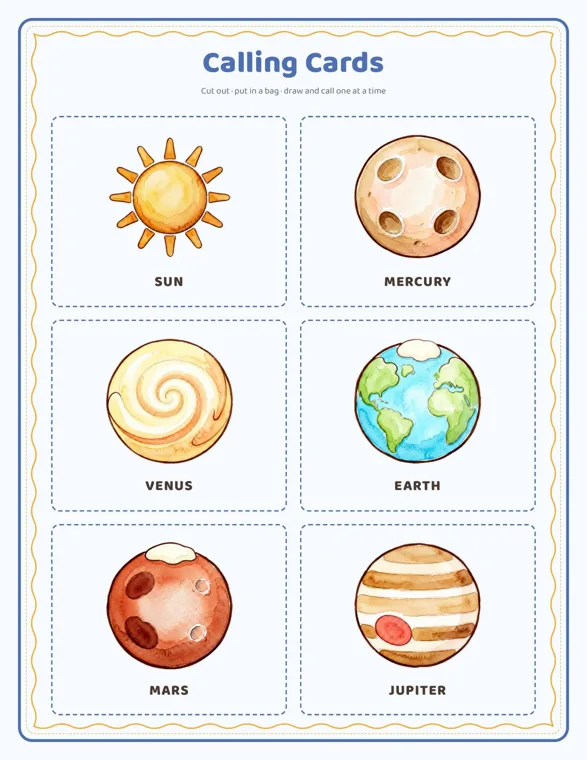
The giant planets: Jupiter, Saturn, Uranus and Neptune
Past Mars, the planets get huge and far apart. Sunlight that reaches Mars in 13 minutes needs 43 minutes to get to Jupiter and about 4 hours to reach Neptune.
Jupiter is the biggest planet, 11 times wider than Earth. Its Great Red Spot is a storm bigger than Earth that has been raging for hundreds of years. The International Astronomical Union officially recognizes 115 moons around Jupiter. Galileo Galilei first saw the four largest, Io, Europa, Ganymede and Callisto, in 1610, and Ganymede is the largest moon in the solar system, even bigger than Mercury. To read aloud: “Jupiter has a storm that’s bigger than our whole planet.”
Saturn is 9 times wider than Earth, and its rings are probably pieces of comets, asteroids or shattered moons that Saturn’s gravity tore apart. The ring system stretches up to 175,000 miles (282,000 kilometers) from the planet, yet the main rings are typically only about 30 feet (10 meters) thick. Saturn isn’t the only planet with rings, since Jupiter and Uranus have them too, but none are as spectacular or as complex as Saturn’s. To read aloud: “Saturn’s rings are very, very wide but very, very thin.”
Uranus spins on its side. Its tilt is 97.77 degrees, so it rolls around the Sun like a ball, and each pole gets a dark winter about 21 years long. William Herschel found it in 1781 and first thought it was a comet or a star. Its 28 known moons are named after characters from the works of William Shakespeare and Alexander Pope. To read aloud: “Uranus is the planet that rolls on its side.”
Neptune is more than 30 times as far from the Sun as Earth, and its winds push clouds of frozen methane at more than 1,200 miles per hour (2,000 kilometers per hour). It looks blue because methane in its air absorbs other colors and reflects blue. Neptune was the first planet found by math instead of by looking: astronomers predicted where it should be, and it was spotted in 1846. It finished its first full trip around the Sun since then in 2011. To read aloud: “Neptune is so far away that one trip around the Sun takes 165 of our years.”
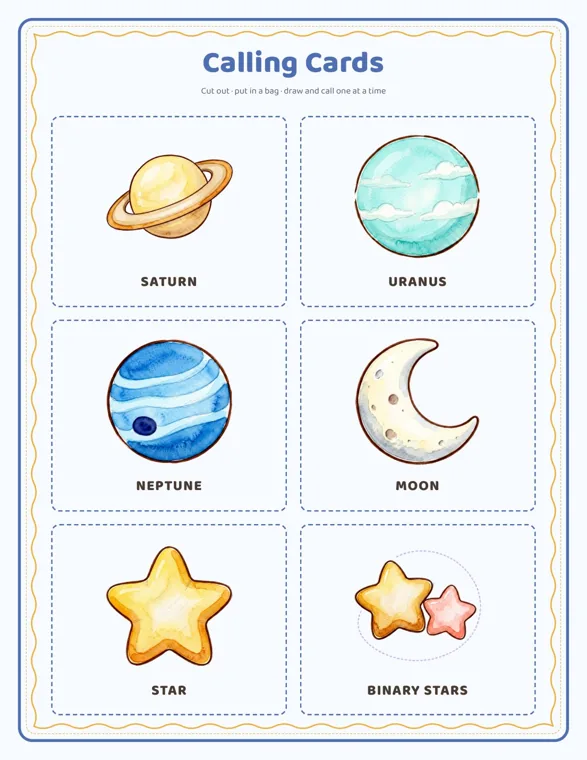
Earth’s Moon: how far, how big and why it changes shape
The Moon is an average of 238,855 miles (384,400 kilometers) away, a gap wide enough to fit 30 Earth-sized planets in a row. It’s less than a third as wide as Earth, and its gravity is one-sixth of ours, which is why astronauts seem to bounce when they walk on it.
The Moon doesn’t make its own light. Moonlight is sunlight bouncing off the Moon’s surface, and the Sun always lights the half of the Moon that faces it. As the Moon travels around Earth, we see different amounts of that lit half, and those shapes are the phases: new moon, waxing crescent, first quarter, waxing gibbous, full moon, waning gibbous, third quarter and waning crescent.
The Moon takes about 27.3 days to orbit Earth, but going from one new moon to the next takes about 29.5 days. In the Northern Hemisphere, a waxing crescent shows its thin sliver of light on the right, and a waning crescent shows it on the left. It also turns at the same rate it travels around us, so the same side always faces Earth.
People have stood on the Moon. Apollo 11 landed in July 1969, with Neil Armstrong as commander and Buzz Aldrin beside him on the surface. Astronauts left equipment, American flags and even a camera behind. To read aloud: “The Moon doesn’t glow by itself. The Sun shines on it, like a flashlight on a ball.”
Stars, galaxies and the star patterns we can see
Stars are giant balls of hot gas, mostly hydrogen with some helium. They form inside huge clouds of gas and dust, and a newly forming star is called a protostar, a baby star. Our galaxy, the Milky Way, holds more than 100 billion stars, and astronomers estimate the universe could contain up to one septillion stars, a one followed by 24 zeros.
The Sun is a single star, but more than half of all stars are in systems with two or more stars. That’s what the “binary stars” picture on a space card means: two stars circling each other.
Constellations are star patterns. Our bingo cards include five of them, the Big Dipper, Orion, Cassiopeia, Scorpius and Lyra, so a child can learn the shapes on paper before trying to find them outside. To read aloud: “Every star you see at night is a sun, and some are much bigger than ours.”
Astronauts and life on the International Space Station
The International Space Station is where astronauts live in space today, and people have lived on it without a break since November 2000. Five space agencies from 15 countries run it together. A crew of seven lives and works on board.
The station moves at five miles per second and goes around Earth about every 90 minutes. In 24 hours it makes 16 orbits, so the crew passes through 16 sunrises and 16 sunsets every day. The living space is larger than a six-bedroom house, with six sleeping quarters, two bathrooms, a gym and a window that looks out in every direction. End to end, the station is 356 feet (109 meters) long, a yard short of an American football field with its end zones.
Living in space is hard on the body. In near weightlessness, muscles and bones get weaker, so astronauts exercise at least two hours a day. To read aloud: “Astronauts on the space station see the Sun come up 16 times every day.”
Space facts that older books and kids often get wrong
Space facts change as scientists learn more, so a book from your library may disagree with this page. These are the mix-ups that come up most often.
- Pluto isn’t one of the planets anymore. It was discovered in 1930 and called the ninth planet for decades, but the International Astronomical Union reclassified it as a dwarf planet in 2006. Books printed before then list nine planets. Pluto still has five known moons, and a schoolgirl named Venetia Burney suggested its name.
- Moon counts keep going up. NASA counted 274 confirmed moons around Saturn as of March 2025, and the International Astronomical Union recognizes 115 around Jupiter. An older book will show far fewer, so check the printing date before a child copies a number for school.
- Mercury is closest to the Sun, but Venus is hotter. Venus’s thick atmosphere traps heat, and Mercury has no real atmosphere to keep it.
- The Sun isn’t the biggest star. It looks biggest because it’s so close. Next to other stars, it’s medium-sized.
- The Moon doesn’t shine by itself. It reflects sunlight, and that’s also why its shape seems to change.
Turning these facts into a game of space bingo
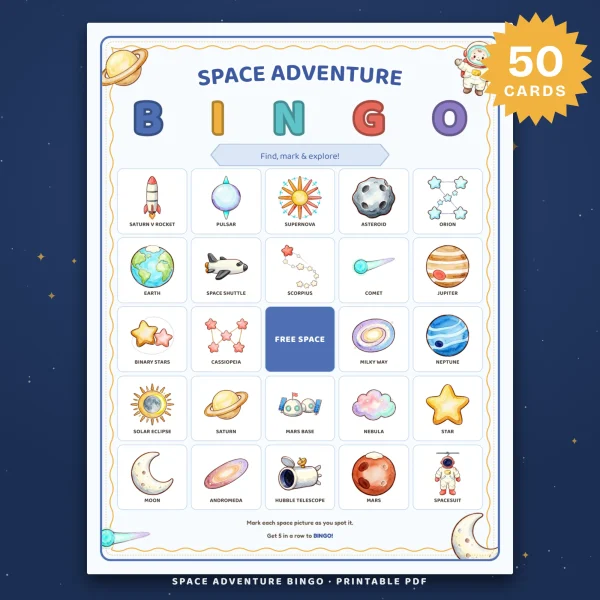
A picture bingo game turns this list into something kids ask to play again, because every call gives you a reason to share one fact. Our Space Adventure Bingo has 40 pictures in its calling deck, including the Sun, all eight planets and the Moon, plus star types, constellations and real spacecraft. There are 50 different cards, each with 24 pictures around a free space.
When you draw a calling card, say the name, let everyone find it, then read one line from this page. For three- to five-year-olds, use the read-aloud lines and the picture-only cards. For kids who can read, use the labeled cards, which print each name under its picture, and add one number. Older kids can play it backward: you read the fact first, and they guess the picture before you show it.
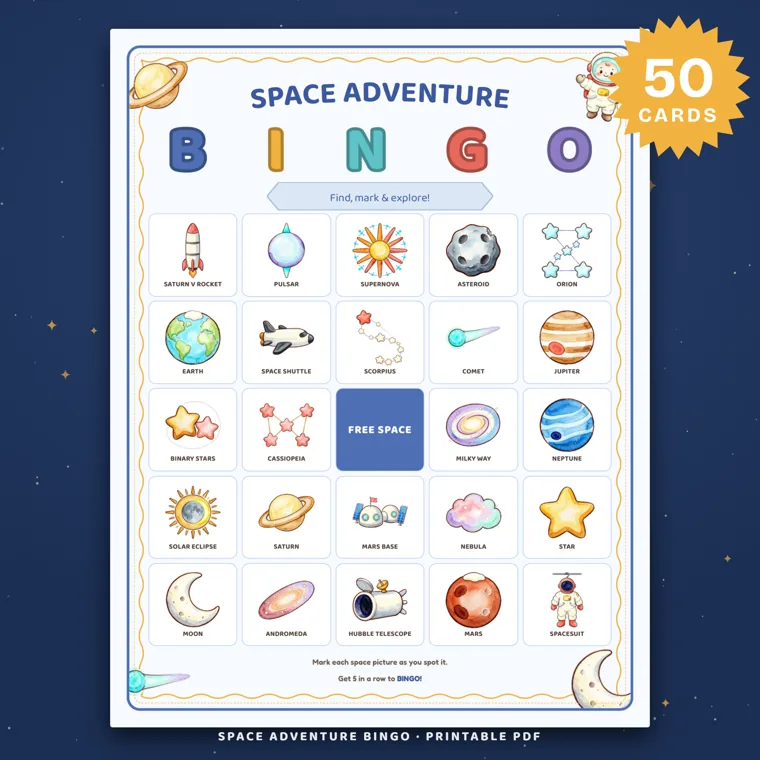
One thing to watch: with eight planets and 32 other pictures in the deck, a game can end before every planet is called. If the goal is learning all eight, keep playing until the planet cards are out of the bag, or call them first. The printable bingo rules cover patterns, calling and how to settle a tie.
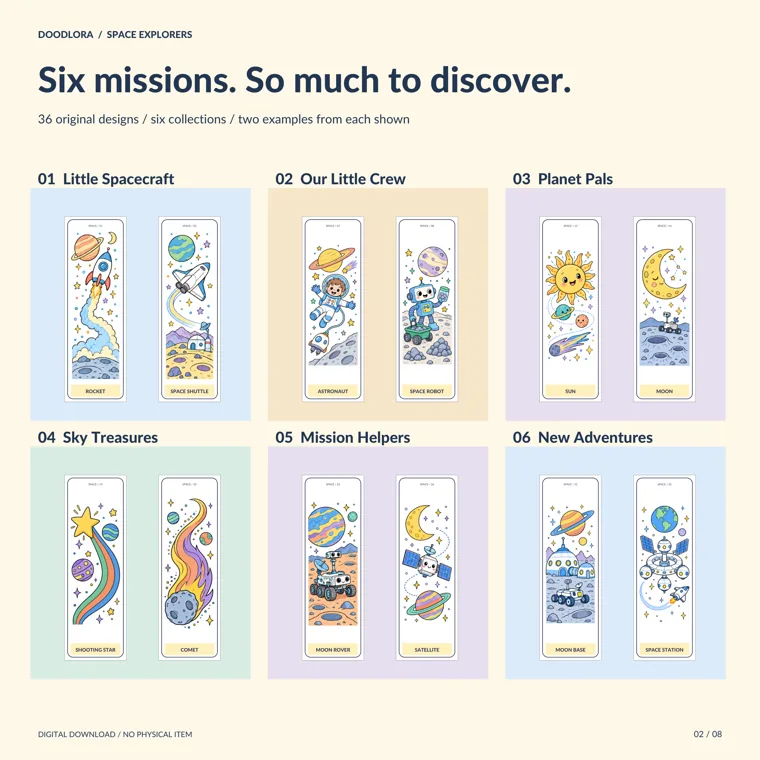
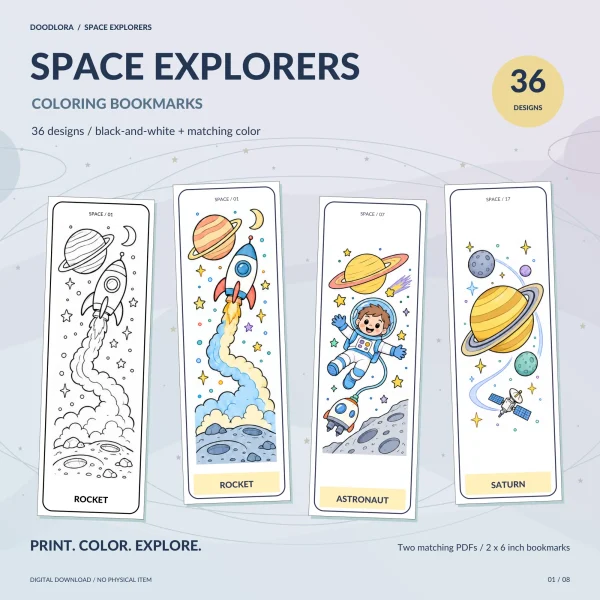
For a quieter follow-up, the Planet Pals collection in our space coloring bookmarks has the Sun, Moon, Earth, Mars, Saturn and Neptune. The bookmarks’ own instructions page calls them playful fantasy illustrations, not scientific diagrams, so a child who just heard why Neptune looks blue gets to decide whether to color it that way.
On a cloudy night when the Moon is hidden, the rainy day activities for kids list has more quiet table projects, and there are more printable games on the Doodlora Studio home page.
Printables from this article
Related articles
Printable Bingo Cards
Space Activities for Preschoolers: Games, Hunts & Moon Watch
Eleven hands-on space activities for three- to five-year-olds, sorted by situation, with group size, prep, how to start and finish, plus a five-day plan.
Printable Bingo Cards
Dinosaur Activities for Preschool: Games, Crafts & Fossils
Thirteen dinosaur activities for three- to five-year-olds, from ice eggs and sand digs to circle-time games, plus dinosaur facts that hold up and fixes for the usual snags.
Printable Bingo Cards
Farm Activities for Preschool: Games, Songs, Crafts, Trips
Thirteen farm activities for preschoolers, grouped by setting, with group sizes, preparation, how to start and finish, and the snag to plan around in each.