Birthday Party Games: Kids Party Games by Age and Space
The best birthday party games for kids match three things: how old the guests are, how much room you have, and how many children will play at once. Three-year-olds do well with freeze dance and duck, duck, goose. Kindergartners through third graders can handle musical chairs, relay races and a piñata. Nine- to twelve-year-olds tend to prefer a timed puzzle race, limbo or a treasure hunt with clues.
Below are 21 games in four groups: little kids, a backyard for ages 5 to 8, a living room for the same ages, and older kids. Every entry gives the number of players, a rough length, the supplies, how a round goes and what decides it. We picked the ages and minutes as a planning guide, not a rule, so adjust them to the children coming. The rules follow the traditional versions of each game.
Pick a birthday game by age, space and group size
| Game | Ages | Players | Space | Time | You’ll need |
|---|---|---|---|---|---|
| Freeze dance | 3 and up | 4 or more | Indoors or out | 5–10 min | Music, someone on pause |
| Duck, duck, goose | 3 to 6 | 6 or more | Room for a circle | 10 min | Nothing |
| Pass the parcel | 3 to 8 | 5 to 15 | Indoors | 10–15 min | A wrapped parcel, music |
| Picture bingo | 3 and up | 2 to 30 | A table or the floor | 15 min | Printed cards, markers |
| Sleeping lions | 3 to 8 | 4 or more | Indoors | 5 min | Nothing |
| Red light, green light | 5 to 9 | 4 or more | A yard or a long room | 10 min | Nothing |
| What’s the time, Mr. Wolf? | 4 to 8 | 4 or more | A yard | 10 min | Nothing |
| Egg-and-spoon race | 5 and up | 4 or more | A yard | 10 min | Spoons, eggs |
| Sack race | 5 and up | 4 or more | Grass | 10 min | Sacks or pillowcases |
| Three-legged race | 6 and up | 8 or more | Grass | 10 min | Scarves for tying |
| Piñata | 4 to 10 | 4 to 15 | Outdoors, clear space | 15–20 min | Piñata, stick, blindfold |
| Musical chairs | 4 to 9 | 5 to 12 | A cleared room | 10 min | Chairs, music |
| Hot potato | 4 to 9 | 6 or more | Indoors | 5–10 min | Beanbag or soft ball, music |
| Simon says | 3 to 8 | 3 or more | Anywhere | 5–10 min | Nothing |
| Pin the tail on the donkey | 3 to 8 | Any | A wall | 10–15 min | Poster, tails, blindfold |
| Memory match | 4 and up | 2 to 4 per deck | A table | 15 min | A printed card deck |
| Word search race | 8 and up | 2 to 12 | A table | 3–5 min a round | Printed puzzles, pencils, timer |
| Telephone | 6 and up | 6 or more | Anywhere | 5 min | Nothing |
| Charades | 6 and up | 6 or more | A living room | 15–20 min | Slips of paper |
| Limbo | 6 and up | 4 or more | A clear floor | 10 min | A pole or pool noodle, music |
| Treasure hunt | 6 and up | 3 to 12 | House or yard | 20–30 min | Clues, a prize |
Birthday games for toddlers and preschoolers, ages 3 to 5
Little kids need games with one rule they can hold in their heads and a round that ends quickly. Plan for a grownup to run every game in this group, because preschoolers’ patience runs out fast.
Freeze dance
Called musical statues in Britain, freeze dance is an old birthday party standby, and any number of children can join. Play music while the kids dance. Stop it without warning, and every dancer has to hold still. The strict version sends out anyone who wobbles or giggles, and whoever is still dancing at the end wins.
With three-year-olds, the elimination rule can backfire, because the first child out often has no idea why, and the disappointment spreads. For the youngest guests, skip eliminations and call out the funniest frozen pose instead. Ten short rounds fill about five minutes.
Duck, duck, goose
You need six or more children, no supplies and enough space for a circle with room to run around it. The kids sit facing inward. One child circles behind them, touching each head with a “duck” until one gets a “goose.” The goose jumps up and chases the tapper around the circle, and the tapper tries to sit down in the goose’s empty spot. If the tapper makes it, the goose takes over the tapping. A tagged tapper simply starts a fresh lap.
There is no winner, so you can stop whenever the energy drops. The usual complaint is “nobody picked me,” so add one house rule: pick someone who hasn’t been a goose yet.
Pass the parcel
A parcel wrapped in several layers goes around a circle while music plays. Each pause in the music lets one child rip away a single layer, and the child who reaches the middle keeps the prize. For the number of layers and the trick to running the music fairly, read how to play pass the parcel.
Picture bingo
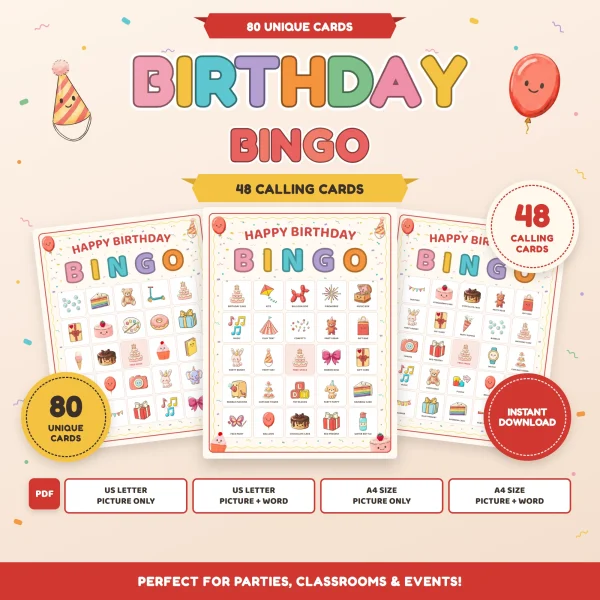
Bingo works for a big mixed group because every child plays at once, and a three-year-old can match pictures without reading. Each player gets a card and a pile of markers. An adult draws a calling card, shows it and says the name out loud. Players cover the matching square, and the first one to finish the pattern shouts “Bingo!”
Our birthday party bingo comes with a rules page, 48 calling cards printed six to a sheet, and a page of colored paper markers to cut out. Each card is a five-by-five grid with a free space in the middle. That gives 24 pictures per card from a set of 48, cakes, presents, toys and party animals among them, so a typical card holds about half of the calls.
With preschoolers, play for a single line and show each calling card around the circle. A full card could take most of the 48 calls, and that’s longer than a preschooler’s concentration lasts. The rules page suggests candy, buttons or coins as markers. For the under-fives, use the paper markers and keep the small items off the table.
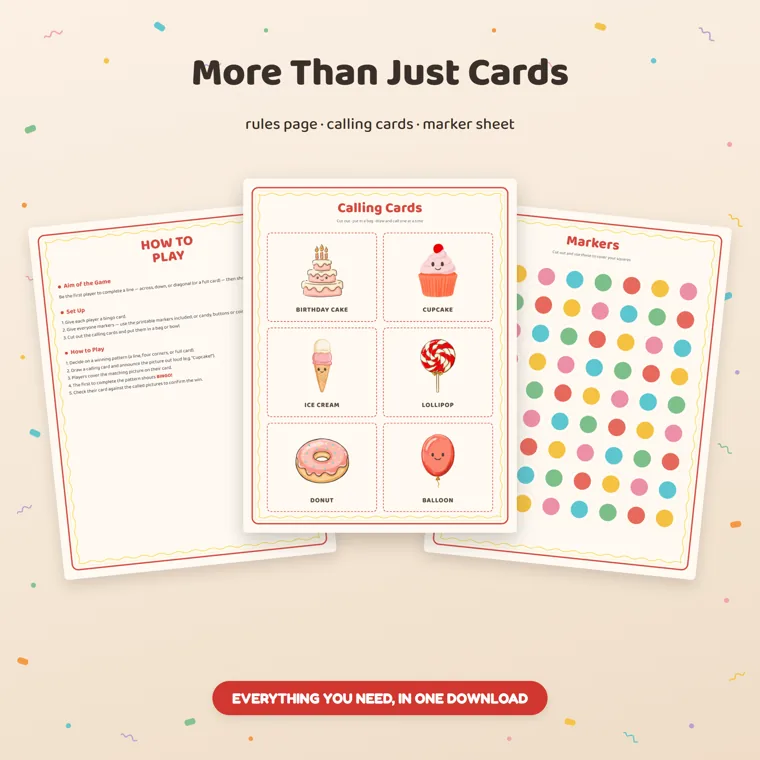
The pack has two card sets, 30 and 50 cards, with no layout shared between them. Each set comes picture-only and with a name under every picture. Use the named cards for early readers and the picture-only ones for toddlers. Our picture bingo rules explain how to call and check a win.
Sleeping lions
Sleeping lions is a calm-down game, and it’s useful right before cake, when the excitement peaks. Everyone except one or two “hunters” lies on the floor with eyes closed, pretending to sleep. The hunters walk around and try to make the lions move with jokes and silly talk, but they may not touch anyone. A lion who moves gets up and becomes a hunter. The last lion still lying still wins.
Remind the hunters about hands-off at the start. Young hunters forget that part first.
Backyard birthday party games for ages 5 to 8
These games need room to run, so play them on grass rather than a patio when you can. Do the races before the food comes out.
Red light, green light
One child, the caller, faces away from the group at the far end of the yard. On “green light,” the players walk or run toward the caller. On “red light,” the caller turns around and everyone has to freeze. A player caught moving returns to the starting line. Whoever tags the caller first wins the round and takes over the calling.
Disagreements about what counts as moving are the usual snag. Decide before the first round whether a wobble sends someone back or only a step does. For variety, add “yellow light,” which means slow motion.
What’s the time, Mr. Wolf?
One child is Mr. Wolf and stands at one end of the yard; the rest stand at the other. The group calls out “What’s the time, Mr. Wolf?” and the wolf answers with an hour, for example, “Four o’clock.” The players take that many steps forward, counting out loud. When the wolf shouts “Dinner time!”, he chases the group, and the first child tagged is the wolf for the next round.
Without a safe zone, a round can drag on with the wolf never catching anyone. Mark a home line the players can run back to, so every round ends quickly with a chase.
Egg-and-spoon race
Each racer balances an egg on a spoon and walks or runs to the finish line. Run it as one race or as a relay with two teams. Decide the drop rule first: either the racer stops and puts the egg back, or goes back to the start. The first rule keeps the race moving, which suits younger kids.
Raw eggs make a mess in party clothes. Use hard-boiled eggs or plastic ones, and check spoons before the start, because the classic cheat is sticking the egg down.
Sack race
Racers climb into a sack with both legs, hold it up and hop to the finish, and the first one over the line wins. Pillowcases work if you don’t have sacks, though the bigger kids may need two tries to keep them up. Run it on soft grass, since falls are part of the game, and line racers up by size rather than by age.
Three-legged race
Partners run as a pair, one child’s left leg bound to the other’s right. The first pair over the line wins. Use a soft scarf or bandana for the tie, and pair children of similar height. Let each pair walk a few steps together first to find a rhythm, or half of them fall at the start.
Piñata
Traditionally, each child takes a turn blindfolded. Hang the piñata on a string, give the batter a stick and spin them a few times. In Mexico, a song times each turn, and an adult can raise and lower the piñata on its rope to make it harder to hit.
A swinging stick is the real risk here, so rope off a wide circle and keep the spectators outside it until the candy falls. Let the youngest go first, since bigger kids break it fast. Hand out small bags for the scramble, so the quickest children don’t end up with all the candy.
Indoor birthday games for ages 5 to 8
These fit a living room or a basement with the furniture pushed back. Several of them knock players out, and the closing section has jobs for the children who are out.
Musical chairs
Set out one fewer chair than players in a circle or a back-to-back row. The children walk around the chairs while music plays. When it stops, everyone sits, and the child left standing is eliminated. Take away one chair and play again until one winner sits on the last chair.
Use sturdy chairs without wheels, because the scramble pushes them around. Eight players means seven rounds. Give the first child out a job, like running the music, so they don’t spend the game standing at the edge of the room.
Hot potato
Seat the group in a ring and send a beanbag or a soft ball around it while the music plays. The child caught with it at the pause drops out, and the final one left is the winner. Insist on passing or gentle tossing, not throwing, and stop the music at uneven moments so no one can time it.
Simon says
Simon calls out actions, like “Simon says touch your nose.” The group copies an action only if those two words came first. Copying a plain command, or ignoring a real one, puts a player out. The last player left wins and can be the next Simon.
The birthday child usually wants to be Simon first, which also spares them from elimination in round one. Mix fast commands with slow ones to catch the group.
Pin the tail on the donkey
Tape a donkey poster to the wall at child height. Each player is blindfolded, handed a paper tail, spun gently and pointed at the wall. Once everyone has gone, the tail nearest the donkey’s rear wins, though the real laughs come from tails on the ears and the grass.
The traditional game uses a pushpin or thumbtack in each tail. For five-year-olds, stick a curl of tape behind each tail instead. Write each child’s name on their tail before the game, or nobody will know who won.
Memory match
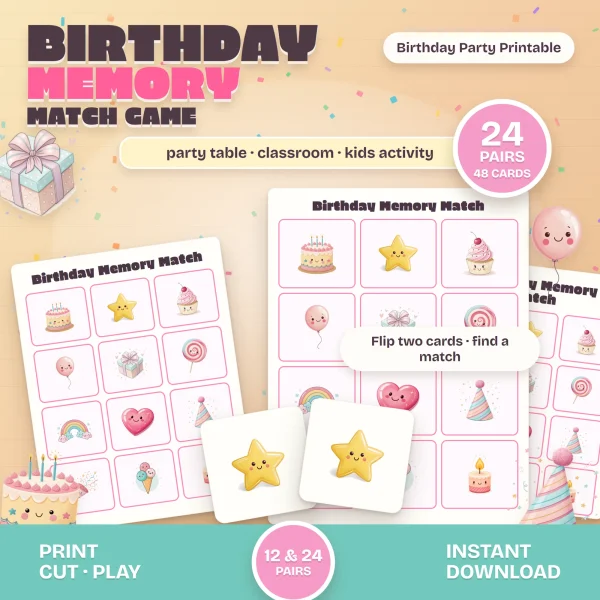
Memory gives two to four children something to do at a table while the rest of the party moves around them. Shuffle the cards and spread them out, picture side down, in rows. Each player turns up two cards per turn. A pair is kept and that player goes again; a mismatch gets turned back over. Once the table is clear, count the pairs, and the biggest pile wins.
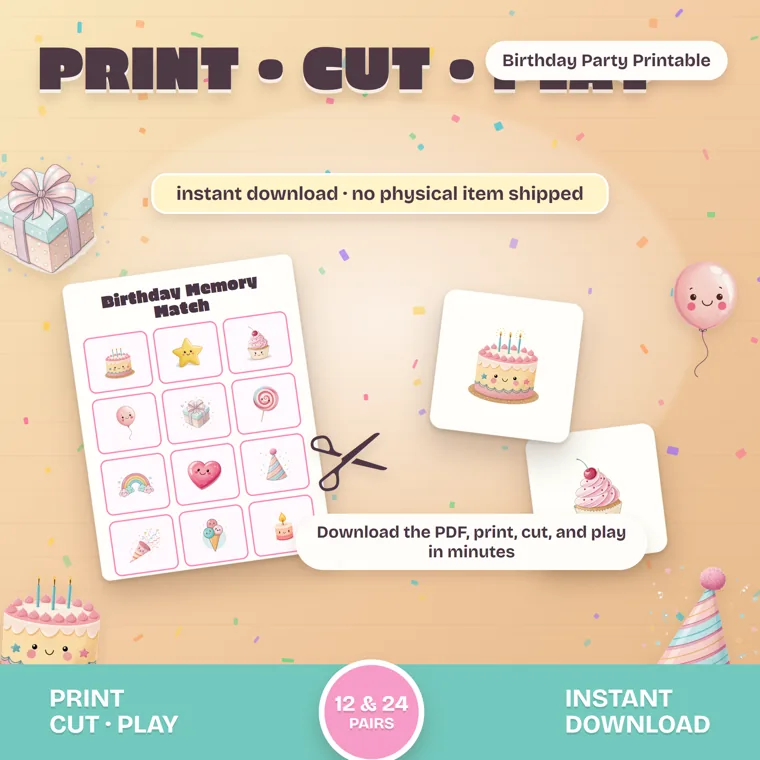
Our birthday memory match comes in two sizes. The small deck has 12 pairs, 24 cards on two sheets, all party things such as a cake, a candle, a balloon, a party hat and a gift box. The full deck has 24 pairs on four sheets and adds a unicorn, a rainbow and a magic wand. Each file ends with a how-to-play page.
That page says to print on cardstock so the cards aren’t see-through, and to use fewer pairs for younger kids. For five-year-olds, start with the 12-pair deck. For two tables, print one deck of each size. Two-player games, teams and the last two cards are all covered in our memory game rules.
Birthday party games for kids 9 to 12
Older kids like a real winner, a timer and some strategy. Many also roll their eyes at anything that looks babyish. Give them some independence: offer two or three options and let them choose.
Word search race
A word search race is a good start for a party where guests arrive over twenty minutes. Every player gets the same puzzle page and a pencil. Start a timer and let everyone hunt. When it rings, mark every sheet with the host’s answer page.
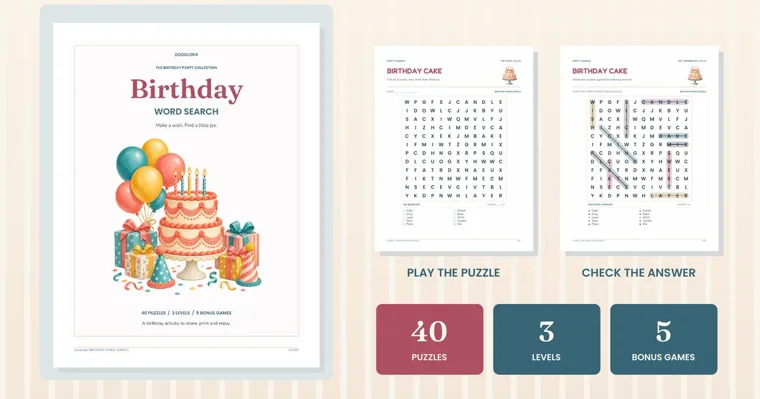
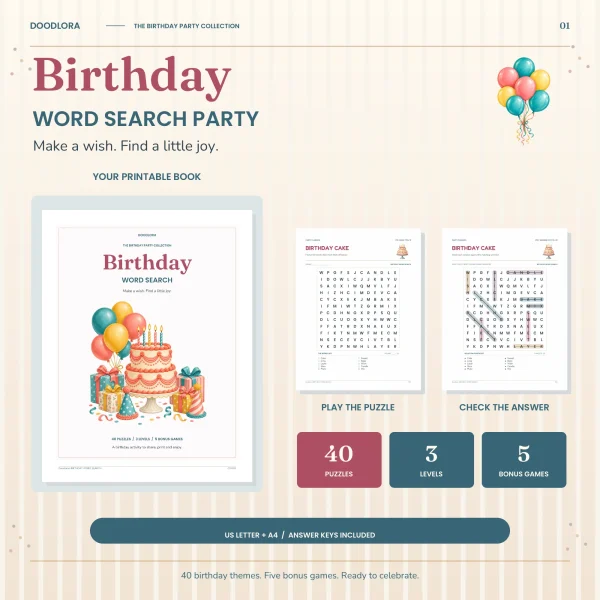
The birthday word search book we make holds 40 puzzles in Easy, Medium and Hard, plus five bonus party games. Confetti Sprint, the first bonus game, has players race on the same page for three minutes. A correct word is worth a point, the biggest total wins, and players who tie share the win. Cupcake Dash uses the Medium puzzle Birthday Bake Shop with a five-minute timer and twelve words. A player who clears all twelve before the bell notes the time, and the quickest complete grid beats the rest.
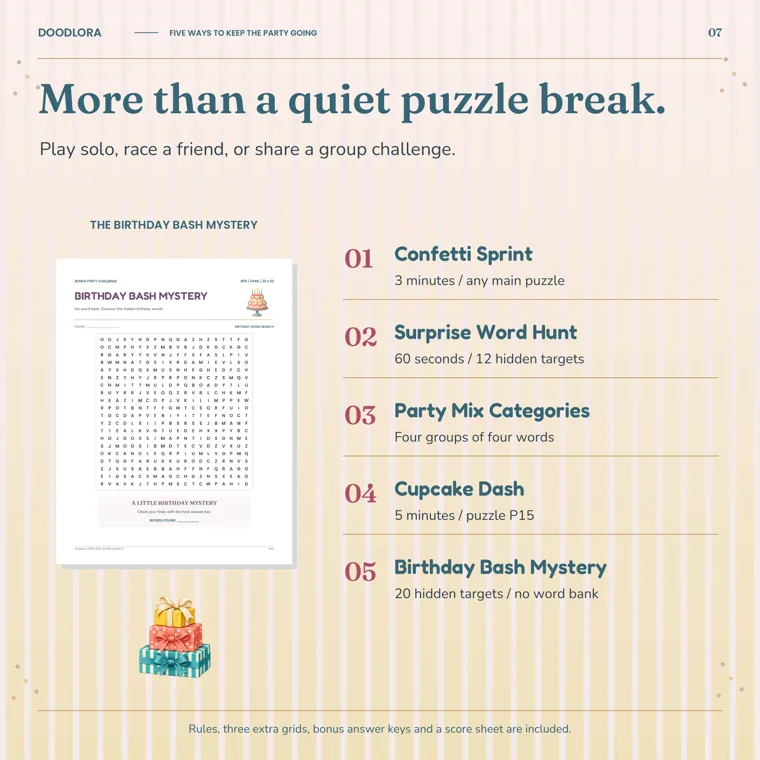
The difficulty levels matter for a mixed group. Easy pages are 12 by 12 with ten words that run across or down, plus at most two on a down-right slant. On the bigger Medium and Hard grids, a word can point any of eight ways, even backward. Both sprint games need every player on the same page. When nine-year-olds race twelve-year-olds, pick an Easy page so the younger kids still score.
A score sheet near the back tracks each player’s puzzle, time, word count and bonus points. The Hard puzzle “The Party Game Collection” hides the names of games from this list, Musical Chairs, Freeze Dance and Charades among them. It makes a good last round.
Telephone
You need six or more players, seated or standing in a row. The first one whispers a sentence to the next, who whispers what they heard to the next, and so on. The last player says the sentence out loud, and the first one reads out the original. Nobody wins. The laugh comes from how far the message drifted.
Settle the repeat rule early: one “say that again” per player, or none. Otherwise every round ends in a fight over who mumbled.
Charades
One player mimes a word or a title in silence, and their team calls out guesses. Make two teams, put the prompts in a bowl, and allow each actor about a minute. The team with the most correct guesses wins. For prompt lists by difficulty and ways to run a big group, see charades for kids.
Limbo
Two people hold a bar level while music plays, and players pass under it one by one, leaning backward and facing up. Nothing but their feet may touch the floor, and they may not knock the bar. A player who touches it or falls is out. Lower the bar a notch after each full turn around the group, and the player who makes it under the lowest bar wins.
Use a pool noodle or a broom handle held loosely, so a bump knocks it away instead of tripping someone. Play on a carpet or grass rather than a slippery floor.
Treasure hunt
A chain of clues, each one leading to the hiding place of the next, ends at a prize. For ages 9 to 12, a hunt of eight to ten clues takes twenty to thirty minutes. Hide the clues before guests arrive, and number them consecutively so you can spot one that has gone missing. Riddle clues and a ready-made clue chain are in our indoor scavenger hunt article.
Teen and adult birthday games
Teenagers usually want games built around talking and bluffing more than running. Our sleepover games list has a teen section with Mafia, Most Likely To and other games that work at a birthday too. For grown-ups, party games for adults includes a birthday group, among them a quiz about the guest of honor and a guess-the-year round. When you need a game with no setup at all, try a few one-minute party games, which suit any age.
Running the game hour: order, prizes and kids who are out
Most of the trouble at a kids’ birthday comes from the sequence of games, not the games themselves. A few choices made beforehand prevent most of it.
Start with something kids can join late. Guests drift in for fifteen or twenty minutes. Bingo, memory match or a word search page lets early arrivals play without waiting for the whole group.
Put the running before the food. Races and chase games in the first hour, then a calm game like sleeping lions to settle everyone before cake. Save a seated game, such as telephone or bingo, for after cake.
Give knocked-out kids a job. In musical chairs, freeze dance, hot potato and Simon says, the first ones out can run the music, judge the next round or hold the limbo bar.
Decide how the birthday child loses. It’s tempting to let the birthday child win every game, but the other guests notice. Letting the birthday child be the first caller, the first Simon or the first wolf works better. They get the attention and a bit of leadership without being handed the win.
Plan the prizes. If only winners get prizes, a few competitive children go home with most of them. One small prize per game plus a treat for everyone at the end is the simpler split. Pass the parcel can also hide a small sweet in each layer, as long as everything wrapped suits the youngest guest.
Have an indoor backup ready. If it rains, musical chairs can stand in for the sack race, and red light, green light can move to a long hallway. The table games need no change at all.
Printables from this article
Related articles
Printable Party Games
How to Plan a Baby Shower: Timeline, Food & 2-Hour Schedule
A baby shower plan from the first talk with the parents-to-be to the last gift: timing, guest list, budget, venue, a two-hour schedule, safe food and backup plans.
Printable Party Games
How to Plan a Bridal Shower: Timeline, Budget and Schedule
A host's plan for a bridal shower, from the first talk with the bride and co-hosts to the guest list, invitations, a timed party schedule, the gift opening and what to do when something slips.
Printable Party Games
35th Birthday Ideas: Party, Trip, Theme and Gift Ideas
Ways to celebrate turning 35, sorted by how many people the birthday star wants around, with group size, time, prep and the snag to plan for in each.