Pass the Parcel: How to Play, Layers & Prize Ideas
To play pass the parcel, wrap one prize in many layers of paper, sit the children in a circle and pass the parcel around while music plays. When the music stops, the child holding it tears off one layer. The music starts again, and the game ends when the last layer comes off and someone finds the main prize. The version that keeps a party happy has a small prize in every layer and as many layers as there are children.
Everything else is in the details: how many layers to wrap, what goes between them, who runs the music, and how to change the game for toddlers, big kids or a Christmas crowd. The prize to keep out of a toddler’s layer gets its own section further down.
Pass the parcel at a glance
Pass the parcel is a British party game, and in the US it often goes by pass the present. It suits a birthday or a Christmas party where the children can all sit on the floor together. The times and ages in this table are our planning suggestions, so adjust them to your group.
| Players | 5 to 15 children, plus one adult on the music |
| Ages | About 3 to 8 for the classic version; changes for younger and older kids below |
| Time | Roughly 15 minutes for 10 children |
| You need | One main prize, a small prize per layer, wrapping paper, tape and a music player |
| How it ends | The last layer comes off and the main prize is revealed |
The adult who runs the music doesn’t play. That person decides when each stop happens, and most of what goes right or wrong in the game comes down to that job.
No time to wrap a dozen layers? Pass the reindeer, in our Christmas games for kids, uses the same circle and music with a stuffed toy and no paper at all.
How to play pass the parcel, step by step
The rules fit in five steps, in the order given by the Wikipedia entry for the game and the How to Play page in our pass the parcel kit.
- Wrap the parcel. Put the main prize in the middle and wrap it. Add a small prize or a slip of paper, then wrap the whole parcel again. Repeat until you have one layer for each child.
- Sit everyone in a circle. Children sit on the floor, close enough to hand the parcel to the next person without reaching.
- Start the music and pass. The parcel goes from hand to hand around the circle, always in the same direction.
- Stop the music. Whoever is holding the parcel takes off one layer and keeps whatever was inside it. Nobody else touches the parcel until that layer is off.
- Start again. Restart the music and keep passing until the final layer is gone and the main prize is in someone’s hands.
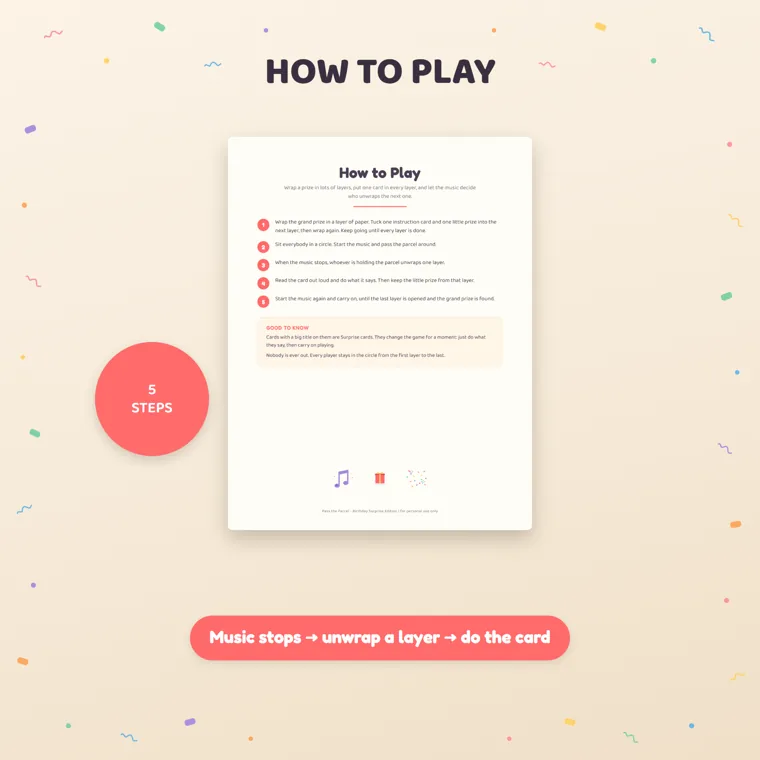
Nobody is out in pass the parcel. Children who’ve already unwrapped stay in the circle and keep passing, which keeps the whole group together until the end.
How to wrap the parcel: layers and what goes inside
The parcel itself decides how fair the game feels. Wrap it the night before, because a parcel with 12 layers takes longer than you’d guess.
One layer for every child
Count the guests first, then wrap the same number of layers. Every stop of the music takes off one layer, so this count lets each child unwrap once. If two extra friends turn up on the day, wrap a couple of spare layers around the outside before the game starts.
Use a different paper for each layer. Wikipedia notes that layers usually differ in design so you can tell them apart, and it helps the children see the parcel shrinking. Christmas paper, old gift bags, newspaper and tissue all work. Tape each layer lightly, because small fingers give up on a parcel sealed with half a roll.
What to put between the layers
A small prize in every layer is the modern habit. Wikipedia describes both versions: some hosts put a prize in each layer, while others keep a single prize in the final layer. With young children, the prize-in-every-layer version heads off most of the tears.
The prize page in our kit lists the sort of thing that fits flat between layers: stickers, temporary tattoos, mini erasers, crayons, bookmarks and hair clips. The main prize can be a small toy, a picture book, a puzzle or a craft kit. You can also skip the small prizes, play for the tasks alone and hand out one shared treat at the end.
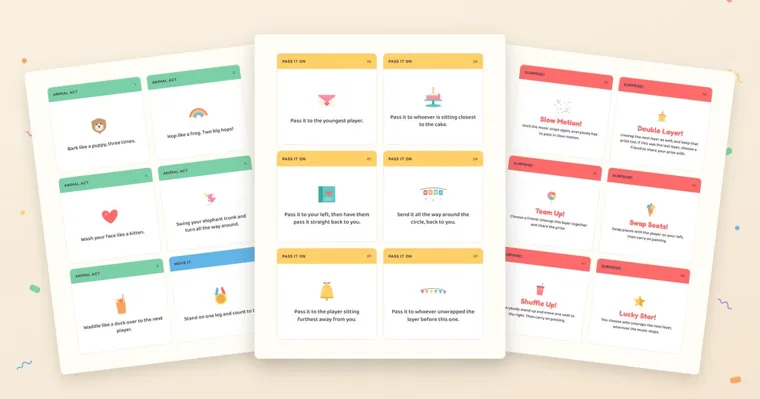
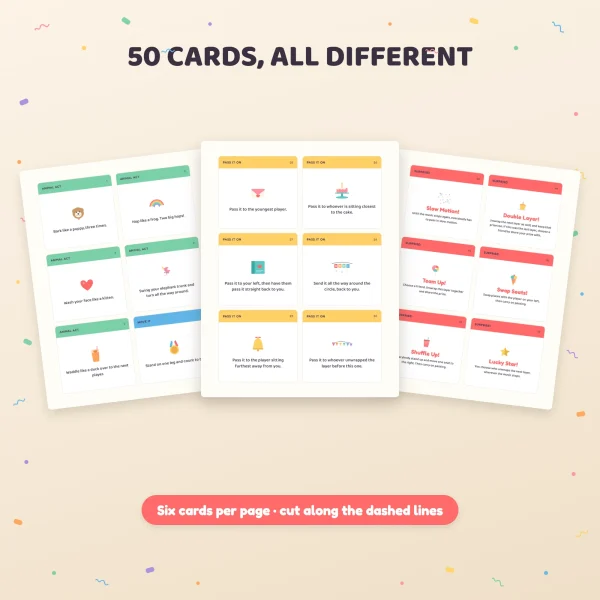
Instead of a prize, a layer can hold a task on a slip of paper. Wikipedia lists challenges or forfeits as a common variation. In our kit, every layer gets one of 50 numbered cards with a task, such as hopping like a frog or naming three animals that fly.
Running the music so every child gets a turn
Running the music fairly takes more care than it looks. Wikipedia says the adult on the music shouldn’t watch the circle, but often does, to make sure every child gets a turn and the prizes are spread out.
The music guide in our kit gives you a middle path. Turn away from the circle when you stop the music, aim for a stop every 20 to 40 seconds, and keep a quick tally of who has unwrapped. When you peek, steer the next stop toward a child who hasn’t had a turn. For younger children, keep the gaps short. For older children, the guide says to stretch them between 10 and 60 seconds for suspense.

Any playlist on your phone does the job. If the speaker is across the room, a kitchen timer works too: set it for a different time each round and the child holding the parcel at the beep unwraps.
For the strictly fair version, Wikipedia suggests preparing recordings of short snatches of music. Older kids who suspect the grown-up is steering will like that version better.
Decide before the game who should get the last layer. Wikipedia mentions both habits: some hosts steer the main prize to the birthday child, others make sure a guest wins it. Either is fine. Just don’t let the children notice you deciding halfway through.
Pass the parcel at a Christmas party
Pass the parcel works at a Christmas party with very few changes. Wrap the layers in Christmas paper, tuck a Christmas sticker or a small shatterproof ornament into each layer for school-age children, and use a book or a board game as the main prize.
If you use our card kit, pull out the seven Birthday cards, numbers 14 to 20, before you shuffle. They ask children to blow out an imaginary candle or say the birthday star’s name, which falls flat in December. The kit’s four blank cards can hold Christmas tasks instead, such as singing a line of a carol or doing a reindeer walk.
For the grown-ups at the same party, a left right story game passes wrapped presents around a circle in a similar way, only on story cues. The gift exchange games roundup covers more ways to swap presents with adults. If the whole family is in one room, the Christmas party games guide plans a full evening for a mixed group.
Pass the parcel for toddlers, older kids and adults
The classic rules suit children from about three to eight. Outside that range, change a couple of things and the same parcel still works.
Toddlers and preschoolers
For two- and three-year-olds, sit an adult in the circle to help hand the parcel on, and keep the music stops short and frequent. Put a prize in every layer and skip task cards that need reading or remembering. A toddler can unwrap a layer, but often not without help.
Leave anything small out of the layers when under-threes are playing. The safety section below has the details.
Older kids, 8 and up
Older children often find the prize-in-every-layer version too soft. Try one of these:
- One prize only. Wrap the layers empty, or with forfeits, and keep a single prize in the middle. Wikipedia lists this as the version some people prefer.
- Tear as fast as you can. Another variation in Wikipedia lets the child holding the parcel tear off as many layers as possible until the music starts again. Use more layers than there are players, or the game ends in two rounds.
- Honest music. Use the recorded snatches of music, so nobody can complain about a fixed stop.
Teens and adults
Teens and adults play the forfeit version. Write a challenge on a slip of paper for each layer, such as doing an impression or telling a joke, and keep a small treat in the middle. For a quicker round of silly tasks, our one-minute party games work with the same group.
The rhyming poem version of pass the present
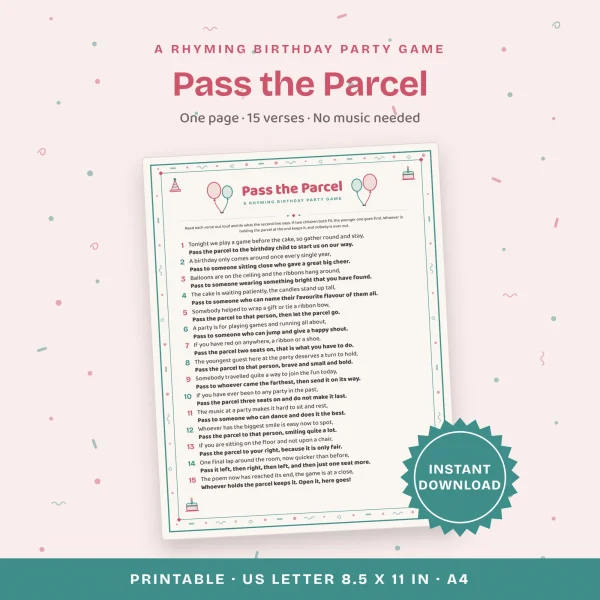
The poem version swaps the music for a rhyme read aloud. Instead of music, one adult reads a poem aloud, and each verse says where the parcel goes next. There’s only one parcel and one prize, and it goes to whoever holds it when the poem ends.
Our pass the present poem is a single page with 15 verses. The first verse sends the parcel to the birthday child, and later ones send it to the youngest guest, to someone wearing something bright, or two seats on for anyone wearing red. Verse 14 sends it left, right, left and then one more seat, and verse 15 hands it to the winner.
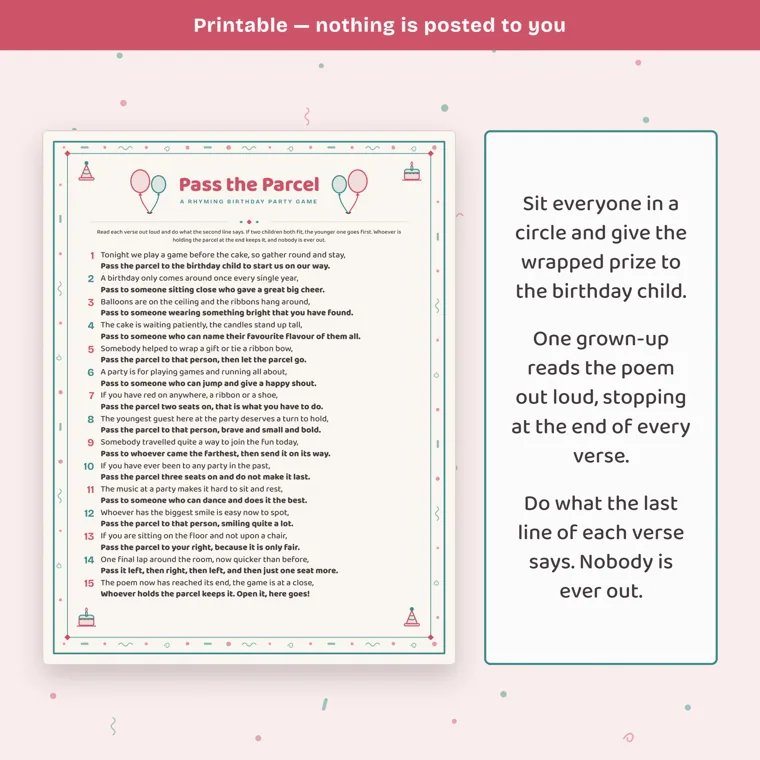
The rules above the poem settle the usual argument: if two children both fit a line, the younger one gets the parcel. The poem is written for a birthday party, with lines about the cake and the birthday child. Only one child goes home with the prize, so we’d keep a bowl of small treats for everyone else.
Pass the parcel problems and how to head them off
Most pass the parcel trouble is predictable. Here’s what tends to go wrong and what to do before it happens.
Grabbing and early tearing. Children start pulling at the paper while the music still plays, or tear two layers at once. Say the rule out loud before you start: one layer, then hands off. Then pause the game the first time someone breaks it.
Throwing the parcel. As the stops speed up, a child will toss the parcel across the circle. Make “hand it, don’t throw it” a rule before the music starts.
The child who missed out. One child ends up unwrapping nothing, usually because of an extra guest or a sloppy stop. Your tally catches this before the last layer. Keep a spare prize in your pocket for the moment it slips.
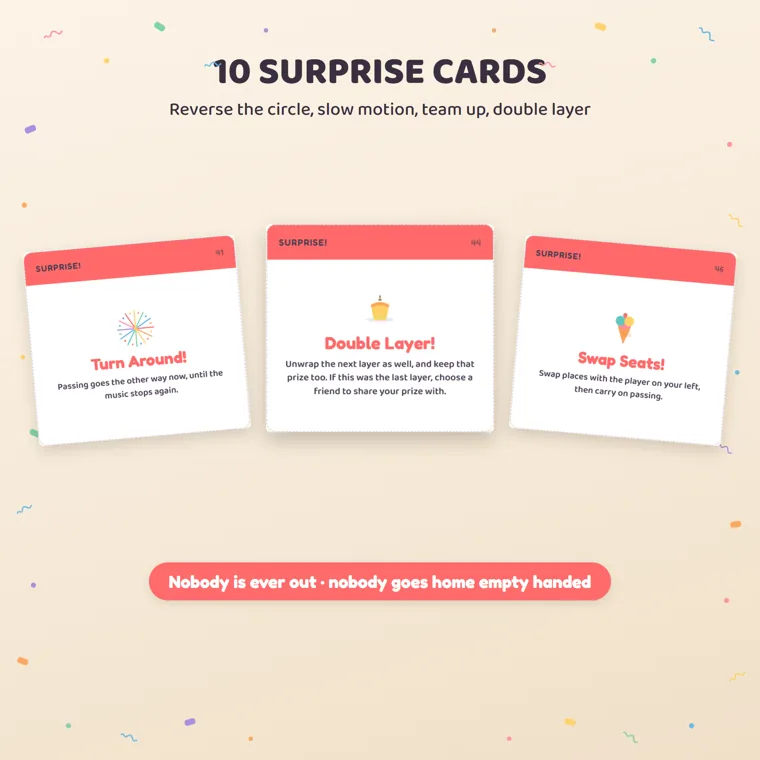
Surprise cards that break the count. Our card kit has 10 Surprise cards, and two of them change who unwraps. Double Layer gives one child two layers, so wrap one extra layer for it or leave it out. Lucky Star and Statue Time let a child pick the next unwrapper, so ask them to pick someone who hasn’t had a turn.
Small parts and balloons in the layers. This is the one to take seriously. Under federal rules summarized in the CPSC’s Child Safety Protection Act fact sheet, any ball with a diameter of 1.75 inches (44.4 mm) or less that’s intended for children under three is banned. The same fact sheet requires latex balloons to carry a warning that children under eight can choke or suffocate on uninflated or broken balloons.
That matters because bouncy balls and balloons are classic layer prizes, and both appear on the prize list in our kit. Leave small balls, marbles and hard candy out of the parcel when any child under three is playing. Leave uninflated balloons out when the circle includes children under eight. Check food allergies before you use candy as a prize.
Tears at the end. Even with a prize in every layer, a child can cry over the main prize. A fair tally, and a shared treat after the poem version, usually keep it to a sniffle. Pass the parcel is a good game to play just before food, so everyone has somewhere to go once the last layer is off.
Printables from this article
Related articles
Printable Party Games
How to Plan a Baby Shower: Timeline, Food & 2-Hour Schedule
A baby shower plan from the first talk with the parents-to-be to the last gift: timing, guest list, budget, venue, a two-hour schedule, safe food and backup plans.
Printable Party Games
How to Plan a Bridal Shower: Timeline, Budget and Schedule
A host's plan for a bridal shower, from the first talk with the bride and co-hosts to the guest list, invitations, a timed party schedule, the gift opening and what to do when something slips.
Printable Party Games
35th Birthday Ideas: Party, Trip, Theme and Gift Ideas
Ways to celebrate turning 35, sorted by how many people the birthday star wants around, with group size, time, prep and the snag to plan for in each.