Sleepover Games: Slumber Party Games for Kids and Teens
Sleepover games go best when they follow the energy of the night: something active while everyone’s still wired, a movie or a sit-down game in the middle, and quiet games once the lights go out. Kids around 6 to 9 like games that move, such as sardines or a string laser maze in the hallway. Tweens tend to settle into puzzles and paper games, and teens usually want voting and confession games about each other.
The age groups and running order below are our planning suggestions, so move a game up or down a group to suit your guests. Each game lists how many can play, roughly how long it runs, what to set out, how a round ends and the one place it tends to go wrong.
Pick a sleepover game by age, group size and time
| Game | Best for | Players | Time | You’ll need |
|---|---|---|---|---|
| Sardines | Ages 6 to 9 | The whole group | A few rounds | Rooms agreed in advance |
| Laser maze | Ages 6 to 9 | One at a time | 15 minutes | String or tape, a timer |
| Silent movement | Ages 6 to 9 | 3 or more | 10 minutes | A blindfold, a set of keys |
| Wink murder | Ages 6 to 12 | 4 or more | 2 to 20 minutes a round | Nothing |
| Moon Crystal escape room | Ages 8 to 12 | 1 or more | 30 to 60 minutes | Printed pages, a pencil |
| MASH | Tweens | 2 at a time | A few minutes a fortune | Paper, a pencil |
| Consequences | Tweens | The whole group | A few rounds | Paper, pencils |
| Most Likely To | Teens | 4 to 20 | 15 minutes | A ballot each, pens |
| Have You Ever…? | Teens | 4 to 16 | 15 minutes | A checklist each, pens |
| What’s On Your Phone? | Teens | 3 to 16 | 10 minutes | A checklist each, phones |
| Mafia | Tweens and teens | At least 6 | 15 to 90 minutes | A moderator, role slips |
| Truth or dare | Teens | 2 or more | Until it stops being fun | House rules |
| Movie bingo | Every age | One card each | The length of the movie | A bingo card each |
| Movie never have I ever | Teens | 3 to 12 | 15 to 20 minutes | Ten fingers each |
| Telephone | Lights out | 3 or more | A few rounds | Nothing |
| Twenty questions | Lights out | 2 or more | A few rounds | Nothing |
| Would you rather | Lights out | 2 or more | As long as you like | A list of questions |
Active sleepover games for kids 6 to 9
Younger guests arrive with the most energy, so put the running games first, before pajamas and sleeping bags cover the floor. All four of these work indoors.
Sardines
Sardines is hide-and-seek turned around: one person hides and everyone else looks. A seeker who finds the hider squeezes in quietly beside them, so the hiding spot gets more crowded each time. The last player to find the group loses the round and becomes the next hider.
At a sleepover, the trouble is that guests don’t know the house. Have the host child give a quick tour first and say which rooms are out of bounds, especially the room where a younger brother or sister is already asleep. Our family game night ideas cover sardines alongside other games for mixed ages.
Laser maze
The laser maze needs a hallway, a ball of string or masking tape and a timer. Tape the string from wall to wall at different heights, with some beams near the floor so crawling becomes part of it. Players cross one at a time from start to finish, each touch of a beam adds 5 seconds, and the fastest total time wins. For a second round, send everyone back the other way, from finish to start.
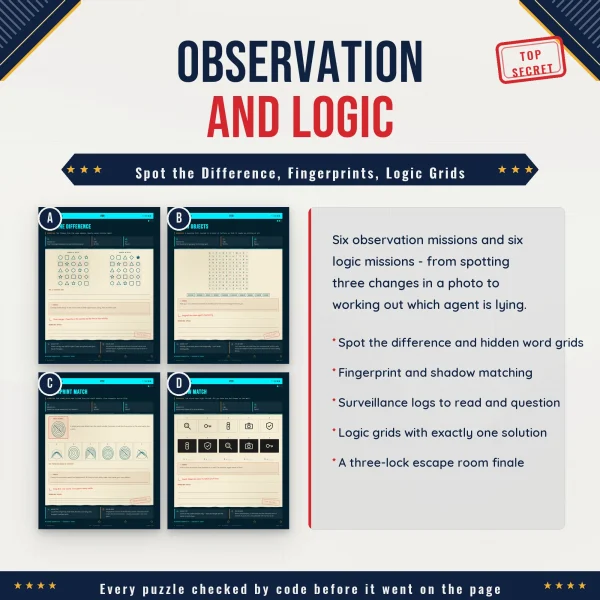
This is mission 21 in our Spy Games for Kids pack, which puts it at 15 minutes. Build the maze before guests arrive, while the hallway is still clear. The party planner in the same pack says setting it up takes ten minutes.
Silent movement
Silent movement is a sneaking game for three or more. One player is the guard, sitting blindfolded with a set of keys on the floor in front of them. Everyone else starts at the far wall and tries to creep up and take the keys without a sound. If the guard points straight at you, you go back to the wall, and whoever gets the keys out wins the round.
Mission 23 of the spy pack gives it 10 minutes and one firm rule, socks only. Agree before you start that a guard who sweeps an arm around the room hasn’t pointed at anyone, or one sharp-eared guard ends every round. When a group gets good at it, the pack’s bonus version has the guard hold the keys.
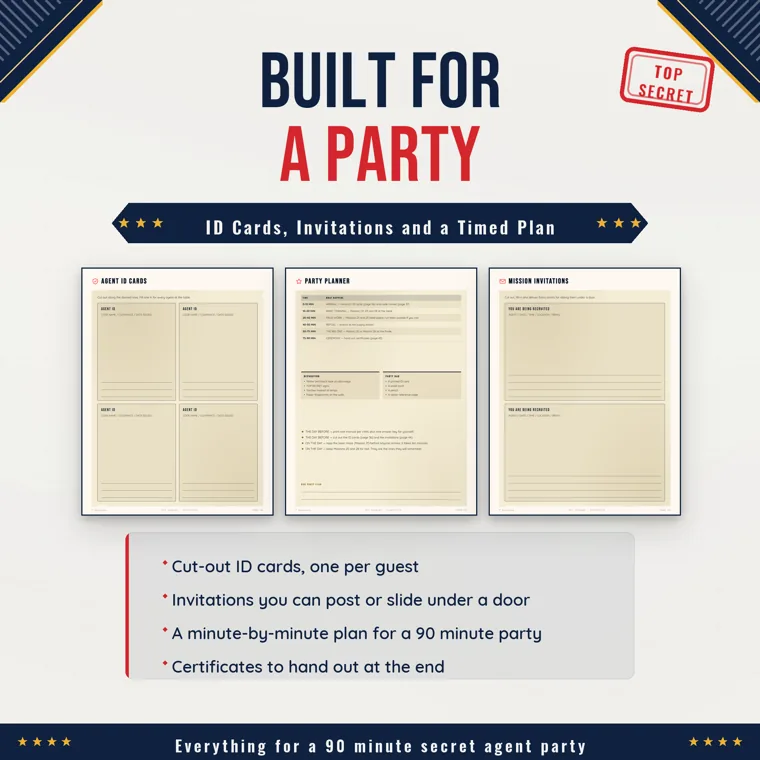
The planner’s full schedule is 90 minutes: ID cards and code names on arrival, three table missions, those two that need space, a snack break, a final mission and certificates. That’s a good first stretch of a sleepover for kids who like a story to the evening.
Wink murder
Wink murder needs nothing but faces and four or more players. One player is the detective and leaves the room while someone else is secretly picked as the murderer. The group stands in a circle with the detective in the middle, slowly turning. The murderer kills by winking at someone, who has to die noticeably. The detective gets three guesses, and each wrong guess costs another player.
A round takes 2 to 20 minutes. Pass out folded slips with one marked M, so the murderer’s name never gets said out loud. Plenty of 6-year-olds can’t wink one eye yet, so let a slow double blink count as a wink before the first round begins.
Sleepover games for tweens: puzzles and paper games
By about 9 to 12, many guests would rather solve something than run. These three keep a group at the table, and the escape room can fill most of an hour. For a shorter puzzle round, our brain teasers for kids are sorted by age.
The Missing Moon Crystal escape room
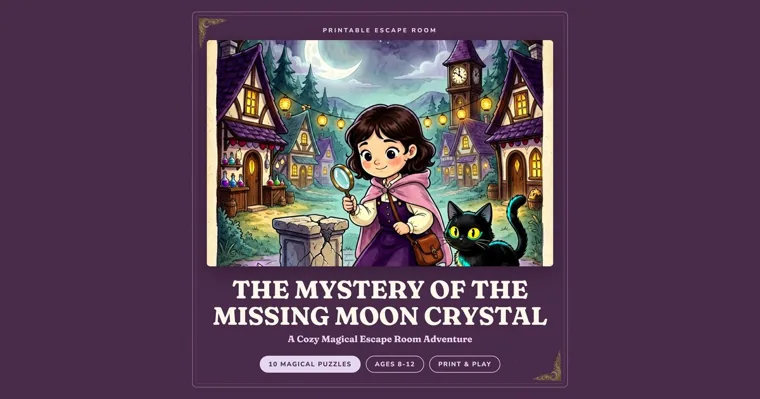
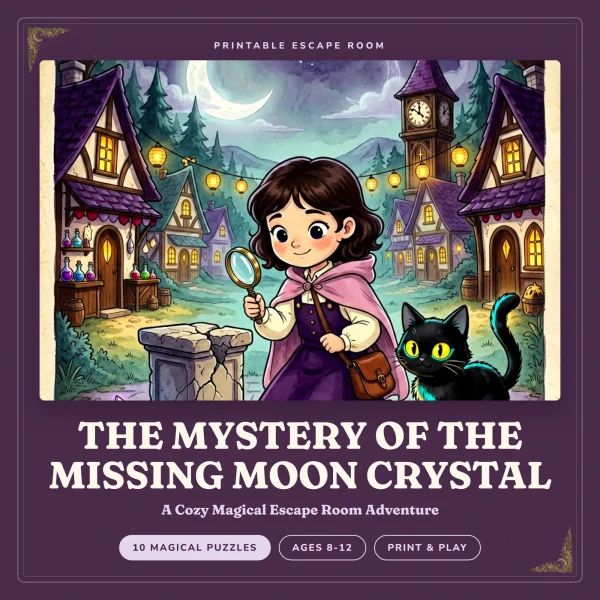
Our printable escape room is written for ages 8 to 12 and takes 30 to 60 minutes. Players work through ten puzzles in a story about a missing crystal, and each puzzle gives a single number. At the end, the Crystal Keeper’s note tells them which four numbers open the final lock. Everyone needs only a pencil, and nobody needs real padlocks.
Players can work alone, in pairs or in teams, with a recording sheet for each team. For a group of six, two teams of three keep the quickest solver from finishing it for everyone. The book tells the grown-up to print pages 5 to 16 for players and keep pages 27 to 29, the answer key, out of sight.
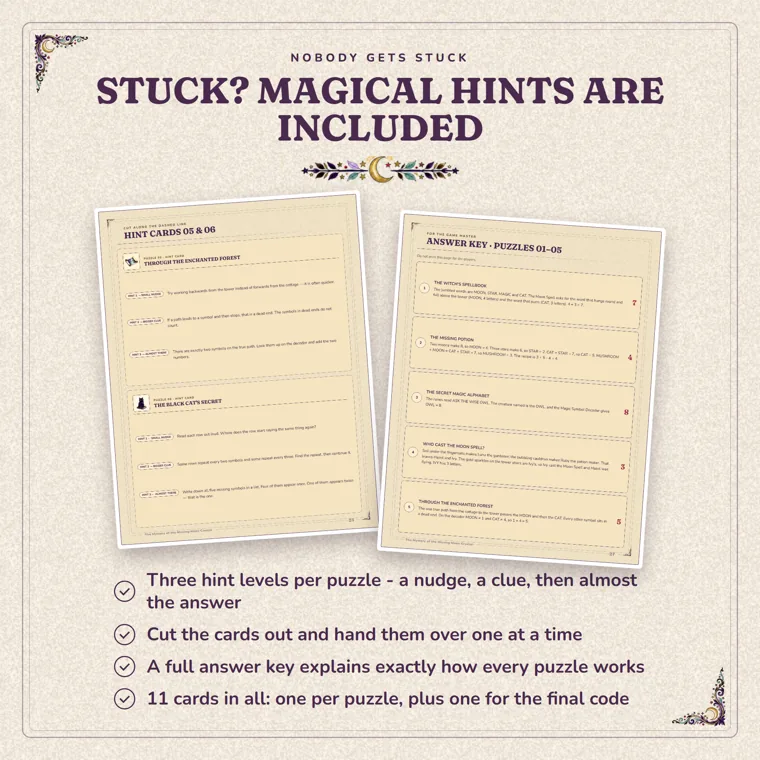
The 11 hint cards can be handed over one at a time, or hidden around the room so players hunt for help. At a sleepover, the hidden version turns a stuck moment into a search instead of an argument. For more hunts around the house, our indoor scavenger hunt guide has lists and clue chains.
MASH
MASH is a paper fortune game for two players at a time, named for Mansion, Apartment, Shack and House. Write MASH at the top of a page, then list categories such as a future job, a car or a pet. For each one, the player picks three answers, two they’d like and one they wouldn’t.
The other player draws a spiral until the first says stop. A line from the end of the spiral back to the center crosses it a number of times. Count that many items down the list, including the four letters, cross off the one you land on, and keep going until each category has one answer left. Those answers are the fortune.
The classic list includes who you’ll marry. At a tween sleepover, that category tends to fill up with classmates’ names and turn into teasing by breakfast. Swap it for a dream pet or a city to live in.
Consequences
Consequences is an old parlor game for the whole group at once. Each player writes a word or phrase to fit a prompt, folds the paper over to hide it and passes it on. One classic order starts with an adjective, a name, “met” with another adjective and a second name, then where they met, what each did, “and the consequence was” and “and the world said.” When the papers come back, read the stories aloud. Nobody wins.
Agree before the first fold that names come from books, movies or pets rather than kids at school. Otherwise someone usually ends up as the joke of every story.
Slumber party games for teens
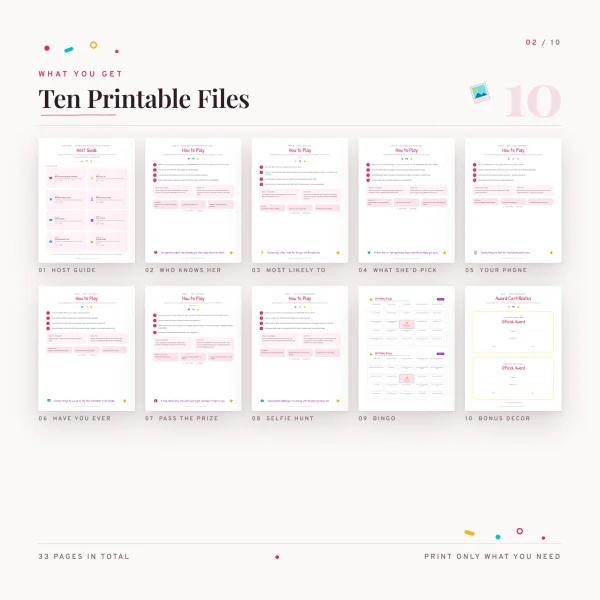
Teens tend to like games where the answers are about each other. The first three come from our teen birthday party pack, which is written about a “birthday girl.” At a sleepover that isn’t a birthday, read “the birthday girl” as the host, and read “girl” as “person” for a mixed or boys’ group.
Most Likely To
Most Likely To is a secret vote on 16 titles, for 4 to 20 players in about 15 minutes. Everyone gets a ballot and a pen. The host reads each title, and players write the name that fits best without saying it out loud. After all 16, the host reads them back one at a time, counts hands and announces each winner like an awards show.
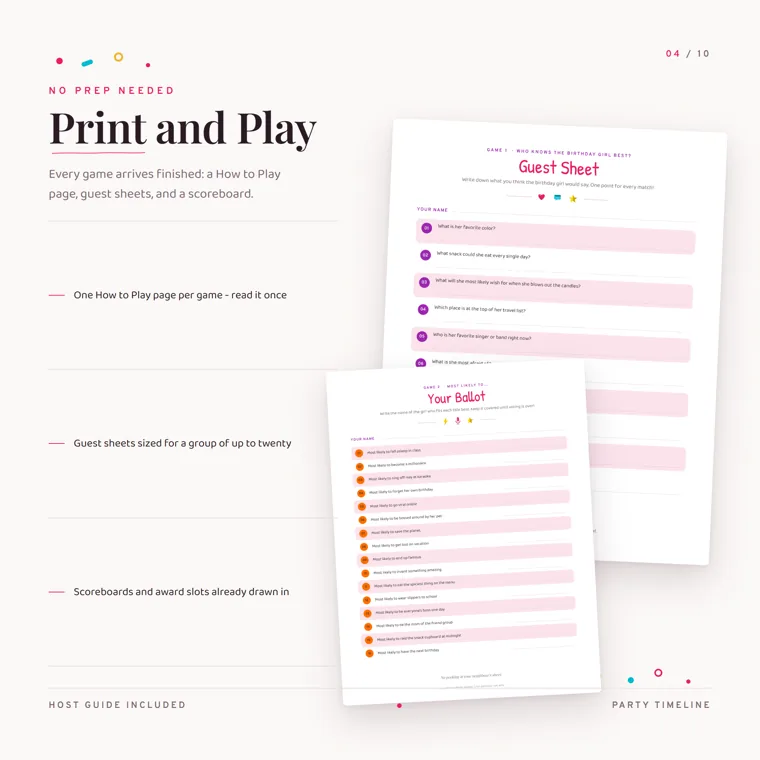
The titles range from “Most likely to save the planet” to “Most likely to raid the snack cupboard at midnight.” The rules let you vote for yourself, and a tie gives both players the title. The risk is a quiet guest who collects a title that stings. Read the ballot first and drop any line that would land badly in this particular group.
Have You Ever…?
Have You Ever…? is a 16-line checklist for 4 to 16 players, and it takes about 15 minutes. Give everyone three minutes to tick what they’ve really done, from “Stayed up past 3 in the morning” to “Danced in the rain.” Then go around the circle: each player picks one ticked item and tells the story behind it in about thirty seconds.
The most ticks wins “The One Who Has Lived,” the fewest wins “The One With Plans,” and the group votes for the best story. The rule that keeps this game friendly is printed on the sheet: “Pass” is always allowed.
What’s On Your Phone?
What’s On Your Phone? is a 10-minute checklist game for 3 to 16 players. The host reads the 20 items one at a time, and anyone who has that thing on their phone ticks it and writes down the points, 5 to 20 per item. Items run from a photo with a pet to a battery under 50 percent. The highest total wins, and second place picks the music.
Anyone can ask to see proof, so phones get passed around. The host tip says nobody has to show a photo they don’t want to show, and skipping only costs the points. Two lines refer to the birthday girl, so swap them for the host at an ordinary sleepover.
Mafia
Mafia is a bluffing game for at least six players, and a game can run anywhere from 15 to 90 minutes. A moderator who doesn’t play hands out secret roles. At night everyone closes their eyes, and the mafia silently pick a victim. By day, the survivors argue and vote someone out. The game ends when the mafia are all gone or they match the number of innocent players.
The night phase suits a dim living room. The weak spot is a player knocked out in the first round who then sits for twenty minutes, so keep games short at a sleepover and start a fresh one quickly. The family game night guide linked above walks through roles and voting in more detail.
Truth or dare
Truth or dare needs two or more players and nothing else. On a turn, each player chooses between answering a question truthfully and doing a dare. It’s popular with tweens and teens, and that’s why the host should set house rules before the first turn, not after something goes too far.
Three rules cover most of it. A pass is always allowed, dares stay inside the house, and nothing gets filmed or posted. Late at night, dares tend to escalate. When the questions start making one guest uncomfortable, that’s the time to switch games.
Sleepover movie night games
Most sleepovers have a movie somewhere in the middle. Two games keep a group together during and after it without anyone pausing.
Movie bingo
Movie bingo runs while the film plays. Each guest gets a card of things that might happen on screen, such as a door slamming, a dog appearing or rain, and crosses them off as they happen. Five in a row wins, but the card says to stay quiet about it.
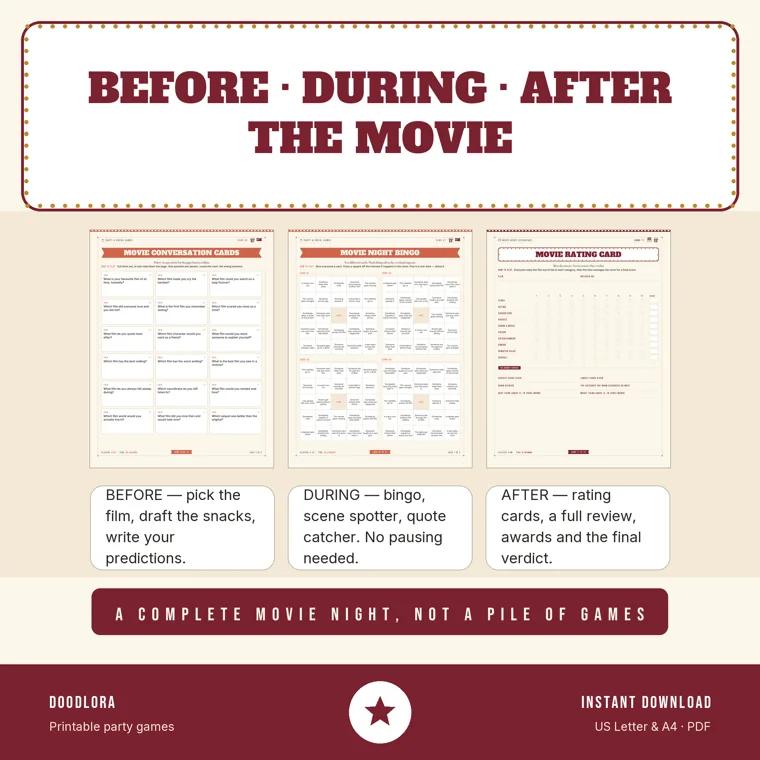
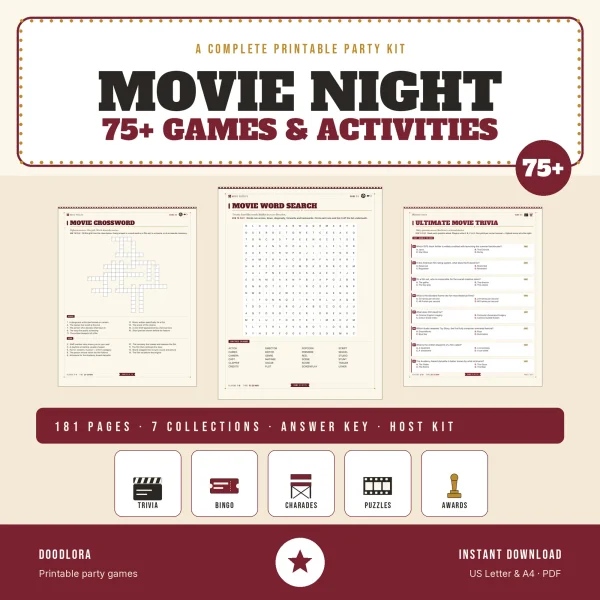
Our Movie Night Party Games kit has ten different screen cards. It also has a second bingo of things that happen in the room, like “A blanket gets stolen” and “A snack runs out,” which suits a living room full of sleeping bags. Its 90-minute plan says to hand out the cards, “Then press play and stop talking.” After the credits, the kit’s 36 movie charades prompts wake the room up again, and our charades for kids guide covers the rules for younger players.
Movie never have I ever
Never have I ever started as a drinking game, and the version kids and teens play counts on fingers instead. In the movie kit, it’s 20 lines about watching habits for 3 to 12 players and takes 15 to 20 minutes. Everyone holds up ten fingers. Read a line, and anyone who has done it puts a finger down. The last player with a finger up wins.
The lines include “fallen asleep and claimed I saw the whole thing” and “hidden behind a cushion during a film.” Because every line is about movies, it stays tamer than the open version, where teens write their own.
Quiet sleepover games after lights out
Once the lights are off, pick games that need no light and can be played lying down. The quietest one also tends to put the first guest to sleep.
Telephone
Telephone needs three or more players lying in a row. The first player whispers a message to the next, who whispers it on, all the way down the line. The last player says it out loud, and the first says what it was at the start. Sleeping bags lined up on the floor already make the line.
Someone will change the message on purpose. Keep that funny by starting with a short, ordinary sentence, since a long one falls apart before the halfway point anyway.
Twenty questions
Twenty questions takes two or more players and nothing else. One player thinks of something, and the others take turns asking questions that can only be answered yes or no. Lying isn’t allowed. Whoever guesses it right becomes the next one to think of something.
In the dark, a category like “an animal” helps younger players. When the answerer falls asleep mid-round, pass the role to whoever is still awake.
Would you rather
Would you rather works in whispers. One player reads two choices, and everyone picks one and says why. Our list of would you rather questions for kids is sorted by age. Skip anything gross or scary after lights out, or the questions will keep everyone up.
What the host parent should settle before the sleepover
Most sleepover trouble comes from things nobody decided in advance. Sort these out when you invite guests, not at 11 p.m.
Tell each guest’s parents the plan for the night: who will be home, who is supervising and what the kids will do. The Sydney Children’s Hospitals Network suggests parents ask about exactly that. It also suggests checking that any movies or online games suit the child’s age, so name the movie in advance.
Ask each family about allergies, both to food and to pets. A guide from Mississippi State University Extension lists allergy concerns, including food and pet allergies, among the information parents should give the host family. Ask too about each child’s usual bedtime and anything that helps them sleep, such as a nightlight or a book.
Have a plan for a guest who wants to go home. The same hospital network suggests a quick phone call home before bed. The MSU guide suggests families pick a code word or emoji their child can use to say they feel uncomfortable. If a guest asks to call home, let them call without making a fuss.
Before any hunt or hiding game, say the boundaries out loud. Our teen pack’s selfie scavenger hunt puts it as house and yard only, no going out front. The same goes for sardines and the escape room’s hidden hint cards.
A running order that suits most groups is active games first, then food and the movie, then the quiet games after lights out. For more printable games for every age, browse our shop.
Printables from this article
Related articles
Printable Party Games
How to Plan a Baby Shower: Timeline, Food & 2-Hour Schedule
A baby shower plan from the first talk with the parents-to-be to the last gift: timing, guest list, budget, venue, a two-hour schedule, safe food and backup plans.
Printable Party Games
How to Plan a Bridal Shower: Timeline, Budget and Schedule
A host's plan for a bridal shower, from the first talk with the bride and co-hosts to the guest list, invitations, a timed party schedule, the gift opening and what to do when something slips.
Printable Party Games
35th Birthday Ideas: Party, Trip, Theme and Gift Ideas
Ways to celebrate turning 35, sorted by how many people the birthday star wants around, with group size, time, prep and the snag to plan for in each.